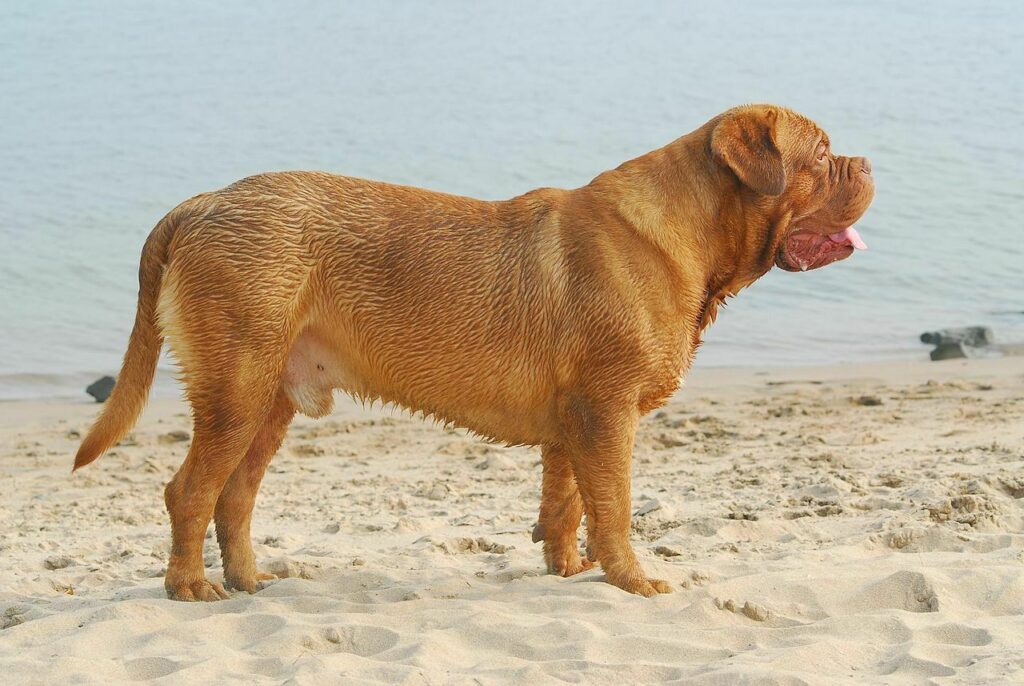
The Doge of Bordeaux(Dogue de Bordeaux) is one of the oldest and most recognizable moles in France: A massive dog with a huge head and a serene look, able to go from imposing guard to quiet companion in a matter of seconds. Behind that resounding look is an animal deeply attached to its family, sensitive and not aggressive without reason. In this guide we review your character, your coexistence, your care and the health points you should know before sharing your life with someone.
Is the Doge of Bordeaux for you?
It’s a great dog, but it’s not for everyone. Its size, its strength and its tendency to health problems make it a breed for people who know where they’re getting into. Before you decide, honestly weigh these pros and cons.
In favour .
- Very close and loyal to his family; a loving companion inside the house.
- Calm and balanced – not a nervous or barking dog.
- Excellent goalie by presence, no need to be aggressive.
- It needs little exercise compared to other large breeds.
- Short coat, very easy to maintain.
- Patient and protective of the children in the house.
Against
- Short life expectancy (around 8-12 years).
- Predisposition to heart, hip and respiratory problems.
- He drools a lot and can snore from his brachycephalic face.
- Poor heat tolerance: be careful in summer.
- Stubborn; needs early education and socialization.
- It carries considerable force: it requires an experienced guide.
- He hates prolonged solitude.
Character and temperament

Under his bulk, the Doge de Bordeaux is a surprisingly serene dog. It is calm, balanced, and intensely attached to its owner and family, to whom it shows constant affection and almost sticky loyalty. He ‘s not a dog who gives himself up to the first man who comes: With strangers it is reserved and vigilant, although usually neutral and polite when its human is present and signals that there is no threat.
That steadfast and resolute character is just what has made him a watchman of reference for centuries. Its mere presence is a deterrent, which is why it rarely needs to resort to force. However, as a good mole, he has a strong personality and a good dose of stubbornness: He knows what he wants and he doesn’t obey because he’s obeyed. That, combined with their physical strength, makes education and socialization from puppyhood onward imperative, not optional.
It is a dog that hates loneliness and inaction. It wants to be with its people, participate in domestic life and feel part of the group. A Bordeaux dog isolated in a yard or ignored becomes a frustrated and unhappy dog, and that is where problematic behaviors can appear.
Coexistence: children, other pets, flat and loneliness
- With children: is usually gentle, patient and protective of the little ones in the family, whom he considers his own.
- Well-socialized With other pets: can coexist without problems, but males can be dominant with other dogs of the same sex.
- On the floor: is perfectly viable. It’s quiet, barks little and tends to be calm indoors. It needs its own space to lie down and go out daily, but it’s not a hyperactive dog that wrecks the living room.
- Soledad: is its weak point. It is not good to be alone for many hours; it needs company and routine. If you spend the day outside, this is not your race.
Education and training
The Doge de Bordeaux is intelligent, but stubborn. It is not the typical dog that lives to please: you have to earn its cooperation. The good news is that it responds very well to positive reinforcement, consistency and a calm and confident leader. Harsh methods are counterproductive with this breed: they generate distrust and can awaken the worst in a dog of this size.
The early socialization is the key piece. A puppy that knows people, noises, other dogs, and various situations during its first few months becomes a stable adult. Without that work, their guarding instinct and suspicion of strangers can lead to reactivity. Basic obedience – walking on the leash without pulling, going to the call, impulse control – should be established while it is manageable; an adult weighing 50 kg or more is not forcibly corrected.
Start early, be brief and consistent in the sessions, and reward generously. Remember that it is a dog that learns by relationship: the stronger your bond, the easier everything else will be.
Exercise and activity

Here, the Doge de Bordeaux breaks with the big dog that needs to run for miles. With a couple of moderate daily walks and some play, he’s enough. He’s not an athlete or an endurance dog; his robust build was achieved at the expense of agility, and you can tell.
There are two important precautions. The first, the heat: Because of its flattened face, it regulates the temperature poorly and gets tired quickly, so in summer you have to walk it first and last and avoid exertion in the sun. The second, the growth stage: puppies of giant breeds should not do high-impact exercise (jumping, intense stairs, long runs) until their joints are mature, so as not to promote hip and elbow problems.
The ideal balance is regular but gentle activity – walking, smelling, exploring, and sharing time. Mental stimulation – smelling games, chewing gum, obedience work – is just as tiring as physical exercise.
Care: fur and hygiene
The maintenance of the hair is the simplest. It has a short, fine and soft coat that only needs a weekly brushing to remove the dead hair and keep it shiny; in the mute, a more frequent brushing. Baths, only the necessary ones.
These characteristic wrinkles accumulate moisture and dirt, and if they are not cleaned and dried regularly, they can cause dermatitis and irritation.
Complete the routine with the usual in any dog: ear control (dropped ears, prone to moisture), nail trimming, dental hygiene and attention to the pads, which in this breed can thicken.
Foodstuffs
Due to its size and muscle mass, the Doge de Bordeaux needs a high-quality diet, rich in protein and adapted to dogs of large or giant breeds. The amount should be adjusted to its age, weight and activity level, avoiding overweight: each extra kilo punishes joints and a heart that already start with a disadvantage.
In puppies, feeding is especially delicate. A specific feed for large breeds, with the right proportion of calcium and energy, helps controlled growth; too fast growth is detrimental to bone development.
As with all large deep-chested breeds, gastric dilation-torsion should be prevented by dividing food into two servings, using feeding trays that curb voracity, and avoiding strenuous exercise just before and after eating.
Health and life expectancy
It is the most serious chapter of the breed and must be faced with open eyes. The life expectancy of the Doge de Bordeaux is short: traditionally spoken of 8 to 12 years, and a large British study of 2024 placed the average around 11 years, below the average of purebred dogs.
- Brachycephalic syndrome: its short snout can cause breathing difficulties, snoring, stress intolerance and, above all, poor heat tolerance with risk of heat stroke.
- Heart problems: the breed shows a marked predisposition to aortic and subaortic stenosis and other valve disturbances; good veterinary cardiological monitoring is highly recommended.
- Dysplasia of the hip: is common in the breed, with prevalences in different studies ranging from a quarter to almost half of the specimens.
- Piel: higher incidence of demodicosis (demodectic scabies) and hyperkeratosis of the pads than in other breeds.
- Reproducción: is a breed with complicated deliveries, high C-section rates and high neonatal mortality.
None of this should automatically frighten you, but it does require that you make good choices about where your puppy comes from, have regular veterinary checkups, take care of your weight, and protect your dog from the heat.
Physical appearance
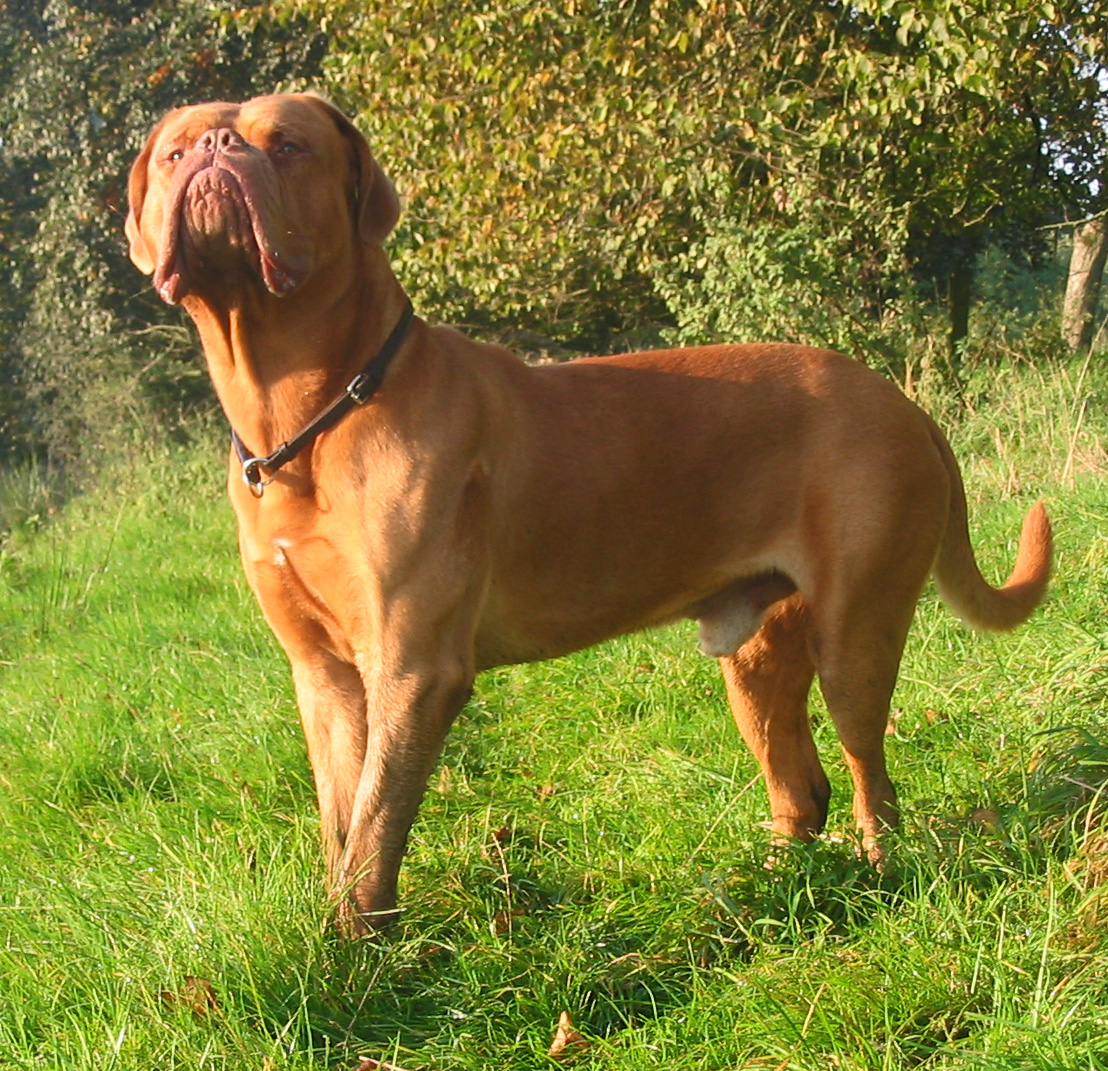
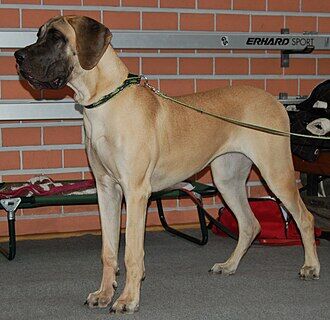
Everything in the Doge of Bordeaux transmits strength and power. It is a massive, muscular and compactly built dog, closer to the ground than the English Mastiff: It doesn’t stand out for its height, but for its roundness. Males measure between 60 and 68 cm at the withers and females between 58 and 66 cm. As for weight, the standard sets a minimum of 50 kg for males and 45 kg for females, with no set maximum, so that many specimens easily exceed these figures.
Its unmistakable hallmark is the head: Bulky, wide and short, with marked folds, it is said to be the largest in the canine world in proportion to the body. When viewed from the front, it draws a trapezoid. The jaw is prognated (the lower incisors are in front of the upper ones) and the upper lip hangs thick over the lower. She always wears a black or red mask to distinguish her from the rest of the coat. The eyes, oval and well separated, range from hazel to dark; the ears are small, sloping and of high insertion.
The neck is short and powerful, with an obvious paw. The body is wide, with a deep chest, and the tail, thick at the base and sharpened towards the tip, is carried low. The coat, short and fine, ranges from light lion’s hair to mahogany. The ensemble must move with elasticity, making clear the strength it treasures.
Origin and history
The Doge de Bordeaux is one of the oldest French breeds and belongs to the large family of dogos or moloses. Its roots can be traced back to the large mastiffs that came to Europe in ancient times, and some trace their ancestry back to the war dogs of classical antiquity. What is documented is that as early as the 14th century it existed in the south of France, in the Bordeaux region, a city that ended up giving the breed its name – “dogue” is the French form of the English word “dog”.
Over the centuries it fulfilled very different functions: He guarded properties, treasures and castles, took part in big game hunting and was even employed in battles in the arena. Her first presentation at an exhibition took place in Paris in 1863, where she won a female named Magenta; from there she gained popularity. It is worth remembering that a uniform type of the breed did not exist until about 1920.
The 20th century almost wiped him out. The breed came close to extinction, reduced to a few hundred after the wars. In the 1960s, a group of breeders led by Raymond Triquet undertook the reconstruction of the breed, which crystallized into a new standard in 1971, updated in 1993, based in turn on the American standard of 2005. The big leap to popular fame came in 1989 with the film Partner and hound(Turner & Hooch), which put millions of people face-to-face with this drooling dog.
Curiosities
- It is credited with having the largest head in the canine world in proportion to the body.
- In males, the perimeter of the skull is approximately equal to its height at the withers.
- The film Partner and hound(1989), starring Tom Hanks, skyrocketed in worldwide popularity thanks to the unforgettable “Hooch”.
- It is also known as the Bordeaux Mastiff, French Mastiff or French Mastiff.
- By the end of the 19th century, it was believed in Bordeaux that the breed had disappeared.
- Despite its fearsome appearance, the standard values a balanced character as much as morphology.
If you are drawn to the world of moles and large guards, you will be interested in comparing the Doge de Bordeaux with other breeds in the same family: the imposing Italian Cane Corso, the balanced Bullmastiff, the colossal English Mastiff and the wrinkled Neapolitan mustard, all large dogs with a strong protective instinct and similar handling needs.
Frequently Asked Questions about the Doge of Bordeaux
Is the Doge of Bordeaux a dangerous dog?
It is not included in the Spanish state list of potentially dangerous dogs, but some autonomous communities and municipalities do include it in their regulations, so it is advisable to review the local regulation.
How long does a Doge of Bordeaux live?
Their life expectancy is short: usually between 8 and 12 years old. A British study from 2024 calculated an average of around 11 years, below the average of purebred dogs.
How much does a Doge of Bordeaux weigh?
The standard marks a minimum weight of 50 kg for males and 45 kg for females, with no maximum set.
Is he good with kids?
It is usually patient and protective of the children in its family. Because of its large size and strength, it is always advisable to monitor contact with the little ones to avoid accidental pushes or falls.
Does he suck a lot?
His droopy upper lip and brachycephalic face make him drool a lot, especially after drinking, eating, or when it’s hot.
Do you need a lot of exercise?
Not too much. With moderate daily walks and some play he has enough. He is not a dog of resistance and it is advisable to avoid intense effort, especially in heat, because of his tendency to respiratory fatigue.
Can you handle the heat?
Its flattened face makes it difficult to regulate its temperature, so it is very sensitive to heat and heatstroke.
Is it easy to educate?
It is intelligent but stubborn. It responds well to positive reinforcement, steadfastness and a calm guide, but needs early socialization and education for its strength and independent character.