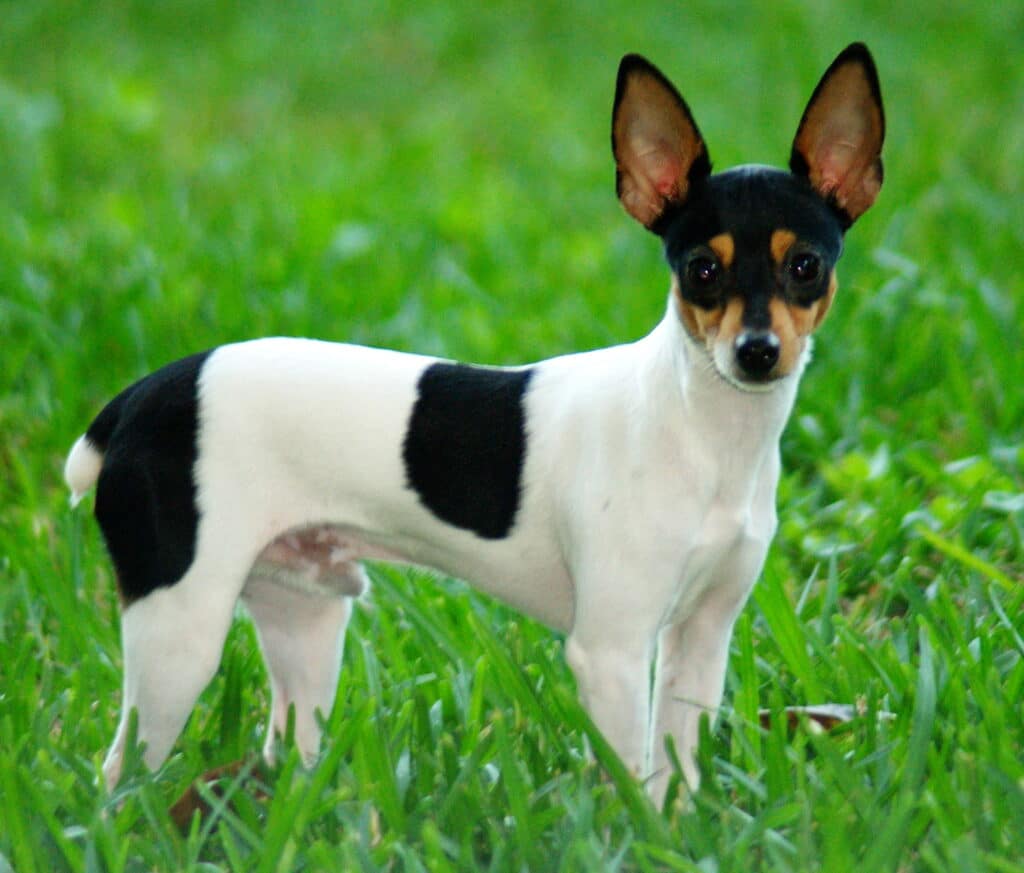
The Toy Fox Terrier is a miniature dog with the soul of a terrier: small, athletic, very smart and deeply attached to his family. Born in the United States from the smooth-haired Fox Terrier, it retains the rodent-hunting instinct in a body of less than five kilos. If you are looking for a pocket-sized companion but with the character and energy of a large dog, the Toy Fox Terrier deserves all your attention.
Is the Toy Fox Terrier for you?
Before you fall in love with its miniature fox face, be honest: the Toy Fox Terrier is not a passive lap dog. It is a real terrier, with its spark, its stubbornness and its need to do things. It fits wonderfully with those who want a small, manageable and very attached to their person, but at the same time give him play, mental sport and some daily activity.
In favour .
- Pocket size: Ideal for flooring if stimulated.
- Very smart and easy to train for his size.
- Loyal and affectionate, he has a strong bond with his family.
- Short coat: hairdressing maintenance almost zero.
- If he’s well behaved, he’s not a particularly barking dog.
- Good companion for seniors and for therapy/assistance.
To be taken into account
- Hunting instinct: can shoot out after cats, birds or rodents.
- He needs mental stimulation or he gets bored and tangled up.
- Sensitive to cold because of its fine hair: winter coat.
- It can be stubborn; it requires constancy, not toughness.
- Physically frail: eye with high heels and abrupt children.
- I’m prone to some joint problems from toy breeds.
Character and temperament

The Toy Fox Terrier is proof that size doesn’t define character. Beneath that delicate appearance beats an alert, courageous and very calm terrier. It’s one of those dogs that seems to understand what’s going on around them, that stares at you waiting for the next instruction and that learns tricks almost for pure pleasure.
It is remarkably sociable and dependent on its people: wants to be where you are, follows you from room to room and enjoys participating in home life. That dedication makes him a superb companion, but it also means he takes regular prolonged loneliness. With his family he is affectionate and playful; with strangers he is usually alert and reserved, without becoming a nervous dog if well socialized.
Compared to other terriers, its energy is more bearable. It is active, yes, but it does not have the almost inexhaustible intensity of a Jack Russell. That combination of liveliness and temperance is just what makes it so prized as an urban companion dog: it gives you play without exhausting yourself.
Coexistence: children, pets, flat and loneliness
- With children: is affectionate and playful, but its fragility forces it to monitor contact with small children. It is better with children who already understand how to treat a small dog than with babies or very brusque children.
- With other dogs: usually gets along well, especially if he grows up socialized.
- With cats and other pets: can get along well with the cats it breeds with, but its rodent-hunting instinct makes hamsters, birds or rabbits not the best companions.
- On the floor: is a great indoor dog, low-occupancy, adapts to small spaces and, well-behaved, doesn’t bark too much, needs his daily dose of walking and play.
- Soledad: is the pending subject. As attached as he is, he can have a hard time if he’s left alone for too many hours.
Education and training
Few toy dogs are as grateful for training as the Toy Fox Terrier. It is smart, picks up routines quickly and is said to be able to learn to respond to a good number of words and commands. It is no coincidence that it historically shone in circus numbers: it has memory, a desire to please and an exhibitionist point.
The key is in the positive reinforcement: rewards, cheerful voice and short sessions. As a good terrier, he has his character, and toughness only gets him to close in on the band. Two things are worth working on early: the socializing(people, dogs, noises, car) so that his alert side does not lead to barking or reactivity, and the tolerance for loneliness to prevent separation anxiety.
Impulse control also deserves attention – its prey instinct can be triggered suddenly. A good call and working on the “quiet” before crossing the street are safety investments for such a small, fast dog.
Exercise and activity
Don’t be fooled by its size: the Toy Fox Terrier is athletic and needs to move. It doesn’t get enough of the express bathroom walks. It’s wonderful to have a couple of daily outings, moments of active play and, above all, mental challenges: intelligence toys, search for hidden prizes, new tricks.
It is an excellent candidate for canine sports of its size, such as miniature agility, obedience rally or olfactory games. Such activity combines physical exercise with mental stimulation and channels its terrier energy in a healthy way. A bored Toy Fox Terrier is a Toy Fox Terrier that invents mischief; a stimulated one is a calm and balanced companion at home.
Care: fur and hygiene

The Toy Fox Terrier’s hair is short, fine, satin, and tightly fitting to the body, so a weekly brushing is all it takes to remove the dead hair and keep it shiny.
Bathrooms, only when it gets really dirty: Washing it too much dries its skin. What you do need to take care of regularly is the basic hygiene: Check and clean the ears (when erect they ventilate well, but you have to watch them), cut the nails, which in such a light dog wear little, and especially take care of the teeth. Like many small breeds, it is prone to tartar, so frequent tooth brushing makes all the difference in the long run.
An important note: its fine coat leaves it unprotected from the cold. In winter or in humid climates it thanks a coat for walks; it is not a whim, it is comfort and health.
Foodstuffs
As a small dog, its rations are modest, but the quality is more important than the quantity. The ideal is a complete and balanced feed or diet, suitable for mini-sized breeds and their stage of life (puppy, adult, senior).
The big enemy is the overweight: a few extra grams are a lot on a body of three to five kilos, and straining the joints of a dog prone to knee problems is not a good idea. Measure the rations, control the rewards (which count, and a lot) and always have fresh water available.
Health and life expectancy
The Toy Fox Terrier is, in general, a robust and long-lived dog for its size.[citation needed] A British study from 2024 placed its average life expectancy around 13 years old, slightly above the average of purebred dogs.[citation needed] With good care, many specimens exceed that figure.[citation needed]
Like all races, it has predispositions that you should know about:
- Dislocation of the kneecap(kneecap displacement), frequent problem in small breeds.
- If you have been diagnosed with Legg-Calvé-Perthes disease, a disorder of the femoral head that affects toy dogs.
- He had von Willebrand’s disease., an inherited clotting disorder.
The best prevention is to go to responsible breeders who carry out the relevant tests on the breeders, keep the dog at his weight, take care of dental hygiene and do not skip veterinary checks.
Physical appearance

The Toy Fox Terrier is a small but muscular and athletic looking, elegant and well-proportioned dog. It measures between about 21,5 and 29 cm to the cross and weighs approximately 3.5 to 9 kg, although most move in the lower part of that range.
Its hallmark is the head, normally solid in color, which contrasts with a predominantly white body. The ears are large, triangular, and erect in the shape of a V, and the eyes, dark and expressive, give it that vivid air that is so characteristic. The tail is short and of high insertion; traditionally it has been amputated a few days after birth, although this practice is increasingly questioned and regulated.
There are several recognized color combinations: the tricolor(black and fire over white) is the most typical, but there are also white and fire, black and white and chocolate variants (with chocolate color marks instead of black).
Origin and history
The Toy Fox Terrier is a genuinely American breed, originating in the early 20th century. Their story begins with the Fox Terrier with smooth hair(Smooth Fox Terrier): Some breeders began selecting the smallest specimens of the litter to fix a reduced size. In fact, some lines can trace their ancestry back to “Foiler”, the first fox terrier registered by the British Kennel Club around 1875-76.
To further refine that miniature size and soften the character, point crosses with other small breeds such as the Toy Manchester Terrier, Chihuahua and Italian Greyhound were introduced. Those crossings left their mark: The ears, which in the original fox terrier were folded in a V-shape forward, became triangular and upright. For a long time, it was both a farm dog and a pet, highly valued for its effectiveness in hunting rats and other rodents.
The official recognition came in 1936, when the United Kennel Club (UKC) of the United States accepted it as its own breed within the Terrier Group; until then it was registered as Smooth Fox Terrier.
Curiosities
- The four-legged clown:‘s intelligence and liking for learning tricks made him a regular in circus acts, where he accompanied clowns.
- Many names: is also known as the American Toy Terrier, Amertoy or Amtoy.
- Assistance and therapy:‘s docility and attachment make it an excellent companion dog for seniors and people with disabilities.
- Little brother of a big one: is directly descended from the smooth-haired Fox Terrier, so it shares that unmistakable air terrier in reduced format.
- Speakers to measure: unlike many small, well-behaved dogs tends not to bark excessively.
If you are interested in this breed, you may also fall in love with other dogs with a terrier-like or compact-sized appearance. Check out its close relative the Wire Fox Terrier, the tireless Jack Russell Terrier, the tiny Chihuahua(which participated in its own genetic history), and the stylized Italian Greyhound, another of the ancestors that helped shape the Toy Fox Terrier.
Frequently Asked Questions about the Toy Fox Terrier
How tall and how much does a Toy Fox Terrier weigh?
It is a toy dog: it measures approximately between 21.5 and 29 cm at the withers and weighs from 3.5 to 9 kg, although most stay in the lower part of the range, around 3 or 4 kg.
Is he a good dog to live on?
Yes, its small size and, if well-behaved, its tendency not to bark excessively make it ideal for flooring, although it needs daily walks and mental stimulation to keep from getting bored.
Does the Toy Fox Terrier bark a lot?
It is alert and alert, but a well-socialized and well-behaved Toy Fox Terrier is not usually a particularly barking dog, unlike other toy breeds.
How long does a Toy Fox Terrier live?
It is a long-lived breed for its size. A British study from 2024 placed its average life expectancy at around 13 years, and with good care many specimens exceed it.
Do you get along with children and other pets?
It is affectionate and playful, but its fragility requires supervision of play with small children. With other dogs it usually coexists well; with rodents or birds, its hunting instinct can be a problem.
How much exercise do you need?
He’s athletic: he appreciates two walks a day, moments of play and, above all, mental challenges. He’s a great candidate for agility or olfactory games tailored to his size.
Is that the same as the Fox Terrier?
The Toy Fox Terrier is descended from the smooth-haired Fox Terrier, but is a separate, much smaller breed, developed in the United States and recognized independently since 1936.
What health problems are more common?
Like other toy breeds, it can present with knee dislocation, Legg-Calvé-Perthes disease, and von Willebrand disease.