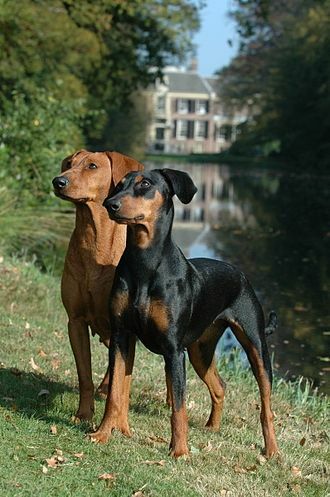
The Pinscher Alemán(Deutscher Pinscher) is a medium-sized, athletic, short-haired German dog, considered the original trunk of the pinscher and schnauzer family. He is lively, courageous and deeply attached to his people, with an instinct for vigilance inherited from his times as a farm rat hunter and guard of blocks and carriages. If you’re looking for an athletic companion, awake and in very good health, the German Pinscher deserves to be thoroughly known. In this guide we review their character, coexistence, care and history with verified data.
Is the German Pinscher for you?
Before you fall in love with its elegant appearance, be honest: the German Pinscher is not an ornamental dog. It is a born worker with a lot of mental and physical energy who needs an engaged owner. These are its lights and shadows.
In favour .
- Robust health: one of the breeds with fewer hereditary diseases.
- Short hair that barely needs maintenance.
- Practical size: fits on a floor but performs like a big dog.
- Very smart and quick to learn.
- Excellent guard who warns without being a compulsive barker.
- Loyal and affectionate to his family, great sportsman.
To be taken into account
- He needs plenty of daily exercise and mental stimulation.
- Dominant character: requires firm and consistent education.
- Be wary of strangers; early socialization is mandatory.
- Their prey instinct can complicate their coexistence with small animals.
- He is easily bored and can then become destructive.
- It’s not the best choice for a first-time, sedentary owner.
Character and temperament

The German Pinscher is first and foremost a extraordinarily lively and attentive. dog. He watches, observes, and reacts; nothing that happens around him goes unnoticed. Inside the house he is usually surprisingly calm and balanced, but when outdoors he displays all his temperament: He runs, explores and moves with the passion of an athlete. That double face – serene on the couch, electric in the field – is one of the keys to its versatility.
He’s a one-parent dog, deeply attached to his own and highly self-confident. This confidence translates into a somewhat dominant character: The German Pinscher needs to know who makes the rules at home, and if you don’t give them to him, he will. It’s not aggression, it’s calm. With his people, he is affectionate, playful, and loyal to the core; with strangers, he is reserved and cautious, making him a reliable guardian.
It inherited from its mouse-eating ancestors a marked prey instinct and a remarkable independence to explore the terrain on its own. It warns of any novelty with punctual barks, but it is not a squealing dog: when it barks, there is a reason. Well-behaved, it defends its territory without falling into excessive territoriality in front of its owner, to whom it remains faithful at all times.
Coexistence: children, other pets, flat and loneliness
The German Pinscher is an adaptable dog that can live both on a farm and in a city flat, as long as its needs are met.
- With children: is playful and energetic, a good companion for older children who understand how to treat an active dog. Its thrust and vitality can be too much for very young children, so it is advisable to supervise play and teach mutual respect for both parties.
- With other dogs: with good socialization from puppyhood usually gets along well, although its safety can generate friction with dogs of the same sex equally dominant.
- With cats and small animals: here is his biggest challenge. his past as a rat hunter gives him a real prey instinct. he can live with a cat if they grow up together, but rodents, birds or rabbits are not a good idea.
- On the floor:‘s medium size and calm indoors make it perfectly suited for apartment living, provided it goes out several times a day to expend energy.
- In the face of loneliness: is a very attached dog that does not like to spend many hours alone. Boredom and lack of activity can lead to destructive behavior or barking.
Education and training
The German Pinscher learns fast, very fast. It’s an intelligent and resolute breed that picks up on exercises almost at the first moment… which is as much an advantage as a cheat: it also learns bad habits at full speed and how to get away with it if you let it. That’s why education should begin the first day it comes home.
The key is in a firm, consistent and fair guidance, it never lasts. It responds wonderfully to positive reinforcement, short and varied sessions and play as a reward; instead, methods based on force or yelling block it or make it stubborn. It needs an owner who maintains calmness and constancy, because its dominant character will test the limits from time to time.
The early socialization is an absolute priority in this race. Given their natural distrust of the unknown, exposing them from puppyhood to people, dogs, noises, environments, and different situations makes the difference between a balanced adult and a reactive one. Working the call and self-control is also critical to managing your prey instinct. As a counterpart to such demanding behavior, he is a brilliant dog for canine sport: It excels in agility, obedience, tracking and as a riding companion dog.
Exercise and activity

If there is one chapter that does not allow shortcuts in this breed, it is that of exercise. The German Pinscher is a dog of an overflowing vitality that he needs to move a lot every day.. Three short walks to the block is not enough for him: he asks for running, intense play and opportunities to loosen up on safe ground to run and frolic at will.
It’s the ideal companion for athletic people. It effortlessly accompanies those who go out running or cycling, enjoys canicross and is enthusiastic about the games of seek and bring. Resilient and tireless, its muscular body is built for sustained physical activity. To the energy of the body must be added that of the mind: Intelligence toys, olfactory work and exercise sessions are as important as walking to relieve stress.
A German Pinscher that gets enough exercise is a happy, calm and manageable dog at home. One that is spared movement becomes a pump of accumulated energy that will look for escape routes: holes in the garden, bitten furniture or barking. It calculates at least one or two long hours of daily quality activity.
Care: fur and hygiene
Here is one of the great practical advantages of the breed: its maintenance is minimal. The German Pinscher wears a short, dense, smooth and shiny hair, attached to the body, which practically takes care of itself. A weekly brushing with a rubber glove or a soft brush is enough to remove the dead hair and keep the coat shiny; in seasonal moults you can increase the frequency.
It does not need to be groomed or cut, and baths should be occasional, only when it gets really dirty, so as not to dry its skin. The rest of the hygiene is the usual routine of any dog: checking and cleaning the ears, cutting the nails when they hit the ground, brushing the teeth regularly and monitoring the eyes.
Special attention should be paid to one feature of the breed: The so-called ear border problem. Since their ears are covered with a very thin layer of hair and the edges are thin, small wounds or cracks may appear on the margin of the pavilion. Check them often, especially in cold or dry climates. Being a short-haired dog, it is also sensitive to intense cold, so in winter it may appreciate a coat on long walks.
Foodstuffs
The German Pinscher needs a quality diet, balanced and adjusted to its high energy expenditure. Being such an active and muscular dog, it is grateful for an adequate intake of animal protein from a good source, whether through premium feed, quality moist food or a natural diet well formulated and supervised by a veterinarian.
As a reference, an adult weighs between 14 and 20 kg, so their rations are moderate, but a specimen that trains or goes running daily consumes much more energy than a sedentary one.
Watch their body condition: although the breed is not particularly prone to obesity, overweight punishes the joints of any sporting dog. You should be able to feel their ribs without them being visible, and notice a defined waistline. Measure the prizes you use in training and discount them from the daily ration so as not to uncompensate their diet.
Health and life expectancy
Health is one of the great pride of the German Pinscher. It is a remarkably healthy breed, with very few hereditary diseases associated, largely thanks to responsible breeding and a genetic pool little manipulated by aesthetic fashions. Even so, serious breeders perform health checks to maintain that robustness. The breed clubs usually place its life expectancy at around 12-14 years, a figure consistent with its excellent general condition.
The most relevant controls and problems to be monitored are:
- Dysplasia of the hip: its detection is mandatory in serious breeding programs, which helps to keep its incidence low.
- Hereditary eye diseases: there are voluntary preventive tests to rule them out in the breeders.
- If you have von Willebrand disease: a blood clotting disorder that is also controlled by genetic testing.
- Dilute gene (dilution of colour): is monitored in breeding for its association with skin and hair problems.
- Problem with the edge of the ear: wounds or lesions on the margin of the auricle, through the thin skin in that area.
Choosing a responsible breeder who does these tests on the parents is the best guarantee of bringing home a healthy puppy. In addition to his careful feeding, daily exercise, and veterinary checkups, you will have plenty of cards to enjoy a long-lived, vigorous companion.
Physical appearance

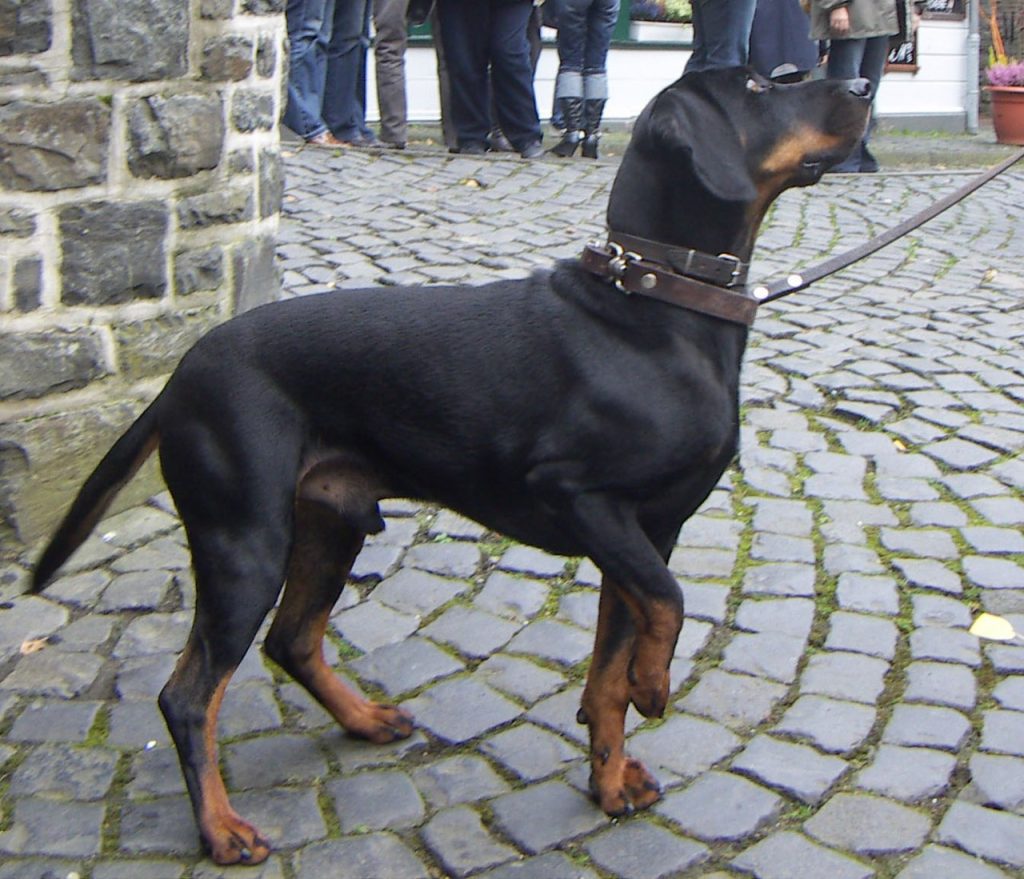
The German Pinscher is a medium height, proud build and powerful muscles dog. It measures between 45 and 50 cm at the withers and weighs between 14 and 20 kg, with no large size differences between males and females.
It has a strong and elongated head, with a well-developed snout, and high insertion ears, folded in the shape of a V and directed towards the cheeks.
Their coat, short, dense and bright, comes in two color variants: black with fire marks.(the classic reddish spots on eyebrows, snout, chest and extremities) and monochrome red, which ranges from a light deer red to a dark reddish brown.
Origin and history
The German Pinscher is an ancient and, in a way, foundational breed. It belongs to the pinscher and schnauzer family, and is essentially the the short-haired equivalent of the Schnauzer: for centuries, hard-haired and smooth-haired puppies could be born in the same litter and all were known as Deutscher Pinscher.
Its exact origins are lost to time, but its function is clear. They were farm and guard dogs that hunted rats and other vermin, and guarded stables and carriages; hence local nicknames such as Stallpinscher or Rattler. Sitting on the back of a chariot, a pinscher dissuaded anyone from approaching to touch the horse or carriage while the coachman was away. That life selected dogs that were brave, vigilant and very attached to their territory.
The “pinscher liso” is already mentioned in texts from 1836, and in 1880 it was registered in the German canine book of origins. In 1895 the Pinscher-Schnauzer-Klub was founded, which still manages both breeds today. But the 20th century almost wiped it off the map: After World War II the breed almost disappeared. It was Werner Jung who rescued it in the 1950s, rebuilding it from a single standard size specimen and four unusually large miniature pinschers. After eight years with no recorded births, a new litter was finally born in 1958. The breed was officially recognized by the International Kennel Federation in 1955 (FCI standard no. 184, Group 2). Even so, it is still a small breed, listed as endangered in Germany.
Curiosities
- Father of famous breeds: the German Pinscher is the ancestor from which both the Doberman and Miniature Pinscher are descended, much more popular than he is today.
- Eclipsed by his own children: according to studies of canine clubs, the Miniature Pinscher became almost 8 times more numerous than the German Pinscher, and the Doberman, more than a hundred times more popular.
- Short-haired twin: shares origin and genetic trunk with the Standard Schnauzer; they are the same breed differentiated by hair type.
- Saved from extinction: the entire current population descends, in large part, from Werner Jung’s recovery work with just five founding dogs.
- The name says it all:“pinscher” comes from German and evokes the idea of “biter” or “pincher”, in reference to his job hunting prey.
- The Multi-purpose athlete: shines in agility, obedience and tracking, and even serves as a companion dog for horseback riding.
If you are attracted to the German Pinscher, you will surely enjoy meeting its closest relatives within the pinscher-schnauzer family. We recommend that you take a look at the Dóberman, its most imposing descendant; the Pinscher Miniatura, its smaller version; the Schnauzer Estándar, its hard-haired twin; and the Affenpinscher, another endearing member of the same family. Comparing their characters will help you to decide which one best fits your life.
Frequently Asked Questions About the German Pinscher
Is the German Pinscher a good family dog?
Yes, it is a very loyal and affectionate dog that bonds intensely with its family. It works best in active homes, with older children who respect its energy, and as long as it receives enough education, socialization and exercise. It is not the ideal choice for a first-time, sedentary owner.
How much exercise does a German Pinscher need?
It is a very vigorous breed that requires at least one or two long hours of intense activity a day: running, playing and the possibility of loosening up on safe ground. It is an excellent companion for running or cycling, and also needs mental stimulation so as not to get bored.
Does the German Pinscher bark a lot?
It is not a compulsive barker. It warns with punctual barking when something deserves it, as it is very attentive and a good watchdog, but it is not usually a squeaky dog. Excessive barking almost always appears when it lacks exercise or spends too much time alone.
Can you have a German Pinscher on a floor?
Yes. Its medium size and its calmness inside the house make it suitable for living in an apartment, as long as it goes out several times a day to expend energy.
Does the German Pinscher lose a lot of hair?
Its short, dense hair requires very little maintenance. A weekly brushing is enough to remove dead hair, increasing the frequency of seasonal mowing.
Is it easy to train the German Pinscher?
It is very intelligent and learns quickly, but also has a dominant and independent character. It needs firm, consistent and positive reinforcement-based guidance from puppyhood, in addition to intense early socialization. With a constant owner it is a brilliant dog for canine sport.
How long does a German Pinscher live and how big does it get?
It is a very healthy breed, with few hereditary diseases, and breed clubs usually place its life expectancy around 12-14 years.
Do you get along with other dogs and cats?
With good socialization it usually coexists well with other dogs, although its safety can generate tensions with dominant specimens of the same sex.