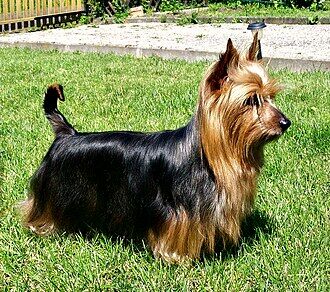
The Silky Terrier is a tiny, lively and distinctive-looking companion dog: a long, smooth, silky coat that falls apart along the back and hides a true terrier of firm character. Born in Australia of British blood, the Silky Terrier combines the elegance of a saloon dog with the hunting temperament of its ancestors. If you’re looking for a small, sharp, family-friendly mate, this breed has plenty to fall in love with.
Is the Silky Terrier for you?
Before you get carried away by his stuffed face, let’s be honest: the Silky Terrier is a small dog with a terrier soul, not a cushion with legs. It needs companionship, mental stimulation and constant brushing. In return, it will give you enormous loyalty and energy to give. Here are its lights and shadows at a glance.
In favour .
- Ideal mini size for flooring and carrying everywhere.
- Very close, affectionate and loyal to his family.
- Smarter and smarter: he learns quickly what interests him.
- Good warning dog: note any visitors.
- Hair-type hair, no woolly undercoat, with a discreet muff.
- Longevity: with care it can accompany you 13-15 years.
To be taken into account
- Silky fur requires almost daily brushing to avoid tangling.
- Barker: if you don’t work, tell me everything and nothing.
- Stubborn and independent; education requires patience.
- Hunting instinct: not the best friend of rodents or very small pets.
- Fragile in size: beware of falls and very young children.
- He doesn’t like prolonged loneliness.
Character and temperament

The Silky Terrier is primarily an alert and active dog. The standard describes it as vigilant and energetic, and so it is: little escapes it inside the house. However, compared to other terriers, it is somewhat calmer and more manageable, which explains why it is classified among companion dogs despite keeping its terrier instinct intact.
He’s a dog intensely attached to his people. He forms strong bonds, seeks out contact, and enjoys being a part of family life; he is not a garden dog who is content to live apart. At the same time, it maintains a striking independence for its size: has its own criteria, decides on its own and does not always obey the first. That mixture of affection and stubbornness is just what captivates his followers.
Another defining trait is their tendency to bark, especially to announce the arrival of strangers. It works like a bell with legs, something very useful as a warning but that should be channeled from a puppy. In intelligence ratings among small breeds, the Silky is usually ranked first for its ability to learn quickly, although its voluntary nature can complicate sessions if not well motivated.
Coexistence: children, other pets, flat and loneliness
The Silky Terrier adapts wonderfully to urban life, but it has its peculiarities.
- With children: is a good companion for older and respectful children, able to understand that it is a small and delicate dog.
- With other dogs:, despite its small size, usually has a lot of wit and does not wrinkle in front of larger dogs.
- Other small pets: is not the best choice for living with rodents, rabbits, ferrets or birds: its hunting instinct can go off.
- In flat or apartment: is one of its strong points. It occupies little, exercises with little space and fits perfectly in an apartment, as long as it receives its walks and its dose of attention. The only but is the bark, which should be managed out of respect for the neighbors.
- In the face of loneliness: is a family dog that needs companionship. It does not tolerate spending long hours alone and, if bored, can become barking or destructive. If you work out all day, think about how to meet its social needs.
Education and training

Training a Silky Terrier is an exercise in patience and perseverance rather than strength. It’s smart and it picks things up quickly, but it’s also stubborn, and if it doesn’t make sense to something, it just ignores it. The key is positive reinforcement: rewards, play, and a lot of enthusiasm accomplish more than any harsh correction, which only gets it to close in on itself.
Short, varied, and entertaining sessions work better than long, repetitive ones, which quickly bore you. Three fronts should be prioritized from puppyhood: socialisation (people, dogs, noises, environments), control of barking and, very importantly in such small dogs, avoid the syndrome of the “bag dog”. Treating him like a stuffed animal and letting him do anything creates a bossy, nervous terrier; treating him like a dog, with clear, consistent rules, gives him a balanced companion.
Habituation to handling is another basic subject. Since he will need frequent brushing and dental checkups, teaching him to let his paws, ears, and mouth be touched as a puppy will save you a lot of trouble in the future.
Exercise and activity
The Silky Terrier is an active dog who enjoys moving around and, above all, keeping his mind occupied.
- One or two walks a day where you can sniff and explore at your own pace.
- Playing mice at home or in safe areas: balls, pull and loosen, rolling toys.
- Mental stimulation: dispensing toys, sniffing games, and little obedience challenges that channel their intelligence.
It is less tireless than a working terrier, but if it does not burn energy or entertain the head, it tends to get bored, and a bored Silky barks and tangles. The other extreme should be avoided: forcing long walks or jumps on a growing puppy can damage its joints.
Care: fur and hygiene
The coat is the Silky Terrier’s hallmark and also its most demanding care. That long, fine and shiny coat, without the woolly undercoat of other breeds, is beautiful but entangles easily.
- Brushed almost daily with soft brush and comb, paying attention to the rubbing areas (behind the ears, armpits, English).
- Regular baths with soft shampoos that respect the silky texture; a good cleaning and careful drying avoid tangles.
- Maintenance cuts on the face, ears and legs so the hair doesn’t bother you or sweep the floor.
- Detailed hygiene: ear checkup and cleaning, nail trimming and eye check.
Dental hygiene, a critical point in miniature breeds, is also mentioned. Regular tooth brushing and veterinary checkups help curb tartar and periodontal disease, which are very common in such small dogs.
Foodstuffs
Since the Silky Terrier is such a lightweight dog, it needs small but quality rations. A complete and balanced food, suitable for its age (puppy, adult or senior) and formulated for small breeds, covers its needs well.
The small croquettes make it easier to chew and help with dental hygiene. Like any small dog, he can be somewhat picky or capricious with food; keeping a fixed schedule, avoiding excessive rewards, and not giving in to the temptation to eat from your plate helps prevent both caprice and weight gain. Fresh water is always available and, if you have any questions about diet or quantities, it is best to consult your veterinarian.
Health and life expectancy
The Silky Terrier is, in general, a robust and long-lived dog. A British study from 2024 placed its life expectancy at around 13 years, above the average of breed dogs, and many well-kept specimens reach 14 or 15 years.
- Dislocation of the patella: kneecap displacement; relatively common in small dogs.
- If you have been diagnosed with Legg-Calvé-Perthes disease: alteration of the femoral head affecting the hip in miniature breeds.
- Dental problems: buildup of tartar and periodontal disease, common due to the size of the mouth.
- Eye problems: as cataracts or progressive retinal atrophy.
- Tracheal collapse and skin disorders that should be on radar and consulted at any sign.
The best recipe is prevention: go to responsible breeders who monitor the health of the breeders, keep up-to-date with veterinary checks, vaccinations and deworming, take care of your weight and dental hygiene.
Physical appearance

The Silky Terrier is a small, compact, short-legged but substantial dog, measuring approximately 23 to 26 cm at the withers and weighing around 3.5 to 5 kg, with some variation depending on the federation.
Its most characteristic feature is, without a doubt, the coat: long, smooth, fine and shiny, of really silky texture, falling on both sides broken by a stripe along the back.
The head is strong and wedge-shaped, with small, almond-shaped and dark eyes – the light ones are considered a defect – which give it a wakeful expression.
Origin and history
The Silky Terrier is an Australian creation of British roots. Their history dates back to the late 19th century, when Yorkshire Terriers were crossed with Australian Terriers in Australia – the last offspring of hard-haired terriers brought from Britain in the early 19th century. From those crosses was born a silky-haired dog that, at first, was known as Sydney Silky, because the city of Sydney was its main cradle.
For years the situation was confused: Until the late 1920s, the Australian Terrier, the Silky and the Yorkshire were not clearly defined, and in the same litter puppies of all three types could be born, which were then separated according to their appearance as they grew. From the 1930s onwards, crosses were discouraged and the breed gained its own identity. In 1955 it officially adopted the name Australian Silky Terrier and, in 1958, the Australian National Kennel Council recognized it within the Toy group.
The international leap came from American soldiers who, during and after World War II, brought some copies to the United States. The breed’s appearance in the press in the mid-1950s skyrocketed its popularity and hundreds of Silkies were imported from Australia. The American Kennel Club recognized her as a Silky Terrier in 1959. Today it is a breed recognized by the main canine clubs of the world and is listed in the International Canine Federation with the number 236, within the group of terriers. Interestingly, although it is a purebred terrier, its small size causes most organizations to classify it as a companion dog.
Curiosities
- In North America it is simply called Silky Terrier, but in Australia and the rest of the world its official name is Australian Silky Terrier.
- Although today it is an urban pet, in Australia it has gained a reputation for hunting and killing snakes as well as rodents.
- It shares ancestors with the Yorkshire Terrier and the Australian Terrier, with which it was for decades confused.
- Because its hind legs are somewhat longer, it finds it very easy to sit on its hind legs and stand upright while demanding attention or food.
- Its coat resembles that of the Yorkshire, but the Silky is somewhat larger and with a more substantial terrier body.
- It was conceived from the beginning as a city and company dog, something unusual among Australian breeds, almost all working dogs.
If you are attracted to this small Australian terrier, you may want to get to know other breeds with which it shares family or family air. Its direct ancestors are the Yorkshire Terrier and the Australian Terrier. And if you like small terriers and companion dogs with character, you will also fit the Cairn Terrier and the friendly Affenpinscher.
Frequently Asked Questions about the Silky Terrier
Does the Silky Terrier shed a lot of hair?
Their hair is hair-like, without the woolly undercoat of other breeds, so the coat is discreet, but that same silky coat needs brushing almost daily to avoid tangling.
Is that a hypoallergenic dog?
There is no dog that is 100% hypoallergenic, but because it has no woolly undercoat and moves little, some sensitive people tolerate it better.
Is it suitable for living in a flat?
Yes, it’s one of its great advantages. It takes up little space and adapts wonderfully to apartment life, provided it receives daily walks, play and attention. The only aspect to work is its tendency to bark.
Do you get along with the kids?
It is a good companion of older and respectful children. With the smaller ones it is advisable to supervise always, because its size makes it fragile against falls or sudden manipulations.
How long does a Silky Terrier live?
It is a long-lived breed, with a life expectancy of about 13 to 15 years, and with proper care, weight control, and dental hygiene, many exceed that.
Does he bark a lot?
It tends to warn, especially to strangers: it works as a good warning bell. With socialization and education from a puppy, this barking can be channeled and kept under control.
Do you need a lot of exercise?
Moderate needs: one or two walks a day plus moments of play and mental stimulation are sufficient.
Are the Silky Terrier and the Yorkshire the same breed?
No. They’re related and similar, but they’re different breeds. The Silky is somewhat larger, with a more substantial terrier body, and it was developed in Australia from the Yorkshire and the Australian Terrier.