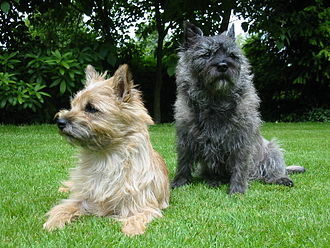
The Cairn Terrier is one of the oldest working terriers in Scotland: A small, robust, all-terrain dog, bred to crawl between rocks and pull prey out of its burrows. Beneath that rustic-looking, uncombed coat hides a cheerful, courageous, and surprisingly smart companion. If you are looking for a dog of manageable size but with true terrier character, the Cairn Terrier deserves your attention.
Is the Cairn Terrier for you?
Before you fall in love with their rebellious face, you should know which dog you’re engaging with. The Cairn Terrier is a pure breed terrier: independent, hunter and with plenty of energy tucked into a small body. It fits in wonderfully with many families, but it’s not a decorative stuffed animal. This is a quick snapshot of its lights and shadows.
In favour .
- Compact size: well suited to flats and small houses.
- Cheerful, sociable and very close to his family.
- Intelligent and willing to learn; relatively easy to train to be a terrier.
- It sheds very little hair and is of moderate maintenance.
- Robust and long-lived – a generally healthy breed.
- Good with kids and good warning dog.
To be taken into account
- Strong hunting instinct: chases cats, rodents and anything that moves.
- He loves to dig; your garden or your pots may suffer.
- Stubborn and independent; needs consistency since puppyhood.
- He may bark if he’s bored or spends too much time alone.
- The coat requires manual stripping, not machine repair.
- He’s not lonely for long: he wants to be with his people.
Character and temperament

The Cairn Terrier is above all a lively dog. Active, resilient, always alert and in a good mood, it embodies the spirit of the Scottish terrier: small but with a courage disproportionate to its size. It was bred to face only foxes and badgers in the middle of the mountains, so courage and determination are in the DNA.
That legacy of work translates today into a curious, alert and very involved companion in everything that happens at home. He is affectionate and devoted to his family, but retains an independent vein: he thinks for himself and does not always obey the first. He is not a nervous or fearful dog; the normal is a Cairn balanced, confident and willing to adventure.
In terms of intelligence, it ranks mid-high on the obedience rankings (around number 35 on Stanley Coren’s well-known list), indicating that it learns above average. Of course, their cleverness includes knowing very well what they want, so it is wise to channel that mind with games, challenges, and positive training. Bored, a Cairn will seek out his own entertainment, and rarely matches your plans for the couch or the garden.
Coexistence: children, other pets, flat and loneliness
The Cairn Terrier is one of the terriers that best fits into family life, but it is advisable to know its nuances according to context:
- With children: is usually an excellent playmate. It is tolerant, playful and resilient, which allows it to keep pace with the youngest. As with any dog, children must be taught to respect their times and supervise first encounters.
- With other dogs: generally gets along well, especially if it has been socialized since puppyhood.
- With cats and small animals: here is the delicate point. His hunting instinct is very strong. He can live with a cat if they grow together, but hamsters, rabbits or birds are a temptation difficult to manage: for him, anything small that runs is prey.
- On the floor: adapts seamlessly to apartments and small houses as long as it covers your daily exercise.
- In the face of loneliness: is a very family-friendly dog and does not tolerate long absences. Boredom and loneliness can lead to barking, digging or destructive behavior.
Education and training
Training a Cairn Terrier is a mixture of pleasure and patience. It learns quickly and enjoys collaborating, but its terrier independence means that it will not do things just to please: it needs to see what it gains. That’s why positive reinforcement (rewards, play, cheerful voice) works much better than imposition or harsh methods, which only get it to close in on the band.
The key is to start early, be consistent and not bore him. Short, varied and motivating sessions give better results than long and repetitive ones. early socialization is fundamental: the more you expose the puppy to different people, dogs, noises and environments, the more balanced he will be as an adult.
There are two classic fronts to working with this breed. The first is the called: With such a strong hunting instinct, a Cairn can shoot out after a trail and become deaf, so it’s best to reinforce the “come here” a lot and be cautious when releasing it into open areas. The second is the barking management and excavation: They are not vices, but natural behaviors; they are controlled by giving him alternatives, sufficient exercise, and teaching him from the beginning what is permissible.
Exercise and activity
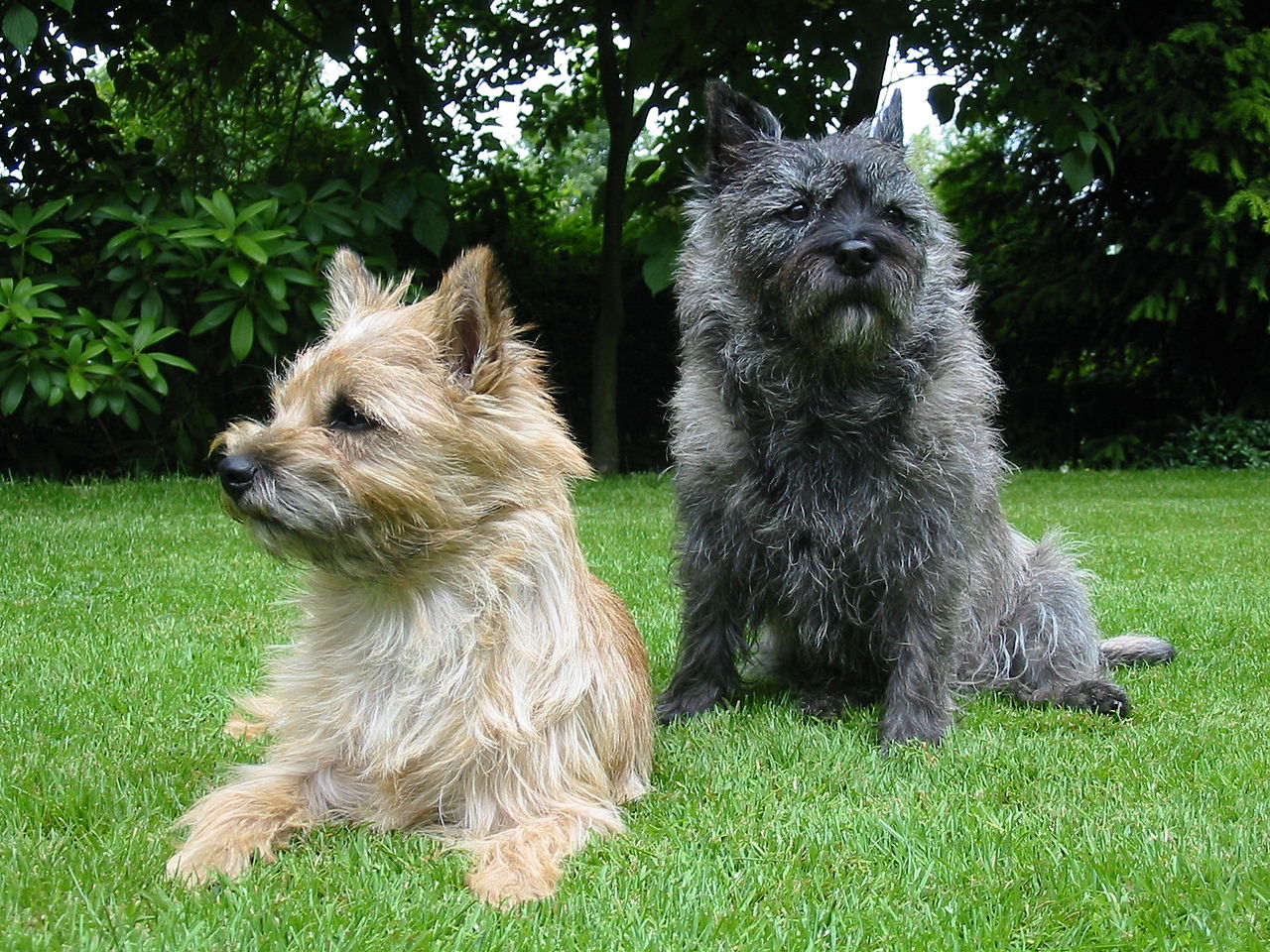
Don’t be fooled by its size: the Cairn Terrier is an energetic dog that needs a daily battery drain. It doesn’t require the marathon sessions of a herding dog, but it does require quality exercise. With a couple of well-used daily walks, where it can sniff and explore freely, plus some playtime, it is usually satisfied.
Where it really enjoys is with mental activity and games that appeal to its instinct: looking for objects, chasing balls, interactive toys or olfactory exercises.
Two things to look out for. One, the tendency to dig: if you have a garden, plant it in an area where it’s allowed or protect your plants, because it loves to dig. Two, safety: because of its eagerness to hunt, ideally it should run free only in fenced or controlled spaces, and always reinforce the call before releasing it.
Care: fur and hygiene
The coat of the Cairn Terrier is twofold: a soft, dense inner layer that insulates, and a rough, weather-resistant outer layer, designed to repel water and mud during hunting days in humid Scotland.
Regular brushing, a couple of times a week, is enough to keep your hair clean and free of knots. But the outer layer must not be cut with scissors or a chisel: Doing so ruins the texture and color, and in the long run leaves the hair soft and dull. Instead, the stripping(hand adjustment) is used, which consists of gently pulling the dead hair from the root to grow new hair with the correct texture. It is a maintenance that is done every few months, at home with practice or in a dog hair salon that respects the coat.
The good news is that the Cairn sheds very little hair; in fact, the American Club ranks it among the breeds considered hypoallergenic (with nuances, because no dog is one hundred percent so). The rest of the hygiene is routine: Check and clean your ears, trim your nails when necessary, brush your teeth regularly and bathe only when it is really dirty, so as not to damage the natural protection of your fur.
Foodstuffs
The Cairn Terrier has no special dietary requirements, but being a small and active dog, it needs a complete and quality food, adjusted to its size, age and activity level.
The critical point is the weight control. It is a gluttonous and very skilled begging breed, and its compact structure makes the extra kilos immediately noticeable and load its joints. It is advisable to measure the quantities, monitor the rewards (which add a lot of calories without you realizing) and check from time to time that you continue to notice its waist and ribs to the touch.
Make sure that fresh water is always available, and if you are unsure about the exact amount, type of diet, or any digestive sensitivities, it is best to consult your veterinarian, who will tailor the guideline to your particular dog.
Health and life expectancy
The Cairn Terrier is a rustic and generally healthy breed, with a remarkable longevity.Recent studies give it a life expectancy of around 13 to 14 years(a 2024 British study placed the average at 14 years, above the general average of purebred dogs), and it is not uncommon for many specimens to exceed that figure with good care.
Still, since every race has a predisposition to certain problems, some hereditary, it is worth knowing:
- Portosystemic shunt (PSS) and hepatic microvascular dysplasia: liver alterations of some incidence in the breed, so a good breeder does checks.
- Eye problems: cataracts, corneal dystrophy, progressive atrophy of the retina, dislocation of the lens and ocular melanosis.
- Joint problems: kneecap dislocation, hip dysplasia and Legg-Calvé-Perthes disease (degeneration of the head of the femur).
- Craniomandibular osteopathy (the so-called “lion’s jaw”): a bone growth disorder affecting the jaw in puppies.
- Otros: hypothyroidism, diabetes, von Willebrand disease (coagulation), atopic dermatitis (to which he is predisposed) and most recently Krabbe’s disease.
The best prevention is to choose a responsible breeder who checks the health of the breeders, keeps veterinary checks and vaccinations up to date, takes care of weight, and addresses any signs of limping or eye problems early.
Physical appearance

The Cairn Terrier is a small, compact and well-grown dog, with a deliberately rustic and natural image: that “unshod” air and ready for action is a sign of the breed’s identity, not carelessness.
The head is broad in proportion to the body, with an alert expression and small, pointed, erect ears that give it its characteristic attentive gesture.
The coat, as already mentioned, is double and hard on the outside. As for color, it supports a wide range: cream, wheat, red, sand, gray and brindle, often with darker ears and muzzle. Pure black and white are not accepted. A curious color: spotted dogs tend to change in tone throughout life, darkening or lightening with age, so that the same dog may look different from puppy to adult.
Origin and history
The Cairn Terrier is one of Scotland’s oldest working dogs. It comes from the Highlands and the Isle of Skye, where it was used for centuries to control vermin. His name says it all: A cairn is a heap of rocks, and this terrier was the expert at sneaking between the rocks to corner foxes, badgers and other prey in their burrows, barking to let the hunter know he had found them.
For a long time, hard-haired Scottish terriers were grouped under the same label, without clearly distinguishing between what are now separate breeds. The Cairn, Scottish Terrier and West Highland White Terrier shared a common trunk and only in the early 20th century began to be bred separately as differentiated breeds. In fact, for a time Cairn litter-born whites were registered as West Highland White Terriers.
The breed arrived at official UK exhibitions in 1909, initially presented as the “Shorthaired Skye Terrier”. The Skye Terrier breeders objected to the name, and as a compromise solution the “Cairn Terrier” was adopted, honoring their work among the rocks. The British Kennel Club gave it its own registration in 1912 and the breed soon achieved championship status. In the United States it had been registered by the AKC in 1903, and the Federation Cynologique Internationale (FCI) recognized it definitively in 1963. Today it is in Group 3 of the FCI (Terriers), among the small size terriers.
Curiosities
- Toto was a Cairn Terrier. Dorothy’s dog in the film The Wizard of Oz(1939) was a female of this breed named Terry, and it shot up the Cairn’s worldwide popularity.
- Very close relatives. shares ancestors with the West Highland White Terrier and the Scottish Terrier; the three breeds separated in the early 20th century from a common origin.
- Master of camouflage. Her gray and earthy fur was not accidental: it allowed her to pass unnoticed among the rocks and heather of the Highlands as she worked.
- It changes color. Rattlesnakes may darken or turn silvery with age, which is unusual in the canine world.
- Small but brave. bred to face only prey that could match its size, it retains remarkable courage and confidence for such a small dog.
If you are attracted to the compact terrier spirit, you will be interested in comparing the Cairn to its relatives and other related breeds. Check out the West Highland White Terrier and Scottish Terrier, its more direct Scottish cousins, as well as the Norwich Terrier, with which it is often confused, and the versatile Border Terrier, another small working terrier with a charming character.
Frequently Asked Questions about the Cairn Terrier
Is the Cairn Terrier a good dog for families with children?
Yes. It is playful, tolerant and resilient, which makes it a good companion for children. As with any dog, it is good to teach the little ones to respect their time and supervise interactions, especially in the beginning.
How long does a Cairn Terrier live?
It is a long-lived breed. Recent studies place its life expectancy at about 13-14 years, and with proper care many specimens exceed that figure.
Does it shed a lot of hair?
It sheds very little hair, and the American Kennel Club lists it as a hypoallergenic breed. Of course, no dog is 100% hypoallergenic, and its coat needs to be hand-stripped rather than machine-cut.
Can he live in a flat?
Its compact size makes it ideal for apartments and small houses, as long as it covers your daily exercise and has company.
Do you get along with cats and other pets?
With cats it can work if they grow up together, but its strong hunting instinct makes it difficult to get along with rodents, rabbits or birds, which it tends to see as prey.
Is it hard to train?
It learns easily because it is intelligent, but its terrier independence requires consistency and positive reinforcement.
Why is he digging and barking so much?
They are natural behaviors inherited from their work as burrow hunters, not vices. They are controlled with sufficient exercise, mental stimulation, adequate alternatives and education from puppyhood. They usually appear mainly from boredom or loneliness.
How much exercise does the Cairn Terrier need?
With a couple of daily walks where he can sniff and explore, plus games that appeal to his instinct (search, chase, smell), he’s satisfied.