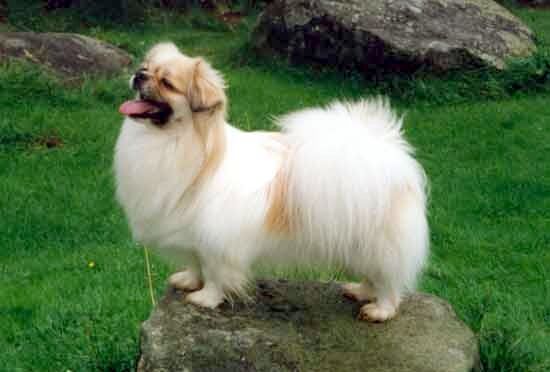
The Spaniel Tibetano is a small, alert and incredibly attached family dog that was born in Tibetan monasteries as a watchdog and companion to monks. Despite its name, it’s not a hunting spaniel: It is a companion dog with the character of a “little lion”, independent, sensitive and surprisingly long-lived. If you’re looking for a dog of manageable size, with little physical maintenance but a lot of personality, the Tibetan Spaniel deserves a thorough introduction.
Is the Tibetan Spaniel for you?
Before you fall in love with its miniature lion face, it’s good to know what kind of dog you’re getting into. The Tibetan Spaniel is a balanced and adaptable breed, but it has very marked traits – especially its independence and its alarm instinct – that fit wonderfully with some homes and clash with others. Here’s the honest summary.
In favour .
- Comfortable size: perfectly suited to flats and small homes.
- Very close and affectionate with his family; a true loyal companion.
- Excellent alarm dog: detects and warns of anything new.
- Attractive coat but without the demands of other long breeds.
- Intelligent and observant, with a remarkable sensitivity to his people.
- A robust and long-lived breed, one of the healthiest among companion dogs.
Against
- Independent and stubborn – not the typical dog that obeys instantly.
- He tends to bark to warn; you have to manage him as a puppy.
- Reserved and suspicious of strangers if he doesn’t socialize well.
- He has a hard time with prolonged loneliness. He needs company every day.
- Propensity to explore on his own; beware of fences and belts.
- Predisposition to some hereditary eye problem that should be controlled.
Character and temperament

The Tibetan Spaniel has a temperament that the breed’s own standard defines as self-confident, independent and alert. It is not a submissive or servile dog: it thinks for itself and decides when it wants to collaborate.
Underneath that self-sufficient façade is a deeply emotional dog. It developed as a companion to the monks and is extraordinarily empathetic to his family’s mood: it senses when you’re sad, when there’s tension at home, and when it’s time to curl up. It’s loyal to the core to its owners, but it tends to be distant to strangers, even after a good socialization.
His watchdog instinct is still very much alive. He loves to rise to the top – the back of the couch, a ledge, the top of the bed – to dominate the landscape and warn with barking of any movement. He is not aggressive, but he is suspicious: he barks first and asks questions later. Understanding and channeling this trait is the key to living with him without going crazy.
Coexistence: children, other pets, flat and loneliness
- Because of its small size, it does not tolerate abrupt play or being manipulated like a toy, so the ideal coexistence is with somewhat older or supervised children.
- With other dogs: usually gets along well, especially if growing up accompanied. It is sociable but can also be somewhat dominant or bossy despite its size; quiet presentations work best.
- Since With cats and other pets: is not a hunting dog, its predatory instinct is low and coexistence with cats is usually peaceful, especially if they have known each other since childhood.
- On the floor: is an ideal breed for apartments. Its size and moderate exercise needs fit perfectly in small spaces; the only point to watch is the alarm barking so as not to disturb the neighbors.
- In the face of loneliness: is its great weakness. The Tibetan Spaniel needs regular contact with its people and it’s not good to be alone for hours.. In homes where it spends too much time alone it can develop anxiety and excessive barking.
Education and training
Training a Tibetan Spaniel is an exercise in patience and diplomacy rather than imposition. It is a he ‘s smart . He understands quickly what you ‘re asking . dog, but its independence often makes it decide that it has better plans than to come when you call it. It is not stubbornness from lack of head, but from excess of self-criterion.
Positive reinforcement is the only way that really works: rewards, play, friendly voice and short and varied sessions. Hard or repetitive methods disconnect him immediately. It is advisable to start socialization very early, exposing him to people, noises, other animals and different situations, because his natural tendency is the reserve to the unknown.
Two fronts deserve special attention. The first is the called: since it is prone to drift away to explore, it must be worked hard and, for safety, kept in fenced areas or on a long leash until it has a reliable response. The second is the control of barking: teach it from a puppy to warn and then to be silent at your signal, so that its watchdog instinct does not become a coexistence problem.
Exercise and activity
The Tibetan Spaniel has a average energy: it is neither a tireless athlete nor a lazy couch dog. With a couple of daily walks at a leisurely pace, some play and mental stimulation, it is perfectly satisfied. It is one of the great advantages of the breed for those who cannot or do not want to devote hours to exercise.
Of course, do not confuse moderate needs with an apathetic dog. He greatly enjoys exploring smells, searching games, interactive toys and any challenge that puts his mind to work awake. The mental stimulation is as important to him as physical walking, and prevents him from boredom that results in barking or mischief.
He loves heights and vantage points, so a good viewpoint by a window may be his favorite place in the world.
Care: fur and hygiene

Good news for those who are afraid of hairy breeds: the Tibetan Spaniel has a medium-length silk double coat that requires much less maintenance than it looks. It does not need haircuts or an obsessive daily brushing. With two or three brushes a week. it is enough to keep the hair clean, without knots and with its natural shine.
As with all dual-coated breeds, two seasonal seedlings is most intense in spring and autumn, when daily brushing is recommended to remove the loose undercoat and reduce hair at home.
Bathing is only necessary every few weeks or when you get really dirty; bathing him excessively dries out his skin. Complete hygiene with the usual care: gentle ears review and cleaning, crying control around the eyes (his flattened face favors it), regular toenails cutting and a good dental hygiene routine, especially important in small breeds.
Foodstuffs
The Tibetan Spaniel feeds like any small and healthy dog: with a complete and balanced diet, of good quality and adapted to its age, weight and activity level. It has no exotic requirements, but its small size makes ration control is essential: a handful of extra feed is a huge percentage in a dog of only 5 or 6 kg.
The tendency to be overweight is the main nutritional risk. Since it is a clever and persuasive dog – those eyes know how to ask – it is advisable to ration with the head, weigh the food and reserve the prizes for training, deducting them from the daily ration.
Divide your food into two servings a day, make sure fresh water is always available, and adjust the amounts as you see fit. If you notice that your waistline is losing or your ribs are not palpable, cut back.
Health and life expectancy
The Tibetan Spaniel is a notably sturdy and long lasting breed. A 2024 British study placed its average life expectancy at 15.2 years, well above the average of purebred dogs (around 12.7 years).
Although healthy, the breed has some hereditary predispositions that should be known:
- Patients who have been diagnosed with progressive retinal atrophy: is the most relevant condition. It is an inherited eye disease that causes progressive and painless blindness, usually between one and a half and four years of age. There is a dNA test(available since 2013) that allows responsible breeders to identify carriers and avoid transmitting it.
- Portosystemic shunt (liver bypass): is a rare vascular abnormality in which blood prevents filtration from the liver.
- Minor eye problems: due to the shape of its face may present “cherry eye” (prolapse of the third eyelid gland) or tearing, in addition to some sensitivity to allergies.
The best guarantee of health is to go to a responsible breeder that performs the eye tests and genetic testing of APR, and maintain periodic veterinary checkups throughout the dog’s life.
Physical appearance

The Tibetan Spaniel is a small and well proportioned dog, slightly longer than tall. It measures around 25cm to the cross. and weighs between 4 and 7 kg, with somewhat larger specimens outside the show ring.
The head is small in proportion to the body, with a slightly domed skull and a short snout and blunt, without wrinkles. The bite is pincer or slightly prognat (the lower jaw somewhat advanced). It has a black nose and some oval, medium-sized eyes, well separated and very expressive.
the ears are hanging. s on both sides of the head, cheek height, embellished with fringes. The neck has a more marked hair follicles on males – hence its nickname “little lion”. The front legs are slightly arched and the feet are “hare-shaped”. The tail, of high insertion and very feathered, it curls over the back. The coat, silky and double-layered, is short in the face and front of the legs, and of medium length in the rest of the body.
In terms of color, the breed supports virtually the entire range: red, lionside, gold, white, cream, black and fire, and particolor combinations.
Origin and history
The history of the Tibetan Spaniel goes back to the buddhist monasteries in Tibet, where for centuries it accompanied the lamas as a companion and guardian. These small dogs walked behind their masters and soon earned the nickname “little lions” for their resemblance to the Snow Lions, the protective creatures of Buddhist iconography.
But they were not just lap dogs. In the monastic life they performed very practical functions: they sat high on the walls of the watching the horizon monastery and, with their keen eyesight, barked to alert the monks and the imposing Mastines Tibetanos of any intruder.
The exchange of dogs as gifts between Tibetan monasteries and palaces in China and other Buddhist countries was intense for centuries, hence the breed probably shares common ancestors with Oriental dogs such as the Chin Japonés and Pequinés. Specimens bred near the Chinese border tended to have the shortest snout.
In the United States, the first documented litter was born in 1965 from two dogs imported from a Tibetan monastery, and in 1971 the North American breed club was founded. The American Kennel Club officially recognized it as 1984, and the International Kennel Federation (FCI) in the year 1987, framing it as Group 9 (pet dogs), Section 5 (Tibetan breeds).
Curiosities
- It’s not a spaniel. Despite its name, it does not belong to the hunting spaniel family. It is thought to have been named so because of its resemblance to miniaturized versions of lap spaniels, such as the Cavalier King Charles Spaniel.
- Her mane and build earned her comparisons to the Snow Lions, sacred symbols in Tibetan culture.
- Height watch. His fondness for climbing furniture and windows is not a modern whim: it is a direct echo of when he stood guard over the walls of monasteries.
- He was spinning prayer wheels. One of the most curious functions attributed to it is to help monks spin their prayer wheels.
- Working partner with the Mastiff. acted as an “alarm” with his eyesight and barking, while the stocky Tibetan Mastiff handled the heavy defense.
- I’m way off the record. With an average of over 15 years, it is among the longest-living companion dogs.
If you are attracted to the character of the tibetan breeds and the little companions of the palace and monastery, there are several races that share part of their history or profile and that you may be interested in: The robust and protective Mastín Tibetano, its long-mantled relative the Lhasa Apso, and two eastern cousins with which it shares ancestors, the Pequinés and the Chin Japonés. They’re all companion dogs with a lot of personality and centuries of history behind them.
Frequently Asked Questions About the Tibetan Spaniel
Is the Tibetan Spaniel a good breed for beginners?
It is a relatively easy breed due to its manageable size, moderate maintenance, and robust health, but its independence and bark instinct require perseverance.
How long does a Tibetan Spaniel live?
It is a particularly long-lived dog. A British study in 2024 placed its average life expectancy at 15.2 years, clearly above the average for purebred dogs. With proper care, proper nutrition and veterinary checkups, many exceed that figure.
Does the Tibetan Spaniel bark a lot?
It has a keen instinct for vigilance and tends to bark to warn of anything new. It is not a hysterical barker, but it is alert. With an early education that teaches it to warn and be quiet at your signal, the barking is kept under control.
Do you get along with children and other dogs?
Yes, in general. It gets along well with respectful children and with other dogs, especially if it socializes from a young age. As a child it does not tolerate rough play, and as it is not a hunting dog it usually accepts cats without problems.
How much exercise do you need?
He has a medium energy. With a couple of quiet daily walks, some play and mental stimulation, he’s satisfied. He fits in very well on floors, as long as you don’t leave him alone for too many hours and offer challenges for his waking mind.
Does he shed a lot of hair and have trouble maintaining his coat?
Its double, silky coat is easier than it looks: two or three weekly brushes are enough. It has two more intense seasonal mouldings in spring and autumn, during which it should be brushed daily. It does not need a haircut.
Can you stay home alone for many hours?
The Tibetan Spaniel is very attached and needs regular contact with his family; prolonged loneliness can cause anxiety and excessive barking.
Why is it called “spaniel” if it’s not a hunting dog?
The name is misleading: it does not belong to the family of hunting spaniels. It is thought to have been named for its resemblance to miniaturized versions of lap spaniels.