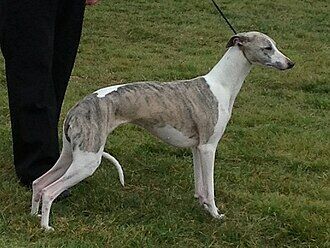
The Whippet is a medium-sized English hare that looks like a miniature Greyhound: Elegant, aerodynamic and of a disarming sweetness. At home it is the quietest dog in the world, able to sleep all day in a bunch; in the field it transforms into an arrow that runs at 55 km/h. If you’re looking for a quiet, clean, caring companion who will also take your breath away when you run, the Whippet has plenty of ballots.
Is the Whippet for you?

Before you fall in love with that little grey silhouette, be honest about what this breed asks for and gives away. The Whippet is a dog of contrasts: Docile and sleepy doors in, intense and fast doors out. It fits wonderfully with someone who values home tranquility but can offer safe runs; it fits worse with someone who wants a guard dog or a partner for endurance marathons.
In favour .
- Quiet, clean and quiet at home; ideal for flooring.
- Very affectionate and close to his family.
- Very short coat: hardly any hair and no smell.
- A healthy, long-lived breed with few hereditary problems.
- Good with kids and other dogs.
- Don’t bark too much.
To be taken into account
- High prey instinct: watch out for cats and small animals.
- He needs to sprint daily in a fenced and secure area.
- It is cold: it requires a coat in winter and a warm bed.
- You can suffer from separation anxiety if you’re left alone too much.
- Delicate physique: thin skin prone to cuts and scratches.
- He’s no good as a guard dog.
Character and temperament
People who live with a Whippet often use the same word to describe them: It’s about balance. It is a calm, reserved, mild-mannered dog, which in the living room behaves with almost feline dignity and appreciates physical contact so much that it will seek your lap or sneak under the blanket without your invitation. The American Kennel Club defines it as “quiet and dignified in its owner’s living room”, adding that it is an excellent indoor dog. That calm, however, is not apathy.
As soon as he steps into an open space, the Whippet shows his other face: The hare’s. Explosions of astonishing power, impossible turns, and a purely athletic exhilaration then erupt, before returning to their natural state of rest. He ‘s a beaked dog: maximum intensity in short bursts, followed by long naps. Beneath all that elegance, there is also a vivid hunting instinct, inherited from generations raised to chase hares and rabbits on sight. He is sensitive, somewhat shy with strangers, and deeply loyal; he is rarely domineering or confrontational.
Coexistence: children, other pets, flat and loneliness

The Whippet is one of the hares best adapted to family life.
- With children: is patient, gentle and tolerant, a great choice for families with children. It is good to teach the little ones to respect their delicate constitution and supervise rough play, because their thin skin is easily injured.
- With other dogs: is sociable and non-confrontational, usually getting along well with its congeners, especially if it has been socialized as a puppy.
- With cats and small animals: here is the important nuance. Its strong prey instinct can cause it to chase cats, rabbits or squirrels. Many Whippets coexist with the house cat without problem if they grow up together, but outside the house any animal that runs can activate the chase.
- On the floor: is perfect. It’s quiet, quiet and manageable in size; as long as you have your daily running dose, you don’t need a garden.
- In the face of loneliness: is his Achilles heel. The Whippet is very attached to his family and can develop separation anxiety if he spends too many hours alone.
Education and training
The Whippet is intelligent and quick to learn, but he’s not the typical obedient dog who lives to please: has the independence characteristic of hares. It responds remarkably well to positive reinforcement – rewards, play, friendly voice – and closes in on harsh methods, which only manage to frighten such a sensitive dog. Early socialization, exposing him as a puppy to people, noises, dogs, and different environments, is key to preventing his natural shyness from leading to fear.
The great challenge of training is the call. When a Whippet locks onto a prey in plain sight, its instinct can do more than your voice: it goes off, and at that speed, it doesn’t listen to reason. That’s why the safety recommendation is almost universal among breed experts: work the call of conscience, but release it unleashed only in fenced or really safe spaces, away from roads.
Exercise and activity

To clear up a misunderstanding, the fact that the Whippet is so quiet at home doesn’t mean that it doesn’t need exercise. It does, but it does need a specific type of exercise. It’s not an endurance dog that can run for hours at a time; it’s a sprinter. What really fills it up is being able to sprint hard, let go of those galloping explosions it carries in its genes, and then rest.
In practice, you need about 45 to 60 minutes a day of well-spent time: combined walks with free running in a safe and enclosed area. He greatly enjoys sports such as lure coursing(chasing a lure), racing, agility or flyball, activities in which the race shines for its speed and agility. A Whippet who can run daily is a happy, balanced dog; one who is walked only at a leisurely pace will accumulate frustration.
Care: fur and hygiene
If there is a low-maintenance breed in terms of hair, it is this one. The coat of the Whippet is short, thin, smooth and attached to the body, without undercoat, so that the muzzle is minimal and hardly leaves hair at home. With a weekly brushing with a rubber glove to remove dead hair and remove shine is more than enough. Baths only when really dirty; abuse dries your skin.
The Whippet’s real care is not in the hair, but in protecting it. Its skin is very fine and it cuts or scratches easily between bushes, so it is advisable to watch for injuries after field races. And his low body fat makes him very chubby: In winter he needs a coat for walks and a warm, soft bed at home. Completing the routine as usual: checking and cleaning ears, cutting nails and maintaining dental hygiene.
Foodstuffs
The Whippet is an athletic dog with lean muscles and very little fat, and its diet should reflect this. He needs a complete, high-quality diet, with good protein intake to maintain his musculature, adjusted to his age, weight, and activity level. It’s not a race prone to obesity, but the balance counts: Because of its natural thinness, it is normal and healthy to notice its last ribs; its slender figure should not be confused with lack of weight or try to “fill it up”.
It is advisable to divide the food into two daily servings and, as with all deep-breasted dogs, avoid intense exercise just before and after eating to reduce digestive risks. Water is always fresh and available.
Health and life expectancy
The Whippet is one of the healthiest breeds in existence, and not by accident: centuries of selection for functionality – hunting, coursing and racing – have given it a solid and balanced structure, free from the physical exaggerations that cause so many problems in other breeds. It is quite safe from ailments common in other dogs, such as recurrent ear infections, skin allergies or digestive disorders. Hip dysplasia is rare, and genetic eye defects, though present, are rare. A 2024 British study put their life expectancy at around 13.4 years, above the average for purebred dogs.
That said, there are some peculiarities that every owner should be aware of. The first is medical and very important: Like other hares, the Whippet is intolerant to barbiturates, due to its low body fat level and a poorly metabolizing liver; it is essential that the veterinarian knows this before any intervention. The second is its large, slow-beating heart, which at rest may sound irregular or intermittent and alarm those unfamiliar with the breed, although during exercise it functions at a perfect rhythm. In older dogs, heart disease – especially mitral valve disease – is among the leading causes of death, so regular veterinary checkups are highly recommended. Finally, a genetic curiosity: a mutation in the breed’s own myostatin gene causes duplicate specimens to develop disproportionate musculature and are known as “Bully Whippets”, without causing any significant health problems.
Physical appearance
The Whippet is the very definition of functional elegance. Medium in size, it features the typical aerodynamic body of the hare, designed to the millimeter for speed: deep chest containing generous lungs, belly gathered in a very marked lower line, arched back, long, thin legs and a dry, defined musculature. The head is elongated and stylized, with small rose-shaped ears and an attentive and sweet expression.
According to the British standard, males measure between 47 and 51 cm at the withers and females between 44 and 47 cm, while American and Canadian standards allow somewhat larger specimens. The typical weight is around 11 to 18 kg. The hair is short, smooth, fine and very sticky, and as for the color reigns absolute freedom: For the FCI the colour is “immaterial”, i.e. not valued, so the Whippet comes in virtually any shade and combination – black, white, lionside, scarlet, blue, cream and all their mixtures. The only exception is the merle pattern, which the British Kennel Club stopped admitting in 2019 for not being a natural color of the breed.
Origin and history
The Whippet was born in northern England as “the poor man’s greyhound”. At the end of the 18th century and throughout the 19th, the working classes – miners and workers from regions such as Lancashire, Yorkshire, Durham and Northumberland – could not afford a real Greyhound, considered a dog of the nobility, so they created their own version: It’s smaller, more affordable and more manageable, but just as fast over short distances. To accomplish this, they crossed English Greyhounds and Italian Greyhounds with several terriers – Bedlington, Manchester, Yorkshire, and others – seeking to combine the speed and print of the greyhound with the endurance and courage of the terrier.
The result was a versatile dog used for hunting rabbits and, above all, for running. Whippet racing became a popular phenomenon: The dogs would loose themselves on a track and run toward their owners, who at the other end would wave a rag or towel to call out to them – hence the breed’s old nickname, “snap dog”, the dog that pulls to bite. Nicknamed “the poor man’s racehorse”, the Whippet was a source of pride and sometimes income for many humble families. The British Kennel Club officially recognized the breed in 1891, three years after the American Kennel Club did, in 1888, by hand of textile workers who brought the first specimens to Massachusetts. Since then, the Whippet has moved from ashtrays to salons and exhibition rings, without losing an ounce of its essence.
Curiosities
- The fastest in his class. The Whippet is the fastest dog within its size and weight range, and is credited with the fastest stop-run acceleration of any breed.
- It’s a double-suspension gallop. When running, its four legs lift off the ground twice with each step – one with the body stretched out and one with the body pulled up – the same gallop that greyhounds use to fly.
- It’s called “Snap dog”. One of its former names alluded to its tendency to “catch with a bite” any nearby prey, the result of its hunting instinct.
- Bully Whippets. A genetic mutation specific to the breed, that of the myostatin gene, produces in double doses hypermuscular specimens, with no known equivalent in other hares.
- Star of the shows. A Whippet won the Westminster Kennel Club’s Best in Show in 1964, and the breed has taken Crufts’ top award on several occasions.
- His name comes from speed.“Whippet” derives from an Old English term meaning “to move with gusto”.
If you are attracted to the Whippet, you will surely enjoy meeting its relatives and other dogs of similar character. Do not miss its older brother, the Greyhound, or its miniature version, the Galgo Italiano. And within the family of hares, the elegant Saluki and the spectacular Galgo Afgano deserve a visit.
Frequently Asked Questions About the Whippet
Is the Whippet a good dog to live on the floor?
Yes, and one of the best. Inside the house the Whippet is quiet, clean and quiet: he spends a good part of the day sleeping on the couch. The only negotiable thing is to give him daily one or two free-running sessions in a safe area to burn his explosive energy. With that covered, he fits perfectly into an apartment.
How much exercise does a Whippet need a day?
It takes about 45-60 minutes a day, but with quality: it needs to sprint at a gallop, not just walk at a pace. Ideally two runs with free runs in a fenced area. It is a dog of short, intense explosions followed by long breaks, not of sustained resistance.
Does the Whippet get along with children and other dogs?
With children it is usually excellent: sweet, patient and not aggressive, although due to its finesse it is advisable to supervise with very small and brusque children. With other dogs it is sociable. The delicate point are small animals (cats, rabbits): its strong prey instinct can shoot, so coexistence with cats requires early socialization.
Does the Whippet lose a lot of hair?
Very little. It has short, fine hair and no undercoat, so moulting is minimal and maintenance is very low: a weekly brushing and little more. It is one of the most comfortable breeds in terms of fur hygiene.
Why is the Whippet so cold?
For his short hair without undercoat and his very little body fat, he is not insulated from the cold, so in winter he is grateful for a dog coat on walks and a warm bed at home.
How long does a Whippet live?
It is a very long-lived and healthy breed: a British study from 2024 placed its life expectancy at around 13.4 years, above the average for purebred dogs.
Is it easy to train the Whippet?
It is intelligent and wants to please, but also sensitive and independent as a good hare. It responds very well to positive reinforcement and nothing to hardness. The biggest challenge is the call when there is a prey in sight: for safety it is advisable to release it only in fenced areas.
Does the Whippet serve as a guard dog?
No, and you don’t have to ask him. He may bark if he hears something strange, but his character is kind and shy: he prefers to retreat before confronting. He is a companion, not a guardian.