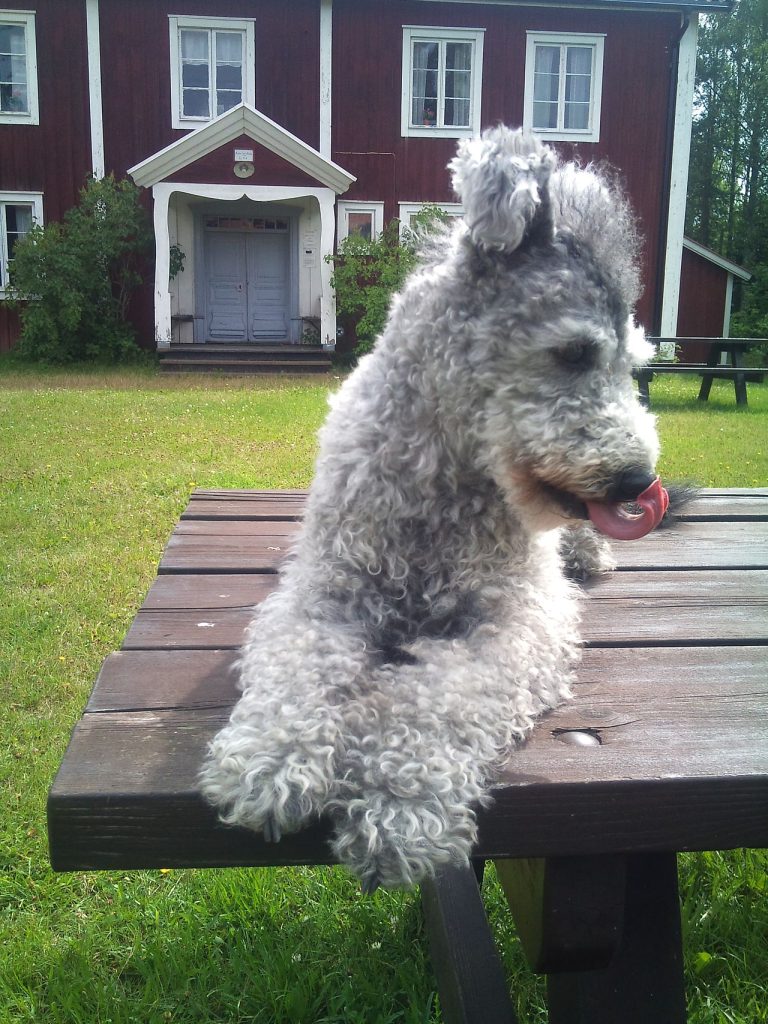
The Pumi is a small to medium sized Hungarian shepherd dog, unmistakable by its always alert ears with a bent tip and curly coat that gives it a mischievous appearance. It’s a lively, highly intelligent and energetic breed, bred for centuries to herd sheep that bark and move relentlessly. If you’re looking for a sporty, alert, high-spirited companion, the Pumi will surprise you; if you’re looking for a quiet couch dog, it may not be for you.
Is the Pumi for you?
Before you fall in love with those ears, be honest: the Pumi is a working dog in a compact body. It needs to do things, think and expend energy every day. It is a fantastic breed for people who are active and want to train, and complicated for those who spend many hours outside or want a dog that is satisfied with two short walks.

In favour .
- Very smart and easy to train with game and prizes.
- It barely changes hair. Ideal if you don’t want fluff around the house.
- Handled size (8-15 kg) and friendly appearance.
- Born athlete: brilliant in agility, obedience and work.
- Healthy and long-lived, with few serious pathologies.
- Playful and affectionate with his family all his life.
Against
- He barks a lot: you have to educate the barker from a puppy.
- High energy; bored and frustrated with no activity.
- Reserved with strangers; needs early socialization.
- Shepherd instinct: you may try to gather children or pets.
- The curly coat requires periodic combing and hairdressing.
- Rare breed outside Hungary; breeders scarce.
Character and temperament
The Pumi is alert, lively, expressive and courageous, with a point of distrust towards strangers that never reaches aggressiveness or extreme shyness. It is a dog that is always ready for action: observes, reacts quickly and participates in everything that happens around him. With his family he is protective and very attached, and retains a playful character until old age.
That terrier spark in his veins – many call him the “Hungarian shepherd terrier” – is seen in his energy, quick movements, and fondness for barking. He’s a dog who constantly communicates with his voice, a direct inheritance of his work with the herd. Well socialized and with sufficient mental and physical stimulation, it does not give behavioral problems; abandoned to its boredom, it can dig, bark incessantly or try to shepherd the family.
Coexistence: children, other pets, flat and loneliness
The Pumi is usually an excellent family dog. With the children he gets along well and enjoys playing with them, as long as he is socialized from a puppy and the little ones are taught to respect their time.

With other pets it lives without difficulty when it grows up with them, although its active character and its tendency to chase advise calm presentations.
The loneliness has its weakness: it is a dog that needs company and activity, and does not like to spend many hours alone.
Education and training
Here the Pumi shines. It’s an intelligent dog that learns easily and enjoys working shoulder to shoulder with its guide. It responds especially well to positive training, with toys and food as a reward, and it gets bored with mechanical repetitions: you have to keep the sessions short, varied and fun.
The early socialization is essential for its natural reserve to the unknown: the sooner it knows people, dogs, noises and different environments, the more balanced it will be as an adult. And there is a chapter that no Pumi owner should skip: teaching shut the fuck up.. As a good shepherd dog, it barks by nature; it is advisable to channel that barking from a puppy so that it does not become an annoying habit.
Exercise and activity
The Pumi is an athlete. It needs intense physical exercise and, above all, mental stimulation daily. It is not enough to walk: it wants to run, solve, play and have a task. That is why it excels in canine sports such as agility, competition obedience and dog dancing, disciplines where its speed, intelligence and desire to please make it an outstanding competitor.
It is also used for detection, search and rescue, and of course for grazing, its original function. The golden rule with a Pumi is simple: a tired dog with a busy mind is a happy and calm dog at home. An unspent Pumi is a dog that barks, digs, and looks for trouble.
Care: fur and hygiene
The Pumi’s mantle is its hallmark and also its main maintenance task. It is a double, curly, medium-length (about 4 to 7 cm) coat, with a rough outer hair and a soft undercoat that insulates it from cold and heat.

In practice there is comb it every few weeks. to prevent the formation of knots and mats, and cut it every two to four months.. A classic trick of the breed: moistening the curl slightly after fixing helps define it. The rest of the hygiene is the usual – check ears, nails and teeth – , without special requirements.
Foodstuffs
As an active small-to-medium-sized dog, the Pumi needs a high-quality, protein-rich diet, adjusted to its actual energy expenditure. An example that competes in agility or works with livestock burns much more than a sedentary companion Pumi, and the ration must reflect this to avoid both thinness and overweight.
If you are unsure about the type of diet or specific rations, it is best to consult your veterinarian, who will evaluate your dog’s individual needs.
Health and life expectancy
The Pumi is a robust and healthy breed, with a life expectancy 12 to 14 years and documented cases that have reached the age of 19. It does not carry the extreme pathologies of other breeds, but it is advisable to know the most frequent hereditary problems and choose breeders who perform health tests.
The points to watch for are hypoplasia of the hip– probably the breed’s most specific problem, although in well-controlled countries such as Finland and Sweden 80% of puppies are born with healthy hips – dislocation of the kneecap and some genetic diseases for which DNA testing exists, such as degenerative myelopathy and primary lens dislocation. Responsible breeders do hip x-rays, knee certification and DNA testing before breeding.
Physical appearance
The Pumi is a square-bodied, lightweight dog that looks somewhat larger than it is because of its abundant hair. It has a long, narrow head, with a snout that occupies about 45% of its length, a barely marked stop !, and a flat skull seen in profile.
Their unmistakable trademark is the ears: They’re tall, always on the lookout, half-shrunken and with their tip bent down, covered in hair longer than the rest of their body, which gives them that mischievous stuffed animal look. In terms of size, males measure 41 to 47 cm at the withers and weigh 10 to 15 kg; females measure 38 to 44 cm and weigh 8 to 13 kg. The most common color is gray – puppies are born black and lighten from 6-8 weeks – although black, white, and masked leopard are also accepted.
Origin and history
The Pumi originated between the 17th and 18th centuries in Hungary, as a descendant of the Puli crossed with German Spitz type dogs, the French Briard and several terriers. During the 18th century, the importation of merino sheep also brought small mountain dogs from the Pyrenees that probably brought that characteristic shorter, curly hair. The earliest known drawing of a Pumi dates from 1815, the same year its name was first used.
For a long time it was considered a simple regional variety of Puli: The Puli dominated the eastern plains and the Pumi the western hills. The official distinction came from the hand of Dr. Emil Raitsits, who in 1921 drafted his own standard and separated it from the Puli, describing it as a “shepherd terrier”. The FCI has approved their standard in 1935. World wars decimated the population, but the breed recovered from 1956. The breed arrived in Finland in 1973 and Sweden in 1985, and was recognized by the American Kennel Club in 2011 and by the British Kennel Club in 2015. In 2016, the Hungarian government declared it one of its eight native canine breeds.
Curiosities
- He is affectionately called “the clown” in Hungary because of his playful temperament and stuffed ears.
- Grey puppies are born black and gradually lighten; the final color can be predicted by the parents.
- Its historical scientific name included the word the terrarius, in recognition of its strong terrier component.
- It is so rare outside Hungary that in all of Spain there were hardly any recorded specimens a decade ago.
- In addition to herding sheep, it has been used to hunt wild boar and as an alarm dog.
- It hardly sheds hair, which makes it attractive to people sensitive to allergies.
If you are attracted to the Pumi because of its energy, intelligence and vocation as a working dog, you may be interested in other herding and sporting breeds with a similar character. Border Collie Pastor Australiano Caniche Welsh Corgi Pembroke
Frequently Asked Questions About Pumi
Is the Pumi a difficult dog?
It is not difficult, but it is also not a dog for passive owners. The Pumi is very intelligent and learns quickly, so it responds wonderfully to training with play and rewards. Its real challenge is its energy level and tendency to bark: if you do not give it mental work and exercise daily, it gets bored and seeks activity on its own. With proper stimulation, it is a balanced and portable companion.
How long does a Pumi live?
The life expectancy of the Pumi is between 12 and 14 years, and it is not uncommon for well-kept specimens to exceed that figure; cases have been documented reaching 19 years.
Does the Pumi shed a lot of hair?
Very little. Its curly coat grows continuously, similar to that of the Poodle, and barely sheds. This makes it attractive to those who are looking for a dog that does not fill the house with hair, but it involves a compromise: you have to comb it every few weeks to avoid knots and trim it every two to four months. It is not a dog without maintenance, but one that sheds little in exchange for regular hairdressing.
Is the Pumi good with children?
Yes, the Pumi usually gets along well with children and other pets if he grows up socialized from a puppy. He is playful, maintains that clownish character all his life and enjoys family activity. It is good to teach children to respect their time, and watch their shepherding instinct, because he can try to ‘gather’ the little ones by chasing them or giving them some soft touch.
Does the Pumi bark a lot?
Yes, it is one of its most striking characteristics. It was bred as a herding dog that controls the barking of cattle, so barking is not uncommon. At home it can become a problem if not managed: it is advisable to teach it from puppyhood to be quiet in order and give it enough exercise so that it does not bark out of boredom. It is not a recommended breed if you are looking for a quiet dog.
Can a Pumi live in a flat?
The Pumi is small-to-medium sized and adapts to indoor space, but it is a working dog with a lot of energy: without outings, games and activity, it becomes frustrated and barks.
Is the Pumi hypoallergenic?
No breed is 100% hypoallergenic, but the Pumi is one of the least likely to cause problems for sensitive people because it hardly shaves and its curly coat keeps the hair from falling out.
Where does Pumi originate from?
The Pumi is a Hungarian breed. It originated between the 17th and 18th centuries in the hills of western Hungary from the crossing of the Puli with German spitz type dogs, the French Briard and several terriers. It was recognized as its own breed, different from the Puli, in 1921, and its standard was approved by the FCI in 1935.