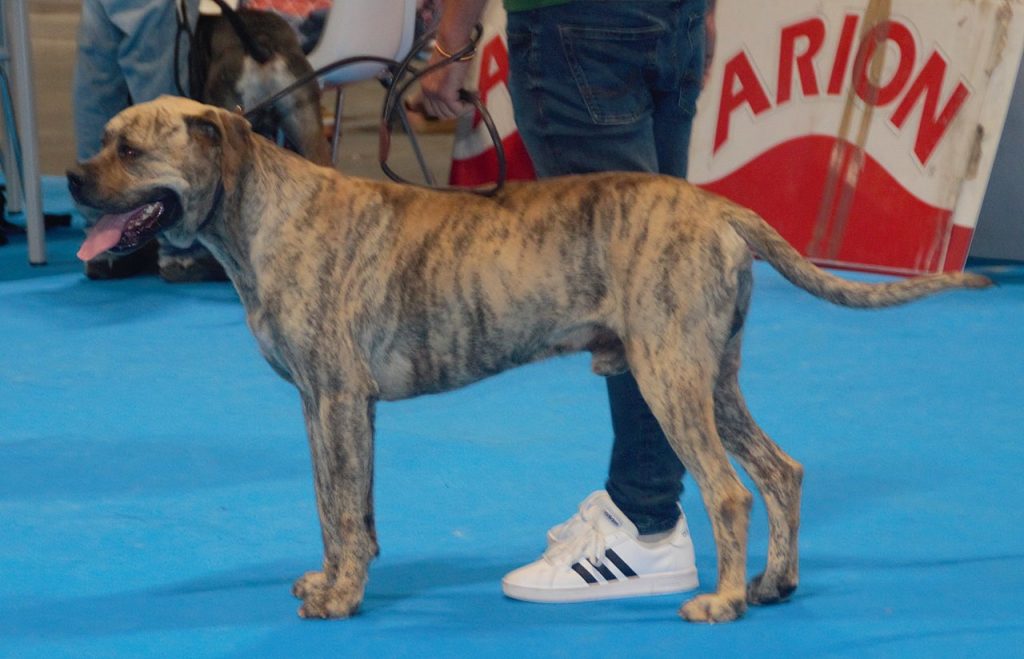
The Alano Español is one of the oldest and most genuine dogs on the Iberian Peninsula: A light, athletic and sober prey mollusk, which was on the brink of extinction in the 20th century and is now experiencing a second youth. It is not a dog for everyone – it needs space, real exercise, and a judgmental owner – but if you meet a well-behaved Spanish Alano, you will find a noble, courageous, and surprisingly quiet companion at home. In this guide, we review their character, care, health, and fascinating history so that you can make an informed decision.
Is the Spanish Alano for you?
The Spanish Alano is a functional prey dog, bred for centuries to hold cattle and hunt wild boar. That marks its character: enormous energy, firm instinct and great loyalty. It fits with active people, with experience in large dogs and, if possible, with a house with land. It is not the best choice for those who are looking for a lounge dog or spend many hours outside.
In favour .
- Very loyal and devoted to his family.
- Quiet and not much barking in the house.
- Rustic, sturdy and hairy with minimal maintenance.
- Sociable with other dogs (raised in packs).
- Excellent keeper for presence and natural courage.
To be taken into account
- He needs plenty of daily exercise and space.
- Strong prey instinct: watch out for small animals.
- Distrustful of strangers; demands early socialization.
- It matures slowly (about 2 years) and requires a firm hand.
- It’s not a breed for small flats or first-time owners.

Character and temperament
The first thing that surprises those who live with a Spanish Alano is the contrast between its imposing appearance and its balanced temperament. In the countryside it is restless, attentive to everything that moves and of a courage that borders recklessness – it is described as facing the boar “disregarding even his own life” – but at home it tends to be a calm, noble and very attached dog to his own.
It is a little barking dog by nature: it warns when necessary, not from nerves. With its owner and its family it is submissive and affectionate; with strangers, suspicious and prudent, which makes it a reliable guardian without the need for gratuitous aggressiveness.
It is worth remembering that the Alano matures slowly: it reaches its physical and mental fullness around the age of two. Until then it is a large, playful and sometimes reckless puppy, which needs clear boundaries and constancy.
Coexistence: children, other pets, flat and loneliness
With children. A well-socialized Spanish Alano is usually patient and protective of the children in the house. Nevertheless, we are talking about a large and powerful dog: coexistence should always be supervised, especially with the youngest, and both the dog and children should be taught to respect each other.
Since With other dogs. was selected to hunt in packs, it tolerates the company of other dogs well, better than many prey breeds.
With other pets. Here is its delicate point: the prey instinct is very high. Cats, rabbits or hens can activate their chase impulse. Coexistence is possible if you grow up with them from a puppy, but it requires head and vigilance.
Flat and lonely. is not a floor dog. It can live in one if it gets a lot of exercise, but its natural habitat is a house with terrain to stretch its legs. It tolerates loneliness better than other breeds if it is well exercised, although it is not advisable to leave it alone for too many hours: it is a dog that needs to be part of the family.
Education and training
The Spanish Alano is intelligent and is “selected primarily for his predisposition to work”, so he learns with pleasure when he understands what is asked of him.
The key is positive reinforcement combined with stable norms from day one. Kind persistence works much better than harshness: punishing or trying to dominate by force only creates distrust in a dog so sensitive to its owner’s treatment. Short, varied and motivating sessions give the best results.
early socialization is non-negotiable. Exposing it as a puppy to people, noise, urban environments and other animals, always in a positive way, is what turns its natural suspicion of strangers into a balanced vigilance rather than fear or reactivity. A well-socialized and obedient Alano is a safe dog; a careless one, a management problem.

Exercise and activity
If there is one chapter that does not allow shortcuts with this breed, it is exercise. The Spanish Alano is an athlete: “of running structure, endowed with great agility, speed and endurance”, with elastic movements that remind of those of a feline.
He needs intense daily activity: long walks, running, playing, sniffing work and, if possible, safe space to run around freely. It is a dog that enjoys having a task – canine sports, mantrailing, canicross, or simply accompanying its owner on long walks. An Alano who is bored or who accumulates energy without releasing it eventually develops destructive or frustrating behaviors. The rule is simple: to more physical and mental exercise, better indoor companion.
Care: fur and hygiene
In terms of maintenance, the Spanish Alano is grateful. Its coat is short and thick, never coated, and only needs a weekly brushing to remove the dead hair and keep the skin healthy; in moods it is advisable to increase the frequency. It does not require hairdressing or frequent baths: with a punctual bath when it is really dirty is enough.
His skin is very thick and has some wrinkles on his neck and face. These folds should be checked and kept dry to avoid irritation. As with any dog, the routine is completed with checking and cleaning the ears (high insertion and falling if not cut), cutting or wearing the nails and regular dental hygiene. It is a rustic dog of simple care, designed to live working outdoors.
Foodstuffs
As a medium-sized, athletic and active mollusk, the Spanish Alano needs a high-quality diet, rich in protein and adjusted to its actual energy expenditure, which is high when it works or exercises a lot.
During growth, being a dog of slow development and large size, it is advisable a specific feed for large breeds that takes care of the correct development of bones and joints, without accelerating it. In adulthood, it is advisable to divide the ration into two portions and, given its deep chest shape, avoid strenuous exercise just before and after eating to reduce the risk of gastric torsion. Water always fresh and available, and weight control so as not to overload your joints.

Health and life expectancy
The Spanish Alano has a well-earned reputation as a robust dog. It is described as “very resistant to both pain and disease”, the result of harsh natural selection: Only the most functional and healthy specimens survived and reproduced in the rural areas where the breed was maintained. It does not carry the extreme problems of other highly modified mollusc breeds, in part because its brachycephaly is “minimal” and it retains a functional snout.
There is no official longevity figure in the standard, but breeders and specialist sources place their life expectancy around 11 to 14 years, the usual in a healthy and well-kept medium molly. As with any large, deep-chested dog, it is advisable to monitor for possible hip or elbow dysplasia and prevent gastric torsion. Its snout, though functional, is shorter than that of a hare-type dog, so caution is warranted in extreme heat. Regular veterinary checks, vaccination, deworming and weight control complete a long and healthy life.
Physical appearance
The Spanish Alano is a dog of the molosoid type light, eumetric and with a running structure: powerful but never heavy. It’s medium to large. According to the various references in the standard, females measure around 55-60 cm at the withers and weigh about 25-34 kg, while males are somewhat larger, around 58-63 cm and 30-40 kg. The general impression is that of a muscular, agile and tough athlete.
The head is large, strong and rectangular in appearance (never cylindrical or globular), with a wide skull, marked but not abrupt nose-frontal depression as in the Boxer, and a short, rough, wide and deep snout. It’s brachycephalic “in its smallest form”. The nose is broad and black; the lower jaw, slightly concave, tolerating a slight prognatism. The ears are of high insertion and fall off if not cut. The skin, very thick, forms folds on the neck and some wrinkles on the face.
The coat is short, thick and never velvety. The most typical coat is the triggered(in any color, including gray or bluish), but the lemonade in its full range, from sand to red, and the black and tan are also supported.
Origin and history
The story of the Spanish Alano is that of a survivor. Its name refers to the people of the alans, a nomadic people who, according to the most accepted hypothesis, brought to the Iberian Peninsula their hunting dogs of the “alaunt” type around the 5th century, after the fall of the Roman Empire.
The first written references in Spain are very old: It is mentioned by Gonzalo de Berceo in the 13th century and, above all, in the Book of the riding of King Alfonso XI (XIV century), where beautifully colored “alani” dogs are already described. Throughout the centuries, the alanos was portrayed in paintings by Velázquez and Goya, and was so recognizable that Cervantes and Lope de Vega spoke of the “alanos of the thirds”.
These dogs traveled to America with the conquistadors and became infamous as war dogs. Two names went down in history: Becerrillo, owned by Juan Ponce de León, and his son Leoncico, who accompanied Vasco Núñez de Balboa and was the first European dog to see the Pacific Ocean. The fame of the alano crossed borders: It was exported to France, England and Germany to improve other breeds, and its blood is at the origin of the ancient English bulldog, the extinct German bullenbeisser, the Argentine dog and the Uruguayan cimron.
From the end of the 19th century began his decline: The prohibition of “bull dogs” in 1880, changes in the riding and breeding, and the substitution of imported breeds almost led to its extinction. His last known public appearance was in Madrid, at the Retiro, in 1963. But it hadn’t disappeared: Small clusters survived in remote areas, especially in the Biscay region of The Encartaciones and the Mena Valley, linked to the management of Monchino cattle. With these specimens was launched in the eighties a recovery project that culminated in the official recognition of the breed by the Royal Canine Society of Spain and the Ministry of Agriculture in 2004. Today the Spanish Alano is not recognized by the FCI, but has again a large population spread throughout Spain.
Curiosities
- Its name does not come from the field or the bull, but from a people: the alans, nomadic horsemen of Sarmatian origin.
- It is considered one of the ancestors of several world-renowned breeds, including the ancient english bulldog and the argentine dogo.
- Despite its moose-like build, it moves “like a feline”: the standard highlights its agility and elasticity.
- It appears in Velázquez and Goya paintings, proof of how widespread it was in 17th and 18th century Spain.
- It’s a little barking dog, which is unusual for a guard of its size.
- It is not recognized by the FCI, but by Spanish legislation, which included it in 2004 among the native breeds to be protected.
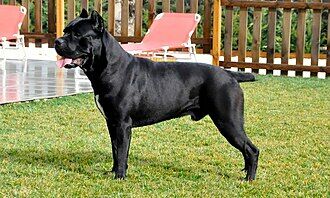
If you are attracted to the Spanish Alano because of its character as a noble and balanced prey mollusk, you may also be interested in related breeds by type, function, or history. Take a look at the Cane Corso, another moldy guard with ancient roots; the Bóxer, related through the old bullenbeisser; the energetic Bulldog, whose ancestor drank the blood of the elk; or the imposing Mastín (Mastiff), another large hound and guard dog.
Frequently asked questions about the Spanish Alano
Is the Spanish Alano a dangerous or aggressive dog?
It is not an aggressive dog by nature. It is brave, territorial and reserved with strangers, but a well-socialized and educated Spanish Alano is balanced and noble. Like any large and powerful dog, it requires a responsible owner and socialization from puppyhood.
How tall and how much does a Spanish Alano weigh?
It is a medium-sized dog. The females are around 55-60 cm at the cross and 25-34 kg; the males are somewhat larger, around 58-63 cm and 30-40 kg, according to the different references of the standard.
Can he live in a flat?
It can adapt to a floor if given plenty of daily exercise, but it is an athletic and energetic dog that performs much better in a house with terrain where it can run and stay active.
Do you get along with children and other dogs?
Well socialized, it is usually patient and protective with the children of the family, always under supervision for its size. With other dogs it tolerates coexistence better than many prey breeds, as it historically hunted in packs.
How long does a Spanish Alano live?
There is no official figure in the standard, but its life expectancy is estimated to be around 11-14 years, the usual for a healthy medium molosser.
How much exercise do you need?
It is a resilient dog that needs intense daily activity: long walks, running, play and, if possible, a dog task or sport. Without enough physical and mental exercise, it tends to become frustrated and develop destructive behaviors.
Is it recognized by the FCI?
The Spanish Alano is not recognized by the Fédération Cynologique Internationale, but it is recognized by the Royal Canine Society of Spain and Spanish legislation, which included it in 2004 among the native breeds to be conserved.
Is he a good guard dog?
Yes, it combines impressive presence, courage and a reserved character with strangers, which makes it a reliable guardian, and it is also not a barker, so it warns with discretion and not out of nervousness.