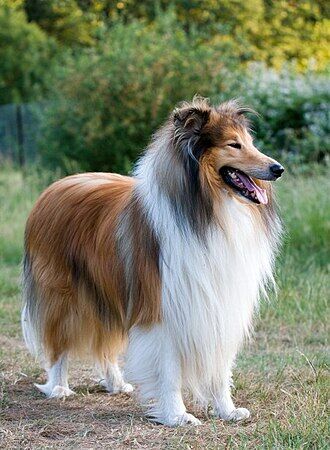
The Collie is a medium-sized Scottish Shepherd dog, elegant and deeply connected to the family, world famous thanks to the mythical Lassie. Hidden beneath its spectacular coat of long hair is a sensitive, highly intelligent and docile companion, bred for centuries to herd herds in the Scottish Highlands. If you’re looking for a faithful dog, good with children and easy to train, the Collie is one of the great classics. In this comprehensive guide we review their character, care, health and history so that you know if this breed is a good fit for you.
Is the Collie for you?
Before you fall in love with their movie image, it’s worth looking at both sides of the coin. The Collie is a wonderful dog for the right family, but its coat and sensitivity demand a real commitment. Here’s an honest summary of its strengths and what you should be clear about before you decide.
In favour .
- Sweet, loyal, and excellent with children.
- Very intelligent and one of the easiest to educate.
- Balanced and not prone to aggression.
- Good warning dog and very attentive to his people.
- Healthy by nature, with few congenital problems.
- He adapts well to an active family life.
To be taken into account
- Its double coat requires frequent brushing and it sheds a lot of hair.
- He is sensitive: he does not tolerate harsh treatment or scolding.
- He needs daily exercise and mental stimulation.
- He can bark a lot if he’s bored.
- Genetic risk of drug sensitivity (MDR1 mutation)
- He can’t stand prolonged loneliness.
Character and temperament
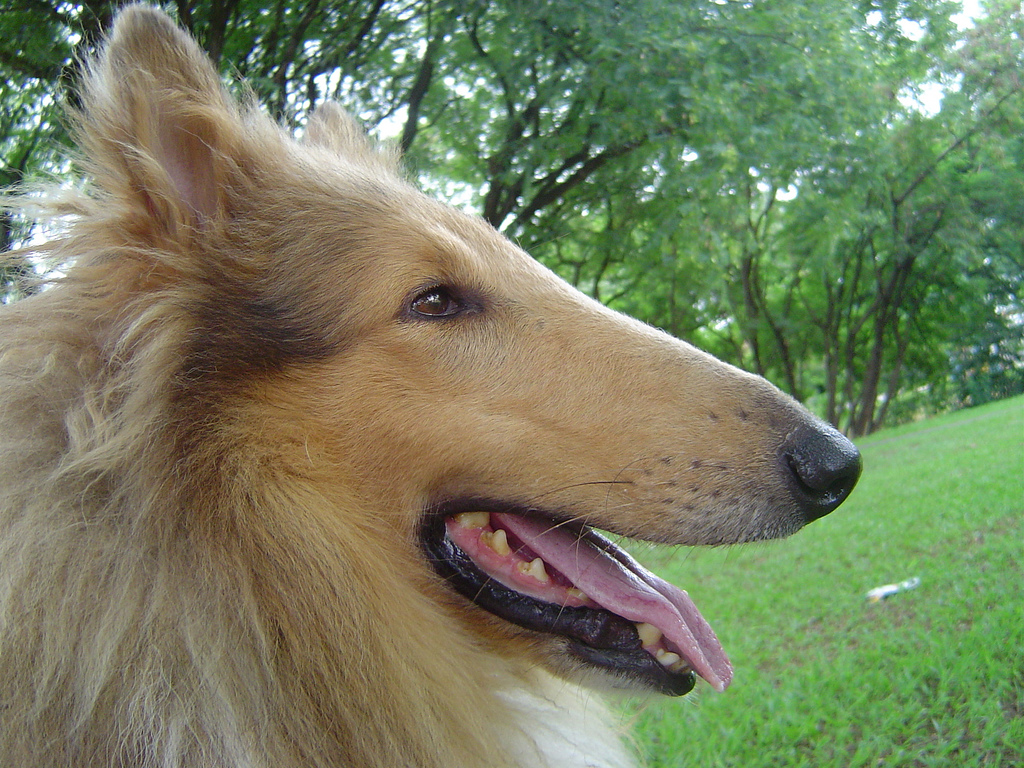
If we had to summarize the Collie in one word, it would be nobility. It is a sweet, affectionate and absolutely devoted dog to its family. It is considered one of the easiest dogs to deal with thanks to its intelligence and an innate desire to please, a direct inheritance of centuries of working side by side with the shepherd.
The Collie has a remarkable emotional sensitivity: it perceives people’s moods and responds to them. This makes it a great companion, but it also means that it needs kind treatment. Voices, harsh punishments or a tense environment affect it more than other breeds and can make it insecure or withdrawn.
He’s loyal to the end: Many individuals follow their owner around the house, “clinging” to him. With strangers it is reserved but rarely aggressive; it barks to warn and plays more the role of alarm dog than guard dog. He is neither fearful nor timid when well socialized, and when faced with real danger he does not hesitate to defend his own. It also has its character: If he is scolded, he sometimes goes away to mumble for a while, although he is not bitter.
Coexistence: children, other pets, flat and loneliness
- With children: is one of its great strengths. Patient, attentive and protective, the Collie is a natural nanny and usually tolerates very well the games and gadgets of the smallest.
- With other pets: is sociable and non-conflict-prone, cohabits smoothly with other dogs and, with a good appearance, also with cats.
- On the floor: can live on the floor as long as it receives enough daily walks and exercise. It is quiet indoors, but its tendency to bark when bored is best controlled in a neighborhood block.
- Soledad: is a very attached dog and has a problem spending long hours alone. Prolonged loneliness can lead to anxiety, barking and destructive behavior. It fits better in homes where it is not alone all day.
Education and training
Few breeds are as grateful to be educated as the Collie. Collie-type dogs rank first in the rankings of canine intelligence, and this one learns quickly, retains well and enjoys working with its person. This greatly facilitates basic obedience, home manners and tricks.
The key is in the positive reinforcement: prizes, play, friendly voice and short sessions. Given their sensitivity, harsh methods are counterproductive; with a Collie, a caress is far more effective than a shout. Early socialization – exposing a puppy to people, noises, other dogs, and a variety of environments – is essential to prevent him from developing shyness and overreactivity.
Thanks to its alert head, it is grateful to have “tasks”: olfactory games, intelligence toys, advanced obedience or canine sports.
Exercise and activity

The Collie is an active dog with good endurance, the result of its pastoral past: its ancestors were able to travel long distances guiding herds throughout the day. It is not as obsessive an athlete as the Border Collie, but needs its daily dose of movement to be healthy and calm.
With one or two good walks a day, some free running and play, he is satisfied. Where he really shines is in activities that combine body and mind: agility, obedience, sports shepherding, flyball or simply long walks in the countryside. He enjoys family outdoors and is an excellent excursion companion.
A Collie who doesn’t expend energy or stimulate his intelligence will tend to get bored, and that boredom often translates into repetitive barking or nervousness.
Care: fur and hygiene
The Collie’s great “but” is its coat. The long-haired variety has a spectacular double coat: a woolly, dense inner coat covered by a long, rough outer hair, with a striking mane on the neck, freckles on the legs and abundant hair on the tail.
- Cepillado: several times a week at least, and ideally daily during moult periods, to avoid knots and tangles, especially behind the ears, on the mane and on the rear “pants”.
- Mudas: constantly sheds hair and, twice a year, performs intense pruning. Be prepared to find hair at home and for extra brushing in those weeks.
- Baño: only when it’s really dirty; too much bathing dries your skin.
- Eyes, ears and nails: checks and cleans the eyes gently (it’s a somewhat delicate area in the breed), watches the ears and cuts the nails regularly.
The short-haired variety (Smooth Collie) is identical except for the length of the coat and is much more comfortable to maintain, although it is also mute.
Foodstuffs
The Collie is not a particularly demanding dog with food, but, like any medium-sized dog with an abundant coat, it appreciates a quality diet.
A complete and balanced feed, a quality moist diet or a natural diet well formulated by a veterinarian are valid choices. Divide the food into two portions a day and measure the quantities instead of leaving the feeding trough always full. Make sure he has fresh water available at all times. As with puppies of large breeds, it is advisable to control overgrowth and consult the veterinarian for appropriate guidelines.
Health and life expectancy

Overall, the Collie is a robust breed with few congenital problems, but has several health characteristics that every future owner should be aware of.
- Mutation of the MDR1 gene (sensitivity to drugs): is the most characteristic of the breed. A significant portion of Collies have this mutation, which reduces tolerance to certain medications (such as ivermectin and some antiparasitics, sedatives and antibiotics) and can cause severe reactions.
- Collie eye abnormality (AEC): is a hereditary disease that affects eye development and, in severe cases, can cause blindness.
- Patients who have been diagnosed with progressive retinal atrophy retinal degeneration leading to vision loss; less common than CEA and detectable by DNA testing.
- If you have been diagnosed with severe neurological disorders such as: severe genetic blood disorder; serious breeders rule out carriers by DNA testing.
- Otros: may show hip dysplasia and hypothyroidism, as in many breeds.
The best guarantee is to go to a responsible breeder who carries out the relevant genetic and eye tests, as well as keeping veterinary checks, vaccination and deworming up to date.
Physical appearance
The Collie is a medium to large-sized dog, with harmonious lines and distinguished air. The body is somewhat longer than it is tall, with an agile and elegant posture. The female measures about 56-61 cm at the cross and the females about 51-56 cm; the weight ranges from approximately 20 to 29 kg in males and slightly less in females, with variations according to the standard (the American type tends to be larger than the British).
Its most characteristic feature is the head: light in proportion to the body, in the form of a fine-tuned wedge that narrows gently from the ears to the black truffle, with a long, rounded snout. The eyes are medium, almond-shaped and of sweet and intelligent expression. The ears are semicircular, with the upper third sloping forward. The tail is long and crowded, leading low with a slight upward curve.
The coat comes in two varieties – long (Rough) and short (Smooth) hair – and in four recognized color patterns: cybelline and white(from light gold to mahogany), tricolor(black with fire marks), blue merle(grayish blue jasper) and white with colored head.
Origin and history
The Collie is native to Scotland and northern England, where for centuries it was a tireless shepherd dog. His name, of uncertain origin, may derive from an old Scottish word for “coal” (for the black-faced sheep he led) or from a term that simply meant “useful dog”. Those primitive collies were more rustic and less hairy than today’s collies, and they were able to drive large herds over long distances.
The great leap came in the 19th century. When these dogs began to be seen in English dog shows from 1860, they quickly gained popularity. Their silhouette was refined – with crosses, it is thought, that added a more stylized and “noble” head – to the elegant show dog we know. The definitive kickback came from the hand of the queen Victoria, who fell in love with the breed at Balmoral Castle and turned it into a fashion item. The British Collie Club was founded in 1881 and the American in 1886, one of the oldest breed clubs in existence.
Today the Collie is part of the Group 1 of the FCI(Shepherd and Boyer Dogs) breed. Although in its native land serious herding passed into the hands of the Border Collie, the Collie continues to triumph as a companion, exhibition and canine sport dog around the world.
Curiosities
- The character of Lassie, a long-haired Collie, brought the breed’s fame to mythical levels since 1938 in books, film and television.
- Queen Victoria was key to making the breed fashionable in the Victorian era.
- One of the smartest: collie-type dogs take the top spots in the canine intelligence rankings.
- Shepherd of ostriches: in South Africa has been used by the Collie to watch over large groups of ostriches, taking advantage of its great sense of vigilance.
- Two in one: The long-haired Collie and the short-haired Collie are, in essence, the same breed; they only change the length of the coat.
Breeds related to the Collie
If you are drawn to the world of sheepdogs and the Collie’s character, you will be interested in learning about other breeds in the same family. The Border Collie is its most industrious relative and considered the most intelligent dog in the world; the Shetland Sheepdog or Sheltie is like a Collie in reduced version; the Bearded Collie shares Scottish roots with its characteristic beard; and the Pastor Australiano is another intelligent and versatile shepherd very in vogue. And if you’re looking for a more imposing guard shepherd, check out the Pastor Alemán.
Frequently Asked Questions About the Collie
Is the Collie good with kids?
Yes, it is one of the most recommended breeds for families with children. It is patient, sweet and protective, almost a natural nanny. As always, coexistence must be supervised and the child must be taught to respect the dog.
How much hair does a Collie shed?
Its double coat continuously loosens the hair and makes two intense mouldings a year. It needs brushing several times a week (daily in mould) to keep it healthy and reduce hair at home.
How long does a Collie live?
Their life expectancy is around 12 to 14 years, with good nutrition, exercise and veterinary care.
What is the drug sensitivity (MDR1) of the Collie?
It is a common genetic mutation in the breed that reduces tolerance to certain medications, such as ivermectin and some antiparasitics or sedatives, and can cause serious reactions.
Can the Collie live in a flat?
Yes, as long as he gets enough daily walks and exercise, he’s quiet indoors, but you need to manage his tendency to bark when he’s bored and avoid leaving him alone for long hours.
Is it hard to educate?
On the contrary: it is one of the easiest dogs to train. Very intelligent and eager to please, it learns quickly with positive reinforcement. Because of its sensitivity, you must avoid harsh methods, which affect it more than other breeds.
What’s the difference between a long-haired collie and a short-haired collie?
They are practically the same breed; they differ only in the length of the coat. The long-haired (Rough) bears Lassie’s spectacular coat and mane; the short-haired (Smooth) is identical in everything else and more comfortable to maintain.
Is the Collie a good guard dog?
It works better as an alarm dog than a guard dog. It is attentive and warns with barking of what is happening, but its character is noble and unaggressive, so it is not a deterrent guard to use.