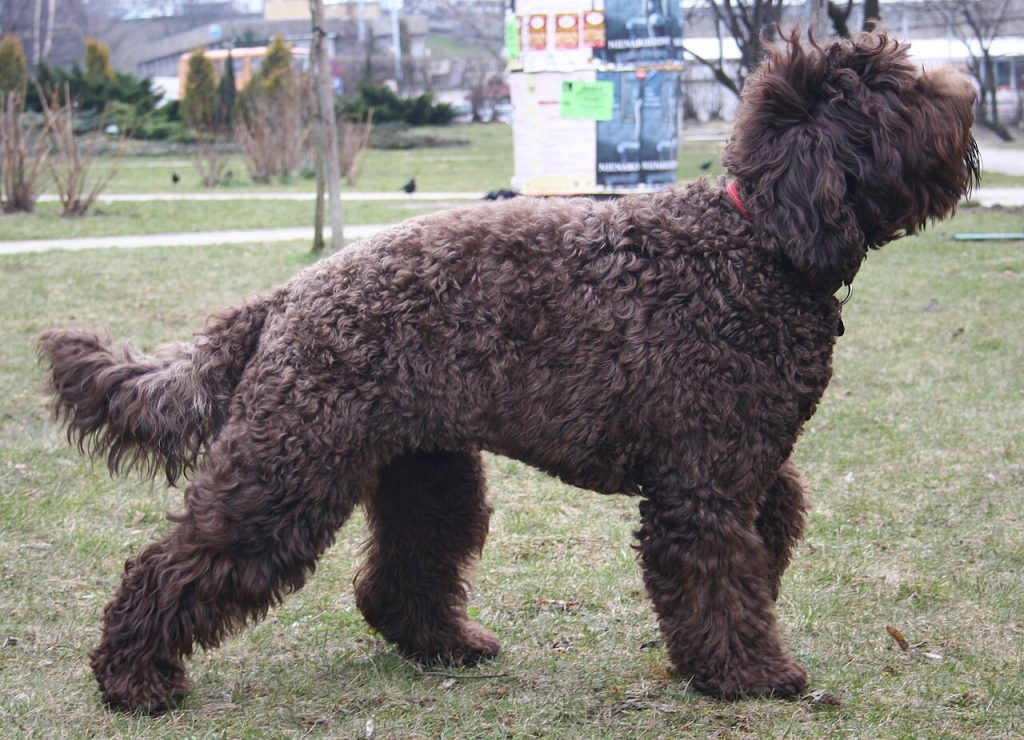
The Barbet is a medium-sized French water dog, unmistakable by its dense woolly, curly coat that covers it from head to toe. Behind that unkempt plush appearance lurks a tenacious waterfowl collector, a passionate swimmer, and a loving, cheerful, intelligent family companion. It is a rare breed, with very few specimens even in France, but it falls in love with those who are looking for a versatile, sociable and deeply attached dog.
Is the Barbet for you?
The Barbet is a dog with a balanced personality that works very well as an active family animal, but it is not for everyone. Its coat requires a constant maintenance routine and its origin as a working dog gives it a need for exercise and companionship that should be clear before deciding.
In favour .
- Kind, cheerful character and very sociable with the family.
- Intelligent and obedient: learns quickly and enjoys collaborating.
- It has very little hair, interesting for homes sensitive to hair.
- Great with kids, seniors and other pets.
- Passionate about water and outdoor activities.
- Good longevity and relatively healthy breed.
To be taken into account
- Demanding coat: frequent brushing and mandatory periodic trimming.
- He needs real daily exercise, short walks aren’t enough.
- He’s very attached. Long-term loneliness is bad for him.
- Rare breed: puppies hard to find and on a waiting list.
- Long, hairy ears call for vigilance to prevent otitis.
- Genetic variety limited by the small population.
Character and temperament

If you had to describe the Barbet in three words it would be friendly, obedient and intelligent. It is a companion dog in the best sense: it seeks to be with its people, participates in family life and shows a cheerful and good-natured temperament that rarely leads to aggression.
It is a sensitive and attentive dog, which reads well the mood of its family and adapts to it. That sensitivity makes it easy to treat, but it also means it doesn’t respond well to harsh methods: The Barbet is motivated by positive reinforcement, play and connection with his guide. With strangers he is usually reserved at first and open afterward, without the marked distrust of a guard dog; he is not, nor does he pretend to be, a defense dog.
It is not uncommon to see a Barbet puppy jumping into a puddle or trying to retrieve any object it throws. Channeling that mental and physical energy is the key to having a balanced and happy adult.
Coexistence: children, other pets, flat and loneliness
The Barbet is noted for its sociability. It is very friendly with children, families and the elderly, and usually integrates seamlessly into homes with other dogs and even cats if properly introduced.
In terms of space, it is suitable for both a house with a garden and a flat, provided that its exercise needs are met. Inside the house it is quiet and discreet; the problem is not the size of the house, but the time spent alone. Because of their strong attachment, the Barbet is unable to cope with prolonged loneliness and may develop separation anxiety or destructive behavior if left for many hours without companionship or encouragement. It’s a dog designed to live very close to its people, not to live isolated in a yard.
Education and training
Training a Barbet is usually a rewarding experience. It is a quick to learn dog and eager to please, a combination that makes the job much easier. However, it needs education: its intelligence and energy ask for clear direction so as not to end up making decisions on its own.
Early socialization is essential. Exposing the puppy to people, other dogs, different environments and noises during its first months builds a confident and balanced adult. From there, positive reinforcement is the way: rewards, play and praise work much better than harsh correction, which only manages to block such a sensitive dog.
The Barbet shines especially in disciplines that combine body and head. In France it can present itself to tests such as the test of natural abilities(TAN), a basic charging test in water, and participates in hunting and field tests. Outside of game work, it excels in agility, obedience, search and rescue and as a therapy dog.
Exercise and activity
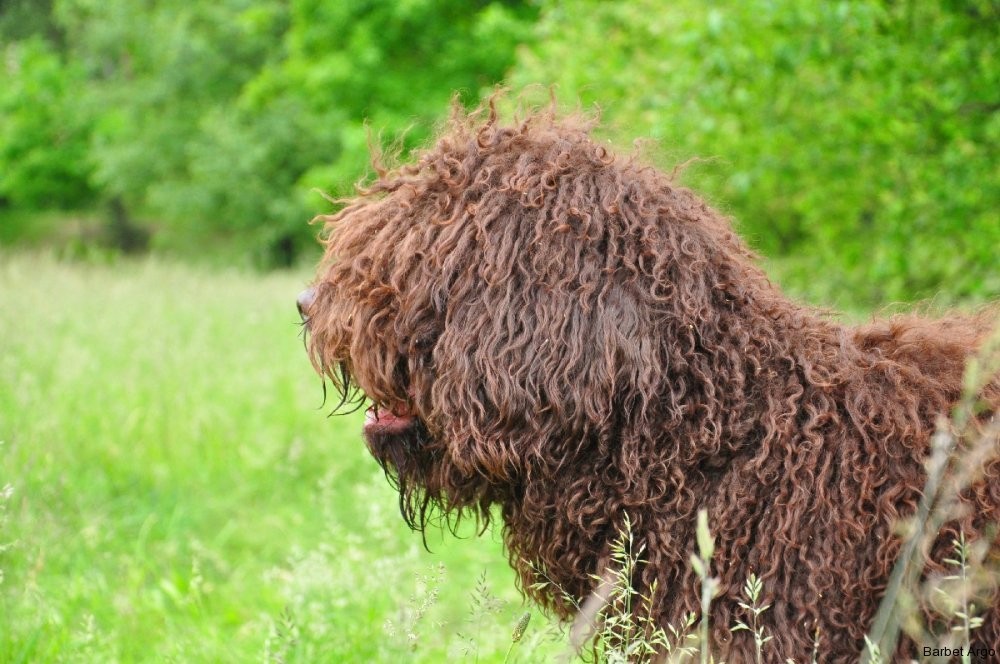
The Barbet is a working dog with medium to high exercise needs. It comes from a lineage of collectors accustomed to long days in marshes and swampy areas, and that resistance is still there.
Ideally, you should offer a variety of daily activities: long walks, controlled races, cash games and, whenever possible, swimming, his favorite activity. Water allows you to expend a lot of energy with little impact on your joints, which is especially helpful. To that physical exercise must be added mental stimulation: Smell games, interactive toys and little training sessions to keep your mind occupied.
A Barbet who receives enough exercise and attention is a balanced and calm dog at home. One who is bored, however, may become restless, barking or destructive. Activity is not a luxury in this breed: it is a necessity.
Care: fur and hygiene
The coat is the Barbet’s mark of identity and, at the same time, its greatest demand for care. It is a long, woolly and curly growing continuously coat, like that of the Poodle, and which hardly comes off.
To avoid this, brush it thoroughly must be applied several times a week, reaching the skin and not just the surface, and trim it periodically. Many owners resort to dog grooming every few weeks to keep the coat to a manageable length, especially in delicate areas such as the face, ears, legs and genital area. After each bath or river bath, dry your hair thoroughly so that moisture does not get trapped.
The ears are long, fallen and very hairy, they retain moisture and promote infections; it is advisable to check and clean them regularly, and monitor the hair that grows inside the duct.
Foodstuffs
The Barbet does not have particularly complicated dietary needs, but it is advisable to adjust its diet to a medium, active and long-lived dog. A complete and quality diet, divided into two daily doses and adapted to its age, weight and activity level, is the best basis for keeping it in shape.
The quantity should be monitored: Under all that hair, it’s easy for excess weight to go unnoticed, and excess weight punishes the joints and promotes problems like hip dysplasia. Ideally, feel your ribs regularly to check your body condition and adjust your rations according to your actual exercise. Always fresh and available water is essential, especially for such an active dog. If you have any doubts about your diet, it is best to consult your veterinarian.
Health and life expectancy
The Barbet is considered a relatively healthy breed, with a life expectancy of around 13 to 15 years, a very good figure for a dog of its size.
Among the conditions described are hypoplasia of the hip, epilepsy and, as in most dogs with long, drooping ears, an increased predisposition to ear infections. A particular issue of the breed is its limited genetic variety: Due to the small population, studies have found high inbreeding coefficients (around 9-12% according to the study), higher than in other French breeds. That is why it is so important to choose responsible breeders who test the health of the breeders and take care of genetic diversity.
Physical appearance

The Barbet is a dog of medium size and solid construction, with a rustic and harmonious appearance. The males measure approximately between 58 and 65 cm to the cross and the females slightly less, around 53-61 cm, with a weight that is usually between 14 and 28 kg depending on sex and line.
The head is broad and covered with long hair that forms a characteristic beard– hence its name, from the French bearded– and a lock that falls over the eyes. The ears are long, sloping and very crowded. The tail, low-inserted, usually carries a light hook at the tip. But what defines the Barbet is its woolly coat, long and curly, which covers it from head to toe. Colors accepted by the FCI include black, brown, maroon in their various shades and gray, sometimes with some white markings; there are rarer variants such as cream or pinto.
Origin and history
The Barbet is one of the oldest water dog breeds in France, although the breed as we know it today is a relatively recent recovery.
Its historical function was that of collector of waterfowl: It was the dog of hunters of ducks, geese and other birds in the marshes, wetlands, estuaries and coastal areas of France. This dirty, wet work gave rise to the French expression “I moved like a barbet”(“wet as a barbet”), very popular in the 19th century. Between the end of the 18th century and the beginning of the 19th century, this same type of dog was known as the barbet in France, barbon in Italy and Pudel in Germany; in fact, for about a century the Barbet and the Caniche were considered the same breed.
Like so many other breeds, the Barbet was close to extinct after World War II. In the 1970s, French breeders began their recovery; between 1975 and 2001 only 307 specimens were recorded in France. The crossing with the Caniche Grande and other breeds helped expand the population and explains why the modern Barbet is somewhat taller than the historical one. Today it is classified by the FCI and the Société Centrale Canine in the Grupo 8(hunting collection dogs, hunting hoisting dogs and water dogs). It arrived in the United States in 1994 and was recognized by the American Kennel Club in 2020, while the British Kennel Club recognized it in 2018.
Curiosities
- A war hero. Moustache (1799-1812) was a Barbet who, according to tradition, participated in the French Revolutionary and Napoleonic Wars and gained fame as a soldier dog.
- Médor, a famous Parisian Barbet, refused to leave the grave of his owner, who had fallen during the July Revolution of 1830, and became an icon of loyalty.
- Relative of the Poodle. For almost a hundred years, Barbet and Poodle were considered the same dog; the Poodle is largely descended from this type of water dog.
- “Wet as a barbet”. His eagerness to get into the water left a mark on the French language with an expression that is still alive.
- A national treasure. In France it is considered a heritage breed, an authentic canine treasure that is being worked to preserve.
If you are attracted to the Barbet for its blend of intelligence, sociability and love of water, you may want to meet other breeds with a similar profile. The Caniche (Poodle) is its closest relative and shares its curly hair and intelligence; the Labrador Retriever and the Golden Retriever are equally sociable and familiar water collectors; and the Cocker Spaniel shares its origin as a versatile and cheerful hunting dog.
Frequently asked questions about Barbet
Is the Barbet a rare dog or hard to find?
The Barbet is a small breed even in France, its country of origin. It was on the brink of extinction after World War II and only recovered thanks to the work of French breeders starting in the 1970s. Today there are still few litters a year, so getting a puppy usually involves waiting lists and going to specialized breeders.
Does the Barbet shed a lot of hair?
It is a very rare breed: its woolly, curly hair tends to get entangled in its own coat rather than falling to the ground, which makes it attractive for homes sensitive to hair, but it does not mean that it does not work: precisely because it does not come off, it must be thoroughly brushed and trimmed regularly to prevent it from getting wet.
Is Barbet good with kids?
Yes. It is a dog described as kind, cheerful and patient, which usually coexists very well with children, families and older people. As with any dog, it is advisable to teach children to respect their rest times and supervise the games with the youngest.
How much exercise does a Barbet need?
It is a working dog of hunter-gatherer origin that is not satisfied with a couple of short walks. It needs daily quality activity: long walks, play, swimming when possible and, above all, mental stimulation. A bored Barbet can develop undesirable behaviors.
Does Barbet like water?
It is a water dog by history and by instinct: many specimens jump to swim as soon as they have the opportunity and enjoy collecting objects from the water. This passion for swimming is one of its hallmarks and a great way to spend energy.
How long does a Barbet live?
Its life expectancy is around 13 to 15 years, a very good figure for a dog of its size.It is a relatively healthy breed, although because it is so few in number there are fewer specific data and it is advisable to choose breeders who monitor the health of the breeders.
Can the Barbet be on one floor?
Yes, as long as it meets its need for exercise and companionship. It’s quiet indoors and very attached to its family, so it adapts to a flat if it goes out enough and doesn’t spend too many hours alone. What’s worse is not space, but loneliness and lack of activity.
Are the Barbet and the Poodle the same breed?
No, although they are very closely related. For about a century the Barbet and the Caniche came to be considered the same type of dog, and in the modern recovery of the breed the Caniche Grande was used to expand the population. That is why the current Barbet is somewhat taller than the historical one and shares with the Caniche its intelligence and curly hair.