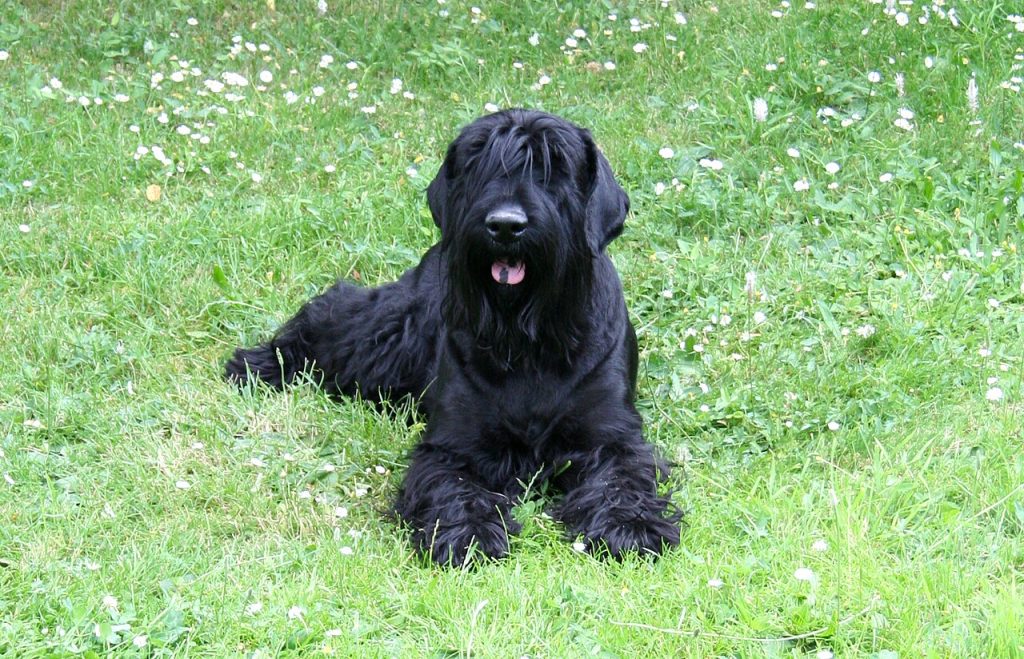
The Terrier Ruso Negro is a black-haired, serious-looking giant, born in Red Army barracks to watch and work in any weather. Despite its name, it’s not a burrow terrier: It’s a huge, well-balanced guard dog and surprisingly affectionate with its family, which needs a steady hand, plenty of exercise and an owner willing to take its upbringing seriously. If you’re looking for a loyal companion with an imposing presence and no fear of brushing or training, the Black Russian Terrier has few rivals.
Is the Black Russian Terrier for you?
The Black Russian Terrier is a giant guard dog with a strong protective instinct and enormous work capacity. It is not a breed for beginners or those who spend many hours outside the home: it needs commitment, space and direction. Before you fall in love with its image, honestly review what it means to live with it.
In favour .
- Exceptional guardian: watch over his family and his territory with equanimity.
- Very attached to his family, loyal and affectionate at home.
- Intelligent and hardworking: brilliant in obedience, agility and defensive sports.
- She’s a little hairy for her size.
- Balanced and self-assured when well socialized.
To be taken into account
- Considerable size and strength: up to 60 kg of muscle.
- He needs early, firm, consistent training.
- Suspicious of strangers if he doesn’t socialize well.
- Coat that requires brushing several times a week and trimming.
- He doesn’t take well to loneliness or canine residences; he ties himself to a family.
Character and temperament

The Black Russian Terrier combines two seemingly contradictory traits in one dog: The toughness of a service dog and the tenderness of a family friend. He was raised by the Soviet state to work, so he has a formidable work ethic and needs to feel useful to be happy. A Black Russian Terrier without enough task or stimulation can become restless, destructive, or overly vigilant.
With its family it is stable, confident and deeply loyal. It tends to cling intensely to its group, and many specimens choose a reference person. That same confidence makes it a natural guardian: it observes, evaluates and reacts, but a good specimen is not nervous or aggressive without reason. The key is a courageous and serene character, not impulsive.
With strangers it is reserved and attentive. It is not an effusive dog with anyone, and that is precisely why early socialization is non-negotiable: it marks the difference between a balanced guard dog and a suspicious dog. Well-behaved, it distinguishes perfectly between a normal visit and a real threat.
Coexistence: children, other pets, flat and loneliness
In the home, the Black Russian Terrier is usually calm and very attached to its people. With the children of the family it is protective and patient, although its size and strength force it to always supervise the game with the smallest: a push without bad intention can pull a child. It is advisable to teach minors to respect the dog and not to disturb him when he rests.
With other pets, coexistence is good if he grows up with them and socializes from puppyhood. His guarding instinct can make him territorial with unfamiliar dogs of the same sex, so introductions should be done calmly and on neutral ground.
Can he live in a flat? Maybe, but it’s not ideal. It is a large dog that appreciates space and, above all, long walks and daily activity. A house with a walled garden is wonderful, as long as you don’t leave it isolated in the yard: This dog wants to be with his family, indoors. What’s worse is prolonged loneliness. Being so attached to your own has a B-side: suffers if he spends too many hours alone or if he is left in a nursing home. It’s not the breed for someone who travels constantly without their dog.
Education and training
Here is one of the great strengths of the breed and, at the same time, one of its demands. The Black Russian Terrier is very intelligent and learns quickly, but also has its own criteria and a size that does not forgive management mistakes. It needs a calm, firm and consistent leader, who sets clear rules from the first day without resorting to harshness.
Positive training, based on persistence and rewards, works very well with this very work-oriented breed. It responds wonderfully to short, motivating sessions, and excels in obedience, where it often outperforms dogs with a more “easy” reputation. Socialization – with people, dogs, noises, and diverse environments – should begin as soon as you get home and continue throughout your life.
It’s a dog to channel: canine sports such as agility, obedience or defense work (Schutzhund/IGP) give it the mental and physical output its service dog head demands.
Exercise and activity

The adult Black Russian Terrier has a medium-high energy: it is not a hyperactive dog, but it does need serious daily exercise to be well. Long walks, play, olfactory work and training sessions cover both its body and mind. Combining physical wear and tear with mental is the best recipe for a quiet dog at home.
Keep an eye on the puppy: It grows very quickly — it can gain about a pound a week — so you shouldn’t force it to do strenuous exercise while its joints are forming. Repeated jumping, long runs, or excessive stairs can damage developing hips and elbows. As a puppy, it sleeps a lot; as an adult, once mature, its energy level drops considerably and it is content to be near its owner after a good walk.
Care: fur and hygiene

The coat of the Black Russian Terrier is double: a rough and hard covering hair on a softer and denser inner layer. It is a coat that should never be woolly, silky or curly in excess, and which is cut to keep it between 5 and 15 cm long. It forms the characteristic beard and eyebrows on the face, in addition to a slight mane on the cross and neck, more marked in males.
Well, the good news is, it doesn’t shed much hair. The downside is that it requires maintenance: brush thoroughly several times a week to avoid knots – especially on the beard, underarms and behind the ears – and periodic cuts. Exhibition specimens shall be arranged at least every three weeks. The beard, which gets wet and dirty from eating and drinking, should be cleaned often to prevent infection. Check and dry your ears well, as moisture promotes problems in that area, and keep your nails and teeth up to date.
Foodstuffs
Being a giant dog, the Black Russian Terrier needs a quality diet well suited to its size, age and activity level. The puppy stage is especially delicate: Because it grows so fast and weighs so much, an unbalanced diet can promote bone development problems. Therefore, it is advisable to use a specific feed for large/gigantic breeds in growth and, above all, not to overfeed them so that they do not get fat or grow too fast.
In large and deep-chested dogs, precautions should be taken against gastric dilation-torsion: Split food into two servings, avoid strenuous exercise just before and after eating, and don’t allow me to eat with anxiety. Maintain a healthy weight throughout your life – excess weight hurts your joints – and always have fresh water available. If you have any doubts about the quantity or type of diet, it is best to consult your veterinarian.
Health and life expectancy
The Black Russian Terrier is, in general, a robust dog, but like any large breed has a predisposition to certain hereditary problems. Its life expectancy is around 10 to 12 years; a British study from 2024 placed the average of the breed at around 11 years, somewhat below the average of purebred dogs, as is usual in giants.
Among the conditions to be monitored are hip and elbow dysplasia, hyperuricuria(predisposition to urinary stones) and juvenile laryngeal paralysis with polyneuropathy. Bone development disorders in rapidly growing puppies (hypertrophic osteodystrophy and panosteitis), heart problems (aortic stenosis, mitral valve dysplasia, cardiomyopathy), eye changes (ectropion, entropy, conjunctivitis) and allergies are also described less frequently. The beard and ear area is prone to fungal infections if kept moist.
The best prevention is to go to responsible breeders who perform health tests on the breeders (hip, elbows, heart, eyes and genetic tests), keep veterinary reviews and vaccination up to date, take care of beard and ear hygiene and monitor weight.
Physical appearance
The Black Russian Terrier is a large, strong, robust-boned dog with a slightly longer silhouette than he is tall and a demeanor that commands respect. According to the FCI standard, males measure between 72 and 76 cm at the withers (not exceeding 78) and females between 68 and 72 cm (up to 74). The weight accompanies that wingspan: about 50 to 60 kg in males and 45 to 50 kg in females, always in proportion and musculature, not fat.
The head is massive and rectangular, topped by the unmistakable beard and crowded eyebrows that give it that veteran, thoughtful dog air. The body is compact and powerful, the chest broad and the tail traditionally worn short, although increasingly it is kept natural according to the legislation of each country. The coat is black or black with some scattered gray hair, always dense and hard-looking. As a whole, it conveys the exact idea of what it was created for: A hardy working dog, athletic and able to move about freely despite its size.
Origin and history
The history of the Black Russian Terrier is one of the most unique in the canine world. It was developed in the former Soviet Union in the late 1940s and during the 1950s at the state breeding farm Estrella Roja(Krasnaya Zvezda), in Moscow, with a very specific goal: to create a working and military service dog capable of withstanding the harshest Russian climate and performing guard, patrol and defense duties for the Red Army.
To accomplish this, Soviet kennels crossed a remarkable variety of breeds – some seventeen are listed – including the Giant Schnauzer (its major influence), the Airedale Terrier, the Rottweiler, the Newfoundland, the Caucasus Shepherd, and the South Russian Shepherd. Many of the breeders came from countries that the Red Army had passed through during World War II, especially East Germany. Hence his popular nickname, “Stalin’s dog”.
At first it was selected only for its ability to work, without regard to appearance, and the first specimens only resembled the current one in its structure and type of coat. The breed was bred exclusively by the State until 1957, when puppies began to be sold to private breeders, who were already looking for a more homogeneous and attractive image. The first standard was published in 1958; the FCI officially recognized the breed in 1984 (it falls into Group 2) and the American Kennel Club did so in 2004. It has since spread across Europe, North America and Australia, although it remains a relatively uncommon breed outside of its amateur circles.
Curiosities
- It’s not a real terrier. Despite its name, it has nothing to do with burrowing terriers: by type and origin it is much closer to the Giant Schnauzer.
- The “dog of Stalin”. So it is popularly known for having been born from the breeding program of the Soviet state in the middle of the Stalinist era.
- Designed to order. is one of the few modern breeds deliberately “tailor-made” by a state, combining many breeds to obtain a particular service dog.
- Young by canine standards. barely has a few decades of history, versus races centuries old.
- Resistant to extreme cold. Its double coat was designed to withstand harsh Russian winters.
If you are attracted to the Black Russian Terrier because of its loyal guarding character and imposing build, you may also be interested in other large, protective breeds. Take a look at the Rottweiler and Dóberman, two classics of guarding and defense; the powerful Cane Corso; or the Terranova, one of the breeds that intervened in its creation and a good-hearted giant.
Frequently Asked Questions About the Black Russian Terrier
Is the Black Russian Terrier a good family dog?
Yes, with its family it is loyal, stable and very affectionate, and is usually protective with the children of the house. However, due to its size and strength it is convenient to supervise the game with the little ones and devote time to education and socialization.
How tall and how much does a Black Russian Terrier weigh?
The males measure between 72 and 76 cm at the withers and weigh about 50 to 60 kg; the females, between 68 and 72 cm and about 45 to 50 kg.
Do you lose a lot of hair?
Instead, its double coat needs thorough brushing several times a week and periodic trimming to avoid knots, especially on the beard and behind the ears.
Is he an easy dog to train?
It is very intelligent and hardworking, and learns quickly with firm, consistent and positive training. It excels in obedience and defensive sports. It is not difficult because of clumsiness, but because its size and character require an owner with experience and constancy.
Why is it called “Stalin’s dog”?
Because the breed was bred at the Red Star State Farm in the Soviet Union during the Stalin era, for military and guard purposes.
How long does a Black Russian Terrier live?
Their life expectancy is about 10 to 12 years, which is typical of giant breeds, and with responsible breeders who do health checks and good care, they can enjoy a long, active life.
Do you need a lot of exercise?
It has a medium-high energy and needs serious daily exercise: long walks, play, olfactory work and training.
Is that really a terrier?
No. Despite its name, it is not a burrow terrier. By type, structure and origin it is much closer to the Giant Schnauzer, which was its main founding breed.