The Boyer of the Ardennes(Manufacture in which the value of all the materials used does not exceed 30% of the ex-works price of the product) is one of the rarest and most fascinating boyer dogs in Europe: A rustic, strong, unkempt-looking Belgian worker who almost disappeared forever. Forged in the harsh climate of the Ardennes for driving and keeping cattle, today it is a rarity that we only recommend to those looking for an active, loyal and characterful companion. In this guide we go through in depth what the Boyero of the Ardennes is like: temperament, coexistence, education, care, health and his amazing story of resurrection.
Is the Boyero of the Ardennes for you?
Before you fall in love with its hairless bear form, be honest: the Ardennes Boyer is not a dog for everyone. It is a real working boyer, with instinct, energy and temperament, and moreover a breed so rare that getting a copy is already a challenge. It fits wonderfully with active and rural families, much less with those who are looking for a quiet couch dog.
In favour .
- Loyal and very close to his family.
- A natural guardian, thoughtful and brave.
- Rustic and resistant: it withstands cold, rain and hard work.
- Smart and versatile for herding and field work.
- Low-maintenance coat, no major hair demands.
To be taken into account
- He needs a lot of exercise and mental work every day.
- Independent character: not a dog for beginners.
- Guard and driving instincts that need to be channeled.
- Very rare breed: few breeders and reduced genetic base.
- Not fit for a sedentary life or to be left alone for long hours.
Character and temperament
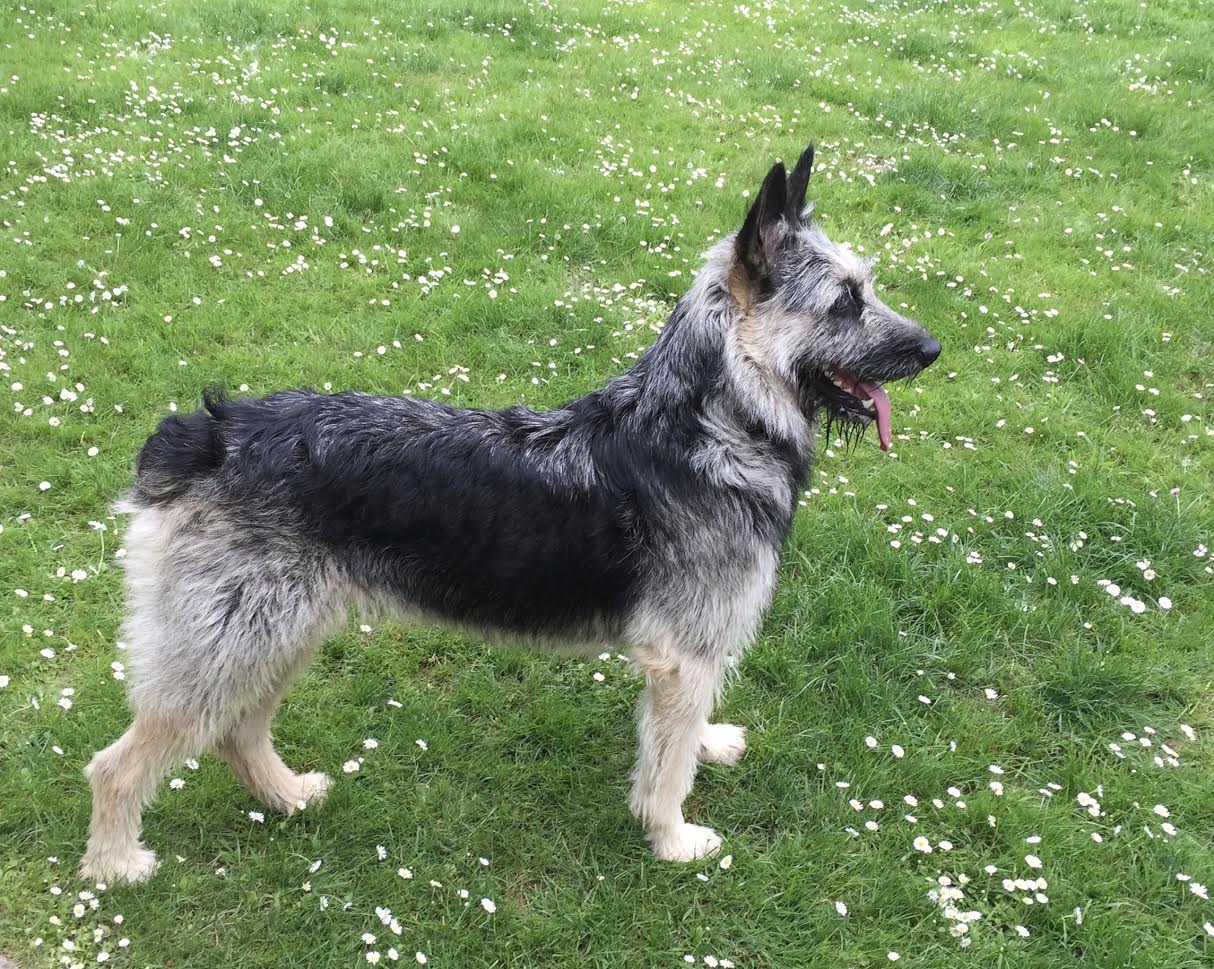
The Ardennes Boyero is, above all, a working dog with a farmer’s soul. For generations, only the toughest, most alert and hardworking individuals were selected, capable of driving cows, sheep, pigs and horses through unforgiving terrain.
With his family he is affectionate, loyal and deeply connected. He likes to participate in everything his own do and does not like to stay on the sidelines. In front of strangers he is reserved and vigilant: he is not a free aggressive, but also not a dog “of everyone”. This healthy distrust, combined with his territorial instinct, makes him an excellent guard who warns of any novelty.
It is important to understand that behind its endearing appearance there is a dog with its own criteria. It does not obey just to obey: it needs a relationship of trust and a guide who earns its respect. It is well-oriented, balanced, stable and a tireless companion; mismanaged, its energy and stubbornness can give problems.
Coexistence: children, other pets, flat and loneliness
Within his family, the Ardennes Boyero is usually an affable dog who tends to watch over children as if they were part of his “herd”. Cohabitation with small children works well when there is mutual respect and supervision: It is a robust and enthusiastic dog, and children should be taught to treat it calmly. His driving instinct may cause him to try to “group” the runners, something that is done with courtesy.
With other dogs and domestic animals the key is early socialization. Raised as a puppy with cats or cattle, it accepts them without problem; however, with unfamiliar dogs it can be dominant, and very small animals awaken its instinct. Gradual introductions and puppy work make the difference.
It is not a floor dog. It tolerates indoor living if it exercises excessively, but its ideal place is a house with terrain, preferably in the countryside, where it can patrol and expend energy. And, as a good dog with a strong bond, it does not tolerate prolonged solitude well: if you leave it alone for many hours a day, barking, wrecking and anxiety will appear.
Education and training
The Ardennes Boyer is intelligent and quick to learn, but its independence forces it to work on education with a head. It responds wonderfully to positive reinforcement, short and varied sessions and consistency; instead, harsh methods or authoritarianism block it and deteriorate confidence.
Early socialization is non-negotiable: the more the puppy is exposed to people, dogs, noises and different environments, the more balanced he will be as an adult.
As a boyer, it shines in any activity that combines body and mind: shepherding, obedience, agility, mantrailing or farm work.
Exercise and activity
This breed was born to move from sun to sun, so it requires a high level of exercise. It is not satisfied with a couple of short walks: it needs long outings, opportunities to run, intense play and, if possible, some task or dog sport that gives it purpose.
Calculate at least one or two hours a day of quality activity, spread out and combining the physical with the mental. Smell games, food puzzles and training are as important as pure exercise, because a bored working dog seeks its own amusement, almost always at the expense of your garden or your furniture.
Because of its resistance and protective coat, it enjoys the outdoors in any season: cold and rain do not hold it back.
Care: fur and hygiene

Good news for busy owners: The Ardenne Boyer’s cloak is low maintenance. His rough, hard, medium-length hair, with that characteristic beard and eyebrows, is meant to protect him from the weather, not to look like a wig. A weekly thorough brushing is enough to remove dead hair and avoid tangles; in moulting seasons it is advisable to increase the frequency.
It does not need scissors or constant exposure cuts; in fact, in the ring it appears in a natural state. Bath it only when it is really dirty, with adequate shampoo, so as not to spoil the protective layer of the mantle.
As with any dog, he completes his hygiene by checking and cleaning his ears, watching his eyes, cutting his nails when necessary, and taking care of dental hygiene with regular brushing.
Foodstuffs
The Ardennes Boyero needs a complete and balanced diet, adjusted to its average size and, above all, to its activity level.
It serves both a good quality feed and a diet supervised by a veterinarian, always with enough protein to maintain its musculature.It is advisable to divide the food into two servings a day and control the weight regularly: obesity overloads the joints of an active dog like this.
Always have fresh water available, especially after exercise, and adjust rations throughout your life according to your age, activity, and physical condition.
Health and life expectancy
The Ardennes Boyero’s big health issue is not a specific disease, but his your genetic history. By rebuilding the breed from very few individuals after near extinction, it carries a high degree of consanguinity and reduced genetic diversity. This generally raises the risk of hereditary problems, so the choice of breeder is decisive: They must monitor mating, breeding health and work to expand the genetic base.
As with any dog of medium size and active life, it is advisable to monitor the joints preventively, keep the weight at bay and follow the timetable of vaccinations and deworming.
For its average size and its profile as a rustic working dog, the expectation is around 10-12 years, always with caution that we are talking about a breed with little genetic basis and few data.
Physical appearance
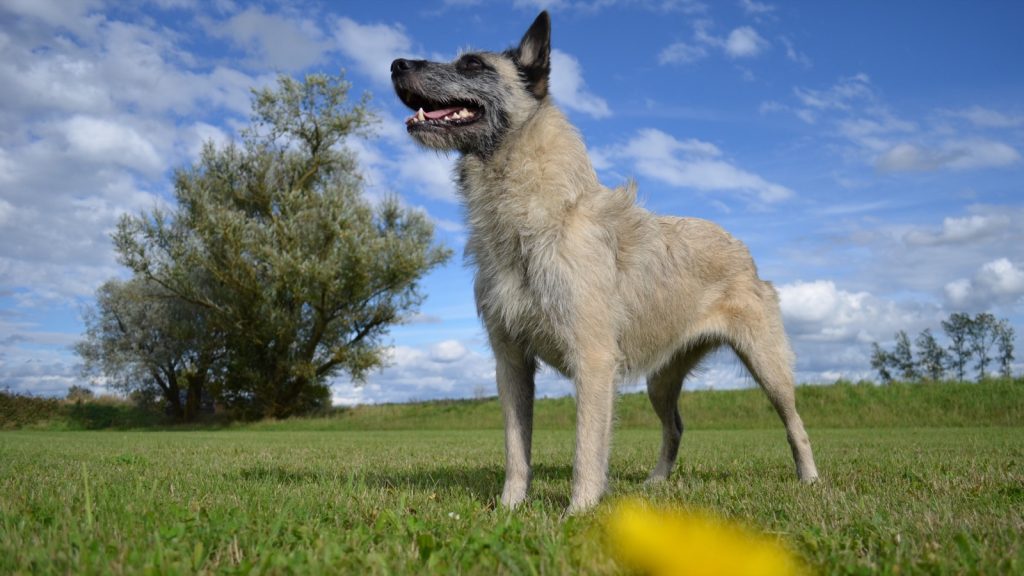
The Ardennes Boyero is a medium-sized dog that prioritizes function and strength over elegance. Short, compact and well-muscled, it has a heavier skeleton than its size suggests and a powerful head topped by a moustache and beard that give it that unmistakable formidable look.
- Altura: males 55 to 63 cm at the withers; females 51 to 57 cm.
- Peso: males 28 to 35 kg; females 22 to 28 kg.
- Pelaje: rough, hard and medium-length, with marked beard and eyebrows.
- Color: almost any except pure white; typically tarred or grey/spotted.
- Cola: can be born naturally short or long; traditionally it was amputated.
- Orejas: small and erect; do not cut.
Its watchful gaze and robust demeanor convey exactly what it is: a safe, agile and built for work field dog. The breed is judged in its natural state, without the guide placing or touching it, just to appreciate that functional authenticity.
Origin and history

The Ardennes Boyer comes from the mountainous region of the Belgian Ardennes, in Wallonia, bordering France and Germany. Already in the 19th century there were boyeros bred in the area to withstand harsh weather, demanding work and difficult terrain; only the toughest and hardest breed were bred. In the past, each dog that handled cattle was called a “bouvier”, and each region had its own variety.
Toward the end of the 19th century, these dogs resembled shepherds, but they were larger, stronger, and more combative. Belgian dog shows created classes for boyer dogs in order to fix their type, and in 1923 a breed standard was published. The Ardennes Boyero as such is considered to have consolidated from 1910 onwards, with crosses of Flanders Boyero, Belgian Malinois and possibly Briard, looking for an intermediate-sized dog.
In addition to driving and guarding livestock, these dogs pulled small carts – like those of milkmen – and were used as poachers, especially during world wars. But the motorization of the countryside and the decline of farms and dairy herds in the Ardennes drastically reduced the need for these boyars. Several related varieties – such as the Bouvier de Roulers, the Moerman or the Paret – were lost forever.
The Ardennes Boyer was thought to be extinct until a small population was discovered in 1985. From there, some breeders took the original standard as a guide to reintroducing the breed, a slow recovery that in Wallonia has also been experienced as a symbol of identity. That resurrection from a handful of dogs explains both their current rarity and their delicate genetic situation.
Curiosities
- It was officially listed as extinct until in 1985 a few survivors were located that saved the breed.
- The word “bouvier” literally means bowery, that is, dog that works with cattle.
- Any color minus the pure white is supported: one of the few hard-and-fast rules of its standard.
- It can be born with natural short tail or with a long tail, something unusual among breeds.
- In the exhibitions in natural season is presented, without the guide placing it, to assess its authenticity.
- Its recovery is tied to the walloon regional pride, which has made it almost an emblem.
If you are attracted to this rustic and hardworking boyer, you may be interested in other grazing and guarding breeds with a similar profile. Check out the Pastor Alemán, the agile Border Collie, the versatile Pastor Australiano, or the small boyer Welsh Corgi Pembroke, another expert cattle driver.
Frequently asked questions about the Ardennes Boyero
Is the Boyer of the Ardennes a strange dog?
Yes, it is one of the rarest dog breeds in Europe. It was on the brink of extinction during the 20th century and survives only thanks to a handful of specimens rediscovered in 1985. Outside Belgium and some parts of France it is almost impossible to find, and getting a puppy usually involves waiting lists and direct contact with Walloon breeders.
Is the Ardennes Boyero a good family dog?
It can be in the right home. It is a very attached dog to its family, attentive and protective, enjoying being with its own. However, it is a rustic working boyar, with energy and character: it needs active owners, with time for exercise and education, does not fit into a sedentary life or in inexperienced hands.
How tall and how much does an Ardenne Boyero weigh?
Males measure between 55 and 63 cm at the withers and weigh 28 to 35 kg; females measure 51 to 57 cm and weigh 22 to 28 kg.
What color is the Boyero of the Ardennes?
Almost any colour is acceptable except pure white. The most common are the brindle and grey or spotted layers (pepper and salt), also lilac and dark. The rough hair, beard and eyebrows give it that characteristic rough air.
Does the Boyero of the Ardennes need a lot of exercise?
Yes. It is a dog bred to work all day in rough terrain, so it demands a lot of daily activity: long walks, running, play and, above all, mental work. Without sufficient physical and mental expenditure it can become restless, barking or destructive.
Does the Boyero of the Ardennes have health problems?
There is no official catalogue of the breed’s diseases, but its greatest risk is genetic: by reconstructing itself from very few specimens, it carries a high degree of consanguinity and a reduced genetic diversity.
Is it easy to educate the Boyero of the Ardennes?
He is intelligent and learns quickly, but also independent and with his own criteria. He responds very well to positive reinforcement, coherence and early socialization; he does not accept harsh methods. With a patient and constant guide he is an excellent student.
Does he get along with other dogs and children?
Well socialized, it usually coexists well with children in the family, whom it tends to watch, and with other animals if it grows up with them.