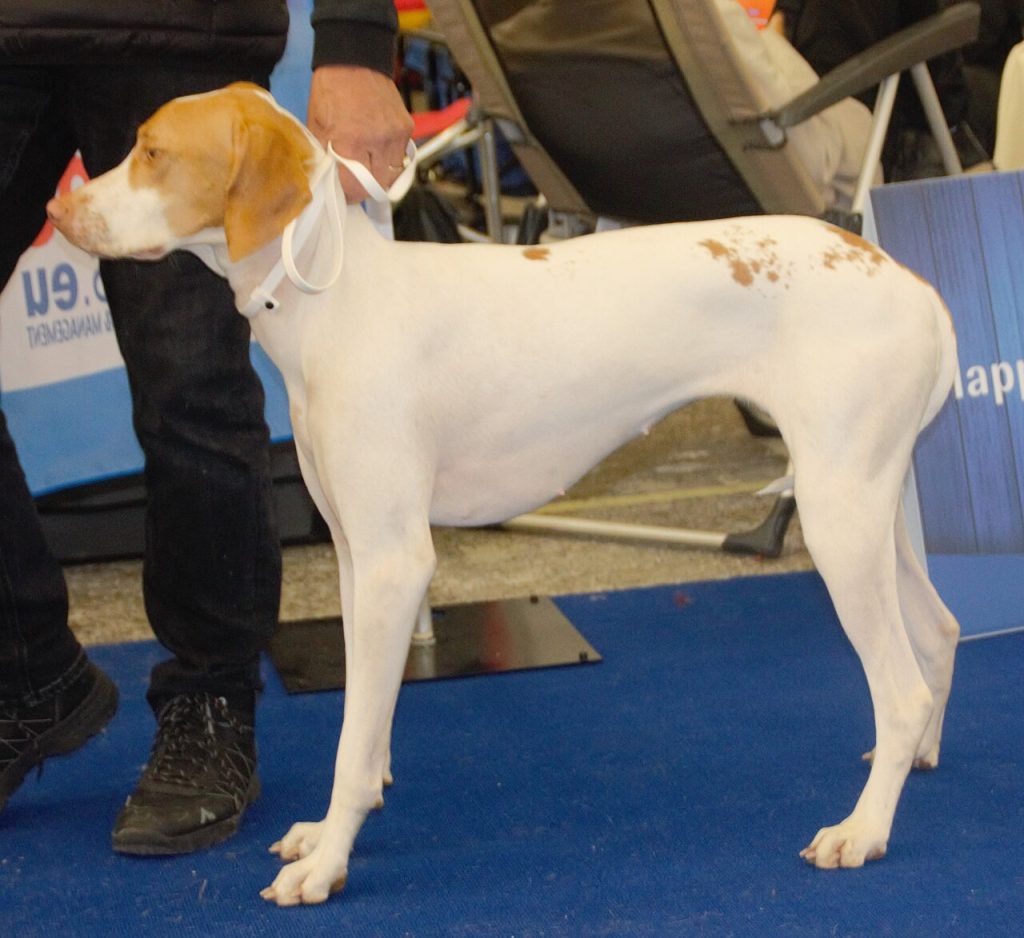
The Brace of Saint Germain is one of those French show dogs that falls in love at first sight: Elegant, white coat dotted with lion-like spots, sweet eyes and a surprisingly balanced temperament to come from a 100 percent hunter lineage. Born around 1830 from the crossing of English Pointers and Continental Braco, today it is a rare breed even in its native France, but whoever lives with a Saint Germain Braco discovers a sensitive, sociable and deeply attached companion to his family. In this guide, we take an in-depth look at its character, care, health and everything you need to know before deciding if it’s the right dog for you.
Is the Brace of Saint Germain for you?
Before you get carried away by his painted image, you should be honest: The Braco de Saint Germain is a hunting dog with all the letters and needs movement, stimulation and companionship. It’s not an ornamental dog or an animal that conforms to the garden. In return, he offers one of the friendliest and most manageable personalities in the braco group. These two columns summarize who fits in and who doesn’t.
It suits you if…
- You are an active person or family, with time for long walks and daily exercise.
- You want a dog that’s affectionate, sociable, and not conflicted with people.
- You like positive training and you enjoy working with a smart dog.
- You have access to country, hill or open spaces where you can run.
- You’re looking for a versatile hunting companion of sample and collection, or a sporting dog.
- You spend a lot of time at home or you can take it with you.
Maybe it’s not your dog if…
- You spend many hours outside and the dog would be left alone every day.
- You’re looking for a quiet couch dog with short walks.
- You don’t feel like spending time on education, socializing and exercise.
- You live in a small apartment with no possibility of long exits.
- You’re bothered by his hunting instinct for cats, birds or small animals.
- You want a breed that’s easy to find: it’s scarce and there are few breeders.
Character and temperament

If anything distinguishes the Braco de Saint Germain within the group of sample dogs is its sweetness. The breed’s own standard describes it as a “hunter above all else” who, however, greatly appreciates life with people.
It is extremely sociable and attached: it forms very strong bonds with its family and needs to feel part of the group. It is not an independent dog that lives its life on its own; on the contrary, it seeks contact, follows its people around the house and enjoys constant company.
We are talking about a smart and attentive. dog, with a good ability to read the environment and its guide. It is rarely aggressive or dominant; its natural tendency is to collaborate. Of course, it keeps intact the instinct of sample and collection: it will detect birds, lift the hare and stand still pointing at the piece. Knowing and respecting this instinct is key to understanding it.
Coexistence: children, other pets, flat and loneliness
With children:‘s friendly and patient nature makes it a good family dog. It enjoys play and tolerates the treatment of the little ones well, always with the supervision and mutual respect that any dog deserves.
With other dogs: being a pack dog by origin, it usually gets along well with other dogs and group coexistence is not a problem for it.
With cats and small animals:‘s hunting instinct comes into play here. It can learn to live with a cat if it grows up with it, but in the face of rabbits, birds or rodents it will activate its sample and chase impulse.
On the floor: is not the ideal breed for an apartment, although it can adapt if given plenty of daily exercise and company.
In the face of loneliness: is its weak point. The Braco de Saint Germain does not like to be alone for long hours; it can develop separation anxiety, boredom and destructive behaviors.
Education and training
Good news for the motivated first-time owner: the Braco de Saint Germain is a more manageable and easier to educate Braco. Its intelligence, desire to please and sensitivity make it very receptive to positive reinforcement. It learns quickly and enjoys collaborating, which facilitates both basic obedience and fieldwork.
The reverse of that sensitivity is that it doesn’t tolerate hardness.. Coercive methods, screaming or punishments block it and deteriorate the bond. The formula that works is the usual one, but here more than ever: rewards, play, patience and constancy.
Two essential pillars from puppyhood:
- Early socialization: to positively expose him to people, dogs, noises, surfaces and environments so that he grows up safe and balanced.
- Call work and self-control: as a good show dog with scent and chase impulse, reliable calling and impulse control are essential before releasing it into open spaces.
If you guide it to the hunt, you will find a grateful learning companion: firm display, soft-spoken charge, and willingness to work close to the hunter.
Exercise and activity

There are no shortcuts here: the Braco de Saint Germain is a athletic and hardy hunting dog, bred to spend hours hitting the field.
We’re talking at least one or two long walks a day, with opportunities to run free in safe areas, sniff and explore. A short walk around the corner isn’t enough for him. He’s a dog that shines with runners, cyclists or hikers, and he’s grateful to have a “job”: a dog sport, sniff games or, of course, hunting.
A well-trained Braco de Saint Germain is a calm and pleasant dog at home. One who is bored and with accumulated energy can become restless, destructive or anxious. The golden rule: more quality stimulation, better coexistence.
Care: fur and hygiene
In the maintenance chapter, this breed is from the more comfortable. Their hair is short, thin and glued to the body, which translates into minimal care:
- Cepillado: a weekly brushing with a glove or pig brush is enough to remove dead hair and keep the coat shiny.
- Baño: only when it gets really dirty.
- Orejas: should be checked and cleaned regularly to prevent infection, especially if you work in the field or get wet often.
- Nails, teeth and eyes: toenail clipping when needed, routine dental brushing and periodic eye check.
- Behind the field: check pads, interdigital spaces and ears for grains, ticks or small wounds.
In short: a dog of low aesthetic maintenance that, in return, demands all its “investment” in exercise and companionship.
Foodstuffs
The Braco de Saint Germain needs a complete and balanced diet, adapted to its age, its weight and, very especially, to its level of activity. A hunting or very sporting specimen burns much more energy than a companion dog with moderate walks, and its diet should reflect this.
Some sensible guidelines:
- Choose a quality food with a good ratio of animal protein, adjusting the amount to keep you at an athletic weight, not overweight.
- Split food into two daily servings instead of one, especially useful in deep-breasted dogs to reduce digestive risks.
- Avoid strenuous exercise just before and after eating.
- Always keep fresh water available, especially on field days and in summer.
- Watch your weight: A hunting dog’s functional thinness should not be confused with a lack of food, but it should also not be allowed to get fat.
When in doubt about the quantity or type of diet, it is best to consult your veterinarian, who will adjust the guideline for each animal.
Health and life expectancy
The Braco de Saint Germain is generally a rustic and healthy breed, without the long list of hereditary problems that drag some widespread breeds down.
That said, it shares with other medium-to-large-sized sample dogs some reasonable vigilance:
- Dysplasia of the hip: as in most breeds of its size, it is advisable that the breeders are tested.
- Otitis: their droopy ears favor moisture accumulation; periodic inspection and cleaning is the best prevention.
- Field wounds and grains: more than a disease, a risk inherent in your working life that requires review after departures.
- Caution in deep-chested dogs: apply the prudent feeding guidelines discussed above.
As for the life expectancy, there are no official figures in the standard, but for its size and hardiness it is in the usual range of medium-sized bracks, around the 12 to 14 years, provided it receives good nutrition, exercise and preventive veterinary care.
Physical appearance

The Braco de Saint Germain responds to the classic prototype of the continental braco: a sample dog of medium to large size, of harmonious construction, elegant and athletic, neither heavy nor light.
Talla: males measure between 56 and 62 cm to the cross, and females slightly less. The FCI standard prioritizes proportion and balance over a specific weight; for its height, it is placed in an approximate fork of about 18 to 26 kg depending on the specimen and its state of form.
Capa: its hallmark. Short and thin hair on the background white with fawn orange spots, spread over the body and especially on the head.
The truffle is usually a light pinkish-brown, in harmony with the coat.
Cola: long, which the dog wears level, horizontally, while working and tracking, a typical detail of show dogs in action.
Origin and history
The history of the Braco de Saint Germain is that of a dog born among royalty and consecrated in the exhibition rings. Its creation is located about 1830, in the royal kennels of Compiègne, from the crossing of English pointers with French and continental bracos.
The breed gained fame in the locality of Saint-Germain-en-Laye, from where it took its name. And although it was an excellent hunting dog, it reached its greatest glory as exhibition dog: from the first canine show held in France, in 1863, the Braco de Saint Germain was for decades the most exhibited sample breed in the country, a symbol of distinction.
The french racing club founded in 1913, consolidating its breed. It is internationally recognized by the FCI with number 115, within the Group 7 (sample dogs), Section 1.1, continental type. In 2006 it was also recognized by the American United Kennel Club.
Curiosities
- From royal kennels to dog walkways: was born in the crown kennels in Compiègne, but its fame was built in the first dog shows in France.
- The most exposed arm of the 19th century: after the first French canine competition of 1863, was for years the sample breed that was most presented at the exhibitions.
- “Soft mouth”:‘s standard highlights the smoothness of charging the parts, a highly valued quality that allows it to pick up the game without damaging it.
- Cover of box:‘s combination of white and orange lionside is so characteristic that it is enough to identify it at a glance.
- A living oddity: despite its brilliant past, today is a rare dog, with a small population even in France.
- St. Germain Pointing Dog: in English is known by that name, which recalls its kinship with the pointer.
If you are attracted to the profile of the Braco de Saint Germain, you will surely enjoy getting to know other similar sample and sport breeds. Vizsla Weimaraner Pointer Cocker Spaniel
Frequently Asked Questions about the Brac de Saint Germain
Is the Braco de Saint Germain a good family dog?
Yes. It is one of the sweetest and most balanced breeds, very attached to its family, sociable and patient with children. Its only condition is that it needs companionship and exercise: it fits into active families that spend time with it, not in homes where it is alone for many hours.
How much exercise does a Braco de Saint Germain need?
It is an athletic hunting dog with medium-high to high energy. It needs one or two long outings a day, the possibility of running freely in safe areas and mental stimulation (smelling, canine sports or hunting).
Is it easy to educate?
It is one of the easiest arms to train thanks to its intelligence and its desire to please. It responds very well to positive reinforcement, but it is sensitive: hard methods block it. Rewards, patience and constancy are the winning formula.
Does he adapt to living in a flat?
It’s not ideal, but it can be adapted if you get lots of daily exercise and company. You need to expend energy outside to rest quietly inside. A house with access to the countryside is much better for you than a small apartment.
How much hair does he shed and what care does his coat need?
Very little maintenance. Their short hair only requires a weekly brushing (slightly more in moles) and occasional baths. The most important thing is to check and clean their fallen ears regularly to prevent infections.
How long does the Braco de Saint Germain live?
There are no official figures in the standard, but due to their size and rusticity their life expectancy is in the usual range of medium-sized cattle, around 12 to 14 years, with good nutrition, exercise and preventive veterinary care.
Do you get along with other pets?
With cats it can learn to do so if it grows up with them, but with rabbits, birds or rodents it will activate its strong instinct for showing and chasing.
Is this a rare breed?
Yes. Despite being a very popular dog at 19th century French exhibitions, today it is a scarce breed, with a small population even in France and few breeders. Finding a puppy may require patience and waiting lists.