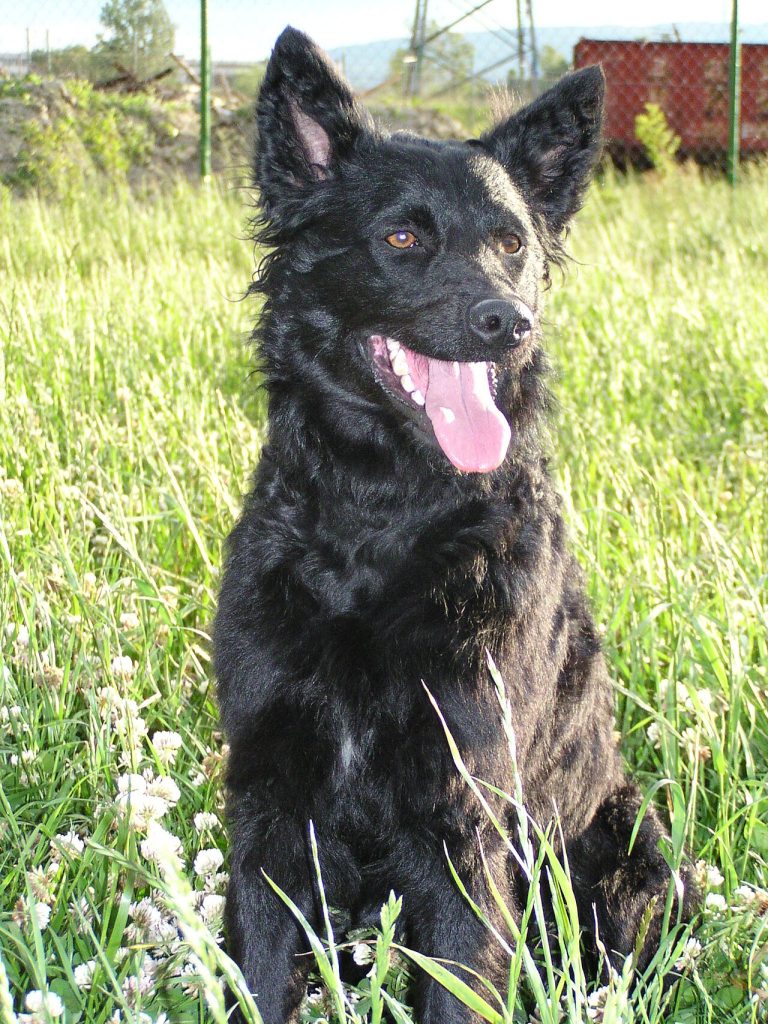
The Pastor Croata(Hrvatski Ovcar) is one of the oldest and least known herding dogs in Europe: a medium-sized herd guardian, black as a bat, with an unmistakable curly coat and a working intelligence rivaling that of any fashionable shepherd. Originally from the plains of Slavonia, it has been moving livestock silently for centuries and today it is beginning to conquer active families looking for an alert, loyal and resilient companion.
Is that the Croatian Shepherd for you?
The Croatian Shepherd is a purebred working dog in an agile and manageable body. It shines with active people who want a companion involved in their day to day lives, but can frustrate those looking for a quiet, low-maintenance pet.
It suits you if…
- You lead an active life and want a dog to run with you, walk with you or train with you.
- You like training and dog sports (obedience, agility, herding).
- You’re looking for a medium-sized, healthy, long-lived dog, easy to transport.
- You value a guardian who warns and is always on the lookout for his family.
- You can devote time, companionship, and mental stimulation daily.
Think about it if…
- You spend a lot of time outdoors and the dog would be alone a lot.
- You want a relaxed dog that’ll settle for a short walk.
- You don’t feel like handling barking or your group instinct.
- You look for a dog indifferent to strangers: this watches and warns.
- You have no experience and no desire to educate consistently.
Character and temperament

If we had to sum up the Croatian Shepherd in one serious word i ‘m awake .. It is a lively, attentive and remarkably intelligent dog, able to anticipate what its guide will ask of it. That spark, which makes it an exceptional shepherd, requires instead a busy mind: bored, it invents its own work and we rarely like the result.
With his family he is deeply loyal and affectionate. He is strongly attached to his people, loves to participate in everything and enjoys contact and play. This dedication makes him very pleasant to live with, but also sensitive: he responds poorly to harsh methods and indifference, and prefers a thousand times to earn a caress or a well-done order than to receive a scream.
In the face of strangers he shows the typical reserve of a guard dog: he is not aggressive, but observes, keeps distances and warns. His courage is proportional to his size; he is not a defense dog, but a sentry who barks and alerts. Well socialized, that distrust remains in polite prudence and not in fear or reactivity.
Coexistence: children, other pets, flat and loneliness
The Croatian Shepherd is an excellent family dog when it is really integrated into the home. With the children with which it is raised it is patient and playful, although it is advisable to supervise the games: its herding instinct can lead it to chase and “group” the little ones when they run.
With other dogs it usually gets along well, especially if it grows up socialized. With cats and other pets coexistence is viable if it gets used to it from puppyhood, but one must always count on that impulse to control the movement of strangers that defines herding dogs.
It can live in floor, provided it meets its high need for exercise and companionship; it is not a dog designed to sit still between four walls.
Education and training
Few breeds are as rewarding to train. The Croatian Shepherd is among the most intelligent and willing herding dogs: he learns at first, retains well and genuinely enjoys working with his guide.
The recipe is simple: start early, use positive reinforcement, short and varied sessions, and always give a “why” to what you do. It responds fatally to hardness and is extinguished by the boredom of mechanical repetitions. Since it tends to make decisions on its own – inheritance of its autonomous work with the reindeer – it is advisable to channel this initiative with exercises that make you think and propose.
The early socialization is the other half of the job. Exposing him as a puppy to people, noises, other animals and different environments turns his natural prudence into safety. And, given his tendency to bark, teaching him a command to be quiet early saves him a lot of upset in the future.
Exercise and activity
This is an athlete. The Croatian Shepherd was bred to spend the day moving cattle across the Slavonian plains, so his energy level is high and his endurance is enormous. A couple of short walks are not enough for him: he needs intense physical exercise combined with mental challenges.
Long walks, running, pick-up and drop-off games and, most especially, dog sports: obedience, agility, flyball, treiball or, if there is an opportunity, real shepherding. Any discipline that a body and head makes you happy and keeps you balanced. Calculate at least one long hour of daily activity, better distributed and varied.
Interactive toys, olfactory work, new tricks, and little “homework” channels your intelligence and prevents boredom from turning into barking or destructive behavior.
Care: fur and hygiene

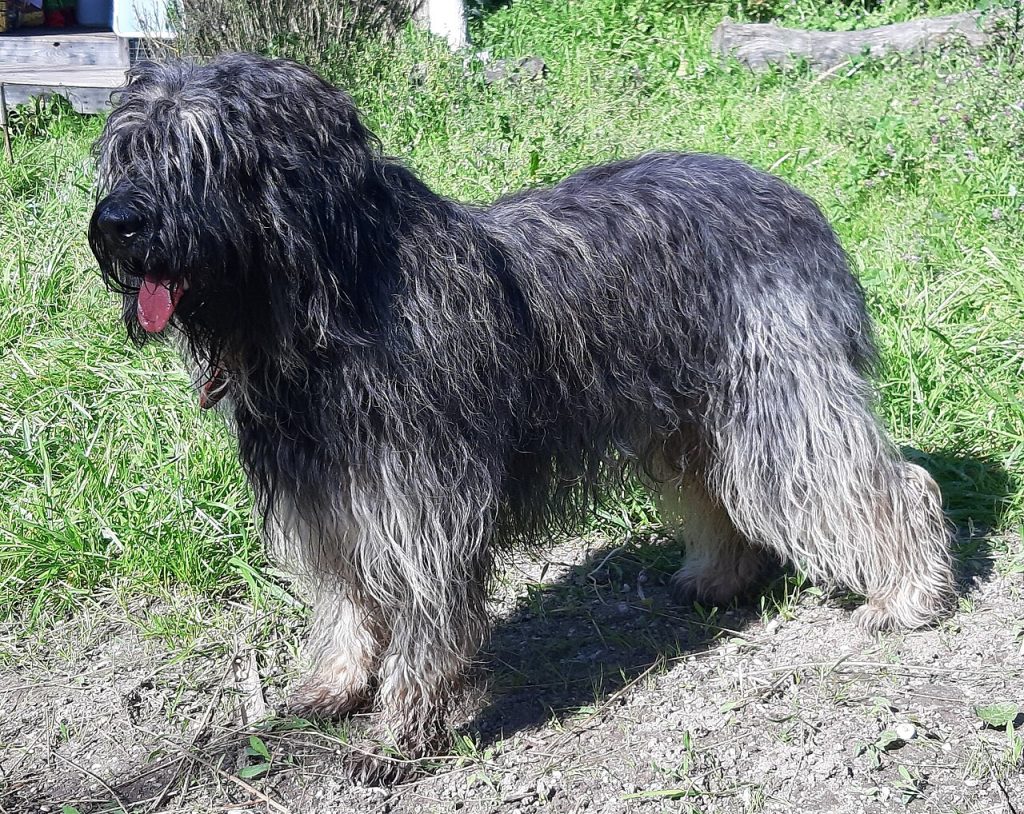
The coat of the Croatian Shepherd is its hallmark, but it demands less than it looks. It has double hair: a dense and soft undercoat under a long, curly or wavy outer layer, which on the body measures from 6 to 14 cm; on the face, ears and lower legs the hair is short. A weekly brushing is enough to keep it clean and untangled most of the anus, increasing the frequency in muddy periods.
She doesn ‘t need a haircut . its coat self-regulates and baths should be occasional, only when it gets really dirty, so as not to spoil the natural protection of its coat. The rest is routine hygiene: Check and clean your ears, brush your teeth regularly and trim your nails if they don’t wear out on their own. Its curly coat protects it well from cold and moisture, the result of generations of outdoor work.
Foodstuffs
As a medium-sized, active and muscular dog, the Croatian Shepherd needs a complete and balanced diet, adjusted to its high energy expenditure.
The quantity must be adapted to their age, weight and, above all, to their actual level of activity: A dog that trains or works daily consumes a lot more than a more sedentary one. It is good to divide the food into two portions, monitor the body condition to avoid overweight – which punishes your joints – and always keep fresh water available. The prizes, abundant in their training, must be deducted from the daily ration.
Health and life expectancy
The Croatian Shepherd is a rustic and remarkably healthy breed. Having developed as a functional working dog, without morphological exaggerations, it has few documented hereditary diseases and a robust constitution.
This does not exempt basic preventive care: daily vaccination and deworming, regular veterinary check-ups, dental hygiene and good weight management and exercise to protect your joints throughout your life. As with any breed, choosing responsible breeders who care for the health and temperament of their breeders is the best guarantee of a balanced and long-lived puppy.
Physical appearance

The Croatian Shepherd is a medium size dog and slightly elongated, agile and well proportioned. Depending on the standard, males measure between 45 and 50 cm at the withers and females about 2 cm less; for specimens of exceptional conformation and type a tolerance of up to 3 cm above or below is allowed. Their weight, proportionate to that size, is usually in a medium range according to their athletic complexion.
The most characteristic is its coat, always black, on which only small white marks are tolerated. The coat is curly or wavy over the body and cuts across the face and lower extremities, giving the head a clear, wrinkled appearance against the woolly mantle of the trunk. The head is relatively light, with ears that can be raised or submerged and dark, vivid, expressive eyes that convey its attentive character. The set depicts a dog of the spitz type from southern Europe, fast, tough and made for work.
Origin and history
The Croatian Shepherd is one of Croacia‘s native breeds and, along with the Tornjak, one of its two recognized herding dogs. Its birthplace is in the historical regions of Orange and Backa, in Slavonia, near the border with Hungary. Its exact origins are lost in time: It may have descended from dogs brought from Greece, Turkey or other parts of the Balkans, and bears a close resemblance to the Hungarian Mudi, with whose territory it overlaps, although it is somewhat older.
The most cited documentary footprint is a 1374 manuscript preserved in the archives of the Archdiocese of Dakovo-Osijek, which would mention herding dogs in Croatia with the Latin expression the following subheadings are added:. It would take centuries for the race to take on a modern form: Towards 1935, the agronomist and veterinarian Stjepan Romic started the selective breeding of the Slavonic black dogs, laying the foundations of the current Croatian Shepherd.
The first specimens were presented at an exhibition in Zagreb in 1949; in 1951, Otto Rohr drafted the breed standard, and the Federacion Cinologica Internacional definitively accepted it in 1967, placing it in Group 1 of herding dogs (FCI standard no. 277).
Curiosities
- Its Croatian name, Hrvatski Ovcar, literally means “Croatian shepherd dog”.
- It is one of the seven recognized dog breeds originating from Croatia.
- The purported written trace of its ancestors goes back to 1374, making it one of the oldest documented pastoral breeds in Europe.
- It is so similar to the Hungarian Mudi that its distribution areas overlap; the Croatian Shepherd is somewhat larger.
- It belongs to the southern European spitz type, which explains its erect ears and lively demeanor.
- He works with an autonomous style: he is able to drive the making decisions for themselves herd, without constant instructions from the shepherd.
If you’re attracted to this smart, hard-working shepherd, you may find other herding breeds with a similar profile to suit you. Check out the Border Collie, the Pastor Australiano, the Shetland Sheepdog and the Welsh Corgi Pembroke, all awake, energetic companions born to work side by side with people.
Frequently Asked Questions about the Croatian Shepherd
Is the Croatian Shepherd a good family dog?
Yes. The Croatian Shepherd is loyal, attached to his people and affectionate with the children in the house with whom he is raised. He needs to be part of family life and participate in daily activities; when given that place, he is a balanced and very devoted companion. He is not a dog that tolerates continued loneliness or abandonment in the garden well.
How much exercise do you need a day?
It is a high-energy working dog. It needs at least one or two hours a day between long walks, running and, above all, mental stimulation. It loves obedience games, agility and any activity that combines body and head.
Does the Croatian Shepherd lose a lot of hair?
It has double hair (dense undercoat and curly or wavy outer layer), so it changes moderately during the anus and more intensely in the seasonal changes.
Is it easy to train?
It is one of the most intelligent and attentive herding dogs: it learns quickly, enjoys working and responds wonderfully to positive reinforcement. The key is to start early, be consistent and give it tasks that make it think.
Does he adapt to living in a flat?
It can live on the floor as long as it is guaranteed plenty of daily exercise and companionship. It is not a couch dog: if it does not burn physical and mental energy, it becomes nervous and barks. In an active home, with long walks and activities, it adapts without problems despite its rural origin.
Is he a good guard dog?
Yes. In addition to being a shepherd, it has traditionally been used as a warning and guard dog. It is vigilant, suspicious of strangers and warns with barking of any novelty, although it is not aggressive.
How long does a Croatian Shepherd live?
It is a rustic and healthy breed, with few documented hereditary diseases. Its life expectancy is usually around 13 or 14 years when it receives good nutrition, exercise and preventive veterinary care.
Do you get along with other dogs and pets?
It usually does, especially if it starts socializing as a puppy. It gets along well with other dogs and, raised alongside them, also with cats. It is good to keep in mind its strong herding instinct: it can try to group and chase other animals or people in motion, something that is corrected with education.