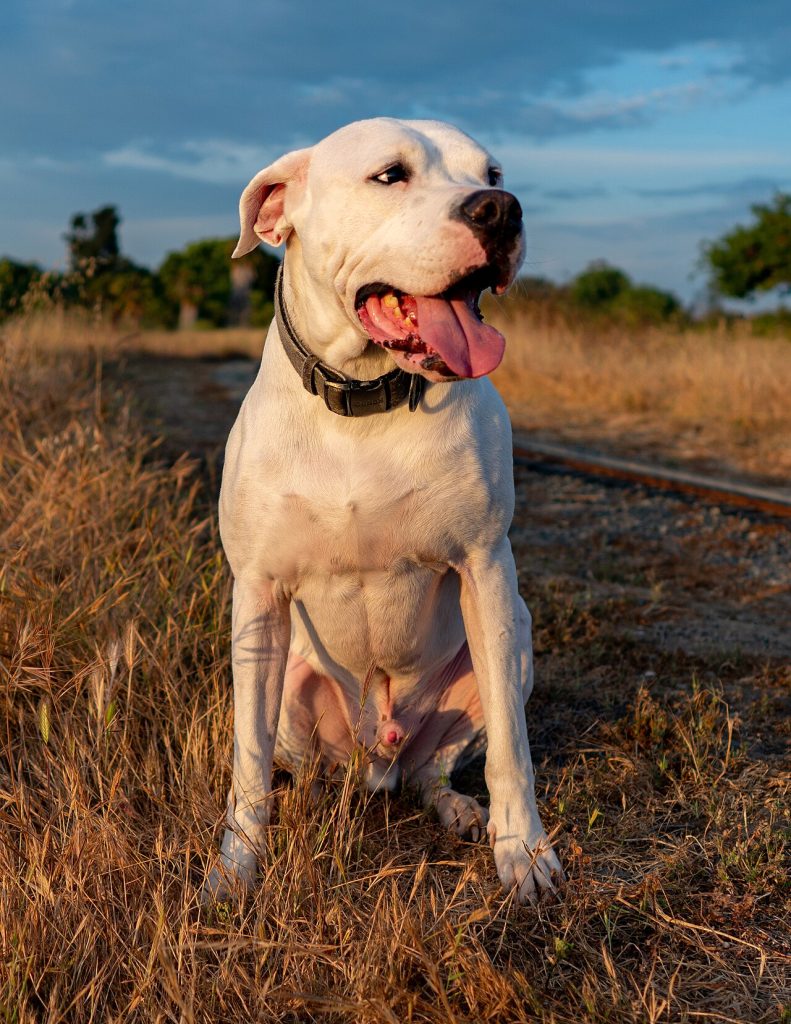
The Dogo Argentino is the only Argentine-born hunting dog that has conquered the world: A white athlete, muscular and of legendary courage, bred in Cordoba to beat the wild boar and the puma in the middle of the mountain. Beneath that gladiatorial facade, however, lies a surprisingly balanced companion, faithful and affectionate to his family. It’s a dog that doesn’t tolerate warm owners: The Argentine Doge demands serene leadership, early socialization and an enormous dose of exercise, but in return he delivers loyalty from those who leave their mark.
Is the Dogo Argentino for you?
Before you fall in love with their image, be honest: the Argentine Dogo is a dog of power, hunting instinct and great character. It works wonderfully in experienced and committed hands, and becomes a serious problem in misguided hands. These boxes summarize who fits in and who doesn’t.
It suits you if…
- You have experience with big, strong-tempered dogs.
- You can offer him intense daily exercise and mental work.
- You’re gonna socialize him well from a puppy.
- You’re looking for a loyal guardian and an athletic companion, not an ornamental dog.
- You have space and time – it’s not a dog to be left alone for many hours.
Maybe it’s not your breed if…
- Either it’s your first dog or you’re looking for something easy to handle.
- You’re out all day or you live in a flat with no time for long walks.
- You’re not willing to invest months in training and socializing.
- You live where race is legally restricted and you don’t want paperwork.
- You want a dog that can tolerate other dogs of the same sex without any previous work.

Character and temperament
The Argentine Dogo brings together two seemingly contradictory souls. On the one hand, he is a big game hunter: brave to the point of recklessness, with a very high threshold of pain and a determination that does not loosen even when the boar punishes him. On the other hand, inside the house, he is a calm, balanced and deeply attached dog to his people, who enjoys contact and lives attentive to his family.
His maker described him as “the best of all the hunting dogs”, and he did not exaggerate his delivery. The Doge is cheerful, self-assured and very sensitive to the home environment: detects tensions, monitors access and reacts to what it perceives as a threat. This natural vigilance makes it a deterrent guard without the need for encouragement; what is needed is self-control and confidence to distinguish between a normal visit and a real danger.
It is important to understand that their prey instinct is still alive. With small animals running – unknown cats, rabbits, chickens – the catching impulse can be triggered. It is not evil: it is the inheritance of generations selected to chase and subdue. So socialization and responsible management are not an extra, but the foundation of their good behavior.
Coexistence: children, other pets, flat and loneliness
With his human family, the Dogo Argentino is usually affectionate, patient, and tolerant of the children in the house, whom he tends to protect. That said, its size and strength compel the golden rule of any large dog: Never leave a small child alone with the dog, and teach them both to respect each other. A well-behaved Dogo is a 150-pound stuffed animal; one without boundaries is too animal for a child’s hand.
With other dogs, it takes nuance. As it was bred specifically to work in packs, it accepts canine company better than many moles, especially if it lives with them from puppyhood. However, conflicts between males of the same sex are not uncommon and it is advisable to manage presentations with the head. With cats and small animals, coexistence is possible if they grow up together, but their hunting instinct will always be dormant.
And the floor? The Argentine Dogo can live in an apartment as long as it gets the exercise it needs; in fact, it’s clean and quiet indoors. What it really feels bad about is prolonged loneliness: it’s a dog that needs its family, and a Dogo that’s bored and alone for hours can become destructive or anxious. It’s not the breed for which you barely step foot in the house.

Education and training
This is where the game is played. A well-behaved Argentine dog is a reliable and pleasant dog; a poorly managed dog is a risk. The good news is that it is intelligent, attached to its owner and eager to please, which makes it very trainable. The bad news is that its strength does not forgive handling errors, so training must be firm, consistent and, above all, early.
Socialization is priority number one. From the moment he arrives home he must be exposed in a controlled and positive way to people of all kinds, noises, other balanced dogs, urban and rural environments. The more people he knows as a puppy, the more stable he’ll be as an adult. At the same time, basic obedience work – responding to a call, controlling impulses, letting go, walking without pulling – must be settled early, for by six months it is already a well-muscled animal.
The method that works is positive reinforcement combined with clear and consistent rules. The Dogo respects a calm and confident leader, not one who shouts or punishes: harsh treatment only creates distrust in a dog so resistant to pain. If it is your first time with such a breed, rely on a professional educator; it is not a sign of weakness, but of responsibility.
Exercise and activity
Forget a couple of laps around the block. The Argentine Dogo is a distance runner born to run, track and work for hours in the mountains, and that boiler needs to burn fuel every day. We’re talking about a minimum of one to two hours of quality exercise: long walks, running, intense play, olfactory work and, if possible, dog sports.
Canicross, mantrailing, sports obedience, agility adapted to your size or carrying a backpack on long routes are activities that you love and that channel your energy and your head. A physically and mentally tired Dogo is a balanced Dogo at home; an underemployed Dogo seeks his own entertainment, and we rarely like the one he chooses. Of course, as a puppy, you need to dose the impact exercise to protect your growing joints.
Care: fur and hygiene
In terms of grooming, the Dogo Argentino is low maintenance. Its hair is short, smooth and white, and a weekly brushing with a rubber glove or crine is enough to remove the dead hair and keep the coat shiny; during the moult it is advisable to increase the frequency.
Her fair skin, on the other hand, demands attention. Because it is white and short-haired, it is sensitive to the sun and can burn, especially in areas with little cover; prolonged exposure in the strong hours should be avoided and, on very exposed skin, protection should be valued. The ears and especially the eyes should be checked and cleaned regularly to prevent irritation. Complete the routine with nail trimming and good dental hygiene.
Foodstuffs
A 40- to 45-kilogram dog with athletic musculature needs a high-quality diet, rich in animal protein and tailored to its activity level, age and metabolism.
Two critical points. First, the puppy stage: Since it is a fast-growing large breed, a specific feed for large breeds that controls calcium and energy intake and protects bone and joint development is appropriate. Second, the weight: The standard calls for a light and athletic body, so you have to avoid obesity, split the rations in two and watch the quantities. In deep-chested dogs such as this one, it is also advisable not to offer vigorous exercise right after eating because of the risk of gastric torsion.
Health and life expectancy
The Dogo Argentino is, in general, a rustic and resistant dog, with a life expectancy of around 9 to 12 years.
The most characteristic is the congenital deafness linked to the lack of pigment, as occurs in Dalmatians or white bull terriers: about 10% of individuals may be affected, either unilaterally (one ear) or bilaterally (both). That’s why serious breeders do the BAER test on puppies and select players with normal hearing, which drastically reduces the incidence. Other predispositions to be monitored are hypoplasia of the hip, skin problems – especially demodexia in young specimens – and laryngeal paralysis/polyneuropathy complex. Buying from a responsible breeder who does health checks is the best policy for your Dogo.

Physical appearance
The Dogo Argentino is the living image of harmonic power. It is a large dog, of massive structure and marked musculature, but without heaviness: the standard seeks an athlete capable of running and fighting, not a slow colossus.
His trademark is the entirely white coat and short hair, designed precisely to distinguish him in the field and the mountain. A single black or dark spot on the head is tolerated, provided it does not exceed one tenth of its surface. The head is large and has a massive skull, a powerful snout, thin lips – which allow it to keep breathing as it grips its prey – and well-set brown eyes. The neck is thick and muscular, the chest broad and deep, and the tail long and thick moving with energy. The ears are triangular in shape; traditionally they were cut off, but this practice is banned or disused in many countries.
Origin and history
In the 1920s, together with his brother Agustín and his family, he set out to create a large hunting dog capable of facing wild boars, pumas and other prey in the Argentine mountains: strong, brave, resistant and with good smell.
It started from the now extinct cordoba fighting dog– a mixture of bull terrier, bulldog, mastiff and alan introduced by immigrants – and was methodically crossed with other breeds to add virtues: bull terrier by temperament, pointer by smell and sociability, and later contributions of Pyrenean Mastiff, Spanish Mastiff, Great Dane, Bordeaux dog, Boxer and Irish hare, among others. From those lines first emerged the Araucana caste and then the Guarani caste, who maintained courage but could hunt in packs without fighting each other.
Towards the end of the forties the type was consolidated. The standard was published in 1947-1948, the Argentine Cinological Federation recognized it in 1964 and the It was finally accepted by the International Cinological Federation (FCI) in 1973., framing it in Group 2 among the molosoids of the dogo type.
Curiosities
- It’s the only dog breed in Argentina with international recognition by the FCI, a whole national symbol.
- Its spotless target is not aesthetic: it was sought so that the hunter would distinguish it from the wild boar in the thickness and avoid accidents.
- Beyond hunting, it is used in search and rescue, police and military work and as a service dog; in Lebanon it has been part of police units.
- In Spain, following Law 7/2023 on animal welfare, the automatic catalogue of ‘potentially dangerous breeds’ ceased to exist, replaced by individual sociability criteria.
- Possession is restricted or prohibited in countries such as the United Kingdom, Australia or New Zealand, so check before travelling or moving.
If you’re attracted to the Dogo Argentino’s profile – power, loyalty, and athletic keeper character – you may also be a match for other molosoid and strong personality keeper breeds. Check out the Cane Corso, the balanced Bóxer, the imposing Gran Danés, and the protective Rottweiler to compare temperaments, care, and needs before you decide.
Frequently Asked Questions About the Argentine Doge
Is the Dogo Argentino a dangerous dog?
It is not dangerous by nature, but it is a dog of great strength and prey instinct that requires socialization, education and a responsible owner.
Is it a good breed to have with children?
With his family he is usually affectionate, patient and protective of the children of the house. However, due to his size and strength, a small child should never be left alone with the dog, and it is advisable to teach both to respect each other.
How much exercise does an Argentine Dogo need?
Enough: one to two hours a day of quality exercise between long walks, running, play and mental or olfactory work.
Can you have an Argentine Dogo on one floor?
Yes, as long as it gets the daily exercise it needs. Inside it’s clean and quiet. What’s worse is the prolonged loneliness: it needs company and it’s not the ideal breed if you spend many hours outside.
How long does an Argentine Dogo live?
Their life expectancy is about 9 to 12 years, and good genetics, good nutrition, adequate exercise, and regular veterinary checkups help them reach the end of that range in good health.
Is it true that many Dogos are deaf?
There is a predisposition to congenital deafness linked to the lack of pigment, which affects about 10% of specimens, unilaterally or bilaterally.
Is it easy to train?
It is intelligent and very attached to its owner, which makes it trainable, but it needs firmness, consistency and early start. Positive reinforcement with clear rules works better than punishment. If this is your first such dog, rely on a professional educator.
Does he get along with other dogs?
Since it has been bred to hunt in packs, it tolerates canine companionship better than many moles, especially if it socializes as a puppy.