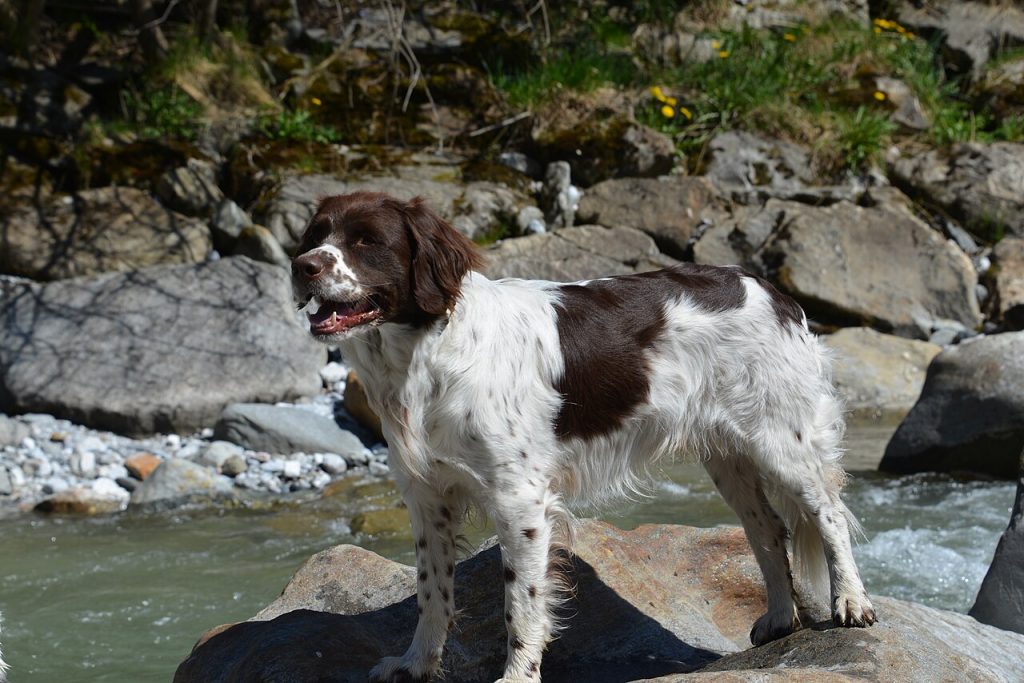
The Perdiguero of Drenthe(in Dutch Drentsche Patrijshond, and known as “Drent”) is one of the most versatile and at the same time most discreet hunting dogs in Europe. Born in the rural province of Drenthe in the northeast of the Netherlands, this spaniel-type model dog brings together two things that rarely go together: A serious and thorough hunter in the field and a quiet, sweet and deeply family-loving companion at home. If you’re looking for a dog that’s versatile, well-balanced and bonded almost to the skin, the Drenthe Perdiguero deserves your attention.
Is the Drenthe Forge for you?
Before you fall in love with his mellow gaze, be honest: the Drenthe Perdiguero is, above all, a versatile hunting dog. That means instinct, energy and a need for purpose. The good news is that, unlike many canine breeds, he knows how to get off revolutions at home and enjoy the calm of the couch. Here’s the honest summary to decide.
It suits you if…
- You want a multi-purpose dog that hunts, coppers and cohabits as one more member of the family.
- You like the outdoors: long walks, nature, dog sports or hunting.
- You’re looking for a very close. partner, sensitive and caring, especially with children.
- You can make time for exercise and companionship every day.
- You prefer a rustic breed, healthy and of moderate fur maintenance.
Maybe it’s not your race if…
- You spend many hours outdoors: you suffer from prolonged loneliness.
- You’re looking for a sedentary dog who’s content to go around the block.
- You live with rabbits, birds or other small animals loose (strong hunting instinct).
- You don’t want to work the mental stimulation or the training.
- You’re bothered by a Velcro dog following you from room to room.
Character and temperament

In the countryside it awakens an intense hunting instinct and can be very motivated, focused and hardworking; but at home it tends to relax much more than most hunting breeds.
It is a faithful, sweet and hugely affectionate. dog of its own. It is not a cold hunter who lives in the kennel: the Drent wants to be with you, participate in domestic life and, above all, listen to you because it cares about your company. This sensitivity makes it kind and affectionate, especially with children, but it also means that it does not tolerate screaming, harshness or isolation.
Intelligent and attentive, it reads the atmosphere of the house very well. It is usually reserved with strangers without falling into aggressiveness, and its past as a warning dog gives it a certain tendency to warn of what is happening around. With respectful and consistent treatment, it returns a loyalty difficult to match.
Coexistence: children, other pets, flat and loneliness
With children. is one of its strong points. The Drenthe Perdiguero is known for being especially gentle and patient with the little ones, whom it usually treats as part of “its” group. As always, it is advisable to teach children to respect their rest times and supervise play, but few hunting breeds fit so well into a family home.
With other pets. With other dogs he is usually sociable and gets along well. The important nuance is in small animals: We are talking about a show dog designed to hunt birds and small mammals (rabbit, hare, fox), so that its instinct can be activated before birds, rodents or cats to which it is not accustomed since puppyhood. Early socialization helps a lot, but it’s best not to rely on it.
On the floor. can live on the floor if you cover its exercise and companionship needs, as indoors it is quiet. However, it greatly enjoys access to a garden or natural spaces: it is not an indoor dog designed for stillness, and you will notice the lack of exits.
Soledad. This is its major limitation. Due to its “velcro” nature, the Drent has a hard time spending many hours alone. Prolonged loneliness and lack of stimulation can lead to boredom, anxiety or destructive behaviors.
Education and training
The Drenthe Perdiguero is intelligent and cooperative, a combination that makes learning much easier – as long as you respect his sensitivity. He responds wonderfully to positive reinforcement, short motivational sessions, and gentle treatment; instead, he closes or discourages himself with harshness, punishments, and coercive methods.
A curious feature of the breed is that it matures with a certain independence of judgment: it thinks for itself in the countryside, which at home can translate into something of a “headache” if the rules are not clear and consistent.
He prioritizes socializing(people, dogs, environments, noises) from puppyhood, reliable calling and chase instinct control. For a dog designed to work at a shooting distance, a good call is not a luxury, it’s safety. Canine sports, sniffing work, collecting and, of course, hunting, are great ways to channel his head and his energy.
Exercise and activity
He needs real daily physical activity and, above all, a purpose that occupies his mind.
The happiest thing you can be is working alongside your person outdoors: tracking, dialing, charging. But you don’t have to be a hunter to keep it in shape. Several energetic outings a day, long walks, games, swimming and sports such as the mantrailing, agility or charging tests make him feel wonderful. After wearing itself out, it returns home and lies quietly in its place: That contrast is part of its charm.
Mental stimulation is just as important as physical stimulation. A Drent who only gets routine walks, no challenges to smell or head, gets bored; and a bored hunting dog always finds something to do, usually to the displeasure of the owner.
Care: fur and hygiene
The Drenthe Perdiguero’s coat is average length, with fringes on the legs, on the back of the limbs, on the chest, ears and tail, giving it a longer hair appearance than it really is.
With a weekly brushing(more common in moulting times) it is enough to keep the hair clean, without knots and to distribute the natural fat that protects it. Pay attention to the fringes and areas behind the ears, where they get entangled more easily, and check the legs after the outings to the field for ears, mud or small wounds.
Like all dogs with droopy ears and active outdoor life, watch your ears should be cleaned regularly to prevent otitis, especially if they swim often.
Foodstuffs
The Drenthe Perdiguero needs a complete and balanced diet, adjusted to its age, weight and, very especially, to its activity level.
It divides food into two doses a day instead of one, a recommended practice in deep-breasted dogs to promote a calm digestion, and avoids strenuous exercise just before and after eating.
Always provide fresh water, especially after activity, and adjust the amounts according to your pet’s physical condition.
Health and life expectancy
Thanks to its origin as a rustic and functional breed, bred for centuries for its usefulness rather than for aesthetic fashions, the Drenthe Perdiguero is generally a healthy and resilient dog.
Among the health problems described in the breed are progressive atrophy of the retina(PRA), an inherited eye disease that affects vision, and hereditary stomatitis, a blood disorder specific to this breed.
This is why it is essential to go to responsible breeders who perform the recommended health tests before breeding: hips and elbows screening and review for hereditary eye disorders.
Physical appearance

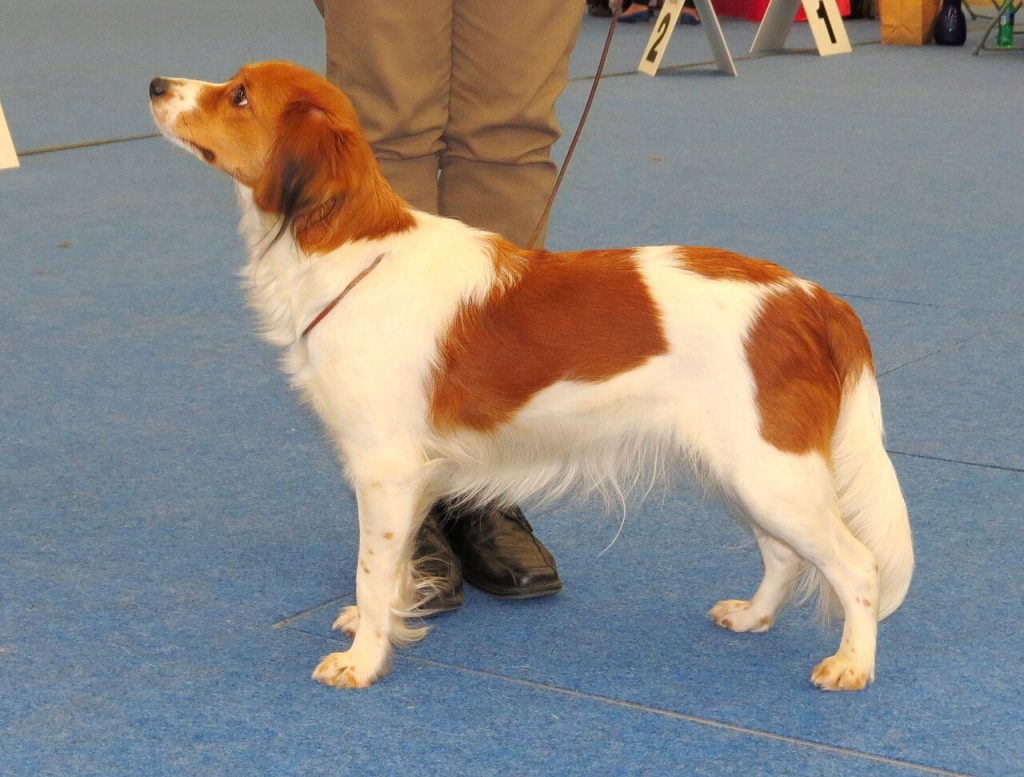
The Drenthe Perdiguero is a medium size and harmonious-built dog, halfway between the spaniel and setter types, giving it a noble and balanced silhouette, neither heavy nor excessively light.
The most characteristic feature is its coat: white with brown spots(the so-called “plates”). The usual is a mostly white dog with large brown plates, one of which often covers the group above the birth of the tail. The standard asks that there be no white touching the eye or in the ears; the mantle over the back is admitted, but is less desirable. The truffle is usually brown, in harmony with the color of the plates.
The hair is medium-length, with fringes on the ears, chest, tail, and limbs, reinforcing that elegant country dog’s image. The expression, sweet and intelligent, with dropped and tightly-fitting ears, completes an unmistakable image of a friendly hunter.
Origin and history

It is descended from the so-called Spioenen or Spanjoelen, spaniel-type dogs that arrived in the Netherlands from Spain, via France. The breed is related to the German Small Münsterländer and the French Epagneul Français; in the Netherlands, these dogs were known as “partridge dogs”, whence their name.
The province of Drenthe had a key feature three centuries ago: It allowed the common people to be hunted as well, not just the nobility. While in much of Europe hunting dogs were developed by and for the elite, in Drenthe the mayor, the farmer or the small landowner needed a dog suitable for all of it.: hunting any piece, watching the house, being the children’s companion and even pulling little carts. So he forged a multi-purpose dog out of necessity.
For centuries, in the rural isolation of Drenthe, this type was kept relatively pure, separate from other breeds but without official documentation. Formal recognition came in 1943, when the This is not the case.(Dutch canine club) approved the first standard. Subsequently the International Kennel Federation (FCI) recognized the breed within the Grupo 7(spaniel-type continental show dogs), and other organizations, such as the United Kennel Club of America, also admitted it. In November 2010 the American Kennel Club incorporated it into its breed development program (Foundation Stock Service), allowing since 2011 its participation in official events.
Today it is still, above all, a dog of its land: it is estimated that there are around 5,000 copies registered in its native country, with breed clubs also in Belgium, Denmark, Scandinavia and North America.
Curiosities
- Its original name, Drentsche Patrijshond, literally means “Drenthe partridge dog”: the patriarchs is “partridge” in Dutch.
- The affectionate nickname “Drent” by which he is known throughout the world comes directly from the name of his home province.
- It appears depicted in 17th-century Dutch painting: the painting The gift of the hunter(The Hunter’s Present, h. 1658-1660) by Gabriel Metsu shows a partridge dog leaning on a hunter’s knee, proof of the type’s antiquity.
- It is one of the few hunting breeds developed by ordinary people and not by the aristocracy, which explains its “all-terrain” and familiar dog profile.
- It shares a cradle in Drenthe with another very distinct Dutch breed, the Schapendoes, a woolly-looking sheepdog.
- Despite its age and virtues, it is still a uncommon breed outside the Netherlands, which makes it a small gem for anyone who discovers it.
If you are attracted to the profile of the Drenthe Perdiguero – this versatile hunter with a sweet character – you may be interested in other sample and collection breeds with a similar spirit. You can compare his way of being with that of the Vizsla, another versatile and very close to his family sample dog; with the elegant Weimaraner; with the classic Pointer; or with the cheerful Cocker Spaniel, also of spaniel root.
Frequently asked questions about the Drenthe Perdiguero
Is the Drenthe Hound a good family dog?
Yes, it is one of its great strengths. Unlike many hunting breeds, the Drent is calm and balanced at home, very attached to his own and especially sweet and patient with children.
How much exercise does the Drenthe Perdiguero need?
It is a hunting dog that suffers if not exercised enough. It needs several vigorous outings a day, long walks and, very importantly, mental stimulation (sniffing, games, collecting or dog sports).
Does the Drenthe Perdiguero adapt to living in a flat?
It can live on the floor if you guarantee daily exercise and companionship, as it is quiet inside the house.
Is it easy to train the Drenthe loser?
It’s intelligent and cooperative, which makes it easy to learn, but it’s also very responsive. It responds wonderfully to positive reinforcement and to short, gentle sessions, and it closes with toughness. It’s good to work on calling and controlling the hunting instinct from a puppy.
What care does your fur need?
Its coat, of medium length with fringes, has a moderate maintenance. It only needs a weekly brushing (more on seedlings), checking the fringes and ears to prevent otitis, and bathing it only when needed.
What are Drenthe’s health problems?
It is generally a healthy and rustic breed. Among its predispositions described are progressive retinal atrophy (PRA), the breed’s own hereditary stomatitis and, as in many medium-sized dogs, hip and elbow dysplasia.
How long does a Drenthe loser live?
Their life expectancy is usually around 12 to 14 years, and as with any breed, it depends on genetics, good nutrition, adequate exercise, and veterinary checkups throughout their life.
Do you get along with other dogs and pets?
With other dogs it is usually sociable. The nuance is in small animals: being a sample and collection dog, it can activate its instinct before birds, rodents or cats to which it is not accustomed.