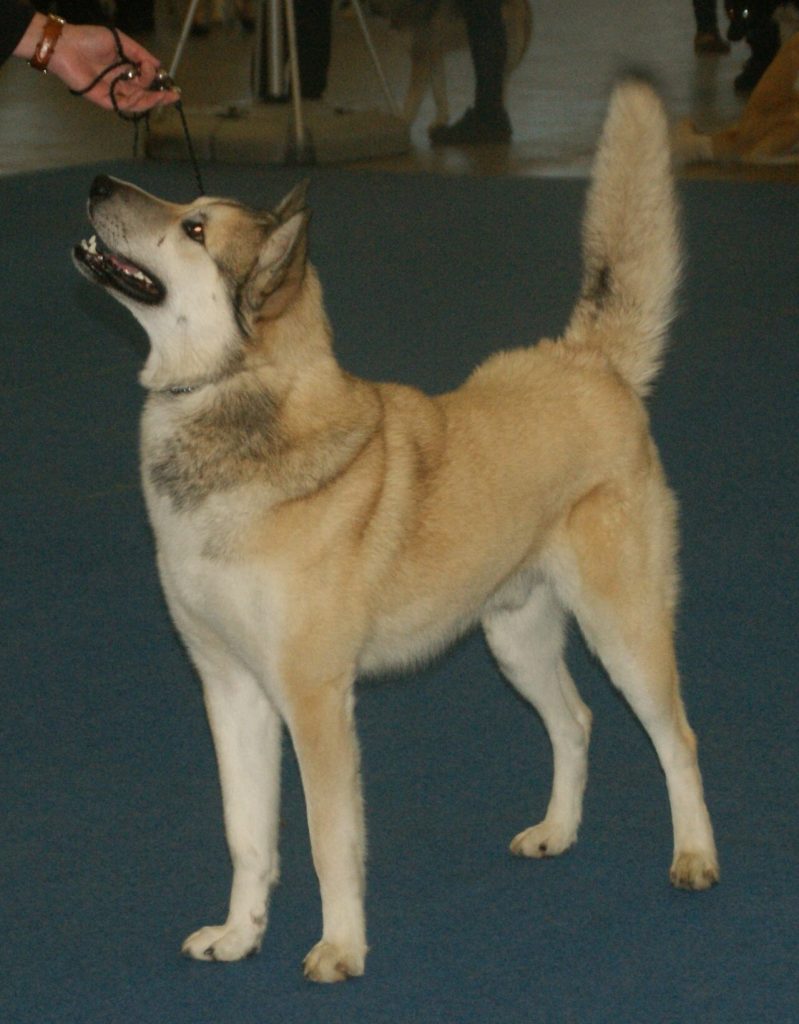
The Laika from Eastern Siberia is a spitz-type dog born in the taiga ranges east of the Yenisei River in immense Russian Siberia. He’s not just another pet. He is a born hunter, resistant to extreme cold, independent and deeply attached to work. If you are looking for a quiet couch mate, this is not your dog; if you are attracted to a rustic, balanced animal with an age-old canine passion, the East Siberian Laika deserves further reading.
Is the East Siberian Laika for you?
Before you fall in love with her wolf face , you better be honest . The East Siberian Laika is a primitive breed, bred for centuries to hunt autonomously in the taiga. That inheritance dictates almost everything you need to know. It is a healthy, long-lived, loyal dog, but also stubborn, with an intense hunting instinct and a need for activity that few urban families can meet. Here’s the honest balance sheet.
In favour .
- Robust and rustic: it is mildly sickly and resistant to extreme cold.
- Balanced and not aggressive with people.
- Intense bond with its owner and good natural warning.
- Smart and resolute when he works.
- Low-maintenance fur most of the year.
- Longevity: with good care, the decade passes with ease.
Against
- High hunting instinct: not to be trusted loose without training.
- High energy; a floor without exercise frustrates him.
- Independent and stubborn: blind obedience is not his thing.
- It can be dominant with dogs of the same sex.
- Seasonal mould abundant twice a year.
- Rare breed outside Russia: difficult to find and socialize.
Character and temperament

The East Siberian Laika has a strong, stable and well-balanced character, the result of generations of selection for its usefulness and not for its docility. With people, he’s surprisingly kind. aggression towards humans is not inherent in the race and, in fact, would be penalized. That doesn’t mean I’m soft. It is a self-confident dog, attentive to its surroundings and endowed with a natural sense of vigilance that, in its native Siberia, also made it a guard of the camps.
What really defines this laika is his hunting passion. It’s programmed to detect, chase and corner pieces on its own, barking to alert the hunter. That autonomy translates, in domestic life, into independence and a little head that decides for itself when it’s worth listening to you. It is not a stupid dog – it is one of the most intelligent of the primitive breeds – but its intelligence is that of a hunter who resolves, not that of an obedient dog who waits for orders.
With its family it is affectionate and deeply attached to one or two people of reference. Reserved but not afraid of strangers, it usually observes before accepting. It is a dog of solid temperament, rarely nervous or reactive without reason, and extraordinarily well adapted to hard work in the most severe conditions.
Coexistence: children, other pets, flat and loneliness
With children: balanced and patient with the children in the house with which he has been raised, always under supervision and with the usual norms of respect.
With other pets:‘s prey instinct is very high, so coexistence with cats, rabbits, birds or rodents is complicated and rarely recommended without very careful early socialization.
Floor and solitude: is not a breed designed for the apartment. It does not tolerate boredom and inactivity well, and an East Siberian Laika without stimulation becomes noisy, destructive or escapist. Ideally a house with well-fenced terrain – it is a jumper and excavator – in a cool climate. It tolerates loneliness well if it has exercised enough, but not the prolonged loneliness of the entire day locked in.
Education and training
Raising a Laika is an exercise in patience and mutual respect. He learns quickly when he understands the meaning of what you ask him, but his independence will make him question repetition without purpose. Forget hard methods: they respond fatal to coercion and very well to positive reinforcement, games and tasks with a clear goal.
- Early socialization and abundant: people, dogs, noises, environments.
- Call and dam impulse: works the call from a puppy, but it assumes that a Laika thrown after a trail can’t hear you.
- Short and varied sessions to keep their interest; monotony is their enemy.
- Consistency and serene leadership: clear and stable standards, no shouting.
It’s not the ideal breed for a first-time owner who wants an obedient “book” dog. It is for someone who values an autonomous mind and enjoys working side by side with a hunter.
Exercise and activity
It is a high-energy dog with an almost inexhaustible work capacity. In its original environment it travels kilometers of taiga for whole days, so a couple of short walks are not enough for it. It needs daily intense exercise: long walks, hiking, running alongside the bike, and above all activities that put its smell and its instinct to work.
A physically tired and mentally stimulated East Siberian Laika is a quiet dog at home; a bored one is a problem. Activity is not a whim with this breed: it is a structural need.
Care: fur and hygiene
The mantle is a medium-length double coat designed for the Siberian winter: a straight, rough outer layer that repels water and snow, and a dense, woolly undercoat that insulates from the cold.
Maintenance is easy most of the year: A weekly brushing is enough to remove dead hair and keep the coat healthy. The exception is two seasonal seedlings(spring and autumn), in which the undercoat is shed in abundance and should be brushed daily. It does not need frequent baths – its hair is quite self-cleaning – nor haircuts, which are actually counterproductive in a double-coated breed. Check your ears, eyes, teeth, and nails regularly, and watch your pads if you are working on rough terrain.
Foodstuffs
As a rustic working dog, the East Siberian Laika makes good use of food and is rarely demanding. The important thing is to adjust the ration to its actual activity level: a dog that hunts or trains daily burns a lot of energy and needs high-quality feed, rich in animal protein, while a more sedentary dog easily gains weight if overfed.
Basic guidelines: quality food adapted to its age and wear, distribution in two daily intakes, water always available and weight control (must be kept lean and muscular, without covering the ribs with fat).
Health and life expectancy
One of the great advantages of primitive breeds little modified by man is their genetic hardiness. The East Siberian Laika is a healthy and hardy dog, with a low incidence of the inherited diseases that plague many fashionable breeds.
There is no long list of associated pathologies, precisely because of their functional origin and genetic variability. Still, it’s good to stick to the sensible guidelines of any breed: periodic veterinary checks, daily vaccination and deworming, weight monitoring and joint care (hip or elbow dysplasia, common in many medium breeds) in breeding animals. Choosing a serious breeder who prioritizes health and temperament is the best guarantee. Its dense coat protects it from the cold but makes it sensitive to heat: Watch out for heatstroke in the summer.
Physical appearance

The East Siberian Laika is the largest of the Russian Laika. It is a medium to large sized dog, of robust build and strong bones, practically square in its proportions and slightly higher at the cross than at the grouper. The males measure between 55 and 66 cm at the cross and the females between 51 and 60 cm; the weight is not strictly fixed by the standard and varies quite a bit with the type, being orientally around 18-30 kg.
The head, somewhat variable in shape depending on the regional variety, ends in erect and highly mobile triangular ears. The tail, hairy, is coiled over the back or flank, spitz-style. The expression is attentive and lively, with dark eyes of wakeful gaze. As for the colour, the breed admits of great diversity: black and fire with light spots (called karami), grey (grey or rough), white, grey, black, red and brown in all their shades, as well as specimens mottled or ticking. This chromatic variability reflects that it is still a more heterogeneous breed than other fully uniform breeds.
Origin and history

The origins of the East Siberian Laika are lost in the history of the nomadic peoples who inhabited the huge Siberian strip between the Yenisei River and the Kamchatka Peninsula. Tribes such as the Evenki, the Lamut (Even), the Yakut, the Tungus or the Amur peoples bred for centuries versatile dogs that were used to hunt, herd reindeer and pull sleds. From those aboriginal dogs, adapted to survive in one of the harshest climates on the planet, descends the modern Laika.
The process of fixation as a race came in the 20th century. In 1947, at the All-Soviet Union Cynological Congress, the name of the breed was established from dogs from the Lake Baikal region, Irkutsk Oblast, Evenkia Autonomous District, the Amur River basin and coastal areas. The first standards were approved in 1949, although systematic and directed breeding did not begin until the 1970s, in state kennels in Irkutsk and Leningrad. Finally in 1980-1981 the Federación Cinológica Internacional (FCI) officially recognized the breed, which today is classified in the Group 5 (spitz and primitive type dogs), Section 2 (Nordic hunting dogs), with the standard number 305.
Within the breed, several regional types coexist – the main ones are the evenki and the Irkutsk, along with other minor ones such as the Yakutia, Amur or Tofolar – which differ slightly in color and constitution.
Curiosities
- The Russian word layka is derived from the verb “bark”: these dogs hunt by locating the piece and warning with their barking until the hunter arrives.
- It is the largest of the Russian Laika recognized by the FCI, ahead of the Western Siberian Laika and the Russian-European Laika.
- A 2011 genetic study found that the East Siberian Laika shares the Y chromosome haplogroup HG9 with the Basenji, the famous “no-barking” dog from central Africa.
- In its native taiga it not only hunts: traditionally it has also served as a guard dog of the camps and as a shooting animal.
- It is an all-terrain hunter capable of working both the smaller game of hair and feathers (ardilla, marta, cibelina, urogallo) and the larger game (moose, brown bear, wild boar).
If you’re attracted to the rustic character and spitz heritage of the East Siberian Laika, you’ll probably enjoy meeting other Nordic and primitive breeds it shares a family air with. Check out the Husky Siberiano, Samoyedo, Akita and Chow Chow, all double-coated bitches with strong personalities and cold climate roots.
Frequently Asked Questions About the East Siberian Laika
Is the East Siberian Laika a good family dog?
It can be in the right family: it is balanced, loyal and good with the children in the house. But it is a working dog with a lot of energy and hunting instinct, not suitable for those looking for a quiet indoor pet. It needs exercise, space and an active owner.
How long does an East Siberian Laika live?
Their life expectancy is around 12 to 15 years. They are a rustic and healthy breed, with a low incidence of hereditary diseases, which favors a remarkable longevity for their size.
Can you have an East Siberian Laika in a flat?
It is not ideal. It is a high-energy breed accustomed to traveling long distances; in a floor without sufficient exercise it tends to get bored and develop destructive or noisy behaviors. It works much better in a house with fenced terrain and cool climate.
Do you get along with cats and other animals?
Its prey instinct is very high, so coexistence with cats, rodents or birds is difficult and not recommended without early socialization.
Is it hard to train?
It is intelligent but independent and stubborn, a product of its past as an autonomous hunter. It learns well with positive reinforcement, short sessions and meaningful tasks, but it is not the breed for whom blind obedience is sought. It responds poorly to harsh methods.
How much hair does it shed and what care does its coat need?
It has a double coat and changes abundantly twice a year (spring and autumn), when it has to be brushed daily.
How big is the East Siberian Laika?
The males measure between 55 and 66 cm at the withers and the females between 51 and 60 cm, with an indicative weight of about 18 to 30 kg depending on the type and sex.
Where do you come from and what FCI group do you belong to?
It comes from eastern Siberia, Russia, from the dogs of the nomadic peoples of the taiga. The FCI recognized it in 1980-1981 and classifies it in Group 5 (spitz and primitive type), Section 2 (Nordic hunting dogs), standard number 305.