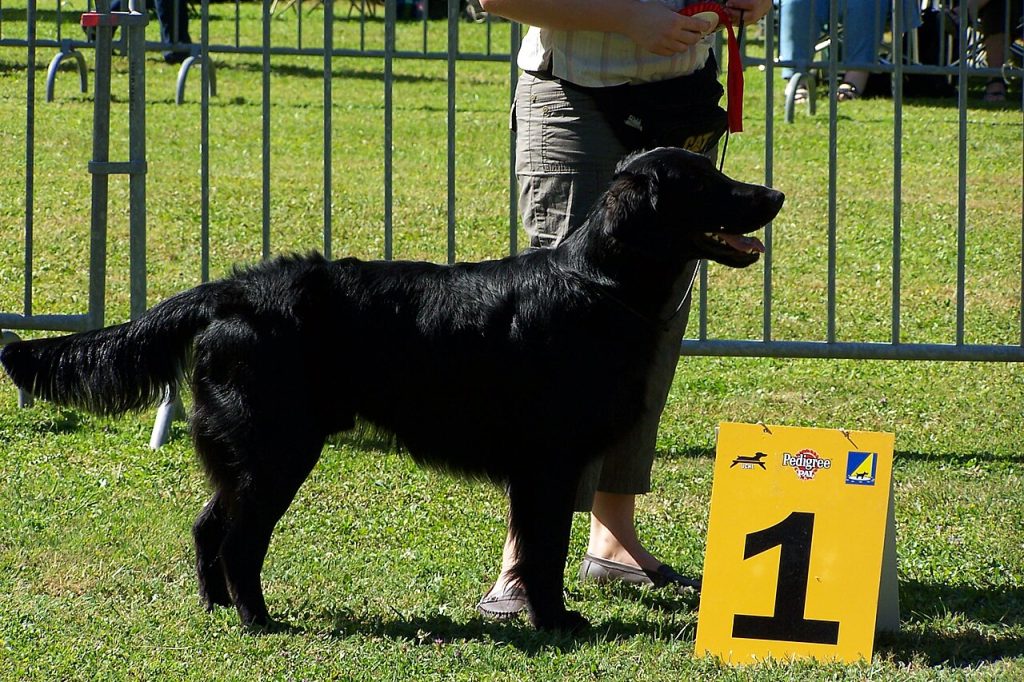
The Other, of circular cross-section, of iron or steel– known in English as the Flat-coated Retriever and also called the Smooth-haired Retriever – is a British, elegant and athletic collection dog, bred to recover the downed piece both on land and in water. Cheerful, sociable and tireless, he is the eternal puppy among the retrievers: An enthusiastic family companion who never stops growing and who demands, in return for his wonderful character, plenty of exercise and companionship.
Is the straight-haired collector for you?
Before you fall in love with their friendly face, it’s best to take a hard look at what it’s like to live with this breed.
In favour .
- Exceptional temperament: affectionate, balanced and sociable with everyone.
- Very smart and easy to train, with a huge desire to please.
- Great with children and other dogs; not prone to aggression.
- Versatile: hunting, gathering, agility, obedience, rescue, detection or therapy.
- He retains a youthful and playful spirit throughout his life.
To be taken into account
- He needs plenty of daily exercise; he gets bored and becomes destructive if he doesn’t have it.
- Slow ripening: years of teenage energy and bustle.
- High predisposition to cancer and relatively short life expectancy.
- It loosens hair and requires regular brushing.
- He’s no good as a guard dog. He’s too friendly.
Character and temperament

If there ‘s one word that defines the smooth-haired collector , it ‘s optimism. It’s a cheerful, confident dog deeply attached to its family, with an almost physical need to participate in everything its humans do. His eagerness to please is legendary and accompanied by remarkable intelligence: The breed ranks 18th – out of 131 – in Stanley Coren’s celebrated canine intelligence rating, categorized as a fast-learning working dog.
Author Paddy Petch, in The Complete Flat-Coated Retriever, nicknamed them the “Peter Pan” of retrievers, because they retain a puppy attitude well into old age.
It protects its family and territory with a firm warning bark, but rarely backs up that noise with real aggression. It is simply too sociable: it welcomes strangers as friends it does not yet know. That is why it is a terrible guard dog and an excellent companion dog.
Coexistence: children, other pets, flat and loneliness
With children: is one of the best breeds possible. Patient, tolerant and playful, it greatly enjoys the little ones. The only precaution is its size and its enthusiasm: a young smooth-haired Cobbler may unintentionally throw a small child in a fit of joy, so games must be supervised.
With other pets: lives very well with other dogs due to its non-conflicting nature, and usually accepts cats if it grows up with them.
On the floor: is possible, but demanding. It needs long and frequent outings, and without them it is frustrated. It is better suited to a house with a garden where it can move, although the garden is never a substitute for walking.
In the face of loneliness:‘s weakness is that it’s a dog that lives for its family and frankly can’t stand to be alone for long hours. Prolonged loneliness causes it to be anxious, barking and destructive. It’s not a breed for someone who spends the whole day outdoors.
Education and training

It combines intelligence, memory, and a willingness to work, so it assimilates commands quickly and responds wonderfully to positive reinforcement, treats, and play. It is a sensitive breed: harsh or punitive methods drown it and make it insecure, while the gentle and motivating tone brings out the best in it.
His only Achilles heel is boredom. He gets tired of mechanical repetition, so the sessions should be short, varied and funny. Alternating exercises, introducing collecting sets and changing scenery keeps his attention much better than twenty repeats in a row of the same command.
Early socialization is the key to channeling their boisterous enthusiasm. The sooner they get to know people, dogs, environments, and noises, the better they will handle their overflowing joy as adults. A puppy well socialized and with clear boundaries becomes an educated adult; one without a guide, a sympathetic but exhausting stalker.
Exercise and activity
There are no shortcuts here: the smooth-haired cobbler is a hardworking athlete and needs to burn a lot of energy daily. As a reference, between one and two hours physical activity spread out at various times of the day, supplemented with mental stimulation. A dog that just walks the fair ends up developing anxiety, barking and destructive behaviors.
He loves running, swimming – he is a natural swimmer – and above all the work of collecting: throwing a dummy or a ball to him again and again is his idea of paradise. He also excels in canine disciplines such as agility, obedience, mantrailing, rescue or field tests.
Care: fur and hygiene
The smooth-haired cobbler’s coat is only one layer(no dense undercoat), smooth, shiny and of medium length, with characteristic fringes on the legs, chest, belly, tail and ears.
It does not need frequent bathing; it is enough to do it when it is really dirty, using specific shampoos for dogs. It is advisable to check and clean their hanging ears regularly, because they accumulate moisture – especially in a dog so fond of water – and can become infected.
Foodstuffs
As a large, active and fast-growing dog, the smooth-haired cobbler needs a quality diet well adjusted to its life stage. During the puppy and young it is suitable a feed for large breeds in growth, which controls the supply of calcium and energy to protect the development of the joints and prevent problems such as hip dysplasia.
In the adult, the diet should be adapted to his actual level of exercise: A dog that works or exercises a lot spends a lot more than a quiet dog. Although it is not as prone to overweight as the Labrador, the scale should not be neglected, for excess weight overloads the joints and aggravates any health problems. Divide the food into two servings a day and always have fresh water available; when in doubt, it is best to check with your veterinarian.
Health and life expectancy

Health is, unfortunately, the most delicate aspect of the race. Their life expectancy is around 10 to 12 years old; a British study from 2024 placed it at around 11.7 years, somewhat below the average of pure breeds. The main motive is a significantly elevated cancer risk: Health surveys in the U.K. attributed about half of race deaths to some type of tumor. The most common are cutaneous histiocytomas and soft tissue sarcomas, and especially devastating are hemangiosarcoma, fibrosarcoma, osteosarcoma and malignant histiocytosis.
In addition to cancer, responsible breeders test for the breed’s most common hereditary conditions: hypoplasia of the hip and eye diseases like progressive atrophy of the retina and glaucoma. Occasionally epilepsy is also observed. Buying from a serious breeder who examines breeders, keeping veterinary checks up to date, and monitoring for the appearance of any lumps are the best tools to maximize the quality and life expectancy of these dogs.
Physical appearance
The smooth-haired cobbler is a medium-sized dog, lighter and stylized than other retrievers, with a harmonious silhouette that conveys elegance and athletic ability.
Its most distinctive feature is the head, described in the standard as “one piece”: long, with a smooth frontonasal (stop) transition and a posterior part of the skull similar in length to that of the snout, without a marked occiput. It has a dark brown almond eyes with an intelligent and friendly expression, small dangling ears glued to its head, arched neck and a firm dorsal line that ends in a straight, well-populated tail of freckles.
The standard colors are black(the most common) and liver(brown). There is also a rare solid yellow specimen that is considered a disqualification in beauty exhibition, although it can compete in field, agility or obedience.
Origin and history
The smooth-haired cobbler was born in England in the mid-19th century, where it earned a place as a favorite dog of rangers and hunters. Some of their ancestry is thought to have come from dogs imported from North America – the now extinct st. John’s water dog(St. John’s water dog) – brought to British ports by Canadian sailors together with Newfoundland, although this origin is not fully verified. To that base would have been added Collie-type dogs to reinforce their learning ability, Newfoundland for Setter’s strength and blood to sharpen their sense of smell.
The first specimens appeared around 1860 and the definitive type was fixed some twenty years later. After its arrival in the United States it quickly gained popularity as a hunting dog; the American Kennel Club officially recognized it in 1915. Shortly thereafter, however, its fame declined, eclipsed by the Golden Retriever – bred in part from the Flat-coat itself. By the end of World War II, so few were left that the survival of the breed was in danger. It was not until the 1960’s that a careful breed recovered it, and since then it has enjoyed modest but stable popularity, appreciated for its relative health, versatility, and matchless temperament.
Curiosities
- It is nicknamed the “Peter Pan” of the retriever because it retains its youthful and playful character into old age.
- The Golden Retriever is partly descended from the Smooth Coated Cobbler, not the other way around: the Flat-coat is the oldest breed.
- Thanks to its exceptional sense of smell, it is used as a drug-detecting dog and in rescue work.
- It is part of the Guide Dog Breeding Programme for the Blind in the UK, both pure and crossed with Labrador.
- He has triumphed at Crufts, the world’s largest dog show: he won Best in Show in 1980, in 2011 and again in 2022.
- His relative lack of popularity has been a blessing – by raising less, he has better preserved his fitness and health.
If you are attracted to the smooth-haired Cobbler because of its gentle nature and energy, you may also be attracted to other hardworking, collector breeds with a similar temperament. You can continue to explore the Golden Retriever, its close relative; the ever-popular Labrador Retriever; the sleek Vizsla, another versatile hunting dog attached to its family; or the highly intelligent Border Collie if you’re looking for a mind that doesn’t stop working.
Frequently Asked Questions About the Smooth Hair Collector
Is the smooth-haired cobbler a good dog for families with children?
Yes. It is one of the most sociable and tolerant breeds there is: affectionate, patient and with a stable temperament that makes it very compatible with children. Of course, it is a large dog and overflowing with energy, especially when young, so it is advisable to supervise games with small children to avoid accidental pushes or falls.
How much exercise do you need a day?
At least 1 to 2 hours a day of physical and mental activity spread over several walks, plus play, swimming or collective work. It is an athletic hunting dog that is not satisfied with a turn to the apple: if it does not expend energy, it tends to develop destructive behaviors or bark out of boredom.
How long does a straight-haired cobbler live?
Their life expectancy is around 10 to 12 years. A British study from 2024 placed the average at around 11.7 years, somewhat below the average of pure breeds. The breed has a high predisposition to cancer, which is its main limiting factor of longevity.
Do you lose a lot of hair?
Yes, it moults moderately throughout the year and more intensely in spring and autumn. Its mantle is one layer, smooth and of medium length, with fringes on the legs, chest, tail and ears.
Is it easy to train?
It is among the most intelligent and obedient breeds according to Stanley Coren’s classification, with a huge desire to please. It learns quickly with positive reinforcement. Its only weakness is that it is bored with repetition: it works best with short, varied and fun sessions.
Does it serve as a guard dog?
No. It warns with a firm bark if it detects anything strange, but is too friendly and trusting with strangers to have guard or defense instincts. Its natural role is that of companion and working dog, not guard dog.
Can he live in a flat?
It may be, but it is not ideal. It is a large and very active dog that needs long and frequent outings. If it lives on the floor, the owner must guarantee it plenty of daily exercise and stimulation; it adapts better to a house with a garden where it can move around.
What’s the difference between the Golden and the Labrador Retriever?
They share a common origin and amiable character, but the smooth-haired Cobbler is lighter, more elegant and athletic, with a characteristic “one-piece” head and smooth black or liver coat.