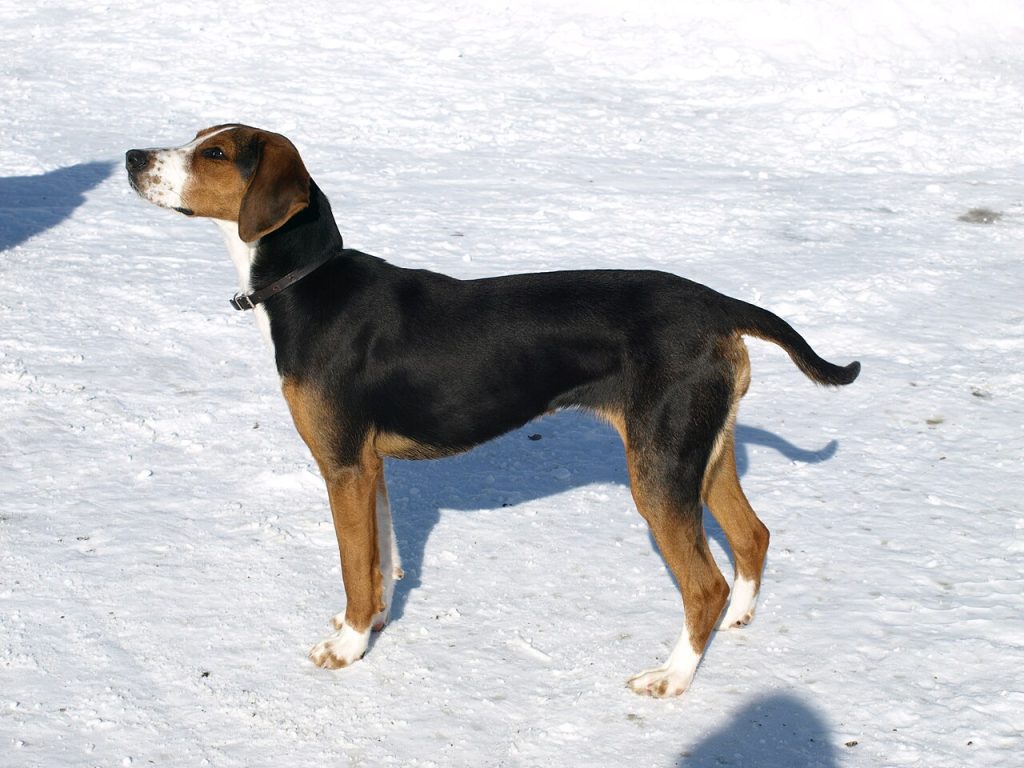
The Finnish hound(i love you.) is Finland’s hunting dog par excellence: a medium-sized tricolor hound, bred for generations to track hare and fox in rugged terrain and deep snow. Outside the forest, he is a quiet and friendly companion, but you should get to know him well before deciding: His tracking instinct, his inexhaustible stamina and his passionate barking mark his character and completely condition the life he needs.

Is the Finnish Hound for you?
The Finnish Hound is a working dog rather than a companion dog, and that’s the key to knowing if it fits you. It’s loyal, balanced and not aggressive, but its head is designed to follow a trail for hours. If you’re looking for a tireless hunter and a serene companion at home, it’s a magnificent breed; if you live in a small apartment, travel a lot, or can’t get enough exercise, it probably frustrates both of you.
In favour .
- Quiet, friendly and balanced temperament at home.
- Not aggressive: sociable with people and other dogs.
- Huge physical endurance; ideal for hunting and outdoor sports.
- Short coat and easy to maintain.
- Robust and rustic, adapted to cold and rough terrain.
- Exceptional sense of smell and tracking ability.
Against
- He needs a lot of exercise. He’s not a couch dog.
- It barks with force and passion as it follows a trail; unsuitable for floors.
- Strong hunting instinct: it goes after a scent and doesn’t hear calls.
- He works independently, which makes obedience difficult.
- It requires safe terrain; running loose unchecked is risky.
- Rare breed outside Finland and the Nordic countries.
Character and temperament
The breed standard describes the Finnish Hound with two traits that define its essence: it is quiet and friendly, and he should never be aggressive.. In everyday life it is a serene dog, affectionate with its family and sociable with strangers, far from the reserved or distrustful character of other guard breeds.
That domestic calm coexists with a completely different personality when it goes into hunting mode. On the trail he is energetic, tenacious and passionate: chases the piece with vibrant barks and a determination that doesn’t give in easily. The Finnish Hound is a hunter like works independently, making his own decisions on the ground without waiting for constant orders. That autonomy, so valuable in the mountains, is also what makes it less “obedient” than a herding dog or a retriever.
Understanding this twofold aspect is essential: at home you will have a companion who is balanced and easy to deal with, but as soon as he catches an interesting smell his tracking instinct takes over. It is not stubbornness or bad manners; it is simply a dog doing what he has been selected for for a century and a half.
Coexistence: children, other pets, flat and loneliness
With children. Its gentle temperament and absence of aggressiveness make the Finnish Hound a good family dog. It is patient and tolerant, and enjoys company. As with any medium-sized and high-energy dog, it is advisable to supervise play with small children and teach the youngest to respect their rest times.
With other dogs. was bred to hunt and live with other hounds, so it usually gets along well with dogs and enjoys group life.
With cats and small animals. This is a case of extreme caution. We are talking about a hound with highly developed prey instinct, selected to chase hares and foxes. Coexistence with cats or other small pets is difficult and not always safe; if attempted, it must be done with very early socialization and without ever lowering the guard.
On the floor. is not its ideal habitat. Its size, its need for exercise and, above all, its powerful barking make it unsuitable for an apartment. It is much better suited to a house with access to outdoor space and, very especially, to life in the countryside.

Soledad. is a sociable dog that needs company and activity. Left alone for many hours and without stimulation, it can become bored and develop undesirable behaviors, including barking.
Education and training
Educating a Finnish Hound requires understanding its independent hound nature. It is an intelligent dog, but it is not “wired” to please the human at all costs like a border collie; it is designed to follow a scent on its own. This means that obedience, and especially the called, cost more and require constant and patient work.
Education works much better with positive reinforcement, appetizing rewards, and short, motivational sessions. Harsh or coercive methods are counterproductive with a dog of such a gentle character: they undermine their confidence without improving outcomes. early socialization– with people, other dogs, and varied environments – is an investment that pays dividends throughout life.
A realistic advice: no matter how well educated you are, you should never rely 100% on a dog’s call when there is a fresh trail in the way. In unfenced areas, it is wise to work with a long leash or in safe spaces. Accepting this limitation is part of living with the breed.
Exercise and activity
If there’s one point where the Finnish Hound doesn’t allow shortcuts, it’s exercise. It’s a working dog with extraordinary endurance, capable of tracking for hours on rough terrain. That machinery needs to be worn daily, and a short walk isn’t enough.
Ideally, provide intense and prolonged physical activity: Long walks, hiking, controlled racing, and of course hunting, for which it was created. He also appreciates the work of smell and tracking games, which channel his instinct and tire his mind as much as his body. A well-trained Finnish Hound is a quiet dog at home; one who does not vent his energy becomes restless and noisy.
Due to its structure and its double coat, it tolerates the cold and bad weather wonderfully: it is not a dog that stays at home because it rains or snows.
Care: fur and hygiene
In terms of maintenance, the Finnish Hound is one of the most grateful dogs. Its coat is short, dense and rough, double type, with an inner layer that insulates it from the cold. It does not require hairdressing or complicated care: a weekly brushing is enough to remove the dead hair and keep it clean, increasing it in moulting seasons.
The rest of the hygiene is the usual for any healthy dog. It is advisable to check and clean their drooping ears regularly, more prone to accumulating moisture and dirt, to prevent infections.
Foodstuffs
As an athletic dog of medium size (about 20-25 kg) and high energy expenditure, the Finnish Hound needs a complete and balanced diet, adjusted to its activity level.
It is advisable to divide food into two servings a day and avoid vigorous exercise just before or after eating. Being a voracious and very active dog, the best reference is his physical condition: You should feel the ribs without sticking out and maintain an athletic figure. When in doubt about quantities, type of food or supplements, it is wise to consult a veterinarian, especially in growing puppies and working dogs.
Health and life expectancy
The Finnish Hound is generally a rustic and hardy dog, but like all breeds it has predispositions that are worth knowing. The most relevant is a progressive cerebellar ataxia of hereditary origin: a very early onset disease (signs may appear as early as 3 months) that causes tremors, progressive loss of motor coordination and developmental delay. Its genetic cause has been identified – a mutation in the SEL1L gene – and there is a genetic testing that allows responsible breeders to avoid transmitting it. It is, therefore, a disease that can be prevented by choosing the breeding line well.
In addition, the breed may occasionally present with hypoplasia of the hip, cardiomyopathy, lymphoma, dysplasia of the black hair follicle and atopic dermatitis.
The best health insurance policy is to go to a serious breeder that performs the relevant genetic and orthopedic tests, and to maintain regular veterinary checkups, vaccination, deworming and a proper weight.
Physical appearance

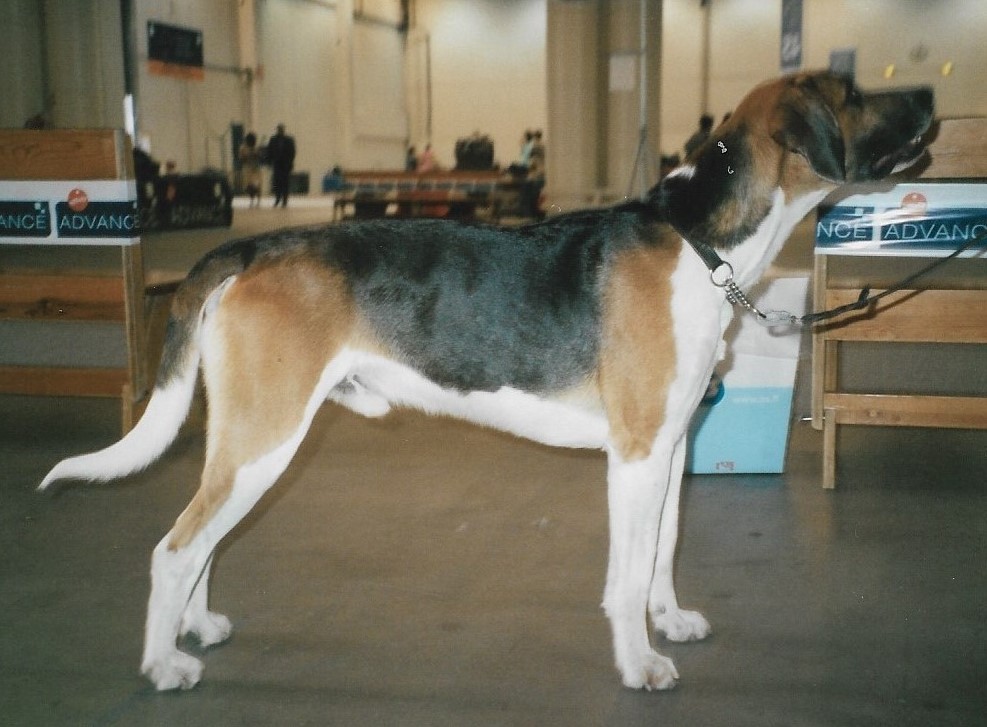
The Finnish Hound is a medium size and strong construction dog, longer than tall, with an athletic silhouette and well angled. The males measure between 55 and 61 cm at the cross and the females between 52 and 58 cm; the adult weight is around 20-25 kg.
Its head has a slightly domed skull and a snout as long as the skull itself, with a smooth but defined stop and a truffle that must be black. The eyes are dark brown, calm expression, and ears hang on the sides of the head. The bite is in scissors, complete and tight. The body is muscular, with a deep, well-marked chest, and the tail is low and slightly arched.
In movement it moves with a light and efficient trot, wide stride, keeping the upper line firm and level. The mantle is the classic tricolor: fire (toasted) and black predominate, with small white marks on the head, neck, chest, lower legs and tail tip.
Origin and history
The Finnish Hound is a relatively young breed, the result of a breeding programme started in the 19th century. Finnish breeders were looking for a hound capable of working in the country’s harsh conditions: rugged terrain, hills and deep snow.
The result was a tracking dog specialized in the hunting hare and fox, which chases the piece by being guided by smell and warns the hunter with a characteristic, sustained barking.
The popularity of the Finnish Hound in its homeland is remarkable: for decades it has been one of the most registered breeds in Finland, reaching to occupy the second most popular breed of the country according to 2013 records.
Curiosities
- Its Finnish name, i love you., literally means “Finnish hunting dog” (they’re sweating= from Finland, other= hound/hunting dog).
- It’s a rare case of a dog that combines absolute calmness at home with total intensity at work: two personalities in one animal.
- It was born from the mixture of three European dog breeding traditions – French, German and Swedish – adapted to the Finnish cold.
- Thanks to genetic research, the cerebellar ataxia that once affected the breed can now be prevented with a simple DNA test, an example of modern responsible breeding.
- It is one of the most popular hunting dogs in Finland, but practically unknown in southern Europe.
If you are attracted to the Finnish Hound’s profile – a hardy, sociable dog with a wonderful sense of smell – you may be interested in other hunting or tracking breeds with which it shares character and needs. You may meet the unmistakable Beagle, another cheerful dog with an infallible nose; the imposing Bloodhound, the quintessential tracker; the eary and quiet Basset Hound; or the sleek and versatile Vizsla, another great hunting and companion dog.
Frequently asked questions about the Finnish Hound
Is the Finnish Hound a good family dog?
Yes. Its temperament is calm, friendly, and never aggressive, making it a good companion for active families. Of course, it needs a lot of exercise and fits much better in a house with space or in the countryside than in a flat.
Does he bark a lot?
It’s a dog bred to warn the room with a loud, sustained bark, so yes, it has a voice and tends to use it, especially when it’s following a trail or getting bored, which is why it’s not the most suitable dog for an apartment with close neighbors.
Can you have a hound on a floor?
It is not ideal. Its medium size, its enormous need for exercise and its barking make it unsuitable for apartment living. It is much better suited to a house with outdoor access and to a rural or semi-rural environment.
Do you get along with other dogs and cats?
It usually gets along very well with other dogs: it was bred to hunt in groups and is sociable. With cats and small pets it is another story; its prey instinct is strong and coexistence is difficult, requiring very early socialization and constant supervision.
How much exercise do you need a day?
It is a working dog with exceptional endurance that needs intense and prolonged daily physical activity: long walks, hiking, controlled running, hunting or sniffing games. A simple short walk is not enough to keep it balanced.
Is it easy to train?
It’s intelligent, but it works independently as a good hound, so obedience and calling costs more than other breeds. It responds well to positive reinforcement and early socialization, but you should never rely 100% on its call when there’s a trail in between.
What health problems might you have?
Its most characteristic hereditary condition is progressive cerebellar ataxia, now preventable by genetic testing. It may also occasionally present with hip dysplasia, cardiomyopathy, lymphoma, hair follicle dysplasia and atopic dermatitis.
Where did the Finnish Hound come from?
It is a Finnish breed developed in the 19th century by crossing French, German and Swedish hounds, with the aim of creating a tracking dog capable of working in hills and deep snow.