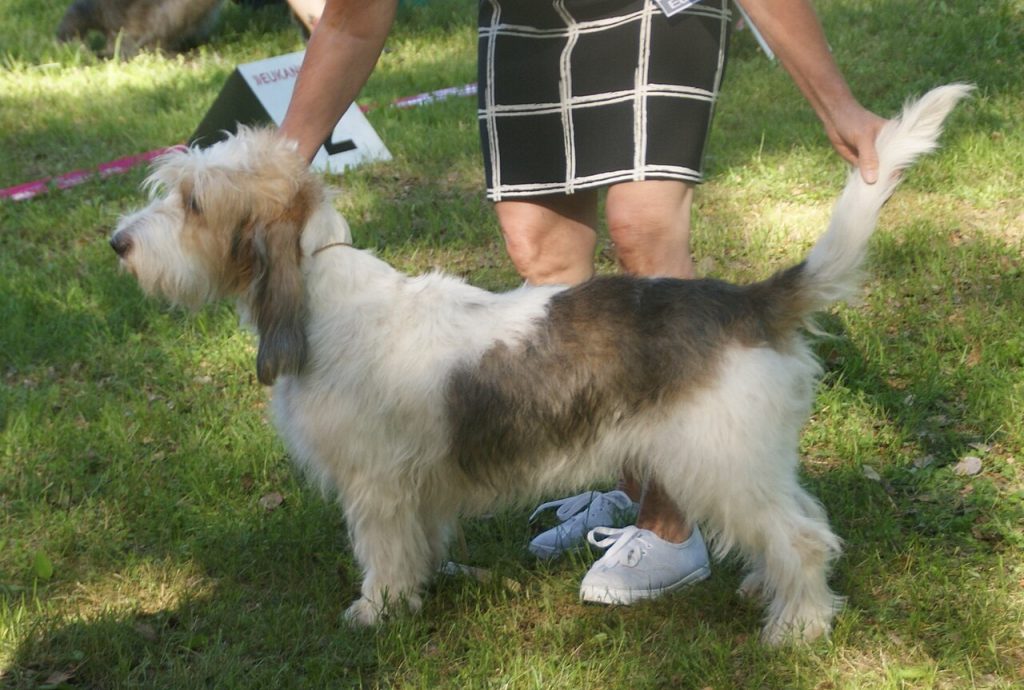
The Gran Basset Grifón Vendeano(Grand Basset Griffon Vendéen or GBGV) is a French hound breed from the Vendée region: Short legs, long body, rough griffin fur and a prodigious sense of smell. Brought up to hunt hare and other game with a tireless stamina, today he is also a cheerful, sociable and surprisingly elegant family companion under his unkempt appearance. This is the dog for anyone looking for a heart hunter who also fills the house with good humor.
Is the Great Basset the Vendian Gryphon to you?
Before you let yourself be conquered by those eyebrows and that beard, you should know that the Great Basset Vendeano Griffin is, above all, a hunting dog with energy and personality. It shines in the hands of active owners who value its independent character and do not expect the mechanical obedience of a shepherd. These boxes summarize for whom it fits and for whom it does not.

It’s a good fit if…
- You’re an active person or family, with time for long walks and daily sniffing.
- You want a dog that’s sociable, cheerful and good with kids and other dogs.
- You like a rustic companion, not delicate and of good physical background.
- You value a sparkling character and don’t mind a point of stubbornness.
- You can offer him a safe garden or plenty of outdoor activity.
Think about it if…
- You spend a lot of time outdoors. Prolonged solitude is not good for you.
- You seek immediate obedience with no margin for independence.
- You’re bothered by a loud bark or the typical hound howl.
- You can’t guarantee a well-fenced space (it’s escapist and excavator).
- You want a sedentary dog with little exercise.
Character and temperament
The Great Basset Vendean Gryphon has a happy, self-confident and curious personality. It is an extroverted dog that rarely shows nervousness or shyness: its thing is to explore, smell and participate in everything that happens around it. This confidence, combined with its intelligence, makes it a funny and expressive companion, although also somewhat mischievous.
As a good pack dog, it is sociable by nature and enjoys both human and canine company. The counterpart to their security is a tendency to stubbornness: When your nose picks up an interesting trace, it can become selectively deaf. It is not a dominant or quarrelsome dog, but it does have a will of its own and responds much better to good humor and patience than to imposition.
Coexistence: children, other pets, flat and loneliness

With the children it is usually an excellent companion: patient, playful and resistant to drag.
With other dogs he understands wonderfully, the result of his past in a pack; life in the company of another dog feels especially good to him. With cats and small pets you have to be careful: his hunting instinct is strong and can be activated before an animal that runs.
As for the floor, it can adapt if given plenty of exercise, but its powerful voice and its fondness for howling are a factor to consider in communities with close neighbors.
Education and training
Training a Great Basset Vendean Griffon is a rewarding exercise in patience. It is smart and learns quickly what motivates it, but its independence as a hound makes it not always willing to obey, especially if there is an irresistible smell in the middle. The key is to start early, use short, fun sessions, and rely on positive reinforcement with rewards and play.
Two fronts deserve special attention. The first is the called: as a nose dog, it tends to go after a trail, so it is advisable to work around from a puppy and be realistic with loose in unenclosed areas. The second is the management of barking, channeling its energy so that it does not vocalize out of boredom.
Exercise and activity
This is a hunting dog and it is noticeable: it has resistance, it does not get tired easily and needs to burn energy daily. Ideally, it should be given between one and two hours of distributed activity, combining long walks, games and, very importantly, sniffing time, which for it is as exhausting and satisfying as running.
It enjoys activities that stimulate its nose, such as tracking work or search games, and also a good run in a safe fenced area. A GBGV that gets enough exercise is a calm and balanced dog at home; one that doesn’t will seek its own amusement, almost always in the form of scratching, barking or exploring the neighborhood on its own.
Care: fur and hygiene

The coat of the Vendean Great Basset Griffon is hard, rough, and unkempt in appearance, with eyebrows, beard, and mustache giving it its unmistakable expression, plus a dense inner layer. It doesn’t require complicated hairstyles: With a weekly brushing it keeps free of tangles and removes dead hair. The mucus is moderate. Those who prefer to retain the rustic texture of the coat occasionally resort to hand-stripping, although this is not essential for a companion dog.
The ears, long and hanging, are its sensitive point: as they are poorly ventilated, they retain moisture and wax, and are prone to otitis, so they must be checked and cleaned regularly.
Foodstuffs
The Great Basset Vendean Griffin needs a complete and balanced diet, adjusted to its medium size and its activity level, which is usually high. A high-quality feed or a well-formulated diet, divided into two daily servings, covers their needs well. As a greedy dog with a good appetite, it is wise to measure rations and control rewards to avoid overweight, which would punish its elongated back and joints.
Water that is always fresh and available is essential, especially after exercise.In the case of weight changes, allergies or digestive problems, it is best to adjust the diet with the veterinarian rather than improvise.
Health and life expectancy
It is a rustic and generally healthy breed, with an estimated life expectancy of about 12 to 14 years. In a 2004 British Kennel Club survey of Vandean griffins, the average longevity was 12.1 years, with specimens reaching over 17. The main causes of recorded mortality were those of advanced age, together with tumour and cardiac processes, a pattern similar to other races of comparable size.
Among the most common incidences in everyday life are ear infections, favored by their long ears, and some dermatological problems. As in all dogs with a long body and short legs, it is advisable to take care of the back avoiding overweight and sudden jumps.
Physical appearance
The Great Basset Vendean Griffin is a medium-sized hound with a robust build and a silhouette clearly longer than tall. The FCI standard fixes the height at the withers between 40 and 44 cm on males and females, and the weight is around the 18 to 20 kg. Its short-legged structure and elongated back, without falling into exaggeration, gives it stamina and agility for field work.
The head, not too large, bears crowded eyebrows, a beard, and a moustache that frame a lively, friendly look. The ears are thin, long and fallen, covered in hair and finished at the tip. The coat, hard and rough to the touch, features as a base the white combined with black, lionskin, gray or tricolor combinations. The tail, wide at the base and tapering toward the tip, is carried upright in alertness, like a scythe.
Origin and history
The Grand Basset Vendean Griffin comes from the French region of Vandea (Vendée) and descends from the Grand Vandean Griffin, the largest hound from which all Vandean varieties are derived. The first selections were made in the late 19th century by Count d’Elva, who was looking for specimens of straight legs, but it was Paul Dézamy who really fixed the type. He realized that to hunt the hare, a dog of a certain size was needed, and he set the size at about 17 inches.
The breed is part of the basset-type varieties recognized by the Fédération Cynologique Internationale, which classifies it in the Grupo 6(saubes and similar breeds), and was recognized definitively in 1967. For decades it lived and crossed with its small relative, the Petit Basset Vandean Gryphon, until in 1975 the crossing between the two was banned to fix each type. Designed for shotgun hunting, the Vendean Great Basset Griffin is capable of working all types of pieces, from rabbit and hare to wild boar and roe deer, and a team of the breed went on to win an edition of the European Hare Hunting Cup.
Curiosities
- Its name describes it in full in French: large(large), basset(short-legged), gryffon(hard-haired) and they sell(from La Vandea).
- It is the largest of the four Vandean Griffons and should not be confused with its smaller version, the Petit Basset Vandean Griffon.
- Their distinctive facial freckles – eyebrows, beard, and mustache – are not just aesthetic – they protect the dog’s face from weeds during hunting.
- The scythe-shaped tail, always high, helped the hunter locate the dog among the dense vegetation.
- His sonorous, melodious voice was a working tool: it allowed him to follow the dog by the ear when the trail took him away from sight.
If you’re attracted to this short-legged, strong-willed French Hound, you may also be interested in other similar breeds by their canine origin, morphology, or temperament. Check out the Basset Hound, the veteran tracker Bloodhound, the popular Beagle, and the stylish Dachshund, all of which are dogs with a distinct sense of smell and personality.
Frequently Asked Questions about the Vendean Great Basset Gryphon
Is the Great Basset Vendean Griffon a good family dog?
Yes. It is a cheerful, sociable and well-balanced hound that enjoys company and fits in well with active families, including those with children. It needs daily exercise and does not do well in prolonged solitude, but as a housemate it is affectionate and easy to deal with.
How tall and how much does a Great Basset Vendean Griffin weigh?
According to the FCI standard, the height at the withers is between 40 and 44 cm in both sexes. The weight is around 18 to 20 kg. It is a dog with a long body and short legs, robust for its size and clearly longer than tall.
How long does this breed live?
Their life expectancy is estimated to be around 12 to 14 years. In a 2004 British Kennel Club study of Vandean griffins, the average longevity was 12.1 years, with specimens exceeding 17 years.
Is it easy to educate?
It’s intelligent but with a stubborn, independent streak, inherited from its work as a hound. It learns well with patience, short sessions, and positive reinforcement, especially if you start early. Its sense of smell can disconnect it from your commands, so calling and leash work deserve special attention.
Do you need a lot of exercise?
Yes, quite. It is a physical hunting dog that does not get tired easily. It is well suited to one to two hours of activity a day: long walks, sniffing, games and, if possible, runs in a safe area. A bored GBGV tends to bark, dig or look for escape routes.
Can you have it on one floor?
It can live on the floor if given enough exercise and stimulation, but it has a powerful voice and a tendency to howl like a hound, something to appreciate with neighbors nearby.
What is its coat like and how much care does it require?
Her hair is hard, rough and unkempt, with characteristic eyebrows, beard and moustache, plus a dense inner layer.
Do you get along with other dogs and pets?
With other dogs it is usually excellent, as it is a herd breed accustomed to coexistence.