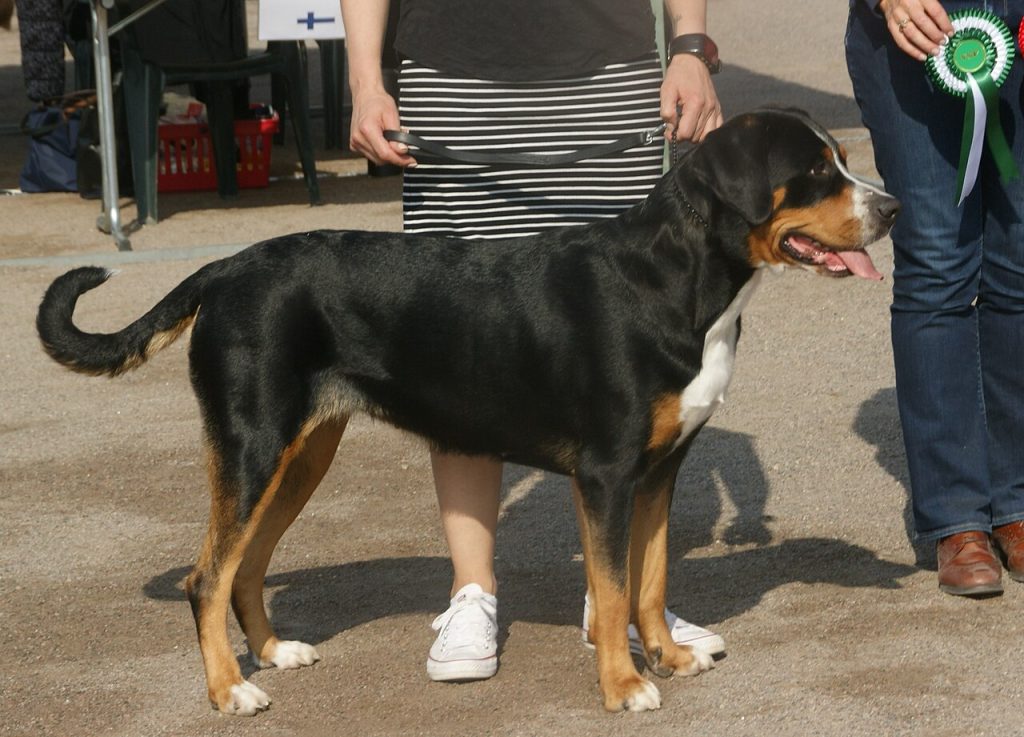
The Gran Boyero Suizo is the largest and oldest of the four Swiss boyars (Sennenhunde), a tricolor giant with strong bones and dense muscle that for centuries hauled carts through the Alpine valleys and today is, above all, a calm, affectionate family dog deeply attached to its people. If you’re looking for a big, noble, hardworking dog, more eager to be with you than to run without you, the Grand Boyer Suisse deserves your full attention.
Is the Grand Boyer Swiss to you?
The Grand Boyer is a wonderful dog, but its gigantic size and character have very concrete consequences on a day-to-day basis. Before you fall in love with that noble face, you should look at the pros and cons honestly.
In favour .
- Balanced temperament, calm and dignified.
- Huge bond with the family and excellent patience with the children.
- Versatile working dog: shooting, wagon, farm guard.
- Pretty healthy for their size, with fewer problems than other giant breeds.
- You don’t need large spaces or extreme exercise to be balanced.
Against
- Short life expectancy, the hardest part of living with the breed.
- He’s got tremendous strength. You’ve got to train him right from a puppy.
- It sheds a lot of hair throughout the year.
- He needs company; he suffers if he is left alone for many hours.
- High maintenance cost (food, veterinarian) for their size.
Character and temperament

If you had to summarize the Swiss Grand Boyer in one word, it would be the balance. It is a sociable, active, calm dog with a serene dignity that is noticeable in how it moves and looks. Unlike other giant breeds, it is not nervous or explosive: it has a cheerful nature and a tremendous affinity with people, especially children.
One of its most endearing characteristics is its attachment to its people. The Great Swede usually stays close to its owners and rarely goes too far without “checking” that everything is in order. It is not an independent or distant dog; its happiness depends on being part of the family and participating in what happens around it.
It is also an excellent warning dog. Its imposing size and deep barking deter by themselves, but it is not an aggressive dog by nature: socialization from puppyhood with people and other animals is what establishes that kind and confident temperament that characterizes the breed.
Coexistence: children, other pets, flat and loneliness
With children The Swiss Big Boyero is simply excellent. Tolerant, patient and protective, enjoys family life. Of course, its size forces it to supervise play with the smallest: a dog of 50 or 60 kilos can throw a child without any ill intention, just out of enthusiasm.
As a farm dog used to working alongside other animals, With other pets usually accepts other dogs and pets if he grows up with them and is taught to relate calmly.
On the floor can live, although its size makes it more comfortable in a house with space. The striking thing is that it does not need a huge land: as long as it has daily walks and company, it adapts to a floor better than its size suggests. What it does not tolerate well is the loneliness: it is a dog that suffers if it is left alone for many hours or isolated in a yard, because its emotional engine is to be with its family.
Education and training
The Grand Boyer is intelligent and eager to please, a great combination for training. It learns with pleasure and responds very well to positive reinforcement, with rewards, play and patience. Being a hardworking breed, it enjoys having “a task” and ongoing training that gives it mental structure.
However, it matures slowly: during its long adolescence it may show some stubbornness and needs clear and consistent boundaries. Like all large working dogs, it is recommended to socialize it from birth with other dogs and people, and to maintain regular activity and training if it is to be kept as a balanced pet.
The number one priority of training is the leash. A dog with this strength must learn to walk without pulling from a very young puppy; otherwise, when it reaches its adult weight it will be almost impossible to drive on a walk. The good news is that its docility and willingness to collaborate make it, consistently, an obedient and reliable companion.
Exercise and activity

Although the breed requires activity, it does not need a huge space to expend energy. It marvels at long walks, play, and outings, always dosing the effort while a puppy to protect its growing joints.
Where it really shines is in activities that appeal to its shooting dog heritage. weight pulling(weight throwing), cart pulling and hiking are ideal exercises: they combine strength, collaboration with the guide and mental stimulation.
Care: fur and hygiene
The coat is double: a dense outer coat between 3 and 5 cm long, with textures ranging from short, smooth and fine to longer, wavy and rough, on a thick undercoat.
The care, however, is simple: a weekly brushing is sufficient most of the year, increasing the frequency daily during moult seasons to remove dead hair and keep the coat healthy. It does not need frequent baths; with basic hygiene of ears, nails and teeth, and an occasional bath, it is sufficient.
Foodstuffs
During the growth, which is long, it is advisable to feed a specific feed for large breeds that controls the energy and calcium supply so that the development of bones and joints is gradual, avoiding strains that overload the joints.
In the adult, the ration is preferably divided into two daily meals rather than one copious one, a sensible measure in deep-breasted dogs to reduce digestive risks. Since abdominal problems have been reported in the breed, it is advisable to avoid strenuous exercise just before and after eating, maintain a balanced weight, and consult your veterinarian for specific guidelines depending on the age, activity, and condition of each dog.
Health and life expectancy

For its size, the Grand Boyer is a relatively healthy breed, with considerably fewer problems than other more popular giant breeds. Still, you have to know their weaknesses. The most specific are spleen conditions: splenic torsion(when the spleen rotates on the axis of its blood supply, with symptoms such as lethargy, abdominal distention and pale mucous membranes) and tumors of the spleen. Dysplasia and joint problems should also be monitored, as with any giant.
The toughest face in the race is your life expectancy. Very heavy dogs tend to live less than medium and small dogs, because longevity is inversely proportional to the size of the breed. The published figures range from: Some sources speak of 10 to 11 years, others of 8 to 10, and a race club survey in the United States placed the median at around 7 years. A responsible breeder, who selects for health, and regular veterinary follow-up are the best investment to accompany those years well.
Physical appearance
The Grand Boyer is a large dog with strong bones and impressive physical strength. Males measure between 65 and 72 cm at the withers and females between 60 and 69 cm; males usually weigh between 41 and 64 kg and females between 36 and 50 kg, although the standard does not fix a specific weight: It’s more about the functional structure. The body is slightly longer than it is tall, in a length to height ratio of about 10 to 9.
His identification mark is the tricolor coat. Black covers the upper back, ears, tail and most of the legs. It appears fire-colored (rust) on the cheeks, in a “thumbprint” over each eye and on the legs, between white and black. And the white is located on the snout, the feet, the tip of the tail, the chest and up the snout until it passes between the eyes. The American Club standard does not prioritize the symmetry of the marks: It’s function that counts, not aesthetics, summed up in the phrase “the head doesn’t pull the cart”. The eyes are almond shaped, medium in size and between hazel and brown in color, preferably dark brown.
Origin and history
The name Sennenhund refers to the Senn, the dairy and cattle breeders of the Swiss Alps. The Grand Boyer Suisse is almost certainly the result of crossing native dogs with large mastiff-type dogs brought to Switzerland by foreign settlers.
Its exact origin is lost in the fog of history: from 1515, the remote valleys of Switzerland were more or less isolated for three centuries, and the breeds were fixed by inbreeding, distributing puppies between neighbors and relatives.
By the end of the 19th century, it was considered almost extinct because other races or machines were already doing its work. Its rescue is due to the geologist and expert in Sennenhunde Albert Heim(1849-1937), who encouraged breeders to take an interest in the breed and succeeded in its recovery. The first club was founded in 1912. The breed gained its first international recognition in 1939, when the Fédération Cynologique Internationale published the Swiss standard; it arrived in the United States in 1968 and the American Kennel Club fully recognized it in 1995. In the FCI it is classified in Group 2, Section 3 (mountain dogs and Swiss boyars).
Curiosities
- He is affectionately known as “Swissy” among his fans.
- Its historic nickname, “the poor man’s horse”, was born from its strength to pull loaded wagons without the need for a horse or mule.
- The St. Bernard shares history and shape with the larger Swiss boyars; except for color and documentation, they are very similar, and the German Rottweiler is another close relative in history and silhouette.
- In the breed standard the phrase “marks don’t pull the cart” is repeated to remind that function and temperament weigh more than aesthetics.
- According to the AKC, it ranks 88th in popularity as a breed in the United States, so it remains a relatively exclusive dog.
If you are attracted to the Swiss Grand Boyer, you will surely enjoy exploring other breeds of large size, working heritage or similar family character. Check out the San Bernardo– with which it shares history and build – , the Rottweiler, a close relative in silhouette, the Terranova, another gentle giant of family vocation, and the imposing Gran Danés.
Frequently asked questions about the Swiss Grand Boyer
Is the Grand Boyer a good family dog?
Yes. It is a sociable, quiet dog with an enormous attachment to its people, especially children. Its balanced temperament and docile character make it an excellent family companion, provided it receives early socialization, moderate exercise and companionship. It is not a dog to be left alone for many hours or to live isolated in a yard.
How long does a Swiss Grand Boyer live?
As is often the case with very large and heavy dogs, their life expectancy is short: various sources place it between 8 and 11 years, and a survey by the breed club in the United States gave a median of around 7 years.
How tall and how much does a Swiss Grand Boyer weigh?
It is a giant dog. Males measure between 65 and 72 cm at the withers and females between 60 and 69 cm. In weight, males usually move between 41 and 64 kg and females between 36 and 50 kg.
Do you need a lot of exercise?
It needs daily exercise, but it is neither an endurance athlete nor a hyperactive dog. It suffices for long walks, play and, above all, activities that involve strength and collaboration, such as weight throwing or carriage riding.
Is it easy to educate?
It is intelligent, wants to please and responds well to training, but matures slowly and can show some youthful stubbornness. With positive reinforcement, constancy and early socialization from puppyhood, it becomes an obedient and reliable dog.
What’s the coat like and how loose is it?
It has a double tricolor (black, white, and fire) coat with a dense outer layer of about 3 to 5 cm and a thick undercoat.
What health problems does the Grand Boyer have?
It is generally a fairly healthy breed for its size, with fewer problems than other very popular giant breeds.[citation needed] Nevertheless, you should watch for abdominal conditions typical of large dogs, such as splenic torsion and spleen tumors, in addition to the dysplasia and joint problems common in giants.[citation needed] A serious breeder and regular veterinary checkups are key.
Why did they call it the poor man’s horse?
Because for centuries it was a sled dog on the Swiss farms and valleys, able to pull wagons loaded with milk, cheese or goods. This enormous traction force earned it the nickname ‘the poor man’s horse’, as it did the work of a pack animal for whom he could not afford a horse or mule.