The Red and white Irish Setter(Irish Red and White Setter) is a poultry sample dog originating in Ireland: Elegant, athletic and overwhelmingly loyal to his family. Less known than its uniform red cousin, it is actually the trunk race from which it came, and today it is still considered a vulnerable breed that retains its working instinct intact. If you’re looking for an active, caring, intelligent companion for an outdoor life, this is a dog worth getting to know thoroughly.
Is the red and white Irish Setter for you?
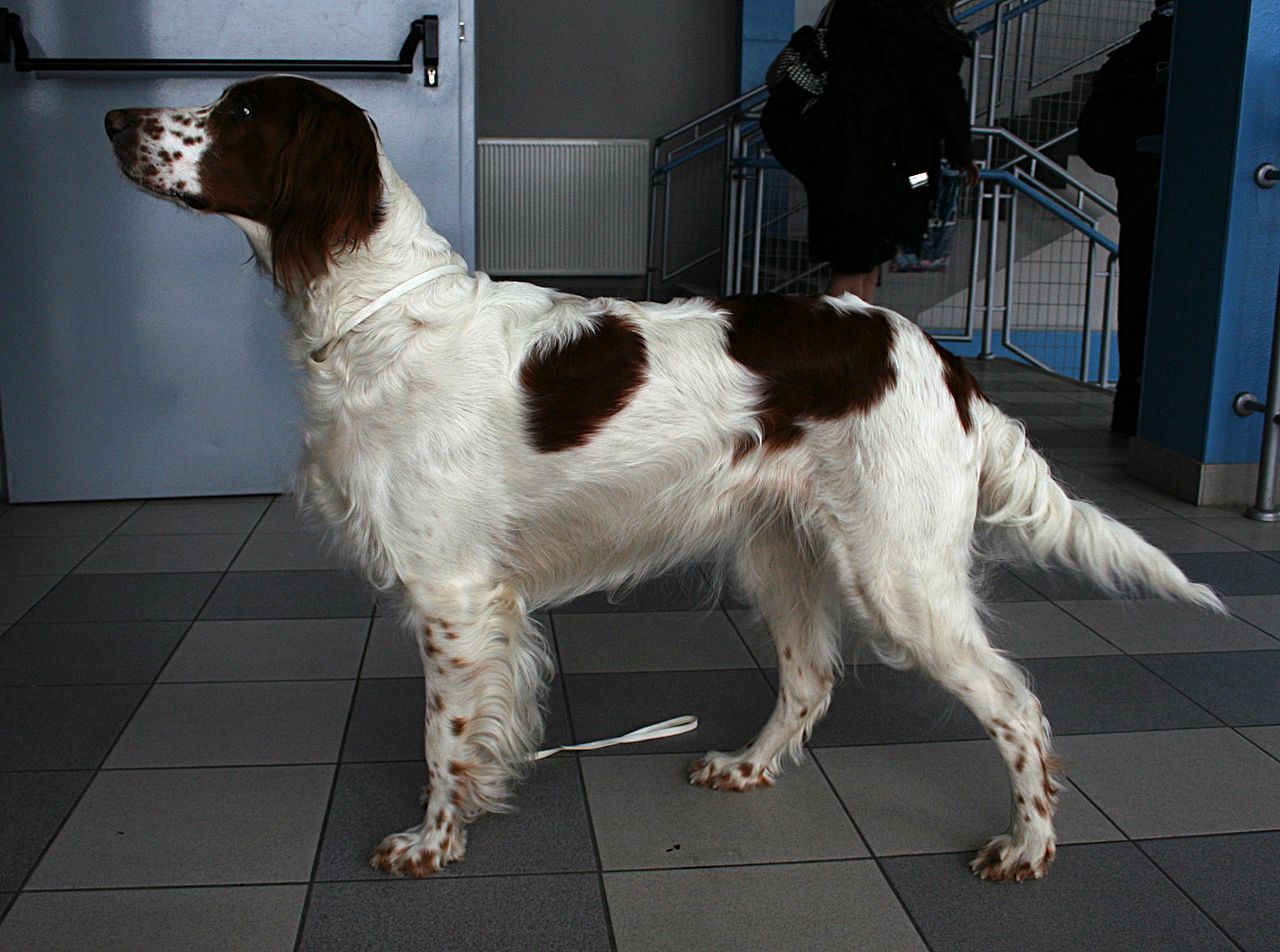
Before you fall in love with his image, be honest: the red-and-white Irish Setter is a field sports dog, not a couch dog. He fits in wonderfully with those who live outdoors and fails miserably with those who can’t give him hours of exercise. These two boxes sum up who goes and who doesn’t.
It suits you if…
- You are a very active person or family, with access to the countryside or open spaces.
- You can give him 1.5 to 2 hours a day of exercise, including running.
- You want a dog that’s affectionate, sociable and good with kids.
- You like training and mental stimulation as part of your daily routine.
- You value a rare breed, easy-to-maintain coat and good character.
Think about it if…
- You live in a small apartment with no possibility of long exits.
- You spend a lot of hours outside and the dog would be alone too long.
- You’re looking for a quiet, sedentary dog or one of immediate obedience.
- You don’t feel like investing time in patient, constant education.
- You have birds or other very small pets with no socialization plan.
Character and temperament
If anything defines the red and white Irish Setter, it’s his devotion. Breeders describe it as one of the most devoted and affectionate dogs in existence, capable of becoming an ideal family companion in every way. He’s extremely intelligent and responds very well to a proper education, but that intelligence comes with a tremendous amount of energy: You need to have things to do, challenges to solve and space to run.
It is a good natured dog, very gentle and balanced, who gets along well with children and other dogs. It is neither a watchdog nor a reactive dog; its character tends towards sociability and people. Now that mild temperament really thrives in active homes, where it can channel its vitality. A red and white Irish Setter with no outlet for his energy gets bored, and a bored Setter seeks his own amusements, almost never the ones you’d like.
Coexistence: children, other pets, flat and loneliness
With children: is excellent. He is gentle, patient and playful, a good companion for a family with small children, always monitoring the game for his size and energy. With other dogs: usually does very well, thanks to its friendly nature. With other pets: here touches on caution. It is a bird specimen dog with a deep-rooted hunting instinct, so coexistence with birds, rodents or very small pets requires early socialization and common sense.
On the floor: is not its ideal habitat. He can live in an apartment if you really guarantee him plenty of daily exercise, but he enjoys it far more with access to a garden or open areas to run. Soledad: is a very attached dog and it’s not good to spend long hours alone. Isolation and lack of stimulation cause boredom and anxiety. If you work outside all day, consider whether you can meet their social and physical needs.
Education and training

The Irish Red and White Setter is very intelligent, but takes longer to train than other hunting dogs. It is not stubborn in bad faith, but matures slowly and has its own rhythm. The good news: once trained, it becomes a loyal, reliable and capable companion, both at home and in the field.
The key is in the method. It needs firm and determined guidance, but it is never harsh or harsh. Positive reinforcement, consistency, and short, varied sessions work much better than severity, which can only block such a sensitive dog. Take advantage of your need to keep busy: Smell games, obedience, collection work and canine activities come as a wonder and strengthen your bond. Start socializing early and you’ll be rewarded for every minute spent.
Exercise and activity
This is the non-negotiable point. The red and white Irish Setter retains a strong work instinct: It was bred to scour terrain at high speed, cover a lot of ground looking for the scent of birds and stand still as a “sample” when locating them. That engine’s still there. As a puppy, it does not need much exercise and should not strain its growing joints, but as it reaches maturity, its instinct demands space to run hard, fast, and over long distances.
Translated to everyday: long walks, loose runs in safe areas, hiking, and possibly activities that combine physical and smell. He loves open environments where he can gallop. If you give him that escape route for his energy, you’ll have a relaxed and balanced dog at home; otherwise, the excess energy turns into nervousness and destructive behavior.
Care: fur and hygiene
Its coat is single coat, short and smooth on the head, ears and front of the legs, with silky and smooth fringes (“feathering”) on the ears, neck, chest, back of the legs, belly and tail.
All it takes is brushing and combing once a week to keep it clean and uncluttered. The loose, fine hair on the feet is trimmed regularly and the thick hair behind the ears is lightened. The bathroom only when it’s really necessary: Since it has no thick coat, it is easy to keep clean. He needs far less grooming for presentation than other setters. Complete the routine with the basics: checking and cleaning drooping ears (prone to moisture), cutting nails and dental hygiene.
Foodstuffs
As a large, active and athletic dog, the Irish Red and White Setter needs a complete and quality diet, adjusted to its high energy expenditure when working or exercising a lot, and moderate in the quieter stages to avoid gaining excess weight.
For large breeds with deep breasts, a classic precaution is to avoid strenuous exercise just before and after eating, to reduce the risk of gastric torsion. Always keep fresh water available, watch that it does not get fat (overweight punishes its joints) and consult your veterinarian about the most appropriate diet, especially for the growing puppy and the senior dog.
Health and life expectancy

Overall, the Irish Red and White Setter is a healthy breed, with a average life expectancy of 10 to 12 years.
- Canine leukocyte adhesion deficiency (CLAD): is a failure of the immune system to fight infections. Affected puppies do not thrive and may die very young. Many registries only admit free specimens of the gene, tested by DNA or heredity.
- If you have been diagnosed with von Willebrand disease (vWD): is a blood clotting disorder that prevents wounds from closing properly.
- In the case of a cataract, the following conditions shall be met: a cataract on the back of the lens affecting vision.
Thanks to the proactive approach of breeders and mandatory screening, CLAD and vWD are today virtually non-existent in the breed. Screening for hip dysplasia is also recommended. Buying from a responsible breeder who performs these tests is the best guarantee of a healthy puppy. As a genetic curiosity, given the breed’s small pool, some registries have studied controlled crossing programs with the Irish setter to increase diversity, a decision not exempt from debate among clubs.
Physical appearance
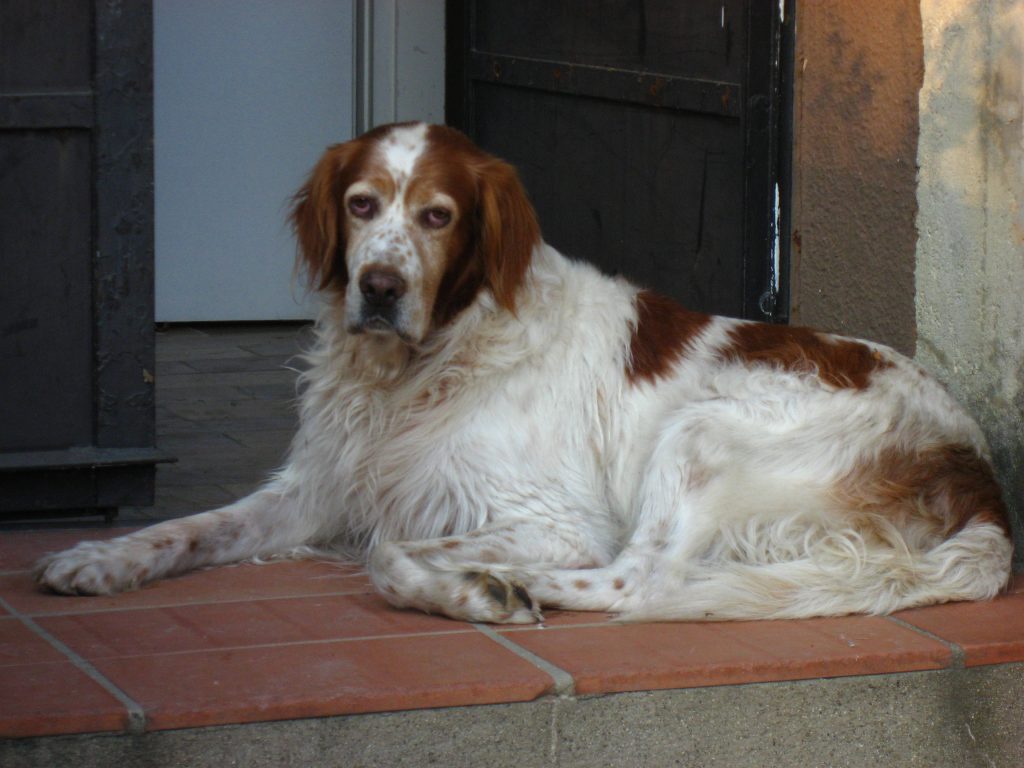
The red and white Irish Setter has an aristocratic air, well proportioned and balanced, but without losing strength or power. It does not have the stylized silhouette of its uniform red cousin: it is heavier in body, with a wider head and less marked occipital bulge.
Its colour is its hallmark, and not a whim: it should be red and white.. The base is a pearly white on which are distributed massive spots of intense red, a mahogany red like that of a freshly opened chestnut, never clear or orange.
In terms of size, the FCI marks heights at the cross of 57 to 61 cm in females and 62 to 66 cm in males, without weight restriction.
Origin and history
Setting dogs – the old term for setters – were developed to locate birds of prey and have been used for centuries: They would find the birds by smell, stay still and then move slowly to pick them up. When firearms appeared in the mid-17th century, the setter’s work was refined as a show dog. In Ireland, the first setters were red, or red and white, or even almost white, and all were accepted indiscriminately as Irish setters.
The turning point came in the late 19th century. At exhibitions of the time (such as one in Dublin in 1875, with 66 entries of which 23 were red and white) the bicolor variety was very common. But the fashion for the uniform red setter, which reached sky-high prices in America and Ireland, cornered the red and white almost to extinction. Only a handful of breeders in remote areas of Ireland kept it alive; the Rossmore family of County Monaghan kept a breed since the mid-18th century, which is why it was sometimes called the “Rossmore setter”.
The recovery started in the 1920s and gained momentum from 1970. The Irish Kennel Club accepted in 1974 the pedigrees of the few surviving specimens, and in 1981 the society was founded that promoted their national and international recognition. A key moment was Crufts 1980, when a red and white display there proved that the breed was not as extinct as had been believed. Since 1 January 2009 it has been fully recognised by the American Kennel Club. Even so, it is still listed as a vulnerable native breed in the UK, with fewer than 300 registrations per year.
Curiosities
- The FCI classifies it in Grupo 7(sample dogs), Section 2 (British and Irish show dogs).
- It’s the trunk breed from which the famous Irish red uniform setter emerged, not the other way around.
- It was on the brink of extinction in the late 19th century and is now considered a vulnerable breed.
- All registered specimens are descended from the few dogs accepted by the Irish Kennel Club during the recovery of the 1970s.
- He was called the “Rossmore setter” by the Irish family who preserved the breed for nearly two centuries.
- It requires less grooming than other setters because its unique coat is lighter.
If you are attracted to the red and white Irish Setter’s profile – sporty, affectionate and show-off – you may be interested in other hunting and companion breeds with energy and good character. Pointer Vizsla Weimaraner Golden Retriever
Frequently Asked Questions about the Irish Red and White Setter
Is the red and white Irish setter a good family dog?
Yes. It is one of the most devoted and affectionate setters with its own, very sociable and patient with children. The condition is clear: it needs an active family that gives it plenty of exercise. A boring setter in a small apartment without long exits is not happy and shows it.
How much exercise do you need a day?
As an adult, at least between 1.5 and 2 hours daily of real activity, with stretches in which he can gallop loose in a safe area.
Is it hard to educate?
It is not difficult, but it is slower than other hunting dogs. It is very intelligent and responds greatly to positive reinforcement, although it matures slowly and needs firm, determined and consistent guidance, it never lasts. With patience it becomes a loyal and reliable companion.
How long does the Irish red-and-white setter live?
Their average life expectancy is 10 to 12 years, a typical figure for a large dog. A healthy weight, adequate exercise, and regular veterinary checkups help to get well into the end of that range.
What health problems does the breed have?
The breed clubs monitor three inherited diseases: canine leukocyte adhesion deficiency (CLAD), von Willebrand disease (vWD), and posterior polar cataract (PPC).Thanks to mandatory DNA testing in many registries, CLAD and vWD are now virtually non-existent in the breed.
Do you get along with other dogs and pets?
With other dogs it usually gets along very well: it is of a kind and balanced nature. With small pets you have to be careful because of its strong instinct to sample and hunt birds; with early socialization and controlled presentations coexistence is possible.
How much care does your coat need?
Little compared to other setters. It has a single coat less abundant, so it is enough with a weekly brushing, trimming the loose hair of the feet and lightening the one behind the ears.
How is it different from the red Irish setter?
In color, especially: the red and white has a pearly white base with large mahogany red spots, while the Irish setter is uniform mahogany red.