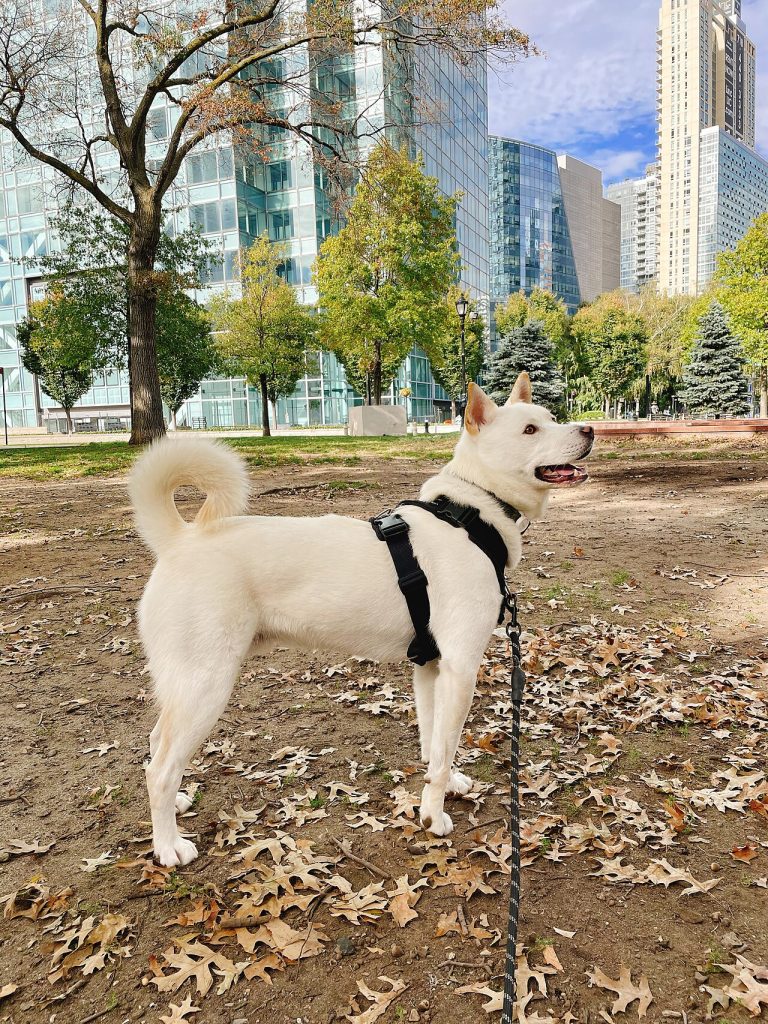
The Jindo is a Korean spitz-type dog, a national treasure of South Korea and one of the most loyal breeds in existence. Originally from Jindo Island, in the southwest of the country, he is a born hunter, clean, quiet and deeply attached to his family. It’s not a dog for everyone: Their independence, their strong prey instinct and their reserved nature with strangers call for an experienced owner. If you’re looking for a loyal companion for life, with the elegance of a fox and the nobility of an ancestral working dog, here’s everything you need to know about the Jindo before you decide.
Is Jindo for you?

The Jindo is a one-piece dog: extremely loyal, clean, healthy and very intelligent. But that same intelligence is accompanied by a strong independence and a hunting instinct that does not disappear with training. Before you fall in love with its white fox pattern, look honestly at whether it fits you.
In favour .
- Legendary loyalty to his family, for life.
- Very clean. She grooms like a cat and barely smells like a dog.
- He barks little; he only warns when there’s a real motive.
- Excellent guard: alert, courageous and very territorial.
- Robust health and good longevity for his size.
- Smart and quick to learn what interests him.
Against
- Strong prey instinct: dangerous with cats and other small animals.
- Independent and stubborn; not a submissive or “pleasing” dog.
- Reserved and suspicious of strangers.
- Escapist: jumps and climbs high fences with ease.
- Very abundant seasonal moldy twice a year.
- Not recommended for first-time owners without advice.
Character and temperament
If the Jindo were to be summed up in one word, it would be loyalty. This breed is famous in Korea precisely for its devotion to a single person or family, a bond that is cited as a cultural reference and that has featured real stories that have moved an entire country.
The Jindo is a independent, intelligent and with their own criteria dog. It is not the typical dog that lives to please and obey simply: it thinks, values and sometimes decides that your order does not compensate it. This autonomy, inherited from centuries of free hunting in the mountains of the island, makes it a fascinating but demanding companion.
With his family, he is affectionate, sensitive and surprisingly delicate. With strangers, however, he is shown as reserved and vigilant: he is not aggressive by nature, but keeps his distance until he decides that the person is trustworthy. This combination of intense attachment and selective distrust makes the Jindo an excellent guardian who does not need to be trained to protect his home; he takes it seriously.
It also has a clear notion of family hierarchy and a strong prey instinct. It is a medium-high energy dog, alert and always attentive to its environment. It is not a nervous or barking dog, but rather serene and observant, reserving its intensity for what it really cares about: its territory, its family and the hunt.
Coexistence: children, other pets, flat and loneliness

With children: A well-socialized Jindo raised within the family nucleus is usually patient and protective of the children in his home.
With other dogs: can get along well with dogs it has been raised with, but tends to be dominant and territorial with strange dogs, especially among males.
The Jindo’s prey instinct is very strong, and although a dog raised as a puppy with a family cat can learn to respect it, it is a dog that rarely has to live with rabbits, rodents or other cats.
On the floor: The Jindo is clean enough, quiet enough indoors, and not barking enough to live in a flat, provided it is given enough daily exercise.
Soledad: is a very attached dog who doesn’t take well to abandonment or whole days alone. He needs frequent interaction with people or other dogs; if he is bored or feels isolated he may become destructive or try to escape. In fact, he’s an accomplished escapist: A garden should be well fenced (ideally with fences of at least 1.80 m).
Education and training
Training a Jindo is an exercise in patience and mutual respect. It is a he’s very smart. He learns fast. dog, but its independence means that it will not repeat an exercise a hundred times just to please you. It needs to understand why it does things and, above all, trust who it is asked to do them.
The keys to this breed are:
- Positive reinforcement: rewards, play and praise work much better than harshness.
- Early and intensive socialization: exposing him as a puppy to people, dogs, noises and various situations is essential to moderate his natural distrust.
- Consistency and quiet leadership: as it has a clear sense of hierarchy, needs stable rules and a serene and secure owner, not authoritarian.
- Short and varied sessions: boredom is your enemy; keep training short and entertaining.
- Watch out for the loose: because of their hunting instinct, many Jindo will never be 100% reliable without a leash in open areas.
It’s not the ideal breed for a first-time owner who expects immediate obedience, but for one who understands and respects its nature, the Jindo responds with extraordinary connection and complicity.
Exercise and activity
The Jindo is an athletic dog, medium to high energy, bred for centuries to traverse mountainous terrain chasing prey. That translates into a real need for daily exercise: long walks, runs, exploration and play. A minimum of one to two hours of activity per day is reasonable, combining physical exercise with mental stimulation.
Its hindquarters are powerful and agile; it runs and jumps with remarkable elasticity, and its light jog allows it to cover any terrain without getting tired. He enjoys hiking, country walks, and activities that combine smell and movement. A Jindo who gets enough exercise is a balanced dog; one who is bored will seek his own amusement, almost always escaping or destroying something.
Care: fur and hygiene
The Jindo has a thick double mantle, typical of the spitz: a soft, woolly inner coat that insulates from cold and heat, and a harder, protective outer coat.
Recommended care routine:
- Cepillado: once or twice weekly in normal season; daily during moulting to remove loose undercoat and avoid knots.
- The Jindo is a naturally clean dog, which grooms itself and hardly emits body odor; over-bathing dries its skin.
- Nails, ears and teeth: check and trim nails regularly, clean ears and take care of dental hygiene as in any breed.
One of the Jindo’s most prized qualities is precisely its cleanliness. Many owners compare it to a cat because of its meticulous cleaning.
Foodstuffs
The Jindo does not have exotic dietary requirements, but it is advisable to feed it with a complete and of high quality diet, adjusted to its age, size and activity level.
As a general rule: rations divided into two meals a day for adults, weight control (it is a breed that stays lean and should not get fat) and water always available.
Health and life expectancy
The Jindo is a rustic and healthy breed, the result of centuries of natural selection on an island, with little human intervention in its development.
As with any breed, it is advisable to keep up-to-date with veterinary checks, deworming and vaccinations, to monitor feeding to avoid overweight and to be attentive to the typical problems of active medium dogs (joints, ears, skin).
Physical appearance

The Jindo is a dog of medium size and spitz silhouette: compact, well proportioned, with an alert and intelligent expression that conveys strength, agility and alertness.
Height and weight. Males measure around 48 to 53 cm at the cross and females around 45 to 50 cm. Weight, always proportional to height to maintain a muscular and slender appearance, rounds the 18 to 27 kg in males and 16 to 25 kg in females.
Head and ears. The head is broad and rounded between the ears, with an almost octagonal appearance when viewed from the front. The eyes are almond-shaped and dark brown (never blue). The ears, triangular and erect, are one of its most characteristic features: they lean slightly forward and open slightly to the sides, a unique detail among the spitz.
Body and tail. The body is square and well-muscled, with a moderately deep chest and firm back. The tail is thick and strong, carried in the shape of a sickle over the back or slightly coiled, with abundant hair at the bottom that opens into a fan when the dog lifts it.
Colores. The Jindo comes in six recognized colors: white(the best known, actually an ivory hue), yellowish or red(mature wheat color), grey wolf, black and fire(with eyebrows that give it the Korean nickname “four eyes”), triggered(lion-based tiger pattern) and solid black, the latter very rare.
Origin and history
The Jindo comes from the jindo Island, in the province of South Jeolla, in the southwest of South Korea. Isolated for centuries in that archipelago, the dog developed naturally as an indigenous hunter, very little crossed with other breeds, which explains its genetic purity and so defined character.
The breed was formally studied in 1937 by Professor Tamezo Mori, and in 1938 received official recognition. During the Japanese occupation of Korea (1910 – 1945), the Jindo survived thanks to Japanese biologists recognizing its kinship with native dogs of Japan, while other Korean breeds had worse luck. In 1962, the South Korean government declared the Jindo National Treasure (Natural Monument No. 53), granting it legal protection that endures to this day.
This special status has very concrete consequences: Only dogs born on Jindo Island can be officially registered as pure Jindo by the Korean government, after an inspection, and it is very difficult to export pure specimens out of the country. The breed was internationally recognized by the United Kennel Club in 1998 and by the Fédération Cynologique Internationale (FCI) in the year 2005. The Jindo even paraded at the opening ceremony of the 1988 Seoul Olympics as a national symbol.
Curiosities
- Because of its status as a national treasure, getting a pure Jindo out of Korea is extraordinarily complicated; the country jealously protects its lineage.
- The legend of Baekgu. In 1993, a Jindo named Baekgu was sold to a new owner in a town about 300 km from the island. The dog escaped and, after a seven-month journey, exhausted, returned to her original owner. The story shocked Korea, became a documentary and children’s book, and in 2004 a statue was erected in her honor.
- Clean as a whistle. The Jindo grooms itself, barely smells and many learn on their own where to defecate; it is one of the cleanest breeds that exist.
- Airplane ears. Its erect ears, slightly open to the sides, are compared to “airplane wings”, a trait that distinguishes it from other spitz.
- Three types of body. In Korea the Tonggol (more robust), the Hudu (more stylized) and a combination of both, the Gakgol, are traditionally distinguished.
- It’s a homonymous alert. Interestingly, “Jindo-gae” is also the name of an official term used in Korea for certain local threat alert measures.
If you are attracted to the Jindo’s (loyal, clean, independent Eastern Spitz) profile, you probably enjoy meeting other related breeds. Take a look at the Akita, its Japanese cousin of similar temperament; the spectacular Husky Siberiano, another hardworking spitz with marked instinct; the quirky Chow Chow, oriental, dignified and independent; and the white, smiling Samoyedo, an equally flamboyant double-coat spitz.
Frequently Asked Questions about Jindo
Is Jindo a good dog for beginners?
It is not the best choice for a first-time owner. Its independence, stubbornness and strong hunting instinct require experience and patience. A very committed and well-advised beginner can achieve this, but it is advisable to be realistic with the effort it demands.
Can Jindo live in a flat?
Yes, as long as he gets enough daily exercise, he’s clean, quiet indoors and barks little, which makes him suitable for a flat, but he doesn’t tolerate lack of activity or spending long hours alone.
Does Jindo get along with cats?
A Jindo raised as a puppy with a family cat can learn to respect it, but is rarely reliable with cats or other small animals.
How long does a Jindo live?
Its life expectancy is around 12 to 15 years, and it is a rustic and healthy breed, with good longevity for its size, always with proper veterinary care.
Does Jindo bark a lot?
No, it’s a rather quiet dog that barks only when it has a real reason, like to warn of a stranger’s presence.
Do you lose a lot of hair?
During most of the year it is manageable, but it moults very abundantly twice a year (spring and autumn), when it releases the undercoat by handfuls.
Why is it so hard to get a pure Jindo?
Because it’s a national treasure of South Korea, only dogs born on Jindo Island can be officially registered as purebred after inspection, and exporting them out of the country is heavily restricted.
Is the Jindo a good guard dog?
Excellent. Territorial, brave, alert and suspicious of strangers, but balanced with his family. Protects the home naturally, without the need for specific training.