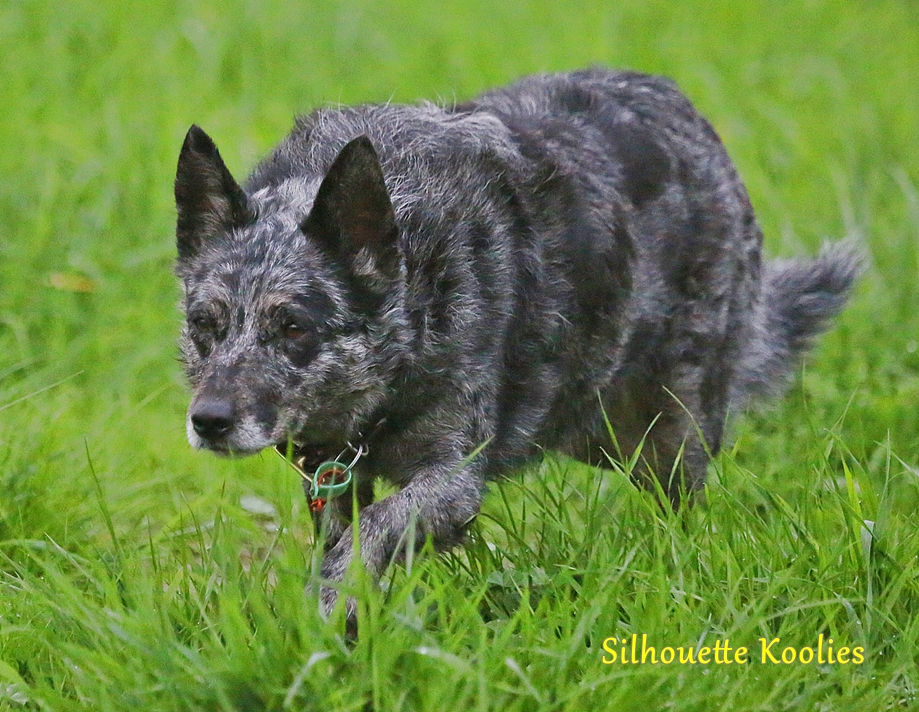
The Koolie is an Australian herding dog bred from the early 19th century to work cattle on Australia’s huge farms. Silent, athletic, and remarkably intelligent, the Koolie is selected not for its appearance but for its ability to work, which explains its enormous variety of sizes, coats, and colors. Today, when demand for farm dogs has fallen, the Koolie also shines in agility, tracking, therapy and as a tireless companion to active families.
Is the Koolie for you?
The Koolie is a wonderful dog, but very demanding in energy and stimulation, so before you fall in love with the merle coat, look honestly at whether your life matches his.
In favour .
- Highly intelligent and eager to learn.
- Very athletic: perfect for canine sport and outdoor life.
- Long lived and generally healthy (median ~15 years).
- Loyal, attached and sensitive to his family.
- Short coat easy to maintain on most specimens.
- Versatile: shepherding, agility, tracking, therapy and emotional support.
To be taken into account
- High energy: needs lots of exercise and daily mental work.
- Shepherding instinct: can herd children and other pets.
- He gets bored and frustrated if you leave him alone or without homework.
- It’s not a breed for small apartments or a sedentary life.
- Rare breed outside Australia: difficult to find.
- Crossing two merles carries the risk of deafness and blindness: it requires responsible breeding.
Character and temperament

The Koolie’s temperament is the result of generations of selection by Australian ranchers, shepherds and farmers who were looking for a dog capable of hard work and, at the same time, devoted to their guide.
It is common for those who do not know the breed to mistake the Koolie for a shy, reserved or even aloof dog. In fact, it is a very intelligent and sensitive animal that needs to be understood in its context: it responds wonderfully to a firm but kind, calm and predictable treatment. Give it time and guidance, and you will see its enormous adaptability emerge in the most diverse situations.
The Koolie shows tireless enthusiasm for the task and remarkable endurance when the work requires it. By its nature, it is essential that puppies receive a good education in obedience and that mental challenges are posed to them in addition to physical exercise.
Coexistence: children, other pets, flat and loneliness
With his family, the Koolie is loyal and affectionate, and usually gets along well with children if he grows up with them and is educated. Now, you have to rely on her shepherding instinct: In the absence of livestock, a Koolie tends to herd family members, and that includes children, whom he may try to gather or direct with small touches. It’s not aggression, it’s work genetics, but it’s best channeled from a puppy.
He can get along well with other pets, especially if he grows up with them, although that same herding impulse may cause him to chase or try to control smaller dogs or cats.
As for the floor, it is not its ideal habitat. The Koolie is a dog of space and activity; it can adapt to the city if you guarantee it plenty of exercise and stimulation, but it is not a dog to be left alone for many hours in an apartment. Prolonged loneliness and lack of work lead to boredom and undesirable behaviors.
Education and training

Few dogs are as rewarding to train as a Koolie. Their intelligence and willingness to please make the task much easier, but experienced guides know that they need clear guidance. A stable, consistent, supportive approach yields the best results; positive reinforcement works much better than harshness with such a sensitive dog.
He begins basic obedience and socialization as a puppy, and always combines them with mental challenges: olfactory games, tricks, agility sequences. The Koolie who only receives physical exercise but not mental gets bored; the one who receives both flourishes. His ease of learning has made him a star in agility, tracking, obedience and shepherding tests.
Exercise and activity
This is a non-negotiable point. The Koolie is a high-energy athletic dog, bred to herd cattle over miles of terrain. He needs a lot of exercise: Ideally one or two hours a day of intense activity, plus mental stimulation. Long walks, running, swimming (he loves the water, which also keeps his coat shiny and free of parasites), dog sport or real grazing work are the best escape valves.
A Koolie who doesn’t expend his energy leads him back to problematic behaviors, and if you can’t offer him plenty of daily activity, this isn’t your breed.
Care: fur and hygiene
The Koolie’s coat is low maintenance in most cases. The short-haired or short-smooth specimens – the most common and preferred by many owners – hardly require a weekly brushing; that short hair does not accumulate grass seeds and occasional bathing is enough to keep it shiny.
In addition to the coat, the care is the usual for any dog: checking and cleaning ears, cutting nails and maintaining good dental hygiene.
Foodstuffs
As an active, muscular working dog, the Koolie needs a complete, high-quality diet tailored to its activity level, age, and weight. A dog that works or competes in canine sports consumes many more calories than a calmer dog, and its diet should reflect this. Divide your food into two portions a day, monitor your body condition so that you do not get too fat or too thin, and always have fresh water available, especially after exercise. If you have any questions about quantities or type of diet, consult your veterinarian.
Health and life expectancy
The Koolie is a robust dog with a very good median life expectancy around 15 years. Its genetic reserve is small but diverse, and like any breed can present hereditary problems. Most have DNA tests available today, and hip and elbow control helps reduce the incidence of dysplasia.
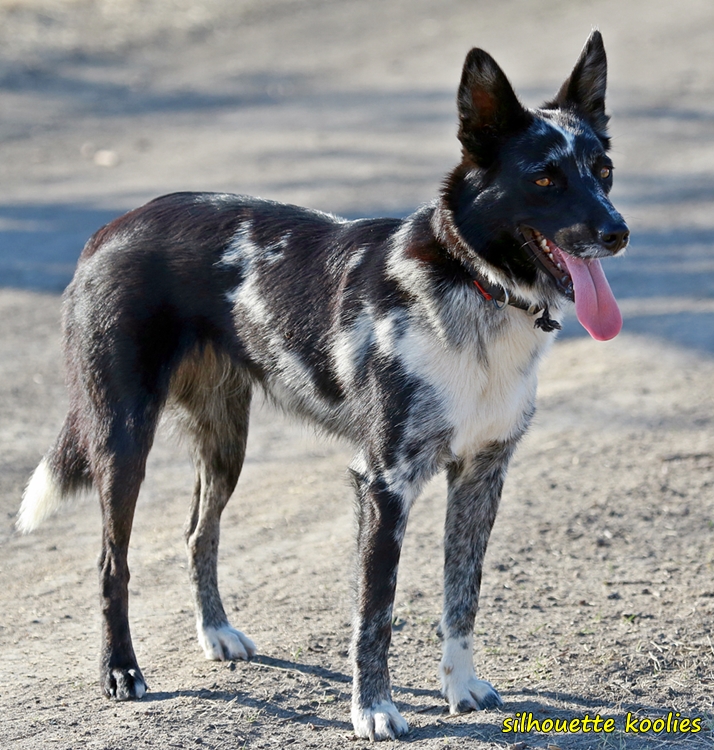
The most characteristic health point is the merle gene: crossing two merle dogs multiplies the risk of blind or deaf white puppies, so the merle test before breeding is essential. A solid-looking dog may carry the hidden gene, so complete sequencing of the merle by DNA is the safest practice. The Australian Koolie Association is the only registry that requires DNA breed identification testing before registering a dog of unverified ancestry, in addition to full health screening of stallions.
An interesting fact: in 2003, DNA tests carried out on 56 bloodlines of Koolie by Dr. Mark Neff (University of California at Davis) ruled out the mdr1-1 mutation in the lines analyzed, responsible for serious – even fatal – reactions to drugs such as ivermectin in other breeds related to the collie.
Physical appearance
The Koolie is as diverse as the country from which it comes. In northern Queensland and New South Wales it is a tall, medium-boned and agile dog, bred to gather cattle over many kilometres. In New South Wales it is a more compact and short breed, designed to pull cattle out of dense weeds.
Males measure between 43 and 51 cm at the withers; females, slightly less, between 41 and 48 cm. The coat ranges from short-flat (like the first blue merle collies of Scotland) to short (like a working Kelpie), passing through the middle and, rarely, the long (like the Border Collie of exposure).
The color is classified as solid or merle. A solid can be black, red, chocolate, cream, or its dilutions (lilac for red, blue for black), with or without white marks and fires. On any of them the merle pattern may appear, with large splashes of darker tones. The eyes and nose follow the base color, and it’s not uncommon to see blue eyes or combinations. The blue merle on black is the most recognizable aspect of the breed.
Origin and history
The Koolie’s ancestors are believed to have been the smooth-haired blue merle collie, imported from Britain in the 19th century, and the black and fire collie from the Scottish Highlands. Influence is also attributed to dogs brought by German settlers, supposedly descended from the “German Tiger”, a European shepherd dog, although DNA has not yet confirmed this. In fact, the breed long carried the erroneous name “German Collie” or “German Coolie”. As early as 1903, Robert Kaleski described in Agricultural Gazette of New South Wales this blue-gray dog the size of a smooth-haired collie.
During the industrial era, some lines received inputs from Kelpie and Border Collie, depending on the region and type of cattle.
In 2000 the Koolie Club of Australia was founded to preserve and promote the breed; later came the Working Koolie Association and the Australian Koolie Association. None of these registries seek recognition as a beauty standard, for fear of harming the breed’s future employment. In 2004 the Koolie was recognised by the Australian Sporting Registrar, and in 2006 was admitted by US herding breed associations.
Curiosities
- The Koolie is a “silent and upright” shepherd – he works without barking and with his head held high, unlike dogs that bark crouched and staring.
- He masters a full repertoire of grazing maneuvers: leading, driving, surrounding, blocking and even jumping over the backs of cattle when necessary.
- He does not have a “sticky eye” – he switches focus easily to hold the flock and go out to look for those who escape.
- He works with the same ease ducks, sheep, pigs or bulls, and in the absence of cattle will graze the family.
- The name “German Coolie” is a historical error: the predominant background of these dogs was British, not German.
- Her interest has spread outside Australia to countries such as the United States, Canada, Germany, Finland, New Zealand, Switzerland and the Netherlands.
If you are attracted to the Koolie for its intelligence and energy, you will surely enjoy meeting other breeds of herding and work of similar temperament. Check out the Border Collie, a close relative and champion of obedience; the Pastor Australiano, also a lover of the merle coat; the versatile Pastor Alemán; or the elegant Collie, from which the Koolie inherits much of its blood.
Frequently Asked Questions About the Koolie
Is the Koolie an officially recognized breed?
The Koolie is an Australian herding breed with its own registries (Koolie Club of Australia, Working Koolie Association and Australian Koolie Association), but is not recognised by the FCI nor does it have a conformation beauty standard. It’s selected for its ability to work, not its appearance, so you’ll see a lot of variety within the breed. In 2006 he was admitted to several United States herding breed associations.
Does the Koolie serve as a family dog or just for work?
It can be an excellent family companion as long as it gets enough exercise and mental stimulation. It is a dog that was born to work with livestock, so if it lives at home it needs a substitute for that work: canine sport, long walks, olfactory games or training. Well-educated and well-spent, it is balanced, loyal and very attached to its people.
What is the merle pattern of the Koolie and why does it matter?
The merle is a pattern of mantle that splashes the base color (blue-grey over black, or shades of red/chocolate) and is the Koolie’s best-known identity sign. It is important because crossing two merle dogs multiplies the risk of blind or deaf puppies.
Does the Koolie look like the Border Collie or the Australian Kelpie?
A bicolored Koolie can be mistaken for a Border Collie, and a solid red or black Koolie for an Australian Kelpie. In fact, DNA studies point to the Australian Kelpie as its closest living relative, and many breeders still cross Kelpie and Border Collie lines in an accepted manner within the breed.
How long does a Koolie live?
The median longevity is around 15 years, a high and healthy figure for a dog of its size. Its genetic reserve is small but diverse; with good breeding practices, DNA testing and hip and elbow dysplasia control, it is a robust and long-lived dog.
Does the Koolie need a lot of exercise?
Yes. It is an athletic, high-energy dog, bred to herd cattle for miles. It needs at least one or two hours a day of physical activity combined with mental work. Without that relaxation it may become restless or develop herding behaviors on children and other pets.
Is the Koolie’s cloak a lot of work?
Most are short-haired or short-smooth, very easy to maintain with a weekly brushing; this short coat also does not accumulate grass seeds and is sufficient with some occasional bathing.
Is the Koolie easy to train?
It is very intelligent and eager to please, which makes training easier, but it needs a patient and consistent guide. It is sometimes mistaken for a shy or reserved dog; it actually responds very well to a calm and positive approach. With positive reinforcement and mental challenges it learns quickly and excels in agility, tracking and obedience.