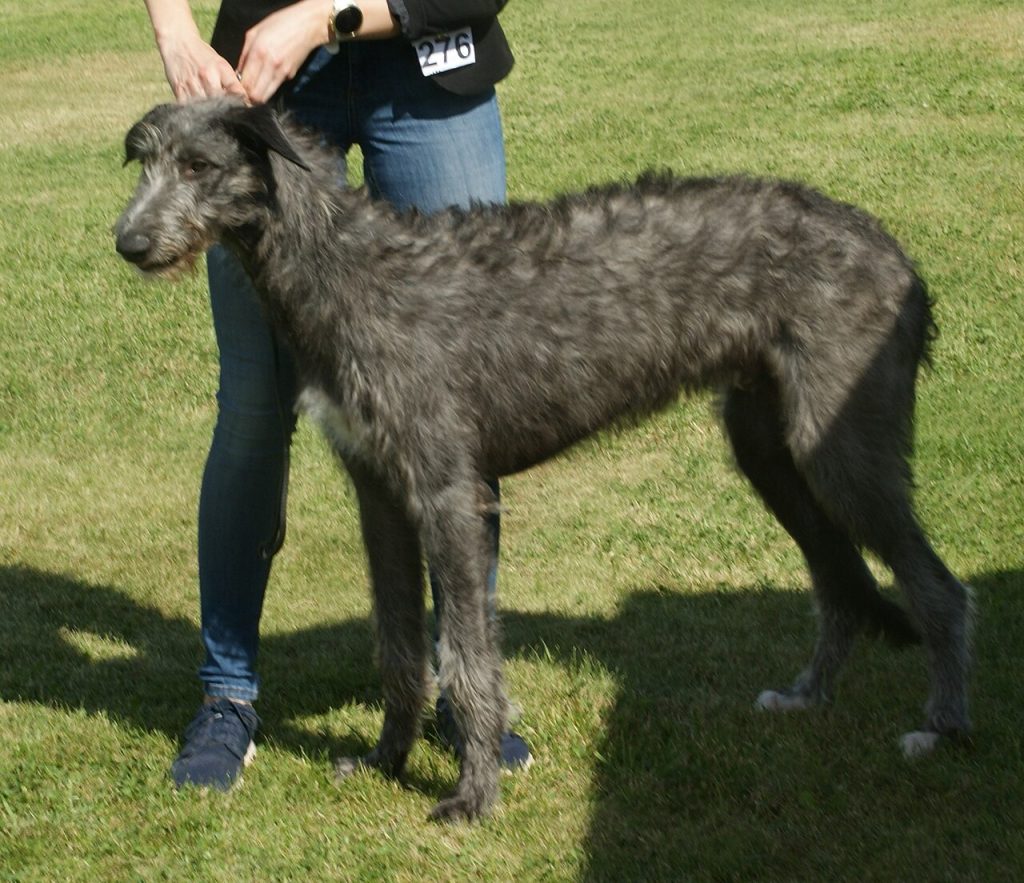
The Lebrel Escocés(Scottish Deerhound) is one of the most noble and lesser known dogs in existence: a giant rough-coated hare, bred for centuries in the Scottish Highlands to hunt red deer in the race. Beneath his imposing figure and almost aristocratic demeanor lurks a sweet, silent companion deeply attached to his family. If you’re looking for a big dog with a quiet home and an athletic soul, the Scottish Greyhound deserves to be thoroughly introduced.
Is the Scotch Lebrel for you?

The Scottish Greyhound is not a dog for just anyone, and he is the first to thank it when it falls into the right hands. He’s huge, he needs to gallop and he can’t stand to be isolated from his family. In return, it offers a surprisingly easy coexistence inside the house: barely barks, doesn’t seek conflict and spends the day sleeping with the elegance of someone who knows he has nothing to prove. Before you decide, take an honest look at these two columns.
In favour .
- Sweet character, quiet and very affectionate with his family.
- Quiet: barks little and is not a scandalous dog.
- Inside the house he is serene and lazy, a comfortable companion.
- Sociable and mildly aggressive, he gets along well with people and other dogs.
- Elegant, clean of odor and with a coat that requires little maintenance.
- Ideal for anyone who enjoys a large, serene and noble dog.
To be taken into account
- It’s huge: it needs space, a big car and a budget.
- Very strong hunting instinct: danger to cats and small animals.
- It requires galloping in wide, safe areas, not just strolling.
- Short life expectancy (about 10-11 years) and delicate heart health.
- He can’t stand prolonged solitude or living in a garden.
- The call is its weak point: without a fence, the belt is mandatory.
Character and temperament
Whoever expects such a large dog to be a fierce guard is in for a pleasant surprise. The Scottish hare is, above all, a dog of gentle treatment and delicate manners. The Scottish tradition itself portrays it as sleeping at the feet of great lords, and that image sums up its soul well: a formidable hunter in the field who, in the living room, transforms into a tender, discreet and peaceful companion.
It is a loyal and devoted dog, which bonds intensely with its family and prefers to be close to it before anything else. It is not especially barking or territorial, and its lack of aggressiveness makes it a terrible guard dog but an excellent house dog.
The other great trait of his character is his instinct for pursuit. He’s a big-game hunter, and he carries a recorded impulse to shoot out after anything that moves fast. At home, he’s an angel; in the open field, in front of a rabbit or a deer, he becomes sheer speed and stops hearing you. Understanding that dual nature is the key to living well with him.
Coexistence: children, other pets, flat and loneliness

With children: is patient and affectionate, and usually behaves very well with the little ones in the house.
With other dogs: is sociable and unconflicted, and enjoys canine companionship. Where extreme caution is needed is with cats, rabbits and farm animals: its hunting instinct is powerful and it must be closely watched whenever it has cattle or small pets nearby.
On the floor: can live on the floor because it is quiet inside and sleeps many hours, as long as it goes out daily to wide spaces to stretch its legs.
Soledad: is his weak point. He was raised to live clinging to people and suffers if left alone for too many hours or relegated to a garden. He needs to be part of family life; isolation makes him sad and can make him apathetic.
Education and training
The Scottish hare is intelligent but independent, with that mixture of nobility and stubbornness so typical of hare. It is not a dog that lives to obey orders; it cooperates when it trusts you and when the treatment is kind. Hardness is counterproductive: it hurts, withdraws and breaks the bond. Positive reinforcement, patience and short sessions always yield better results.
It is good to start early with socialization and the handling of a body that will grow into a giant: walking tightly tied, getting in the car, getting checked. Teaching basic manners to a manageable puppy is much easier than correcting a 45-kg adult.
The great challenge of training is the call. When their chase instinct goes off, the Scottish hare stops listening and comes out at full speed. That’s why in unfenced areas the leash is non-negotiable, and call work must always be practiced in controlled environments. It’s not disobedience: it’s genetic.
Exercise and activity

Here is the heart of the breed. The Scottish Lebrel is a distance and speed athlete designed to chase deer through the Scottish hills. On flat ground it is not as fast as the greyhound, but on rough, wet or hilly terrain it can be left behind: it was shaped precisely by the cold and rugged valleys of the Highlands.
Their need for exercise is for quality rather than constant exhaustion. He loves to gallop deep into a wide, safe space, and then he goes home to sleep peacefully. A good daily sprint, combined with leisurely walks, covers your needs better than miles and miles of jogging. Many examples enjoy in addition to the courses or the racing of hares, sports that reproduce its original function safely.
Important: Puppies and young dogs should not be subjected to strenuous exercise or jumping until their bones and joints are formed.
Care: fur and hygiene
The coat is rough and hard to the touch, about 7 to 10 cm long, with a deliberately unkempt appearance that forms a beard, mustache and a slight mane.
It is a grateful coat: it does not require sophisticated hairdressing. It is enough to brush regularly, once or twice a week, to remove the dead hair and avoid tangles, and some occasional stripping to maintain the hard texture. It does not give off a strong odor and is kept clean easily. As with any large dog, you need to check and care for the ears, cut the nails and monitor dental hygiene.
Foodstuffs
As a giant dog, the Scottish Greyhound needs a quality, well-adjusted diet at every stage of its life. In the puppy, the goal is slow and controlled growth: specific feeds for large/giant breeds help bones and joints develop without haste, avoiding the overweight that causes so much damage in these dogs.
In adults, it is advisable to divide food into two servings a day and avoid vigorous exercise just before and after eating, a sensible measure against the risk of gastric torsion that threatens large, deep-chested dogs like this one. Maintaining a balanced weight, no extra pounds, is one of the best investments for your heart and joints. If you have any doubts about the quantity or type of diet, it is best to consult your veterinarian.
Health and life expectancy
The Scottish Greyhound’s life expectancy is approximately 10 to 11 years; a British study from 2024 placed it at 10.5 years on average, somewhat below the average of purebred dogs.
The Achilles heel of the race is the heart. Heart disease is the number one cause of death, accounting for about a quarter of all deaths, and dilated myocardial disease has one of the highest prevalences of all breeds in the Scottish Leprechaun: A U.S. study found that 6% of individuals had it, the highest figure on record. The second leading cause of death is cancer, accounting for about 18 percent of cases.
Like any deep-chested giant, you also have to be on the lookout for gastric torsion/dilatation, a vital urge, and bone and joint problems. Interestingly, the breed has its own values in some blood parameters – something common in hares – so a veterinarian who is familiar with these parameters is in order. Choosing breeders who monitor the heart health of their breeders is the best possible prevention.
Physical appearance
It is one of the tallest existing hares: males start from about 76 cm at the withers and weigh between 39 and 50 kg, and females from about 71 cm with 34 to 43 kg.
The head is long, with a flat skull, little frontal depression (stop) and a snout that narrows towards the tip. The eyes are dark – dark brown or hazel – with the edge of the eyelids black and a soft expression. The ears, small and silky-tactile, are folded backwards in the shape of a “pink” and only rise halfway up when the dog is excited.
The breast is deep, the back well arched and the grouper falls towards the tail, which is long, tapers towards the tip, reaches almost the ground and bends when the dog is in motion. The feet are compact, with the knuckles well marked. In terms of color, the modern mantle is almost always gray in different shades, the bluish gray being the most appreciated; historically there were also tigers and lions, but the selection made it the most uniformly colored breed among all hares. Some white on the chest, fingers and tail tip is admitted, but no white spot on the head or a white collar.
Origin and history
The Scottish Lebrel is a dog deeply linked to the Scottish Highlands, where for centuries it was used to hunt the red deer to the race: One or two dogs would get as close to the prey as possible and, once released, they would kill it at sheer speed in a matter of minutes. Although Pictish stones from over a thousand years ago show large dogs chasing deer, the breed as we know it is identified as the Scottish Deerhound in the early 19th century, related to the ancient Highland Greyhounds.
It was a dog of kings and nobles – Anne of Denmark, wife of James I, gave specimens to her brother the king of Denmark – but also of ordinary people who hunted with it when they could, as it was a fast and quiet hunter, highly valued both by the aristocracy and by poachers. With the fall of the clan system, these dogs became the sport animals of the great landowners.
Its most critical moment came at the end of the 19th century. When hunting switched from racing to rifle hunting – which required only a tracking dog to follow a wounded animal – the Scottish Greyhound was no longer needed and was on the verge of extinction. He was rescued by a few enthusiasts who turned him into a show dog. In addition, this breed was the fundamental basis on which the modern Irish Wolfhound was rebuilt at the end of that same century.
Curiosities
- Dog of writers and generals. The hares “Dusk” and “Dawn” were wedding gifts to writer Karen Blixen (Isak Dinesen) during her years in Kenya, and appear in her play and film Memories of Africa.
- The dog of Walter Scott. The famous Scottish novelist Sir Walter Scott had a Scottish Greyhound named Maida, whom he adored and who is pictured next to him.
- General Custer had Scottish Greyhounds; his dog “Tuck” died in the Battle of Little Bighorn. Custer wrote about her with evident affection.
- He was a kangaroo hunter. In Australia, the Deerhound and its crosses (such as the Kangaroo Dog) were used to hunt kangaroos, emus and wild boars.
- The most uniform color. is, according to geneticists, the most homogenously colored hare of all: selection towards gray caused other historical colors to be lost.
If you are attracted to this giant’s noble demeanor and quiet soul, you may be interested in other races of similar temperament or silhouette. You can continue to explore the Greyhound, the sleek Whippet, the imposing Gran Danés or the veteran tracker Bloodhound, all with their own history and personality.
Frequently Asked Questions about the Scottish Greyhound
Is the Scottish Greyhound a good companion dog?
Yes, and it surprises those who only see its imposing size. Outside the field it is a calm, quiet and very affectionate dog, which seeks the closeness of its family and enjoys lying at home. Its docile character and its lack of aggressiveness make it an excellent companion for those who can give it the space and exercise it needs.
How long does a Scottish Greyhound live?
Their life expectancy is around 10-11 years; a British study in 2024 placed the average at 10.5 years, below the average of purebred dogs.
Does the Scottish Greyhound need a lot of exercise?
It needs quality exercise, not exhausting amounts. It benefits from a good daily gallop in a safe, fenced space, in addition to its walks. It is a hare: it goes from absolute calm to explosive speed and then goes back to sleep. It is not a dog to jog for hours, but to run hard in short runs.
Do you get along with children and other dogs?
With children it is usually patient and affectionate, although its size and energy in the race advise to supervise the games with the smaller ones. With other dogs it is sociable and not conflicted.
Can the Scottish Greyhound live in a flat?
It can adapt to a floor because indoors it is very quiet and sleeps a lot, but it needs space to move around when outdoors and frequent access to wide areas to gallop.
How tall and how much does a Scottish Greyhound weigh?
It is one of the tallest hares. The males measure from about 76 cm at the withers and weigh between 39 and 50 kg; the females start from about 71 cm and weigh from 34 to 43 kg. It is a large and stronger bone dog than the greyhound, but with elegant lines.
What health problems does the breed have?
The main weak point is the heart: dilated cardiomyopathy has a particularly high prevalence in the race, and cardiac causes are the number one cause of death.
Is it hard to train the Scottish Greyhound?
It is not difficult, but it is independent. It responds much better to gentle treatment and rewards than to hardness, which hurts and blocks it. The tricky thing is the call when it sees a prey: its chase instinct is very strong, so safety goes through fences and straps in open areas.