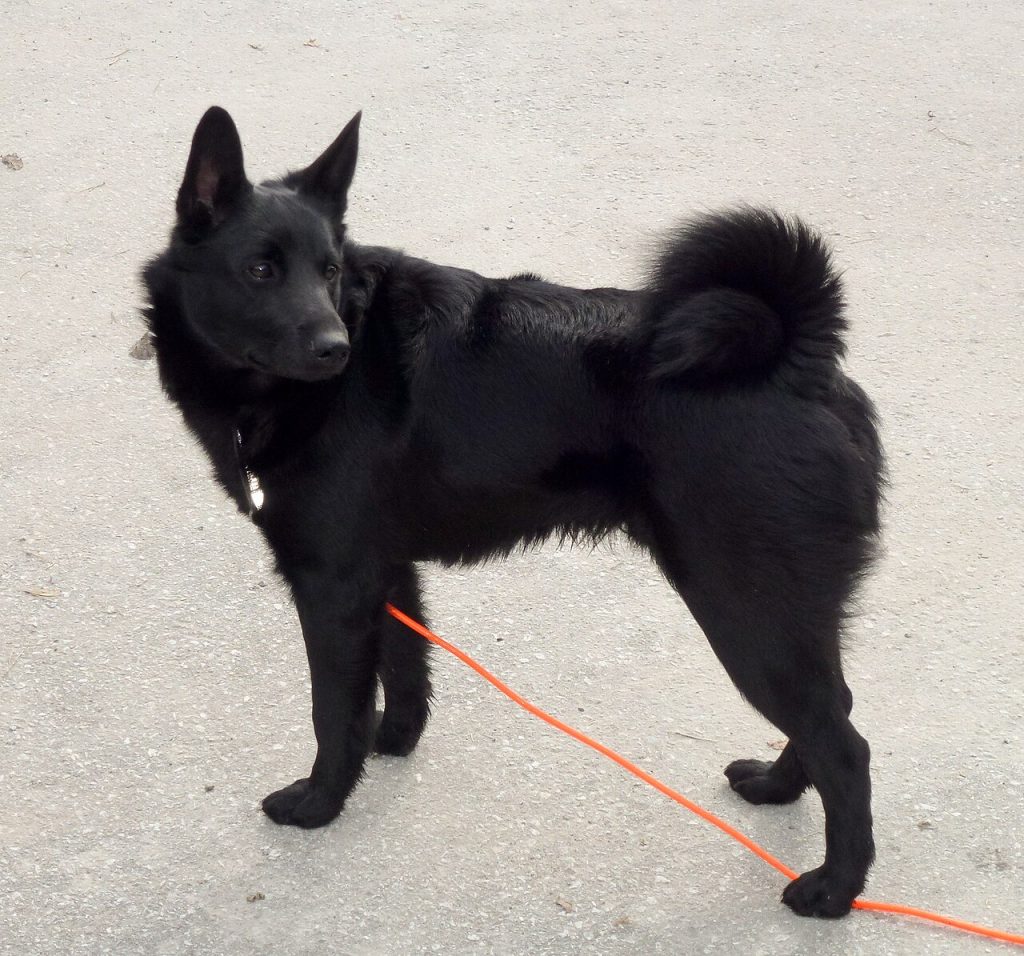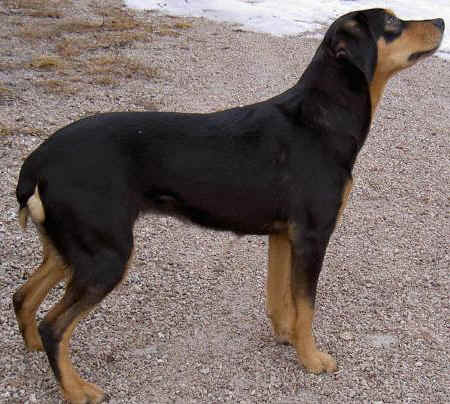
The Smaland hound(in Swedish Smålandsstövare) is the oldest and smallest hound in Sweden: a robust, compact, black-coated trail dog with copper markings reminiscent of a miniature Rottweiler. Born in the 16th century in the Småland region to hunt everything on the farms of southern Sweden, today it is a rare breed – only about 60 puppies are registered a year – that combines the hunter’s hardworking instinct with an attached, protective and surprisingly homely character. If you are looking for a balanced, intelligent, and unusual companion, this article unvarnishedly tells you what the Smaland Hound really is like and whether it fits you.
Is the Hound of Smaland for you?

The Smaland Hound is a working dog with a hound soul: it needs real exercise, enjoys using its sense of smell and forms an intense bond with its family. It’s not a decorative dog or a permanent couch dog, but it’s not the typical indomitable hound either: it’s more manageable and tame than most tracking dogs. Before you fall in love with how weird it is, see if your life fits in with theirs.
In favour .
- Medium-sized, easy to handle and transport.
- Very smart and eager to learn.
- Loving and attached to his family; good house dog despite his hunting background.
- Protective and reserved with strangers – excellent warning dog.
- Short coat, easy to maintain.
- Healthy, rustic breed with good longevity.
Against
- High need for exercise: not worth a short walk.
- It’s not ideal for small apartments or sedentary people.
- Hunting and tracking instinct marked; can follow a scent and disconnect.
- Territorial and vigilant: can bark to warn.
- Extreme rarity outside Sweden: almost impossible to find.
- He needs mental stimulation or he gets bored.
Character and temperament
The Smaland Hound combines two facets that do not always coexist in a hound: that of the tireless hunter and that of the quiet family dog inside the house. It is a very clever. dog, attentive and with a strong bonding capacity with its owner; many specimens develop a clear attachment to a reference person, while still being sociable with the rest of the family nucleus.
Its nature is kind and protective. At home it tends to be balanced and affectionate, which explains why in Sweden it is also valued as a companion dog and not only for work. Outside the house, or in front of strangers, its side reserved and territorial emerges: distrust of strangers and warns of what seems out of place, qualities that make it a good guard dog without becoming aggressive by default.
Like all hounds, it has its own initiative and a sense of smell that commands. It is not a submissive dog that obeys because it obeys: it wants to understand what is asked of it and why. Well channeled, this awakened character translates into a versatile companion; poorly managed, into a dog that gets bored and seeks its own amusement.
Coexistence: children, other pets, flat and loneliness
With children:‘s gentle nature and attachment to family make it a good companion for homes with children, always with regular supervision and mutual education.
With other pets: is a dog bred to hunt hares, squirrels, foxes and birds, so its instinct to chase small animals can be activated. With other dogs it usually gets along well, especially if it socializes from a puppy; with cats or small pets coexistence is possible but requires careful presentations and not lowering the guard.
On the floor: is not its ideal habitat. It is a dog with a lot of energy and need for exercise, not recommended for small apartments. It can live on the floor if it goes out a lot and demandingly, but performs and enjoys more in a house with safe access to the outdoors.
Soledad: due to its strong family bond, is not a dog to spend the day alone. It tolerates moments of loneliness if given enough exercise and company, but prolonged isolation takes its toll in the form of boredom, barking or destructive behavior.
Education and training
The Smaland Hound is very clever., which plays for and against: it learns fast, but it also learns fast to get away with it if you let it.
- Early socialization: early exposure to people, environments, noises and other animals softens their tendency to distrust strangers and prevents excessive territoriality.
- Positive reinforcement: responds better to motivation (food, play, smell) than to imposition.
- Smell work: harnessing his tracking instinct in search games and field tests keeps him mentally satisfied and strengthens the bond.
- Reliable call: by its hunting instinct, training the turn and control when it catches a trail is a priority; until you have it solid, be careful about releasing it in open areas without control.
In Sweden, it is becoming increasingly common to see a hound taking part in work tests, a sign that it is a dog that enjoys having a task.
Exercise and activity
This is the part that doesn’t support shortcuts: the Smaland Hound he needs a lot of exercise.. It’s an endurance hunting dog, bred to spend hours working in the field, and that energy is still there even though it lives as a pet. A short walk is not enough for it.
Ideally, you should combine intense physical exercise – long walks, running, exploring nature – with mental stimulation through smell: tracks, search games, dog sports. A Smaland Hound that spends body and head is a calm and balanced dog at home. One that falls short of activity is a frustrated, noisy and potentially destructive dog. It remains active and able to work until about twelve years of age.
Care: fur and hygiene
One of the practical advantages of the breed is the easy to maintain. The coat is of medium length in the outer layer, with a shorter and denser undercoat; the longer coat is concentrated in the tail and thighs.
- Cepillado: a weekly brushing is enough to remove dead hair and keep the coat healthy; increase it in moult seasons.
- Baño: only when it’s really necessary.
- Orejas: should be checked and cleaned regularly to prevent infection, especially after field trips.
- Nails and teeth: cuts nails when asked and routine dental hygiene, like any dog.
Foodstuffs
The Smaland Hound is a medium-sized dog (15 – 20 kg) and very active, so its diet should be adjusted to a high energy expenditure when working or exercising a lot, and moderated in times of less activity to avoid accumulating excess weight. Interestingly, its origin comes from farmers who could only afford to feed a single hunting dog, so the breed was selected in part for its efficiency and hardiness.
As general guidelines, without inventing exact figures: divide the ration into two meals a day, choose a quality feed or diet appropriate to your size, age and activity level, and monitor your weight regularly. Always adjust the amounts with your veterinarian according to each specimen. Fresh and clean water should always be available, especially after exercise.
Health and life expectancy

The Smaland Hound is a notably healthy breed. The Swedish breed club commissioned genetic studies on several specimens between 1994 and 2008, and the tests found no breed-specific or breed-exclusive health problems, nor any widespread serious genetic pathologies.
The breeders’ recommendation is sound: when a rare health problem occurs, do not breed with it to prevent the problem from spreading to the already small population; this responsible management, coupled with the natural hardiness of the breed, explains its good health.
Your average life expectancy is 12 to 15 years, an excellent figure confirming the strength of the breed, basic care – vaccination, deworming, veterinary checkups, weight control and adequate exercise – is the best policy for you to take full advantage of.
Physical appearance
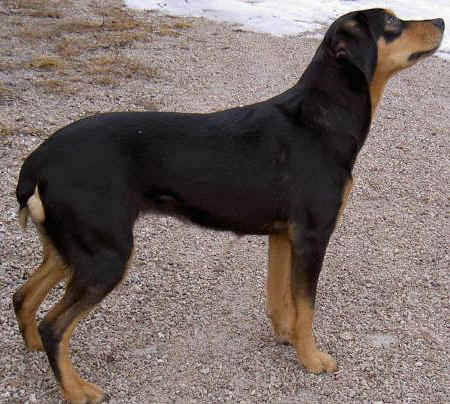
The Smaland Hound is a compact, robust and almost square body dog, the smallest of the Swedish hounds.
- Altura: between 41 and 53 cm at the withers, with males slightly larger than females.
- Peso: about 15 to 20 kg in both sexes.
- Manto: medium-length outer coat with dense undercoat; black with fire marks, which can range from amber to reddish brown.
- Cola: is naturally short (birth tail or the bobtail), a trait deliberately fixed in the breed by selection.
- Cabeza: floppy skull with well-marked stop, black nose with wide nostrils, scissor bite and typically dark brown eyes.
- Orejas: rounded tips, inserted rather high and hanging flat on the sides of the head.
Origin and history
The history of the Smaland Hound dates back to 16th century in the Småland region in southern Sweden, from which it takes its name. During the time of the Swedish Empire, many wars were fought, and returning soldiers brought with them tracking dogs of various origins. These hounds were crossed with local dogs of the spitz type, and from that mixture emerged the foundational trunk of the modern Smålandsstövare.
Swedish farmers, who often could only keep a single hunting dog, were looking for a multi-purpose hunter capable of chasing hares, squirrels, foxes, birds and even larger prey such as moose. At that early stage the breed was very heterogeneous in color, size and tail length; selective breeding did not begin until the 19th century. At the first dog show held in Sweden in 1889, 444 dogs were registered, of which 189 were hounds, including Smålandsstövare.
In the early 20th century breeders worked to recover the old type, with the characteristic short tail from birth. The The Swedish Kennel Club recognized the breed in 1921, the same year the first standard was written; the first recorded example was Skoj av Myren. Baron Frederik von Essen was key in fixing the short tail as a feature of the entire breed, initially developed in the province of Jönköping. The most recent standard dates from 1952. Today an average of about sixty puppies are registered a year, making this a rare breed that is rarely seen outside Sweden. The Fédération Cynologique Internationale recognizes it, and the United Kennel Club did so in 2006 under the name Smaland Hound.
Curiosities
- It’s the oldest hound native to Sweden and also the smallest of the Swedish hounds.
- It is often confused with the Rottweiler for its black coat and fire, despite being a totally different dog in type and function.
- Your natural short tail is not a cut-out: it was genetically selected to be born that way.
- It is a it ‘s so weird . breed that only registers about sixty puppies a year in Sweden, and is practically not seen outside the country.
- Genetic studies from 1994 – 2008 confirmed it as one of the healthiest breeds, with no pathologies of its own.
- Originally it was the Swedish farmer’s “all-terrain” hunting dog: only one was suitable for almost any prey.
If you are attracted to the profile of the Smaland Hound, you may be interested in other tracking and working breeds with a balanced nature. You may discover the Beagle, another medium-sized hound guided by smell; the Basset Hound, a quiet hound with a prodigious smell; the imposing Bloodhound, the tracker par excellence; or the versatile Rottweiler, with which it shares that characteristic black and fire coat.
Frequently Asked Questions About the Smaland Hound
Is the Smaland Hound a good family dog?
Yes. Despite its hunting origin, it is a kind, affectionate and protective dog that behaves very well indoors. In Sweden it is valued as both a pet and a working dog. It needs enough exercise and an active family to give it its best.
How much exercise do you need?
It is a highly energetic and resilient hound, requiring intense daily physical exercise plus mental stimulation of the sense of smell. A short walk is not enough; without sufficient activity it becomes bored and may become noisy or destructive.
Can you have it on one floor?
It is not ideal. Its high need for exercise makes it unsuitable for small apartments. It can adapt to a flat if it goes out a lot and demandingly, but enjoys it more in a house with safe outdoor access.
Why does he look like a Rottweiler?
The Smaland Hound is a smaller and more stylized Swedish track hound.
Is it a healthy breed?
Yes, remarkably. Genetic studies conducted between 1994 and 2008 found no specific health problems or serious genetic pathologies inherent in the breed. Their hardiness and responsible breeding explain their good health and longevity of twelve to fifteen years.
Why is his tail so short?
Baron Frederik von Essen was instrumental in establishing this trait as characteristic of the entire Smålandsstövare at the beginning of the 20th century.
Do you get along with children and other pets?
With children it is usually patient and affectionate, better with children who already know how to treat a dog. With other dogs it gets along well if it socializes early. With cats or small pets you have to be careful because of their hunting instinct: coexistence is possible but requires controlled presentations.
Is it hard to find the Hound of Smaland?
It is a rare breed even in its native Sweden, where only about sixty pups are registered a year, and is almost never seen outside the country.