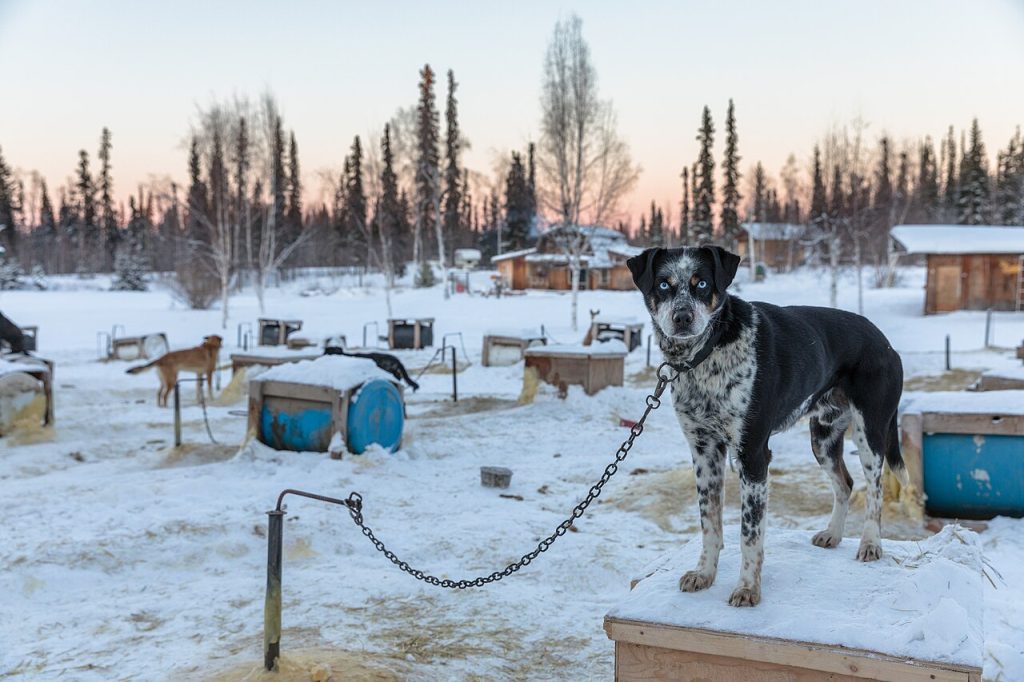
The Husky of Alaska(Alaskan husky) is not a breed in use, but the best sled dog that has produced the sport of mushing: A medium-sized athlete raised for over a century by a single obsession, running fast and far pulling a sled. If you’re attracted to its inexhaustible energy and functional elegance, here’s the complete guide to understanding what the Alaskan Husky really is and if it fits you.
Is that the Alaskan Husky for you?
Before you fall in love with his athletic wolf stance, be honest: The Alaskan Husky is, first and foremost, a working dog. He enjoys running, is not content with a couple of laps around the block and needs an owner as active as he is. These are his lights and his shadows.
In favour .
- Strength and energy out of the ordinary: the ideal companion for shooting and endurance sports.
- Very intelligent and resolute; he learns quickly what motivates him.
- Sociable with other dogs, used to life in a pack.
- Rustic and healthy, with remarkable hybrid vigor.
- Balanced and unaggressive; usually friendly to people.
To be taken into account
- Exercise needs very high: bored, destroying and running away.
- Strong running and prey instinct; loose unchecked may get lost or go after other animals.
- He sneezes and “talks”; he’s not a silent dog.
- He’s not a watchdog or a sedentary little floor dog.
- Best for experienced owners and outdoor life.
Character and temperament

The Husky of Alaska‘s temperament varies greatly from one line to another, precisely because it has never been selected for appearance but for teamwork ability. Still, there are traits that are repeated because they are essential for a good sled dog: The desire to pull and run is almost an impulse, and mental solidity is non-negotiable. A shooting dog spends hours glued to its companions, handled by people and, in a race, surrounded by the public and other teams; whoever does not remain calm in that context is not useful, and that is why breeders prioritize temperate nerves.
The other great quality is intelligence. Since the dog works away from the guide and without direct physical contact, it must read the terrain, anticipate danger, and make decisions for itself. That autonomy, highly valued in guide dogs, translates at home into an alert, curious, problem-solving animal – including opening a door or jumping a fence if bored. The Alaskan Husky is not a submissive dog that obeys for the sake of obeying: cooperates when it understands the meaning of what it is asked to do.
Coexistence: children, other pets, flat and loneliness
With people the Alaskan Husky is usually cordial and unconflicted; its habit of being handled by mushers, veterinarians and volunteers makes it tolerant of treatment and, well socialized, it is good with kids., although its thrust and energy require supervision with the smaller ones. He’s not a territorial dog or suspicious, so as a guard he leaves a lot to be desired: Most likely, it will receive the intruder by wagging its tail.

With other dogs it shines: it is designed to live and work in a group, and canine coexistence usually occurs naturally.
In terms of habitat, the Alaskan Husky tolerates the cold much better than the heat and prefers a house with land to a flat. It can adapt to living indoors, but only if it receives intense exercise daily; otherwise, loneliness and boredom lead to howling, escapism and destruction.
Education and training
Training an Alaskan Husky requires an understanding of its psychology: He’s smart, but independent, and he responds fatally to imposition. Positive reinforcement works, short sessions, and most of all, giving you a job that excites you. Early socialization and good recall (going to the call) are priorities, because their instinct to run can take them far in seconds. It should be assumed from the outset that loosening in unfenced areas is always a risk.
The good news is that it channels its mental and physical energy wonderfully when you teach it to harness. Mushing, canicross, or bikejoring not only tires it, it gives it purpose, and an Alaskan Husky with purpose is a balanced and happy dog. Without that outlet, no obedience training will compensate for the accumulated frustration.
Exercise and activity
This is the heart of the breed. The Alaskan Husky has been bred to run for hours, and its numbers are breathtaking: speed teams reach up to 28 miles per hour, and long-distance teams have completed tests of more than 1,500 miles in just over eight days, mandatory breaks included. That engine doesn’t shut down living in a city.
An Alaskan Husky needs daily and demanding exercise: running, hiking, cycling, or, ideally, shooting sports. We are talking about a dog who knows nothing about a quiet walk. If you give him what his body asks for – kilometers and a goal – he will be an untiring companion; if not, he will show you in his own way what energy is contained.
Care: fur and hygiene

The coat of the Alaskan Husky is double but its density varies according to the line: long-distance runners wear a denser coat to withstand cold and wind, while speed runners wear shorter hair to better dissipate heat in the race. In general, maintenance is simple – regular brushing and more frequent during spring and autumn mowing, when the undercoat is released in bunches.
A very distinctive feature of the breed are the feet: Hard, healthy pads are such a prized trait that they go into the breeding criteria. On long expeditions it is common to see these dogs with boots and coats to protect themselves from ice and abrasive terrain. Otherwise, bathe only when necessary, check your ears, teeth, and nails, and pay special attention to your feet if you are training on hard surfaces.
Foodstuffs
The Alaskan Husky’s metabolism is one of the most extraordinary in the canine world. Studies on active sled dogs show that their bodies quickly switch to using low-glycemic energy sources – fats and protein – during long exertions, and that this dependence is heightened the longer they work. That’s why a good appetite is a highly valued trait in the calf: A dog that eats well is a dog that gives.
In practice, your diet should be tailored to your activity level. A sporty specimen in the middle of a racing season burns a barbaric number of calories and needs a high-energy feed rich in fat and quality protein; an Alaskan Husky who lives as a companion with moderate exercise requires more restricted rations in order not to gain weight. Water always available and food distribution according to the day’s effort.
Health and life expectancy
Being a functional cross and not a closed breed, the Alaskan Husky benefits from a remarkable hybrid vigor and, overall, is a robust and healthy dog. Their life expectancy, as a guideline, is usually around 12-15 years with proper care. A large study published in 2020 on nearly 5,000 sled dogs – mostly Alaska Huskies – observed that their anti-inflammatory and anti-aging markers improved with training up to an average of 6.6 years, illustrating how well they feel about the activity.
The diseases most associated with these dogs are those of their trade rather than their genetics: for example, bronchial problems linked to cold and intense effort, colloquially known as “skier’s asthma”.
Physical appearance
The Alaskan Husky is a medium-sized, athletic and agile dog, usually taller than the Siberian Husky and lighter than the Alaskan Malamute, its two closest relatives. It measures between 51 and 66 cm at the withers and weighs between 16 and 34 kg, with considerable variation depending on whether it is a speed or long-distance specimen.
His appearance is anything but uniform. Some lines retain spitz traits – erect ears and curled tail – while others betray their hound or show dog heritage, with half-slung ears, straight tail and a more stylized greyhound profile. The coat supports any color and pattern, and the eyes are usually brown, although it is not uncommon to find specimens with blue or disparate eyes. In short: If you’re looking for a fixed standard, this is not your dog; its beauty is that of pure functionality.
Origin and history
The story of the Alaskan Husky is the story of sport mushing itself. When European traders and settlers arrived in Alaska, they found native dogs – strong and hardy, but not particularly fast – pulling sleds, and they soon turned that means of transportation into a competition. To gain speed they began to cross them with faster foreign breeds, including Siberian imports that dominated the first organized races.
Since the early 20th century, different breeders have been creating their own lines of race dogs. Almost all retain some husky heritage – the Alaskan Malamute and Siberian Husky are the most common contributors – but Mackenzie River huskies, Greenland dogs, and Samoyeds have also been added. By mid-century, the use of sled dogs shifted from utility to sport, and in the quest for more speed blood from sample dogs and hares was introduced: Pointers, greyhounds, German Shorthaired Pointer, Salukis, Borzois, Labradors and Setters; some breeders even went as far as to use wolves. Modern genetic analysis confirms this mosaic: The Alaskan Husky is descended from the old North American Arctic village dogs and Siberian imports, crossed with European breeds to improve performance, and forms a related group with the Siberian, Malamute and Chukotka sled dogs.
Curiosities
- Although not a recognized breed, DNA tests do identify the Alaskan Husky by its own genetic signature.
- It is the most widely used dog in the world’s great sled races, such as the Iditarod, Yukon Quest and Finnmarksløpet.
- There are two genetic “subtypes” depending on their function: speed lines, with more pointer and saluki input, and long distance lines, with more Arctic blood.
- The Eurohound, a crack of the sprint, is a cross derived from this philosophy: Alaskan Husky with short-haired German arm.
- Its ability to pull loads far in excess of its own weight and to convert fat into energy makes it one of the most efficient endurance athletes in the animal kingdom.
If you like the Alaskan Husky for its Nordic and athletic spirit, you will surely enjoy getting to know its relatives and the breeds that run through its veins: the Siberian Husky, the Samoyedo, the athletic Pastor Alemán and the very fast Pointer, all of which are present in one way or another in the history of this incredible sled dog.
Frequently Asked Questions About the Alaskan Husky
Is the Alaskan Husky an officially recognized breed?
No. The Alaska Husky is not recognized by the FCI or any canine club, and has no morphological standard. It is a dog defined by its function– pulling a sled fast and far – not by its appearance. Despite this, DNA studies show that it shares a recognizable genetic signature, to the point of being identifiable in breed genetic tests.
How is it different from the Siberian Husky and the Alaskan Malamute?
The Alaskan Husky descends from both and shares their lineage, but is usually taller and lighter than the Siberian and considerably more stylized than the Malamute. The key difference is not in aesthetics but in purpose: The Siberian and Malamute are standard breeds, while the Alaskan Husky is bred solely for sport performance, also mixing pointer, greyhound or saluki blood to gain speed.
How tall and how much does an Alaskan Husky weigh?
It is a medium-sized dog. The typical height ranges from 51 to 66 cm at the withers and the weight ranges from 16 to 34 kg, with considerable variation depending on the line: speed specimens tend to be lighter and those of long distance somewhat more robust and with more hair.
Is the Alaskan Husky a good family dog?
It is sociable, balanced, and used to living in packs and being handled by people, but its energy is enormous: it needs an active owner to give it work and exercise daily. It is not a couch dog or a good choice for those looking for a quiet, sedentary companion.
How much exercise do you need?
He’s been trained for generations to run for hours, so a couple of short walks aren’t enough. Ideally, it’s canicross, bikejoring, mushing, running or strenuous hiking several times a week. Without a real outlet, his frustration translates into wrecking, escapism and howling.
What color are her eyes and fur?
The coat can be any color and pattern, as the appearance is not selected. The eyes are usually brown, although there are also specimens of blue or disparate eyes inherited from his Siberian Husky blood. The coat is double, denser on long distance lines and shorter on speed lines.
How long does an Alaskan Husky live?
As it is a functional cross with remarkable hybrid vigor, it usually enjoys a long life for a dog of its size: as a guideline, around 12-15 years with good health, proper nutrition and the activity that its body demands.
Can you have an Alaskan Husky on a floor?
It is not advisable to live indoors if you get a lot of daily exercise, but your level of activity, your tendency to howl, and your running instinct are much better suited to a house with terrain and, especially, to an owner who practices shooting or endurance sports with you.