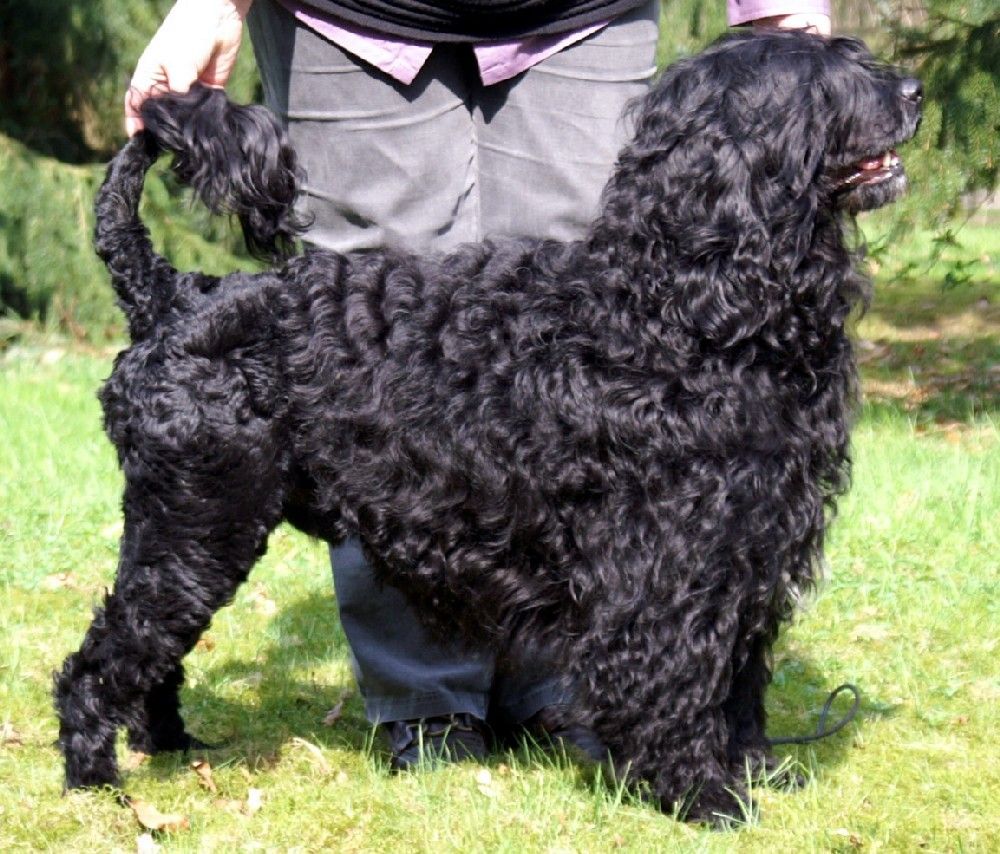
The Portuguese Water Dog is a working dog born on the Algarve coast, bred for centuries to get into the sea with fishermen. Intelligent, athletic and deeply attached to his family, he combines a curly or wavy coat that barely loosens hair with an energy that needs daily outlet. If you’re looking for an active, alert, attached companion, the Portuguese Water Dog has plenty to offer, but it’s good to know what you’re getting into before you take the plunge.
Is the Portuguese Water Dog for you?
Before you fall in love with its curly hair, be honest: the Portuguese Water Dog is a working dog that enjoys having a task. It fits wonderfully in active homes and is complicated in homes where you would spend many hours alone and without stimulus. These two boxes summarize the good and what you should value calmly.
In favour .
- Very intelligent and with an excellent memory: he learns complex commands quickly.
- One-coat coat that practically doesn’t change, an advantage for someone who hates hair at home.
- Intense attachment to his family; he usually chooses a reference person and follows her everywhere.
- It loves water and activity; it is an ideal companion for swimming, agility or spending the day outside.
- Versatile as an assistance dog: it serves as a hearing aid for deaf people, mobility support or therapy dog.
- Sociable and usually kind to strangers.
To be taken into account
- He needs intense physical exercise and daily mental challenges; boredom makes him destructive.
- Prolonged solitude is not good for him. He is not a dog to be left alone for long hours.
- Hair grows indefinitely and requires a haircut every few weeks, in addition to frequent brushing.
- Their strong collecting instinct sometimes translates into biting, pulling, and jumping to greet.
- It’s a rare breed, so finding serious breeders can take time.
- It is advisable to require genetic health tests of the breed before buying a puppy.
Character and temperament
Defining the Portuguese Water Dog in one word is difficult, but if I had to choose it would be “worker”. We are dealing with an alert, affectionate and equally independent dog that enjoys collaborating with its owner and waiting for instructions from his side. He learns very quickly, seems to do well during training, and retains the names of objects for a long time, a clear sign of his intelligence.
It’s a dog that tends to stay close to its owners, both inside and out. Although he is very sociable, he often develops a particularly strong bond with a family member. Some attribute it to its origin: In the small fishing boats he worked sticking to the fisherman, not drifting away like herding dogs do. That trait persists to this day and explains why he prefers to be always in sight of his reference person.
It has a curious, multi-toned voice, and although it is a rather quiet dog, it warns when someone approaches the house with a loud, recognizable barking. He also “speaks” in his own way: It emits an expressive gasp, a kind of “ha-ha-ha”, inviting you to play or demanding something. Their collecting instinct is strong, so many individuals pull, bite, or jump as a greeting. Some even walk or “dance” on their hind legs when excited, and it is not uncommon for them to lean on countertops and tables if they smell food overhead.
Coexistence: children, pets, flat and loneliness
The Portuguese Water Dog is a family dog that adapts to different environments as long as its needs are met.
- With children: is gentle and patient, and enjoys play and shared activity, making it a good companion for dynamic families.
- With other pets: is sociable and usually gets along well with other dogs. Its strong collecting instinct makes it advisable to introduce small animals with the head and supervise the first coexistence.
- On the floor: can live perfectly in an apartment as long as it gets enough outings and exercise. It is not a dog to keep locked up: lack of activity takes its toll in the form of destructive behaviors.
- In the face of loneliness: is your Achilles heel. It’s designed to work and live alongside people, so it doesn’t fit in homes where you spend many hours alone. If you work outside all day, consider alternatives like dog daycare, walking or the company of another animal.
- With strangers: is generally friendly and likes to be stroked, so it does not stand out as a guard dog, although it does warn of visitors.
Education and training
The Portuguese Water Dog combines remarkable intelligence with a genuine willingness to cooperate, which makes it outstanding in obedience and agility. It learns very quickly and, in addition, seems to enjoy the process: for him a training session is another way to spend time with his favorite person.
The key is positive reinforcement and keeping sessions varied and stimulating. Because he has such a good memory for object names, search and discrimination games delight him and keep him mentally occupied. Starting as a puppy, you should channel his collecting instinct and his habit of jumping up and down to greet him, as well as teach him early on to be alone for short periods to prevent separation anxiety.
Its willingness to call out and then search for its owner when something happens makes it ideal as a signal dog for deaf people: it can be trained to bark when the phone rings and then warn its owner.
Exercise and activity
Don’t be fooled by its stuffed look: this is a working dog and needs to expend real energy. It requires intense regular physical exercise and, as important as that, mental challenges to keep its head occupied. A bored Portuguese Water Dog finds its own entertainment, and you rarely like it.
Water is its natural element. Swimming is probably the activity he enjoys most, and his legs with interdigital membranes make him an excellent swimmer. If you have access to a safe beach, lake, or river, take advantage of it: For him it is a reward and a complete exercise at the same time. Add to this quality daily walks, collectible games, agility and any dog sport that combines body and mind. He’s not a couch dog, so he plans his routine with an active day in mind.
Care: fur and hygiene
The most distinctive feature of the Portuguese Water Dog is its coat, and also its main demand for care. It has a single coat of hair that does not change, curly or wavy depending on the specimen, and that continues to grow indefinitely if left untreated. That requires constant maintenance: If neglected, the hair around the eyes can become opaque and the hair on the body can become flaky, causing skin irritation.
In practice this means brushing it every other day and taking it to the hairdresser about every other month. There are two classic cuts. The lion cut is the traditional fishing dog: the posterior third, the snout and the base of the tail are shaved (leaving a flag-like lock) and the rest of the body is kept long. It was used to dampen the cold when jumping into the water, shelter vital organs, and, when shaving the hindquarters, give freedom of movement to the legs and that rudderlike tail. The court of Collector is more modern: leaves the hair about two and a half centimeters evenly distributed throughout the body, and is the most common today. In summer many owners choose to shave even shorter.
Otherwise, maintain basic hygiene: check and clean your ears (especially if you swim often), take care of dental hygiene, and watch your nails.
Foodstuffs
Since it is a medium-sized, muscular and very active dog, the Portuguese Water Dog needs a quality diet that maintains its activity level without exceeding its calorie intake.
Divide food into two daily servings instead of one and avoid overweight, which especially punishes the joints in a breed with a certain predisposition to hip dysplasia. Consider their fondness for watching countertops and tables for food: The best defense is not to leave food in their reach and not to reward that behavior. As always, if you have any specific questions about quantities or special diets, it is best to consult your veterinarian.
Health and life expectancy
The Portuguese Water Dog is a robust dog, but like any purebred with a limited genetic pool, it carries some hereditary pathologies that you should know about. The good news is that the community of serious breeders has been working with genetic testing for years to minimize them, so the best guarantee of health is to choose a puppy from tested parents.
These are the main race-related conditions:
- Dysplasia of the hip: congenital and developmental hip joint problem. The risk is greatly reduced by checking the health certificates of both parents.
- Cataracts and progressive retinal atrophy (PRRA): is a recessive gene and there is a DNA test (the so-called Optigen test) to identify carriers.
- Distiquiasis: eyelashes that grow inward and fringe the eye. It is not very common in the breed and, if treated, has easy surgical solution.
- Disease due to storage of GM1 (gangliosidosis): is a recessive, life-threatening disorder that usually manifests around six months of age.
- Juvenile dilated cardiomyopathy: is a life-threatening recessive heart condition that affects very young puppies.
The official sources consulted do not set a specific life expectancy for the breed, but what is clear is that a Portuguese Water Dog from tested lines, well fed, in its weight and with regular veterinary checks has a long and full life ahead of it as an active companion.
Physical appearance
The Portuguese Water Dog is a medium-sized dog of solid and muscular build, with strong and well-developed bone, neither thin nor rough.
Their coat supports two textures, both from a single layer that does not shed hair. The curly forms cylindrical, compact curls, somewhat dimmed in brightness; the wavy falls in soft waves, with a slight luster. It is not uncommon to find specimens with mixed hair: Curly in body and wavy in tail and ears. Colors include black, brown, black-and-white, and brown-and-white, as well as specimens with silver tips. It is common to see white spots on the chest or legs; in fact, black with white markings on the chin (the so-called “milk chin”) and chest is the most common pattern, while white is the less frequent color. The Portuguese standard does not allow more than 30% white markings.
Origin and history
The Portuguese Water Dog originated in the Algarve region of southern Portugal, and from there spread throughout the country’s coastline. His work was inseparable from the sea: He was taught to guide fish to the fishermen’s nets, to retrieve lost gear or broken nets, and to mail between ships, or between ship and shore. He even boarded fishing boats that sailed from Portuguese waters to the coasts of Iceland in search of cod. Hence their other names: cão de água algarvio (water dog of the Algarve) or cão pescador português (Portuguese fishing dog).
The Portuguese Water Dog and the Poodle appear to come from the same ancient genetic stock; breeders also point to the Kerry Blue Terrier and the Irish Water Dog as possible ancestors. With the decline of traditional fishing, the breed was on the brink of extinction. In the 1930s, wealthy Portuguese shipowner Vasco Bensaude began looking for dogs among the fishermen to set up a breeding program and rescue the breed. From his kennel, Algarbiorum, came his most famous dog, Leão (1931-1942), a stallion so representative of the type that about half of the pedigreed Portuguese Water Dogs are descended from him.
The witness was picked up by figures such as Conchita Cintron of Castelo Branco and António Cabral, founder of the Alvalade kennel, who registered its first specimen in 1954 and left as a seal the “mark of Cabral”, a triangle of hair of different color or texture near the base of the tail. The arrival in the United States is mainly due to Deyanne Miller, who in 1972 founded with fourteen other people the Portuguese Water Dog Club of America. Among the first American breeders was, interestingly, the actor Raymond Burr.
Today it is a rare breed. To give you an idea, at the prestigious Crufts exhibition in the UK in 2013 only 36 specimens were registered.
Curiosities
- The dog of the White House: was the breed chosen by President Barack Obama, who had two, Bo and Sunny.
- Swimmers’ feet: has interdigital membranes between its fingers, a natural adaptation that makes it a formidable swimmer.
- “Counter surfing”:‘s habit of standing up on his hind legs to inspect desks and tables is so typical that it has a proper English name.
- ¿Hipoalergénico? is often given that label for not changing their hair, but there is no scientific evidence that any breed is truly hypoallergenic.
- Aquatic relatives: shares roots with the Poodle and a common origin with the Spanish Water Dog.
- Steering column: the traditional lion cut left the powerful tail exposed precisely because it served as a rudder in the water.
If you are attracted to this hardworking water dog, you may be interested in other breeds of similar air or function. The closest relative of the Portuguese Water Dog is the Caniche (Poodle), with which it shares genetic trunk and that curly hair that does not change. Another water dog worth knowing is the Lagotto Romagnolo, today’s famous truffle hunter. And if you’re hooked on his passion for charging in the water, check out the rugged Chesapeake Bay Retriever and the ever-versatile Labrador Retriever.
Frequently Asked Questions About the Portuguese Water Dog
Does the Portuguese Water Dog shed a lot of hair?
No, it has a single-layer coat that practically does not change, so it is well tolerated by many people with allergies, but that hair grows indefinitely and needs frequent brushing and hairdressing every few weeks.
Is that a hypoallergenic dog?
It has a reputation for not shedding hair, but there is no scientific evidence to prove that any breed is truly hypoallergenic.
How much exercise do you need?
Pretty much. It’s a working dog that requires intense daily physical exercise, in addition to mental challenges. Swimming is its favorite activity, and it’s fascinated by collectibles and canine sports like agility.
Can he be left alone for many hours?
He is raised to live and work with people and is very attached to his family, so prolonged loneliness makes him feel bad and can lead to destructive behavior.
Is he good with kids?
It is gentle, patient and playful, which makes it a good companion for active families.
Is it easy to train?
It’s very intelligent, has a great memory and a willingness to cooperate, so it excels in obedience and agility, responds greatly to positive reinforcement, and enjoys working sessions with its owner.
How big is it?
It is a medium-sized dog. The males measure about 50-57 cm at the withers and weigh around 19-25 kg; the females are around 43-52 cm and 16-22 kg.
What health problems does the breed have?
The most relevant hereditary conditions are hip dysplasia, cataracts and progressive retinal atrophy, GM1 storage disease, and juvenile dilated cardiomyopathy. Genetic testing is available for several of these, so it is best to choose a puppy from tested parents.