The Spitz Finlandés is the national dog of Finland: A red-haired hunter with upraised ears and a curled tail that looks like a smiling fox. Lively, smart and profoundly independent, he stands out for an almost musical fondness for the barking that made him famous in the Nordic forests. If you’re looking for a cheerful, attentive, self-confident mate, here’s everything you need to know before deciding on this breed.
Is the Finnish Spitz for you?
The Finnish Spitz is not a dog for everyone. Its beauty and cheerful nature make you fall in love at first sight, but behind it there is a hunter with his own opinion and a voice he loves to use. Before you fall in love with that fox face, it is advisable to put on the table what is good and what can complicate your life.
In favour .
- Affectionate and especially good with the children in the family.
- Clean, almost dog-like and manageable in size.
- Very healthy: few serious hereditary problems.
- Smart, curious and always willing to play.
- Excellent warning dog: detects and announces anything new.
- Simple maintenance coat, no need for a hairdresser.
To be taken into account
- He barks a lot: it’s his instinct, not a flaw that can be completely corrected.
- Independent and stubborn; not a submissive dog.
- High hunting instinct: unreliable with small animals and birds.
- He needs daily exercise and mental stimulation.
- Reserved with strangers; not everyone’s dog.
- It changes the undercoat intensely twice a year.
Character and temperament

The Finnish Spitz is a active, alert and full of life dog. It spends the day attentive to everything that happens around it, with that mixture of curiosity and aplomb so typical of Nordic hunting breeds. At home it is usually quiet and discreet, but as soon as it steps outside it lights up: it smells, explores and demands action.
It is, first and foremost, a independent and strong-willed dog. He doesn’t live to please his human like a retriever would; he thinks for himself and decides when he wants to collaborate. That doesn’t mean he’s distant from his own. On the contrary: It is strongly connected to its family and many individuals choose a favorite person whom they follow like a shadow. With strangers, however, he is cautious and reserved, without gratuitous aggression but keeping his distance.
Its most distinctive feature is the barking. In his homeland he is valued precisely for his voice: It warns of anything that it perceives out of the ordinary and can go from loose, dry barking to real bursts reminiscent of singing. As a hunter, that bark was the work tool; as a housemate, it makes him a watchful guardian who will not let the postman or a falling leaf pass. It’s a sensitive dog that responds fatally to screams and punishments, and wonderfully to patience and good humor.
Coexistence: children, other pets, flat and loneliness
- With children: is one of its great virtues. The Finnish Spitz is friendly and playful with the little ones in the house, always ready for a game. If a child overwhelms him, he prefers to retreat before reacting badly. As with any dog, it is advisable to monitor the contact with the smallest.
- With other dogs: most get along well with other household dogs. Males may show a more dominant point than females, especially with strangers of the same sex.
- With cats and small animals: here runs on hunter instinct. It’s not to be trusted with rodents, rabbits or birds. With cats it can work if you grow up with them from puppyhood, but it’s never a total guarantee.
- On the floor:‘s medium size allows for it, but his fondness for barking is a serious problem in neighborhood communities.
- Soledad: tolerates being left alone reasonably well if it is well exercised, but it is a family dog that does not fit into a strictly kennel or isolation life.
Education and training
Training a Finnish Spitz is an exercise in patience and psychology, not imposition. It is a smart and capable of learning a lot. dog, but its independence makes it constantly ask “and why should I listen to you?” The answer has to be convincing: rewards, play and a relationship of trust.
It works wonderfully with a soft voice, positive reinforcement, and short, varied sessions that don’t bore him.[citation needed] Hard methods are counterproductive: a sharply treated Finnish Spitz closes in on the band.[citation needed]
The early socialization is essential for softening his natural suspicion of strangers and for him to learn to live with other animals. And the great chapter of the training is the barking: you will not eliminate it (it is part of its essence), but you can teach him a reliable “enough is enough” so that the barking does not become a permanent problem.
Exercise and activity

It is not an extreme athlete, but it does need its daily dose of activity: ideally they are one or two long walks a day, supplemented with family playtime.
Inside, it tends to be pretty quiet, almost lazy, as long as it’s spent energy outside, and that balance between outdoor exercise and home life is just what it needs: it’s not satisfied with walking around the block, it’s not comfortable indoors all day.
Due to its hunting instinct and its tendency to run after a trail, it is advisable to be very careful with loose in unfenced areas.
Care: fur and hygiene
The good news is that the Finnish Spitz is a easy maintenance dog. Its double coat of hair stays surprisingly clean, repels dirt well and barely emits odor. It does not need a hairdresser: in fact, trimming its hair is frowned upon and alters its natural insulation function.
The normal brushing is once or twice a week to remove dead hair and keep the coat healthy. The exception are the two annual seedlings: the dog “loosens” the undercoat with a bang and, during those weeks, touches brushing daily. It is important to remove that old undercoat well so that the new one grows properly; an excess of undercoat can cause skin problems.
The rest of the hygiene is the usual routine: checking and cleaning the ears, cutting the nails when necessary and taking care of dental hygiene with regular brushing.
Foodstuffs
The Finnish Spitz has no special dietary requirements beyond those of any active medium-sized dog. The important thing is a complete and quality food, adjusted to its age (puppy, adult, senior), weight and actual activity level.
It’s a dog of a muscular build, and it’s best to keep it that way. The overweight is a silent enemy that punishes the joints and reduces quality of life, so it is worth monitoring rations and moderating prizes, especially in less active or older specimens. Divide the food into two servings a day and always have fresh water available. If you have any doubts about the quantity or type of diet, it is best to consult your veterinarian.
Health and life expectancy
The Finnish Spitz is usually a very healthy and robust breed, with few serious hereditary problems. It is one of its great attractions: centuries of selection as a functional working dog have left a resistant breed. Its life expectancy is around 11 to 13 years(with a median around 11 years, based on available data).
That said, there are some problems that have been described in the breed that you should be aware of:
- Hip and elbow dysplasia: joint developmental disorders that may cause pain or lameness; responsible breeders test the breeders.
- Dislocation of the patella: kneecap displacement, common in small and medium sized breeds.
- Idiopathic epilepsy is defined as: has been observed in the breed, with a higher prevalence in males.
As always, the best guarantee is to go to a serious breeder who selects for health and temperament, keeps up-to-date with veterinary checkups, vaccinations and deworming, and takes care of weight throughout the dog’s life.
Physical appearance

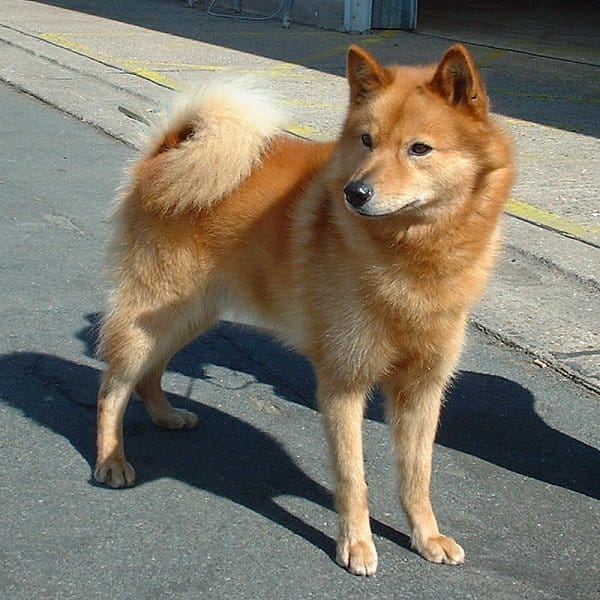
The Finnish Spitz is the living image of the Nordic spitz-type dog: square and harmonious build, small, pointed and always erect ears, bright and dark eyes, and a bumpy tail that curls elegantly over the back.
It is a medium size dog. Males measure between 44.5 and 50.8 cm at the withers and weigh about 12-14 kg, while females are noticeably smaller, at 39.4-45.7 cm and about 7-10 kg.
The coat is twofold: a soft and dense undercoat under an outer coat of coarse and long covering hair (2,5 to 5 cm), more abundant in the neck, back and tail. The colour is its hallmark: A golden reddish that ranges from pale honey to deep brown, always alive and shining, never extinguished or uniform. The coat becomes darker on the back and lighter toward the chest and belly. The nose, lips and eyelids should always be black. A small white spot on the chest and white spots on the legs are allowed, although they are not desirable. Interestingly, the cubs are born much darker (grey, black, brown) and resemble fox cubs until their final color emerges as they grow.
Origin and history
The origins of the Finnish Spitz go back to prehistory. It is believed to be descended from spitz-type dogs that arrived from central Russia about 1000 years ago, accompanying Ugrofin tribes that migrated to northern Europe. For those hunter-fisherman clans, the dog was not a luxury: Their sense of smell and their ability to spot prey made the difference between eating and starving. For centuries, the isolation of the Finnish forests kept the breed practically pure.
Everything changed to 1880. Improvements in transportation brought very different peoples and dogs closer together, and crossbreeding with other breeds nearly erased the Finnish Spitz as a distinct breed. It was then that a Helsinki sportsman, Hugo Roos, discovered still-pure specimens while hunting in the northern forests. Aware of their value, she devoted three decades to selecting and breeding authentic dogs: The modern Finnish Spitz is a direct descendant of that rescue effort.
Official recognition came with time. The Finnish Kennel Club set and revised the breed standard (the current version dates from 1996), and in 1979, on its 90th anniversary, declared the Finnish Spitz finnish national dog. The breed began breeding in the United States in the 1960s and gained recognition from the American Kennel Club in 1988. Even today, in his country, he is still mainly a hunting dog.
Curiosities
- The king of barkers. In Scandinavia a competition is held to crown the “King of Barks”.
- Barking to be champion. In Finland, a specimen must demonstrate its barking ability in the field before it can qualify for the beauty contest.
- The bark pointer. Its hunting technique is unique: it locates birds such as the urogallo, makes them climb trees and entertains them by barking as the hunter approaches.
- National dog since 1979. Few countries have an official dog; Finland chose this red spitz as its national symbol.
- As a puppy, he looks like a fox. The young are born dark and resemble a red squirrel, far from the bright golden of the adult.
- He’s almost lost. Without the efforts of Hugo Roos in the late 19th century, the breed probably would have been diluted forever between crosses.
If you are attracted to the world of Nordic and Spitz dogs, you will find it interesting to compare the Finnish Spitz with other breeds of the same family and with dogs of similar character. Check out the Norwegian Elkhound, another hardy Nordic hunting dog; the spectacular Siberian Husky, a companion of the Arctic peoples; the sleek, hairy Samoyedo; or the small and popular Pomerania, a miniature spitz with the same lively air. You might also like to meet the independent Shiba Inu.
Frequently asked questions about the Finnish Spitz
Does the Finnish Spitz bark a lot?
Yes, a lot. Barking is its hallmark and its hunting tool: it can reach 160 barks per minute. It’s not completely eliminated, but with socialization and training from a puppy, you can teach it to control it. It’s a key point to evaluate whether you live in an apartment or a neighborhood community.
Is he a good dog for families with children?
Yes, it is one of its best qualities. It is friendly and playful with the children in the family, and if it feels overwhelmed, it prefers to withdraw rather than react badly.
How much exercise does the Finnish Spitz need?
It needs one or two long walks a day, as well as time to play with the family. At home it is usually quiet if it has spent energy outside. It is not a dog that is content to live locked up all day.
Is it easy to train?
It is intelligent, but also independent and stubborn, so it requires patience. It responds very well to positive reinforcement, soft voice and short sessions, and very poorly to hard methods. It needs calm, firm and consistent handling.
Do you lose a lot of hair?
It has a double coat and changes the undercoat intensely twice a year; in those times it is advisable to brush it daily. The rest of the year one or two brushes a week is enough.
Do you get along with other animals?
It usually coexists well with other domestic dogs, but has a strong hunting instinct, so it is not to be trusted with rodents, rabbits or birds.
How long does a Finnish Spitz live?
Their life expectancy is around 11 to 13 years. It is a very healthy breed in general, with few serious hereditary problems, which helps to a good quality of life if the weight is taken care of and veterinary checks are maintained.
Can he live in a flat?
By size, yes, but their fondness for barking complicates it in neighborhood communities. you’ll have to work on barking control from a puppy and ensure enough daily exercise so he doesn’t get bored.