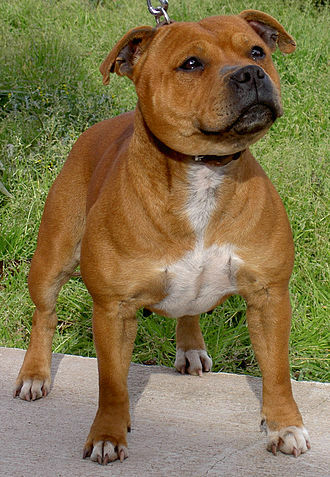
The Staffordshire Bull Terrier is a medium-sized, compact and hugely muscular British dog, famous for combining enormous strength with a surprisingly sweet character with people. Nicknamed “Staffy” or “Stafford”, he was born in the English Midlands over two centuries ago and is today one of the most beloved family dogs in the UK. In this comprehensive guide, we’ll look at whether the Staffordshire Bull Terrier fits you, what his character is like, what care he needs, and what you should know before living with one.
Is the Staffordshire Bull Terrier for you?
The Staffordshire Bull Terrier is a dog of strong character in a small but powerful body. It is ideal for those who are looking for a loyal, playful, family-oriented companion who can devote daily exercise, head training, and plenty of contact. It is not the best option for those who spend many hours away from home, are looking for an independent dog or are not willing to take on the legal obligations it entails in Spain.
In favour .
- Loving and loyal: loves his people and is excellent with children.
- Handled size, fits well into family life.
- Short hair and minimal maintenance.
- Smart, brave and willing to learn.
- Robust, athletic and tough for sport and play.
To be taken into account
- In Spain it is a potentially dangerous breed: license, insurance and muzzle.
- A lot of strength: it needs socialization and responsible driving.
- He can be stubborn and tense with other dogs.
- High energy: gets bored and suffers if left alone for too long.
- Predisposition to some hereditary eye and skin problems.
Character and temperament

If anything defines the Staffordshire Bull Terrier, it’s the contrast between its hard appearance and its soft heart. It is a brave, bold and tenacious dog, which does not wrinkle at a challenge, but at the same time deeply attached to people. Its standard is one of the few that specifically states that it must be “totally reliable” with humans, and especially with children. That is why it is affectionately known in its home country as the “nanny dog”.
It is a cheerful companion, demonstrative and with a great sense of humor. It likes to participate in everything, seeks physical contact and enjoys the game until it is exhausted. This emotional intensity has a reverse: it hates solitude and, if it does not receive attention and stimulation, it can become destructive or noisy. It is not a “garden” dog that is left alone; it wants to live inside, with its family.
It is also intelligent and a stubborn point. It learns quickly when motivation is good, but does not respond well to harsh methods: the Staffy is won with patience, consistency and positive reinforcement, never with imposition. Well guided, it is one of the most balanced and grateful dogs that exist.
Coexistence: children, other pets, flat and loneliness

- With children: is excellent. It is patient, tolerant and playful, one of the most recommended breeds for families.
- With other dogs: requires early socialization. It tends not to shy away from conflict, so introductions should be calm and progressive.
- With other pets: if raised with cats or other animals can accept them well, although it retains some prey instinct inherited from its former terrier.
- On the floor: fits perfectly on a floor as long as you have your daily dose of exercise and company.
- Soledad: is very dependent on his family and it is not good to be alone for many hours; it is best to get used to it gradually from puppyhood.
Education and training
The Staffordshire Bull Terrier is clever and pleasant, which makes it easier to train him, but his determined nature demands constancy.
It works wonderfully with positive reinforcement: awards, game and voice. He’s sensitive to tone and becomes unmotivated by harshness or punishment. It is advisable to work from puppy the inhibition of the bite in the game, the call and walking with a leash without pulling, because as an adult it has a lot of strength. Short, fun, and frequent sessions yield better results than long, repetitive ones. Because of its energy and desire, it shines in such activities as obedience, agility or olfactory games.
Exercise and activity
We’re talking about an athletic, vigorous dog who needs to burn energy daily. At least one or two good walks daily combined with active play and mental challenges. He enjoys running, swimming, throwing toys and chasing balls, and is grateful to have a job or game that gives him a goal.
There is an important nuance in their development: Staffy grows quickly in bone but matures slowly in muscle, tendons and ligaments. At six or eight months it’s already a heavy dog with an immature structure. Therefore, during the first year and a half, the impact should be dosed: Progressive walks, avoid repeated jumps and hard surfaces, and reserve long runs, drag races and slopes for when the body is formed, around 18-24 months. This prevents injuries to which this short, muscular breed is prone.
Care: fur and hygiene

In terms of maintenance, the Staffordshire Bull Terrier is the simplest. Its hair is short, hard, dense and attached to the body, without abundant undercoat, so a weekly brushing with a glove or pig brush is enough to keep it shiny and remove the dead hair.
He doesn ‘t need frequent baths . Only when it’s really dirty, with a mild shampoo so it doesn’t dry out your skin, which is one of your sensitive areas. Complete the routine by checking and cleaning your ears, cutting your nails when they ring when you walk, and maintaining good dental hygiene with regular brushing. Watch the skin for redness or itching, because it is a breed with a certain tendency to dermatological problems.
Foodstuffs
The Staffy is a compact dog with a lot of muscle mass, so it needs a quality food, rich in animal protein, adjusted to its age, weight and activity level.
It is important to monitor your weight: even if you are athletic, you tend to eat cravings and excess weight punishes your joints, already required by your constitution.
Health and life expectancy
The Staffordshire Bull Terrier is, in general, a robust and healthy dog, with a life expectancy that is usually between 12 and 14 years. Recent British veterinary studies have measured a somewhat lower average, around 11-12 years, in line with the set of dogs.
Among the hereditary problems most associated with the breed are cataracts (it is one of the most affected breeds), progressive retinal atrophy and two diseases for which DNA tests exist: L-2-hydroxyglutaric aciduria (L-2-HGA), an inherited neurological disorder. Hip and elbow dysplasia, knee dislocation, Von Willebrand disease, and predisposition to juvenile demodicosis and other skin problems are also described. Buying from breeders who do these tests greatly reduces the risk.
Physical appearance
The Staffordshire Bull Terrier is the living image of concentrated strength. Medium to small in size, it measures between 35.5 and 40.6 cm at the withers, with a weight of about 13-17 kg in males and about 2 kg less in females, always in proportion to height. Its body is compact, with a straight upper line, deep chest, well-arched ribs, and well-separated bony extremities.
The head is one of its most characteristic features: short and broad, with a broad skull, very marked cheek muscles, pronounced stop and short snout with black truffle. The ears are pink or semicircular, neither large nor heavy, and the eyes, round and dark, look straight ahead. The hair is short, hard and sticky, and supports many colors: Red, maroon, white, black or blue, alone or in combination with white, and all varieties of tarragon. Liver color and black and fire are considered undesirable by the standard.
Origin and history
The Staffordshire Bull Terrier originated in England, in the county of Staffordshire and the Black Country area north of Birmingham, over two centuries ago. It emerged from the crossing of the old English Bulldog with different terriers of the time to create the so-called “bull and terrier”, a dog that combined the power and tenacity of the bulldog with the agility and courage of the terrier. Unfortunately, its original purpose was cruel activities already banned: First the harassment of bulls and bears, and then the outlawing of dog fighting and the hunting of rats in ditches.
When these practices were pursued, the breed found its place as a companion dog. In the mining houses of the region, smaller specimens were selected and, above all, absolutely reliable with the family, because they lived in small spaces with children. That selection work explains its current double nature. In May 1935 the British Kennel Club officially recognized the breed and the first club was founded, which set its name and standard. Then came recognition by the FCI, in 1954, and the American Kennel Club, in 1974. It shares ancestry with the Bull Terrier and the American Staffordshire Terrier, although each breed evolved on its own.
Curiosities
- It is one of the most popular breeds in the United Kingdom, where it is listed as the seventh most popular dog, and also triumphs in Australia, France and New Zealand.
- His nickname “nanny dog” reflects his reputation for being patient and protective of children.
- Despite its image, it is not banned in the UK: when it was proposed to be included in the British Dangerous Dogs Act, associations such as the RSPCA, the Kennel Club or the Dogs Trust opposed it and the proposal was rejected.
- It shares a common trunk with the Bull Terrier, the American Staffordshire Terrier, the Boston Terrier and the American Pit Bull Terrier, all descendants of the ancient “bull and terrier”.
- In Spain it is below the height and thoracic perimeter of reference of the regulations, but its typology keeps it within the potentially dangerous breeds.
If you are attracted to the Staffordshire Bull Terrier, you may also be interested in other breeds in the same family or with a similar profile. Check out the Bull Terrier, its close relative with an unmistakable head; the American Staffordshire Terrier, the larger American version; the friendly Boston Terrier, also descended from the “bull and terrier”; or the English Bulldog, one of the ancestors of the breed.
Frequently Asked Questions about the Staffordshire Bull Terrier
Is the Staffordshire Bull Terrier a dangerous dog?
He’s not a dangerous dog by nature. His breed standard describes him as “totally reliable” with people and with a special affinity for children. He has a lot of strength and a history of fighting, so he needs socialization and education, but a well-bred and handled Staffy is a balanced and caring companion. In Spain it is listed as a potentially dangerous breed (PPP), which requires a license and insurance, not that the dog is aggressive.
Is it a good breed for families with children?
Yes, it is one of its great virtues. Few breed standards expressly mention its reliability with children as does the Staffordshire Bull Terrier. It is patient, playful and very attached to its family.
In Spain, do I need a PPP license to own a Staffy?
Yes. In Spain the Staffordshire Bull Terrier is listed among the potentially dangerous breeds by Royal Decree. To legally own it you must be of legal age, obtain a license for the possession of potentially dangerous dogs, take out a civil liability insurance and register it in the corresponding municipal register.
How much exercise does a Staffordshire Bull Terrier need?
It is an athletic and energetic dog that appreciates one or two long walks a day plus intense play and mental stimulation. During the first year and a half, the effort must be dosed because its skeleton grows quickly and its muscles and tendons mature more slowly; demanding jumps and runs must be introduced gradually.
Does he get along with other dogs?
A Staffy socialized as a puppy with other animals can coexist without problems; calm introductions and watching the game with unfamiliar dogs are advisable.
How long does a Staffordshire Bull Terrier live?
Their life expectancy is usually between 12 and 14 years.Recent British veterinary studies have measured a somewhat lower average, around 11-12 years, similar to that of all dogs.With good nutrition, adequate exercise and veterinary checks many specimens reach or exceed that range.
What kind of skin care do you need?
It is a low maintenance breed in terms of hairdressing; it is advisable to care for teeth, ears and nails regularly.
Is it the same as an American Staffordshire Terrier or a Pit Bull?
The American Staffordshire Terrier and the American Pit Bull Terrier are breeds developed in the United States from the same “bull and terrier” trunk, but taller and heavier.