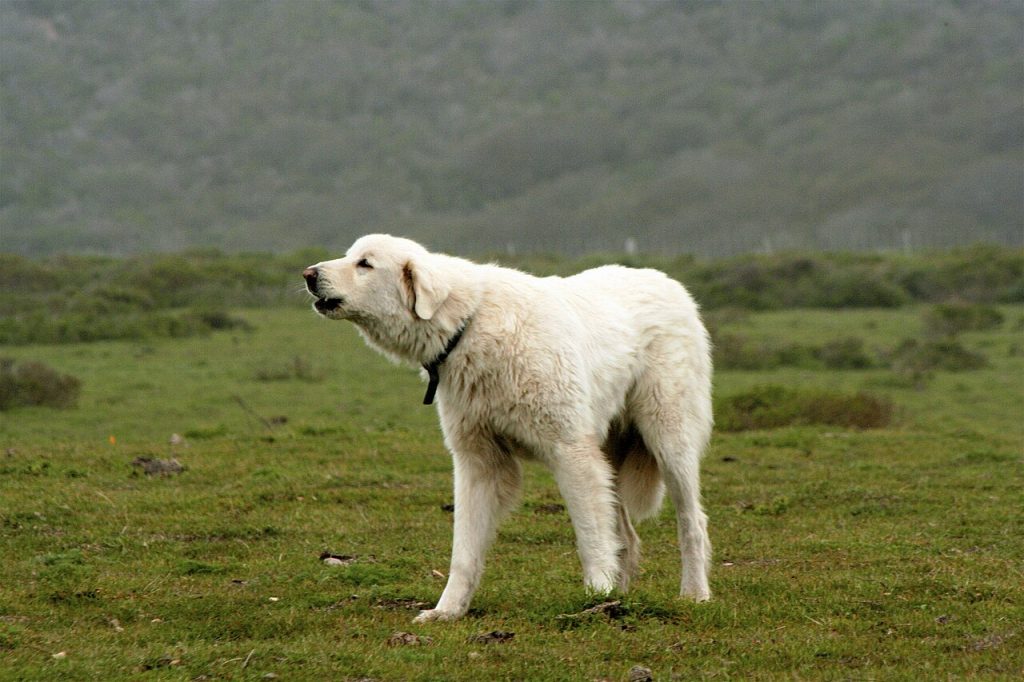
The Akbash is one of Turkey’s great cattle guard dogs: a white, serene, majestic-looking mastiff, bred for centuries in western Anatolia to live among sheep and stand up to wolves and other predators. He is not a herding dog – he does not lead the flock – but an independent protector who makes his own decisions. Before you fall in love with its white pattern, you should understand that the Akbash is a cold-headed, territorial, and self-disciplined working dog, designed for space, not a floor sofa.
Is the Akbash for you?
The Akbash is a spectacular dog, but not suitable for everyone. It is a cattle guard breed (what in English they call livestock guardian dog): independent, territorial, protective and of imposing size. It works wonderfully on a farm with animals or land to take care of, and much worse in an urban environment without space or function.

In favour .
- Exceptional guardian: watches over livestock, farm or property with a serious protective instinct.
- Quiet and balanced at home when not on duty; not a nervous or hyperactive dog.
- Very loyal and attached to “his own”, be they people or animals of the flock.
- Rustic and hardy, adapted to harsh climates and outdoor life.
- Bright white coat and relatively simple care for its size.
Against
- It needs space: it’s not a dog for flat or small terrain.
- Very independent and stubborn; he does not seek obedience because he does.
- Territorial and suspicious of strangers; tends to bark and dissuade.
- A guard instinct that must be socialized and managed from a puppy.
- It is not a breed for beginners or anyone who wants a “saloon” dog.
Character and temperament
The Akbash combines two seemingly opposite things: an almost imperturbable calmness and the ability to react forcefully when it detects a threat. At rest it is a calm dog, with slow movements and watchful gaze, which conveys confidence and composure. That calmness is not laziness: it is the attitude of a sentry who conserves energy while watching.
Its defining feature is the independence. For centuries, the Akbash has worked alone in the mountains, away from the shepherd, deciding for himself when something is dangerous and when not. That has shaped a dog that thinks before it acts and doesn’t wait for orders to do its job. He is deeply loyal to his family and, according to Turkish tradition, is able to create such strong bonds with his sheep that he protects them as if they were his own. With strangers, however, he is reserved and vigilant: Evaluate before you trust.
It’s not an aggressive dog for nothing. Its guard is based more on presence, warning barking and deterrence than on attack. But it’s a large, strong animal with its own criteria, so its protective instinct must be channeled through responsible socialization and handling from puppyhood.
Coexistence: children, other pets, flat and loneliness
With children: within its family, the Akbash is usually patient and protective, and many specimens tolerate the children of the house very well.
With other pets: is just the animal designed to live with cattle and other species, which it tends to protect rather than harass. With dogs of the same sex it can be dominant, and coexistence with cats or other small animals improves greatly if it grows with them.
On the floor: here needs to be clear. The Akbash is not a floor dog. It needs terrain, a solid fence and, if possible, a function to perform. Locked in a small space and without stimulus, a dog of this size and instinct gets bored, barks and becomes frustrated.
In the face of loneliness: tolerates being outdoors on its own better than many breeds – that’s what it was bred for – but “just watching a field” is not the same as “being locked up and abandoned”.
Education and training
Training an Akbash is not like training a Border Collie or a Labrador. It’s not a dog that lives to please you: it’s a dog that decides. That’s why education should start early, based on positive reinforcement and, above all, on a relationship of respect and trust. Harshness and physical punishment are counterproductive: they create distrust in a dog that needs just the opposite.
The early socialization is the key piece. An Akbash puppy must know people, noises, situations and other animals to learn to distinguish the normal from the threatening; this depends on its guarding instinct being balanced and not overly suspicious.
It is to be assumed that you will never have the millimeter obedience of a cooperative working breed: the Akbash will always retain its criterion. The realistic goal is a reliable, reasonably sociable and under control dog, not a obedience competition dog.

Exercise and activity
The Akbash is not a hyperactive dog or an endurance athlete like the husky, but it does need space and movement. In its natural environment it patrols large areas at a leisurely pace throughout the day, so it is best served by having secure terrain where it can move freely and, if possible, a meaningful watchdog job.
For an Akbash who lives as a pet dog on a farm, the ideal is to combine freedom in a well-fenced area with daily walks that allow him to explore and smell. You don’t need strenuous runs, but you do need constant low-intensity activity and, above all, mental stimulation: A boring warden is a troubled warden. Extreme heat makes it regular because of its dense coat, so it is best to reserve exercise for cooler summer hours.
Care: fur and hygiene
The Akbash’s mantle is double– a protective outer layer and a dense undercoat – and can be medium or long in length, always white with possible cream or cookie shades.

Outside the moulting season, a weekly brushing is enough to keep the hair clean and free of tangles, especially on the fringes of the legs and the tail, which is very feathered. It does not require frequent bathing: The white coat tends to self-clean and too much bathing dries the skin. As with any dog, it is advisable to monitor the nails, check and clean the ears, and maintain regular dental hygiene. Its white coat suits it well for outdoor life, but it will make the dirt more noticeable after a day in the field.
Foodstuffs
As a large breed of dog, the Akbash needs a quality diet tailored to its size, age and activity level, without overfeeding it. The puppy stage is especially delicate: giants must grow slowly, with feed formulated for large breeds that controls energy intake and calcium-phosphorus ratio, because too fast growth favors joint problems.
In adults, it is prudent to divide the daily ration into two servings instead of one, a common practice to reduce the risk of gastric dilation-torsion in deep-breasted dogs. Avoid strenuous exercise just before and after eating, keep fresh water available, and watch your weight: Obesity overloads the joints of an animal that’s already starting from a large skeleton. It is best to adjust the amounts and type of diet with the veterinarian according to each specimen.
Health and life expectancy
The Akbash is a rustic and functional breed, selected for centuries for its work capacity rather than aesthetics, which generally translates into robust and healthy dogs. Still, like any large dog, you should be on the lookout for the most typical conditions of large and giant breeds: hip and elbow dysplasia, joint problems and gastric dilation-torsion(the dreaded stomach twist), a veterinary emergency affecting deep-chested dogs.
Life expectancy is around 10 to 11 years, the usual for a guard dog of this size. Regular veterinary checks, weight control, controlled growth, and, if a puppy is to be reared, health checks help to maintain its long-term health. Being a rare breed and without the pressure of mass breeding, it retains much of its original vigor.
Physical appearance
The Akbash is a great and mighty dog, more stylized in build and with longer legs than many other guardian mastiffs, which gives it an agile look despite its body size. The height at the withers is round and exceeds 75 cm, and specimens of up to about 86 cm in males are cited; the average weight is around 45 kg, although the largest males can easily exceed that figure, always above the females.
Its trademark is the white colour, sometimes with slight cream or biscuit undertones, on a medium to long double coat, with fringes behind the legs and a very feathered tail that tends to curve over the back. The head is long and proportionate, with sloping V-shaped ears and a calm, noble expression. That white isn’t aesthetic chance: It allowed the shepherd to distinguish his dog from the wolf even in the dim light of the moon, avoiding fatal confusion in the dark.
Origin and history
The Akbash is a traditional breed originating from Western Anatolia, in Turkey, where it is mainly distributed around the provinces of Afyon, Ankara, Eskişehir and Manisa. His name says it all: akbaş means “white head” in Turkish, as opposed to karabaş or “black head”. It has also been called accush, “white bird”. For generations, Anatolian shepherds used it to protect their flocks from wolves and other predators in arid, mountainous terrain.
For a long time, in Europe and America all large Turkish dogs were put in the same sack under the label of “Anatolian shepherd dog”. It was an international symposium held at the University of Konya in 1996 that promoted the distinction between the different Turkish cattle guardian breeds. The Akbash finished officially consolidating in their country in 2006, when the Turkish Ministry of Agriculture recognized it as a national breed, following the publication of a standard at the beginning of the decade. Today it is protected by the Dog Federation of Turkey, although is not recognised by the International Canine Federation (FCI).
Interestingly, the Akbash have traveled far from their mountains: was one of the base breeds used to create the modern Shepherd from Anatolia(Anatolian Shepherd), a cross of several Turkish breeds. In the United States there is an international association dedicated to Akbash that has boosted its popularity, and there it is used to protect livestock from coyotes, showing that its ancient craft is still in full force on the other side of the world.
Curiosities
- Whitehead on purpose. The light color is not only pretty: it helped the shepherds not to confuse the dog with a wolf in the dark.
- Relative halfway around the world. The Akbash is reminiscent of other white guards such as the Maremma Shepherd, the Pyrenean Mountain, the Kuvasz, the Slovak Cuvac or the Tatra Shepherd, all selected for the same mission in different countries.
- She doesn’t shepherd, she protects. Unlike a border collie, the Akbash does not lead the herd: it lives inside it and defends it.
- Father of another race. was the starting material for creating the Anatolian Shepherd, alongside the Kangal.
- From Anatolia to the American prairies. today works on ranches across the United States protecting sheep from coyotes.
If you are attracted to the Akbash for its size, protective character and imposing coat, you may be interested in other large, protective breeds with a similar profile. English Mastiff Cane Corso San Bernardo Samoyedo
Frequently Asked Questions about Akbash
Is the Akbash a good family dog?
It may be in the right home: it is loyal, quiet at home, and protective of its own, but its size, independence, and strong guardian instinct make it unsuitable for families without experience or space.
How tall and how much does an Akbash weigh?
It is a large dog: the height at the withers is round and exceeds 75 cm, with males reaching around 86 cm, and an average weight close to 45 kg which the largest males can overcome.
Can you have an Akbash on one floor?
The Akbash needs space, a well-fenced terrain and, if possible, a function to fulfill. In a small floor, with no stimulus or territory to monitor, it tends to get bored, bark and become frustrated.
Is the Akbash aggressive or dangerous?
Its guard relies more on presence, warning barking, and deterrence than attack. It is distrustful of strangers and territorial, so it needs early socialization and responsible handling so that its protective instinct is balanced.
How much exercise does the Akbash need?
It is not hyperactive, but it needs space and low-intensity daily movement – patrolling safe terrain, hiking to explore, and mental stimulation.
How long does an Akbash live?
Their life expectancy is around 10-11 years, the usual for a large guard dog. Veterinary checkups, weight control and slow growth in the puppy help to take care of their long-term health.
Does the Akbash shed a lot of hair?
It has a double coat and, in the spring and autumn moulds, sheds a lot of hair and needs more frequent brushing.
How is the Akbash different from the Kangal or the Anatolian Shepherd?
The Akbash is white and more stylized in appearance; the Kangal is brown-coated with a dark mask. The Anatolian Shepherd is, in fact, a modern breed created by crossing several Turkish breeds, including the Akbash itself and the Kangal.