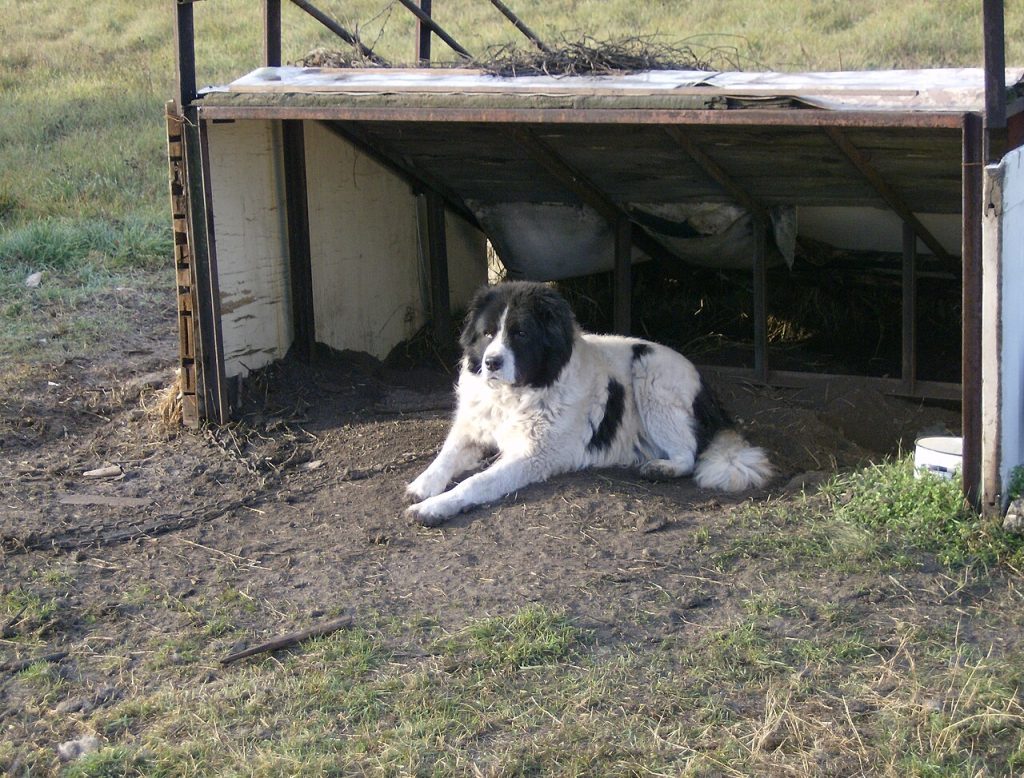
The Karakachan is an imposing cattle guard dog born in the mountains of Bulgaria, bred for centuries to stand up to wolves and bears and protect the flocks of nomadic shepherds in the Balkans. Rustic, courageous and independent, he earned the nickname “matalobos”. It’s not a dog for just anyone: who seeks the Karakachan seeks a serious guardian, loyal to his family and his territory, rather than a docile and sociable companion to everyone.
Is the Karakachan for you?

Before you fall in love with their image, be honest: the Karakachan is a working dog with a strong character, designed to live outdoors and guard. It fits wonderfully in a rural environment with space and a clear function, and very badly in a conventional urban life. These two boxes summarize who suits it and who doesn’t.
It suits you if…
- You live in the countryside, on a farm or on a fenced cattle farm.
- You’re looking for a serious guardian to protect cattle, property or family.
- You have experience with large, protective, independent dogs.
- You value a rustic, autonomous, low-maintenance dog.
- You can offer him space, fresh air, and a meaningful task.
Think about it if…
- You live in a flat or no land of your own that I can look after.
- Either it’s your first dog or you’re looking for a companion who’s docile and sociable with everyone.
- You can’t stand barking at night or a territorial dog with strangers.
- You get a lot of visitors or you’re constantly being moved around by strangers.
- You can’t spend time socializing with them or set firm boundaries.
Character and temperament
The Karakachan is the definition of a classic livestock watchdog: independent, self-assured and with a huge sense of responsibility towards what it considers its own.
With his own, he’s calm, balanced and deeply loyal. It is neither a nervous nor a noisy dog; its energy flares up only when it senses a real threat. That ability to be calm for hours and activate in an instant is just what makes it so effective at surveillance. With strangers he is naturally suspicious and reserved, something expected of a guardian and which a good owner channels with socialization, not harshness.
Its independence is a trait, not a defect: for centuries it has worked alone in the mountains, making decisions without waiting for orders. This makes it a dog that thinks for itself, something wonderful to keep and demanding for anyone who wants blind obedience.
Coexistence: children, other pets, flat and loneliness

With the kids at home is usually patient and protective; it is part of “its” group and takes care of it.
With other animals shines precisely where other breeds fail: it is bred to live with sheep, goats, horses or chickens and defend them, not to harass them. Its instinct is guarding, not hunting. With other dogs it can be dominant, especially among males, so early socialization and well-made introductions are key.
On the floor is not its place. It is large, territorial and barking, and needs space and something to watch out for. The Loneliness does reasonably well if it has terrain and a routine, but it is not a dog to be locked up and bored: if it has no function or space, boredom translates into barking, escapism and frustration.
Education and training
Educating a Karakachan has little to do with training a sport or companion dog. He’s smart and he learns fast, but his independence makes him not obey “because he does”: cooperates when it trusts its guide and understands the meaning of what you are asking. The foundation is a relationship of respect built from a puppy, with calmness, consistency and positive reinforcement, never based on punishments that only a suspicious dog with the size to be dangerous would achieve.
The early socialization is the most important part of his education: the more people, animals and situations he meets as a puppy in a positive context, the better he will know as an adult to distinguish between normal and real threat. The boundaries should be clear early on, because re-educating a 50 kg adult is much harder than guiding a puppy. It is not a recommended dog for a first-time owner.
Exercise and activity
The Karakachan is not a hyperactive athlete, but a goalkeeper. Its natural job is to patrol and watch the ground for hours at a leisurely pace, not to run non-stop. It needs, of course, space and daily activity: long walks, wide terrain to move in the air and, above all, a task that gives it purpose.
What really satisfies him is having something to guard: a herd, a farm, a property. A Karakachan with function and space is a balanced dog; a Karakachan without space or task is a frustrated dog. It is not the ideal companion for urban runners or for precision obedience sports, but it is for someone who lives in the countryside and wants a tireless guardian.
Care: fur and hygiene
One of the great advantages of this breed is its unpretentiousness in care. Its coat is double, dense and resistant, designed to withstand harsh mountain winters and the summer sun. In the day to day it is enough with a weekly brushing to keep it healthy and free of knots; during the seasonal mowing, in spring and autumn, it is advisable to brush it more often because it lets loose a lot of hair.
It does not need a hairdresser or a cutter: its coat keeps it alone and protects the dog from the weather, so it is not advisable to shave it. Baths should be sporadic, only when it is really dirty, so as not to damage the natural protective layer of the skin. The rest is basic hygiene: checking and cleaning ears, watching the nails and taking care of the teeth.
Foodstuffs
As a large, rustic and slow-growing dog, the Karakachan needs a quality feed well adjusted to its size, age and activity level.
In puppies of large breeds it is especially important not to force growth with excess energy or calcium, to protect the proper development of bones and joints. Divide the food into two servings daily for the adult, always have fresh water available and, given its size, be aware of the risk of gastric dilation-torsion: avoid strenuous exercise just before and after eating. When in doubt, it’s best to adjust the ration with your veterinarian.
Health and life expectancy
The Karakachan is a remarkably healthy breed. Having been selected for centuries for its functionality and not for aesthetics, it has escaped many of the hereditary problems that affect more handled breeds.
That said, like any large dog, it’s not without its risks. It is advisable to monitor the hip and elbow dysplasia, typical of large breeds, and the already mentioned gastric dilation-torsion, a vital urgency in deep-breasted dogs. Keeping it at a proper weight, with moderate exercise and regular veterinary checkups, is the best way to take advantage of its good genetics. Being a rare breed, it is always advisable to go to serious breeders who work on health and temperament.
Physical appearance

The Karakachan is a large, powerful and rustic looking dog, with a solid build and a strong skeleton that conveys safety. The males usually measure about 63-75 cm at the cross and the females a little less, with weights that are usually between 40 and 55 kg depending on the specimen.
Its coat is double and dense, with an outer coat that can be medium or long in length and an abundant undercoat that insulates it from cold and heat. The most characteristic layer is the with white and black spots, although specimens with other color combinations are also seen. The head is strong and proportionate, the ears drop to the sides and the tail, crowded, is carried high when the dog is attentive. The set depicts an imposing but harmonious animal, made for work and weather.
Origin and history
The Karakachan is one of the oldest breeds in Europe and has its roots in Bulgaria and the whole of the Balkans. Their ancestors began to form millennia ago: He is considered a descendant of the dogs of the Thracians, a people famous for their livestock, and in ancient Thracian treasures have been found figures of large guard dogs with long hair and curly tails. It is related to the cattle guard dogs of neighboring countries, from Romania to Greece and from Serbia to Turkey.
Its name comes from the carrots(or sarakatsani), nomadic Greek shepherds of the Balkans. Thanks to their very conservative livestock traditions, this village has preserved some of the oldest domestic breeds on the continent: The Karakachan sheep, the Karakachan horse and, of course, the dog. With that name he appears even in works of classics of Bulgarian literature, and already in 1938 he was written about in a German cinological magazine.
In the 20th century the breed was on the brink of extinction and survived only thanks to the tenacious dedication of mountain herders. For a time he was also employed as a guard dog at the country’s borders. The first researcher of the breed, Todor Gajtandjiev, proposed its standardization in the seventies; the standard was drafted in 1991 and finally the Karakachan was officially recognised as an indigenous Bulgarian breed in 2005. Today the largest populations of working specimens are found in Bulgaria and the United States. It is also part of the origin of the Bulgarian Shepherd, with which it should not be confused.
Curiosities
- El «matalobos». Its fame as a wolf hunter is no ornament: it is bred precisely to stand up to wolves and bears in defense of the herd.
- When President George W. Bush visited Bulgaria in 2003, he received a Karakachan as a gift. In 2010, Bulgarian Prime Minister Boiko Borisov gave another, named Buffy, to then Russian Prime Minister Vladimir Putin.
- A trio that came together until today. The Karakachans simultaneously preserved three very ancient domestic breeds: their sheep, their horse, and their dog, a rare case of continuous livestock preservation.
- The border guard. In addition to protecting herds, the breed came to be used as a guard dog on the borders of Bulgaria.
- Not to be confused with imitations. In Bulgaria new exhibition breeds have emerged by crossing karakachans with giant dogs; the authentic Karakachan is the rustic working dog, not those similar-looking mixtures.
If you are attracted to the profile of the Karakachan – a large, rustic and protective guard – you may be interested in other guard and working breeds with which it shares character or functions. Cane Corso Mastín Rottweiler San Bernardo
Frequently Asked Questions about Karakachan
Is the Karakachan a good family dog?
It can be for a specific family: the one that lives in the countryside, has experience with large dogs and character, has fenced terrain and understands that it is above all a guardian. With its people it is calm, loyal and protective, and is usually patient with the children of the house. It is not a dog designed for a flat or for a first-time owner who is looking for a docile and sociable companion with everyone.
The Karakachan is aggressive?
It is a serious guard dog, wary of strangers and able to stand up to a wolf or a bear to defend its flock. Such firmness is part of the breed and should not be confused with gratuitous aggression. Well socialized and with a boundary-setting owner, he’s perfectly capable of distinguishing between a real threat and a normal visit. Modern breeding also tends to soften aggression toward people while maintaining its guarding ability.
How long does a Karakachan live?
As a rustic breed, little modified and selected for centuries for its functionality, it usually enjoys good health and a longevity estimated at around 12-14 years, high for a dog of its size.
Does the Karakachan need a lot of exercise?
It needs daily activity and, above all, space. It is not a hyperactive dog that demands constant running: it was bred to patrol and watch for hours at a leisurely pace. It likes long walks, wide terrain to move at its own pace and a task that gives it meaning. What it does not tolerate well is confinement and boredom.
Can you have a Karakachan on one floor?
It is not recommended. It is a large, territorial, barking dog, with a strong need to monitor its environment. Living in a flat clashes with almost everything the breed asks for: space, own land to guard and outdoor activity. It fits much better in a farmhouse, a house with fenced land or a cattle ranch.
Does the Karakachan get along with other dogs and animals?
With the cattle it must protect is its reason for being: it is bred precisely to live with sheep, goats or horses and defend them. With other dogs it can be dominant, especially among males, so early socialization and careful presentations are appropriate.
Is Karakachan recognized by the FCI?
The Karakachan is not recognized by the International Kennel Federation (FCI).[citation needed] It was officially approved as a Bulgarian autochthonous breed in 2005 by the corresponding state commission, and its standard is managed by Bulgarian Kennel Federations.
How much does a Karakachan weigh and measure?
It is a large and powerful dog. The males are usually around 63-75 cm at the withers and the females a little less, with weights that are usually between 40 and 55 kg depending on the specimen and sex.