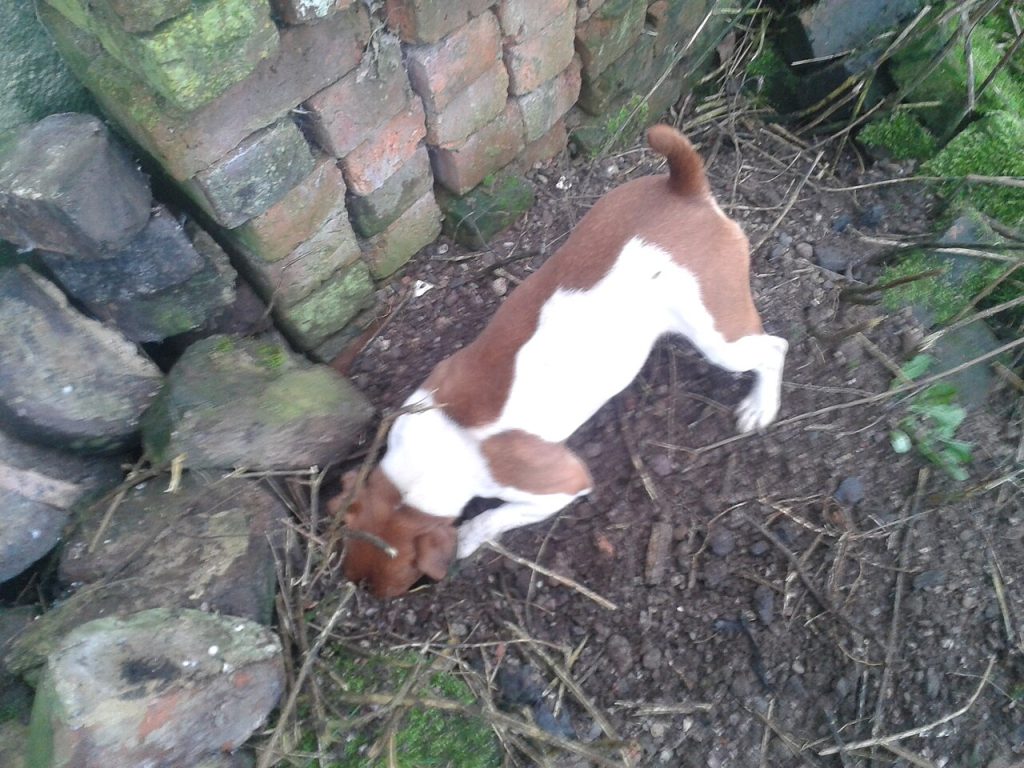
The Plummer Terrier is a British working terrier created in the 1970s by writer and hunter Brian Plummer with a very specific goal: hunting rats and vermin with unusual efficiency and harshness. It is not recognized by any official canine club, and that is precisely where much of its character lies: He’s a dog selected for what he does, not what he looks like in a ring. If you’re looking for a tireless companion who’s brave, smart and has a hunter’s instinct for fur, the Plummer Terrier deserves your attention, but it’s good to know what you’re getting into.
Is the Plummer Terrier for you?

The Plummer Terrier is not a dog for everyone. It’s a pure working terrier, with a motor that rarely shuts off and a very strong prey instinct. It shines in the hands of active people, experienced in dogs of character, who can give you real mental and physical work. In a quiet, sedentary, or timeless home, he gets bored and pursues his own, often inconvenient, pursuits.
In favour .
- Extremely intelligent, helpful and eager to learn.
- Handled size (not exceeding 35 cm at the cross) and great physical strength.
- Short coat that requires very little maintenance.
- Good sense of smell, good collection and many go to the water without problem: a versatile dog in the countryside.
- Healthy and rustic, with few documented hereditary problems.
- Loyal and very close to his family.
Against
- High prey instinct: real danger with rodents, cats and small animals.
- It needs plenty of exercise and stimulation; it doesn’t fit into a sedentary lifestyle.
- Stubborn and on his own initiative if not educated consistently.
- It tends to dig and chase; it requires a secure garden and fenced enclosure.
- It’s not recognized by any kennel club: fewer breeders and fewer pedigree guarantees.
- He may be reserved or conflict with other dogs of the same sex.
Character and temperament
If there ‘s one word that defines the Plummer Terrier it ‘s toughness. He was selected for decades for his determination in confronting underground monsters and for his physical and mental toughness. From there comes a dog that is courageous, determined, and remarkably energetic, not writhing in the face of challenge. That same intensity, well channeled, makes him an exceptional coworker; badly channeled, a little whirlwind of mischief.
He’s a very intelligent terrier with a very good sense of smell. Fans point out that it learns quickly and that it is bidable, that is, willing to work with its guide instead of going on its own, something that is not always abundant among terriers. That doesn’t mean I’m submissive: He has his own criteria, and if he feels he can get away with it, he’ll try. With his family, he is usually affectionate, close, and very loyal, but he always keeps that hard-working, alert background that must be respected.
Coexistence: children, other pets, flat and loneliness

With children: Well socialized, a Plummer Terrier is usually an energetic and fun playmate for children who already know how to treat a dog.
With other pets: here is the big nuance. The Plummer was created to hunt rodents, so coexistence with hamsters, rabbits, ferrets (outside work) or even cats is problematic and must be handled with great caution. He can get along well with other dogs if he is socialized early, although it is not uncommon for him to show tension with members of the same sex. In a work pack they cooperate, but that is the result of specific selection and management.
On the floor: can live on the floor if – and only if – you meet its daily exercise and stimulation needs. Without that, a floor becomes a cage for such an active dog, with the expected consequences: barking, wrecking and nervousness.
In the face of loneliness: is a dog very attached to its people and does not like to spend many hours alone. Boredom easily translates into digging, biting and anxiety. If you work outside all day without an alternative plan, it is not your breed.
Education and training
The good news is that the Plummer Terrier is quick-witted and collaborative, making it easier to train compared to more independent terriers. The bad news is that it has character and initiative, so it needs consistent, firm and unflinching education from puppyhood. Positive reinforcement, with rewards and play, works wonderfully with a dog so motivated by food and pleasure.
Clear priorities: a early and extensive socialisation(people, dogs, environments and noises), good call control – essential in a dog with such a chasing instinct – and specific work on self-control and handling of the prey instinct. Short, varied, and purposeful sessions are far more productive than the monotonous repetitions that bore such an alert dog. Giving him a “job” – advanced obedience, olfactory games, agility – channels his energy and prevents most behavioral problems.
Exercise and activity
This is the non-negotiable point. The Plummer Terrier is a rustic athlete with remarkable endurance and high energy. He needs a lot more than a quiet walk around the block: long walks, runs, intense games and, above all, activities that put your head and your sense of smell to work. Dog sports like agility, tracking games or the earthdog fit him like a glove.
The origin of his work says it all: he is an enthusiastic collector, many go into the water enchanted and enjoy the ferret, tracking and hunting deer. Without sufficient physical and mental relaxation, a Plummer becomes frustrated and develops behaviors such as digging, barking or escaping in search of adventure.
Care: fur and hygiene
In terms of hair maintenance, the Plummer Terrier is one of the most grateful dogs. It has a short, dense coat and a striking fire-red color, designed for work and not for hairdressing.
Bathing, only when absolutely necessary – after a day in the mud, for example – so as not to damage the skin’s natural protection. The rest of the care is the basics of any active dog: checking and cleaning the ears (which fall forward and retain moisture), cutting the nails if they do not wear out on their own, brushing teeth regularly and monitoring the skin for ticks or small wounds after field trips.
Foodstuffs
Being a working dog with a high energy expenditure, the Plummer Terrier appreciates a complete and quality diet, adjusted to its actual level of activity.
It is advisable to divide the food into two daily servings and control the weight: although they are very active dogs, an excess of rewards during training can pass the bill. Water is always fresh and available, especially if it is a dog that works or trains in the open air.
Health and life expectancy
One of the great points in favor of the Plummer Terrier is its rusticity. Having been selected for its ability to work and not for aesthetic criteria, and starting from a range of base breeds, it is generally a healthy, resistant dog with few documented hereditary problems. There is no official club that centralizes health statistics, so the best guarantee is to go to serious breeders who work their dogs and care for genetic diversity to limit inbreeding.
As with any active terrier, prevention involves periodic veterinary checks, a daily schedule of vaccination and deworming, and special care after field trips (ticks, wounds, foreign bodies).
Physical appearance

The Plummer Terrier is a compact, robust and functional, small-to-medium sized dog. The standard drafted by Brian Plummer in 2000 marks a rise of not more than 14 inches (about 35 cm) at the cross, with a well-muscled body designed to work underground and on the ground with agility.
Its most distinctive feature is the fire-red fur, which must be intense and present one of two accepted patterns: collared(with a white band around the neck) or caped(with white only on the throat). Specimens without these marks are called shattered and, although they are perfectly valid as working and companion dogs, they are not considered good representatives of the breed; the same is true of tricolors that wear black. The ears drop forward as in most terriers, the nose and eyes are usually black and the bite is scissor-like. In the development of the breed appeared two types: one thinner and sharper-snouted, and one stronger-headed; Plummer opted for the second.
Origin and history
The history of the Plummer Terrier is inseparable from that of its creator, Brian Plummer, a schoolteacher in South Yorkshire and the Midlands during the sixties and seventies, and already then known in his county for touring it with a pack of terriers hunting rats. In the seventies he decided to create his own breed of terrier and, greatly knowledgeable about the breed, crossed the Jack Russell Terrier with Beagle, Fell Terrier and Bull Terrier to fix a unique type.
That initial pack became known as Huddlesford Rat Pack, and over time the breed came to be named after its creator. Contributions from recognized lines of work were added – examples such as Jaeger, Flint or the Pagan tricolor are among the early pillars – to refine the form and fix the type. In television documentaries of the 1980s (Rat hunting man, Lone Furrow), Plummer expressed his wish that one day his dogs would be known as Plummer Terriers and recognized by the Kennel Club.
In 1985, a near-fatal heart attack forced him to disperse his large herd among friends. Plummer retired to a remote farm in Caithness (Scotland) and devoted himself full-time to writing, but in the early nineties he recovered much of the original genetic stock and resumed work, expanding the swimming pool gene to avoid consanguinity and even introducing Bull Terrier blood of known ancestry at the end of the decade. Brian Plummer died of cancer in September 2002; his work continued and the standard remains intact.
Curiosities
- The original name of Brian Plummer’s pack was Huddlesford Rat Pack; the breed only came to be called “Plummer Terrier” over time.
- Despite the wish of its creator, the Plummer Terrier still not recognized by any kennel club., and many enthusiasts prefer it to remain so to preserve it as a real working dog.
- Brian Plummer was not only a breeder: he was a prolific writer and publicist, with numerous books and television appearances on working dogs.
- Examples without the typical white markings are called shattered: they are still excellent workers, but are not considered good representatives of the standard.
- The Beagle that entered the front lines came from an exhibition breed with American imports, an unusual crossing on a working terrier.
- Although born to hunt rats in packs, it is a multi-purpose dog: cobra, goes to the water, plays the ferret and participates in batting.
If you are attracted to this working terrier but want to compare it with other breeds of similar temperament or function, take a look at these related dogs: the energetic and mousy Yorkshire Terrier, the tenacious and hunter Dachshund, the tireless sniffer Beagle– one of Plummer’s own base breeds – and the extremely intelligent Border Collie, ideal if you are looking for another working dog with a lot of head.
Frequently Asked Questions about the Plummer Terrier
Is the Plummer Terrier an officially recognized breed?
The Plummer Terrier is not recognized by any official kennel club. It was selected as a working terrier for its ability to hunt prey, and many breeders and enthusiasts prefer it to remain so to maintain its function and avoid a purely aesthetic selection.
How tall and how much does a Plummer Terrier weigh?
The standard marks a height of no more than 14 inches at the withers, i.e. about 35 cm. It is a small-medium, compact and muscular dog.
Is he a good family dog?
It can be in the right family: active, with time and, if possible, with experience with dogs of character. It is loyal and affectionate to its owners, but needs a lot of exercise and stimulation. It does not fit well in sedentary homes or people who spend many hours away from home.
Do you get along with cats and other small animals?
The Plummer was bred to hunt rodents, so it has a very high prey instinct. Coexistence with cats, rabbits, hamsters or other small animals is risky and requires very early socialization and constant supervision; in many cases it is not recommended.
How much exercise do you need a day?
Enough. At least one or two hours a day of real exercise (long walks, running, games) plus mental stimulation. Dog sports, tracking, and smell work go wonderfully. Without enough relaxation, he develops behaviors like digging, barking, or running away.
Is it hard to train?
He is intelligent and collaborative, which helps, but he also has character and initiative of his own. With consistent education, positive reinforcement, early socialization and short and varied sessions he responds very well. Calling and control of prey instinct should be priorities from puppyhood.
How long does a Plummer Terrier live?
There are no official statistics as there is no club that collects them, but being a rustic and healthy dog, with good care it usually enjoys a longevity in line with that of other medium-sized terriers, which are often around 12-15 years.
What kind of hair care do you need?
Their red coat is short and dense, so a weekly brushing and bathing only when absolutely necessary is enough. The rest is basic care: checking ears, nails, teeth and monitoring the skin after field trips.