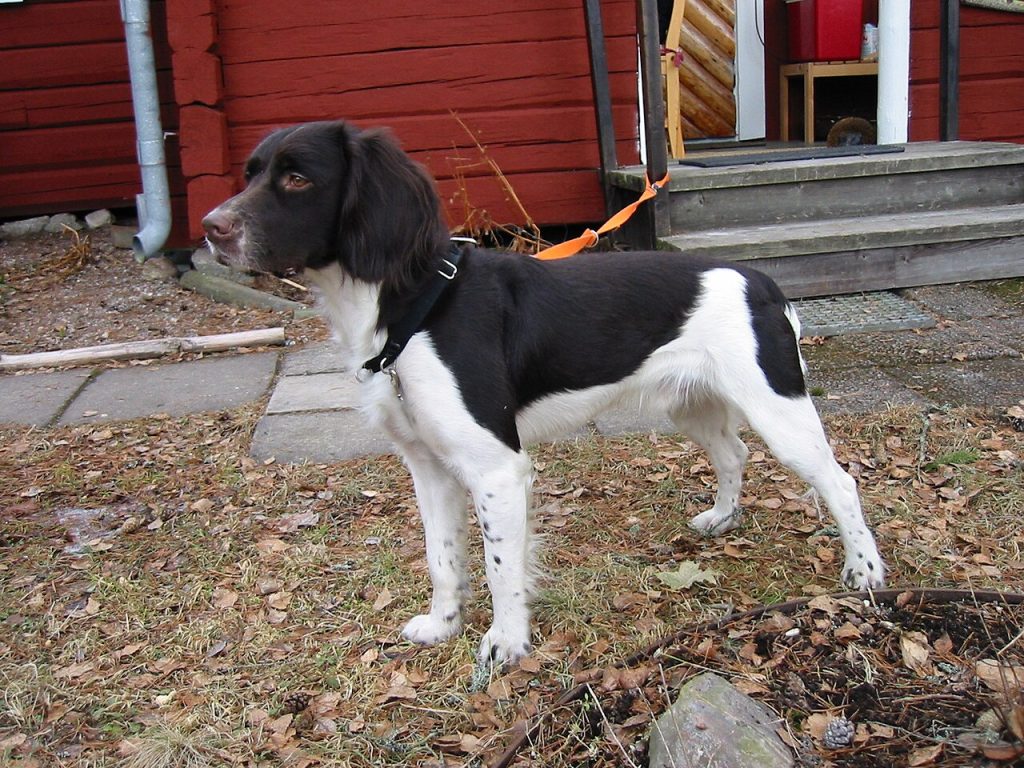
The Münsterländer Pequeño(German: Kleiner Münsterländer) is one of the most complete and lesser-known versatile hunting dogs in existence: It samples, charges and tracks with the same ease in the field as it does in the water, all with a manageable size and a gentle character indoors. Born in the Münster region of Germany, this spaniel-setter combines intelligence, energy, and an almost obsessive bond with his family. If you are looking for a sporty, caring, hardworking companion – and you are willing to give him the exercise he needs – the Small Münsterländer may be one of the best choices you make.
Is that the Little Münsterländer for you?

The Little Münsterländer is a real hunting dog, not a companion dog that likes to “go for a walk”. Its engine is designed to work for hours in the field, and that demand is what decides whether or not it fits into your life. Before you fall in love with its face, look honestly at these two columns.
In favour .
- Intelligent and highly trainable: he learns fast and enjoys working with you.
- Extremely affectionate and close to his family; excellent indoor dog.
- Medium in size and manageable, more practical than other large hunting breeds.
- Born and multi-purpose swimmer: sample, charge and trace on land and water.
- A rustic and healthy breed with very few hereditary problems thanks to selective breeding.
Against
- He needs an hour or more of vigorous exercise a day, every day.
- Strong prey instinct: it is not easy to live with small pets.
- He is easily bored and frustrated; boredom leads to ruin.
- He doesn’t tolerate loneliness or living in a kennel. He needs to be with his people.
- Rare breed: Getting a good-line puppy can be difficult.
Character and temperament
The word that best defines the Small Münsterländer is versatility, and that versatility also applies to his character. He ‘s a dog with a double life: At home it becomes an affectionate, quiet, clingy companion who wants to be where you are; in the field it becomes a focused, tireless hunter with an extraordinary sense of smell. Mastering both facets seamlessly is precisely what has kept this breed alive for centuries.
It’s a very clever. and attentive dog, with a remarkable ability to read its guide. While at work, he often looks back to look for silent signals – voice or hand – from the hunter, a cooperative trait reminiscent of the harmony between a shepherd and his Border Collie. That same intelligence has a B-side: If he senses that his owner is inconsistent or insecure, he will not hesitate to challenge him and do things his way. He’s not a stubborn dog by nature, but one that needs calm, consistent leadership.
It has a very strong prey instinct and genuinely enjoys hunting and “rewarding” its human with productive catches. It is sensitive: it responds fatally to harsh methods and thrives on kind and patient treatment.
Coexistence: children, other pets, flat and loneliness

With the children, the Small Münsterländer is usually an excellent companion: he is patient, playful, affectionate and loves to be part of family life. His sociable nature makes him integrate the little ones as “his pack”. As with any active dog, it is advisable to supervise play with very young children, not for aggressiveness but for his energy and size.
With other pets, the key is early socialization. Raised as a puppy with cats or other dogs in the household, it can coexist in harmony, although it will not give up the occasional game of “chase and show”. The problem is outside: the unfamiliar small animals that are crossed outdoors will fully awaken their prey instinct, so recall and leash control are non-negotiable.
On the floor, is not the ideal option, but it is viable if – and only if – you are guaranteed the daily exercise you need. He’s not a dog who’s content to live in an unkempt garden: He wants to be inside, with his people. What he really doesn ‘t tolerate is the loneliness. It is a deeply social dog that is not made to live in a kennel or to spend long days alone at home; lack of companionship and stimulation almost always leads to anxiety and destructive behaviors.
Education and training
Training a Small Münsterländer is, in general, a pleasure: it is one of the smartest and most willing dogs that exist within hunting breeds. It learns quickly, retains well and wants to please. Now, that intelligence demands a guide at the height. The method should be kind, patient and consistent; positive reinforcement is the way, and coercive methods are directly counterproductive with such a sensitive breed.
Consistency is the cornerstone. If the rules change depending on the day or the person, this dog senses it and starts making his own decisions. The work involves both voice and hand signals, and he himself seeks that communication by looking back to “consult” his guide. Take advantage of that predisposition: Short, varied, motivating sessions will yield far more than boring repetition.
Early socialization – people, environments, noises, other animals – is key to channeling their energy and their instinct. And don’t forget the mental stimulation: for such an alert breed, olfactory work, search games and continuous training are as necessary as physical exercise.
Exercise and activity
There’s no middle ground here: The small Münsterländer needs one hour or more of strenuous exercise per day, and not a leisurely stroll, but demanding activity that also occupies his head. It thrives on hunting or any comparable physical challenge: long-distance hiking, running, canicross, swimming, mantrailing, agility or work tests. It’s an exceptional swimmer, remarkably better than most short-haired hunting breeds, so water is a magnificent resource to vent it.
The consequence of not meeting that need is predictable and documented in the breed itself: Lack of exercise and mental challenge results in unwanted behaviour– wrecking, barking, anxiety – common in highly intelligent, high-pulse dogs. It’s not a “difficult” dog; it’s a dog with a motor that needs to be run. If you can give him that day job, you’ll have a balanced, happy partner in return.
Care: fur and hygiene
The coat of the Small Münsterländer is medium length, bright, dense and smooth or slightly wavy, with fringes on the front legs and “shorts” on the hindquarters. It is a relatively easy-to-maintain coat: a regular brushing, a couple of times a week, is enough to keep it clean, without knots and looking good, paying special attention to the fringes, where leaves and seeds become entangled after working in the field.
After every swim in a river or pond, dry his ears well: The entry of water into the ear canal is one of the few weak spots in this breed and a routine checkup prevents otitis. Skin dryness can occur in cold climates, so watch your skin in winter. As with any active dog, complete hygiene by cutting or wearing nails, brushing teeth, and periodically checking pads, especially if working on rough terrain.
Foodstuffs
As a medium-sized dog with a high energy expenditure, the Small Münsterländer needs a complete, balanced and tailored to their level of activity diet. An individual who hunts or trains for several hours a day burns much more than one who does moderate exercise, and the diet should reflect this: quality feed with good protein intake and adequate fats to sustain performance and recovery.
Divide food into two portions a day and avoid strenuous exercise just before or after eating. Adjust the amounts according to your body condition – you should notice the ribs without seeing them – and adjust the intake throughout the year, increasing it in hunting season and moderating it in times of less activity. Water always fresh and available, especially after work. If you have any questions about diet or supplements, consult your veterinarian.
Health and life expectancy

The Small Münsterländer is one of the healthiest breeds within the canine world, and this is no accident. Breed organisations, responsible breeders and owners maintain a very strong commitment to health: breeding programmes are extraordinarily selective and require breeders to be free from hypoplasia of the hip(OFA/PennHIP), eye problems(CERF) tests and with a correct temperament. Any animal showing physical or behavioural abnormalities shall be discarded from the litter.
The result is that the incidence of congenital diseases is extremely low. It is a robust dog whose few problems are usually limited to dry skin in cold climates and water entering the ears after swimming – both manageable with basic care . As for life expectancy, exact figures are not documented in the consulted sources; as a general reference for a medium-sized and healthy hunting dog, a long life can be expected with proper care, feeding and veterinary checks. Choosing a breeder that works with the health tests mentioned is the best guarantee.
Physical appearance
The Small Münsterländer is a medium size dog, of strong and harmonious build, with balanced proportions and an air of quality and elegance. The males measure between 52 and 56 cm to the cross and the females between 50,2 and 54 cm. The weight ranges between 17 and 26 kg, with the males being the largest specimens.
It gives a feeling of strength in the hindquarters and of general balance, with a distinguished and not too massive head. The front legs look like good fringes and the back legs, “calzones”. The mantle is medium-length, shiny, dense and smooth or slightly wavy. In terms of color, the coat is white – ticked or solid – with large brown spots, a pattern reminiscent of spaniels and setters. His movement is athletic, elegant and of good range.
Origin and history
The history of the Little Münsterländer is long and fascinating. It is considered one of the four oldest versatile breeds, with over 500 years of history and documentation of its ancestors dating back to the 13th and 14th centuries. Its birthplace is the Münster region of Germany. A common misunderstanding should be clarified: Despite sharing name and region with the Münsterländer Grande, they’re not related; they were developed from different breeding lines.
In its origins it was a dog bred exclusively for noble families, working alongside the hawks before firearms entered the hunt. His job was to raise the falcon’s prey to higher ground and then keep it on display until the falconer could retrieve it. Hence their excellent instinct for close search and sampling. The abolition of the privileges of the German nobility in 1919, with the Weimar Constitution, and the increased availability of weapons and land for the common people popularized hunting and transformed the breed into an equally effective collector on land and water.
During the 19th century the breed fell into oblivion, preserved by a few peasant families in the vicinity of Münster. For half a century, the few specimens were mostly companions used for hunting and bringing food to the table – the so-called “bread hunt” – rather than for sport. That domestic stage left a very valuable legacy: His magnificent character within the home. In the late 19th century, a conscious effort was made to recover the breed from the surviving lines. Edmund Löns, the brother of the famous nature poet Hermann Löns, was a key player in this endeavour. He located specimens in two locations in Lower Saxony and brought together two breeding lines with complementary temperaments and abilities.
Curiosities
- In Germany it is also known as Spion, and in the Netherlands as Heidewachtel.
- It is related to the Epagneul Français and the Drenthe Perdiguero (Drentsche Patrijshond), not the Münsterländer Grande.
- The FCI classifies it in the Grupo 7, Sección 1.2, continental sample dogs of the spaniel type.
- It’s a exceptional swimmer, far superior to most shorthaired hunting breeds.
- It is a rare breed in the United States, with only about 2,000 individuals; breeders often give preference to hunters because demand far outstrips supply.
- It works “in team” with the hunter almost uniquely, hunting close – between 90 and 140 meters under light cover – to always maintain a connection with its guide.
- The British Kennel Club recognised it as an imported breed in 2006; it is still very rare in the UK.
If you are attracted to the profile of the Small Münsterländer – a versatile, intelligent, and very familiar hunting dog – you will also be interested in learning about other similar breeds by function or character: The stylish Vizsla and the athletic Weimaraner, both versatile show dogs; the classic Pointer, a show specialist; and the unrivaled Cocker Spaniel, with which it shares spaniel-type roots. They’re all active dogs who shine with a family willing to give them work and exercise.
Frequently asked questions about the Small Münsterländer
Is the Little Münsterländer a good family dog?
Yes, it is an excellent indoor family dog: affectionate, sociable and very attached to its people.
How much exercise do you need a day?
He needs an hour or more of vigorous exercise each day – hunting, hiking, swimming, canoeing, or sniffing.
Can he live in a flat?
It can, as long as it is guaranteed the daily exercise it requires. It prefers to live indoors with its family rather than in a garden. What it does not tolerate is prolonged solitude or living in a kennel.
Is it hard to train?
On the contrary, it is one of the most intelligent and trained breeds, but it requires a kind, patient, and consistent approach.
Do you get along with cats and other dogs?
With early socialization, it gets along well with pets, including cats. However, it has a strong prey instinct toward small, unfamiliar animals outdoors, so it needs control and good recall.
Is it a healthy breed?
It is one of the healthiest breeds thanks to a very selective breeding that requires breeders free of hip dysplasia (OFA/PennHIP), eye problems (CERF) and good temperament.
How is it different from the Münsterländer Grande?
Despite the name and origin in the same region, they are not related: they developed from different breeding lines.
Is it easy to get a puppy?
Not particularly. It is a rare breed outside countries such as Germany, Belgium, the Netherlands, Denmark or the Czech Republic. The demand usually exceeds the supply and many breeders give priority to hunters, so it is advisable to be patient and look for lines with health tests.