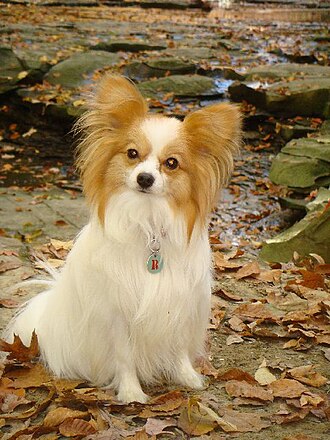
The Papillón is one of the oldest and most elegant companion dogs in Europe, easily recognizable by its large, fringed ears that resemble the wings of a butterfly (hence its French name). Beneath that delicate toy appearance lurks a surprisingly smart, athletic dog with a hunting instinct few expect. If you’re looking for a small, alert, family-oriented companion, the Butterfly deserves a thorough review before deciding.
Is the Butterfly for you?
The Butterfly is a great fit for anyone who wants a small dog to be a real companion: It will follow you from room to room, learn what you teach it almost effortlessly and adapt to both a floor and a house with a garden. It’s not, however, an “ornament” dog that you can leave alone all day: He needs companionship, mental stimulation, and careful treatment for his physical frailty. Before proceeding, weigh these pros and cons.
In favour .
- Very intelligent and one of the easiest to train among small dogs.
- Small size: ideal for floor and travel.
- Sociable, cheerful and deeply attached to his family.
- Undercoat: Maintenance is easier than it looks.
- Tall and, for a toy, quite sturdy and athletic.
- He shines in dog sports like agility and obedience.
To be taken into account
- He has a hard time dealing with loneliness – he may develop separation anxiety.
- He tends to bark to warn of any news.
- Physically fragile: beware of high jumps and abrupt children.
- Prone to dental problems and kneecap dislocation.
- He needs mental stimulation or he gets bored and “invents” mischief.
- Your dental hygiene demands consistency throughout your life.
Character and temperament
If we had to summarize the Butterfly in one word, it would be “awake”. It is a lively, curious and attentive dog, with a learning ability that surprises those who associate it only with a cute lap dog. In fact, it is considered one of the most intelligent companion dogs in existence: In Stanley Coren’s well-known classification of obedience and work intelligence, it appears in the elite group, side by side with much more “serious” breeds like the Border Collie or the German Shepherd.
That wide-awake head coexists with an enormously affectionate character. The Butterfly lives attentive to his reference person and his main goal is to please, which makes him docile and collaborative. He’s cheerful and playful without falling into the nervousness of other toys, and keeps his old hunting instinct intact: It’s not uncommon to see him chasing butterflies, flies or birds in the garden with total concentration. He is usually confident and open-minded, although he may be somewhat reserved with strangers until he takes the measure.
Coexistence: children, other pets, flat and loneliness
- With children: is affectionate and playful, but its small size makes it fragile. It fits better with somewhat older children who understand that it is not a stuffed animal; with very young children you must always monitor the game to avoid falls or pulls.
- With other dogs: usually gets along well and enjoys canine company, although it is sometimes unaware of its size and stops in front of much older dogs.
- With cats and other pets: coexistence is viable, especially if they grow together, but remember their hunting instinct with birds, rodents and insects.
- On the floor: is an ideal indoor dog for its size, the only thing to work with is its tendency to bark at noises, so it doesn’t disturb the neighbors.
- In the face of loneliness: here is his great weakness. He is so attached that he suffers when he is alone for many hours; he needs company and, if you spend a lot of time away, a plan so that he is not isolated all day.
Education and training
Few small breeds do training as gratefully as the Butterfly. It learns quickly, enjoys training, and responds wonderfully to positive reinforcement with rewards and play. That same facility has a flip side: If you don’t set clear rules for it, it will learn just as quickly habits that don’t interest you, such as barking to get attention or demanding constant pampering.
The priorities are three. First, the early socialization: The more he knows about puppies (people, dogs, noises, surfaces, transport), the more balanced he will be as an adult. Second, avoid the “little dog syndrome”: no matter how monkey he is, he must learn the same limits as a big dog, because to indulge him creates insecurity and barking. Third, the control of barking from the beginning, teaching it a silent command and not to be alarmed by every noise. Short, frequent, fun sessions work much better for him than long ones.
Exercise and activity
The Butterfly is small, but it is not a sedentary dog: it has energy and endurance in abundance. It is not enough to take four steps on the sidewalk. It needs one or two daily walks of good rhythm, playing moments and, above all, mental challenges. It is a miniature athlete that stands out in agility, obedience and rally, disciplines in which its agility and its desire to learn look very much.
Mental stimulation is as important as physical stimulation. Interactive toys, sniffing games, new tricks and stuffed kongs keep you busy and happy. A Bored Butterfly is a Butterfly that barks, digs, or looks for a way to entertain itself. The good news is that with relatively little space (even indoors) you can give him much of the activity he needs.
Care: fur and hygiene
The Butterfly’s hair impresses with its sheen and freckles, but its maintenance is more bearable than it looks because has no undercoat: It is a long, silky, smooth, one-layered cloak. Brushing thoroughly two or three times a week is enough to avoid knots, paying attention to the areas of freckles – behind the ears, on the chest, on the back of the legs, and on the plumage of the tail – that are most likely to become entangled.
It doesn’t need haircuts or frequent baths: bathing it when it gets really dirty is enough. The point you can’t ignore is the mouth: as a good little dog, it is prone to tartar and tooth loss, so regular tooth brushing is almost mandatory. Complete the routine by checking and cleaning the ears, trimming the nails and monitoring the eye area.
Foodstuffs
Being such a small dog, the Butterfly eats a small amount, but that amount must be of good quality and well-adjusted. Ideally, a complete and balanced food designed for small breeds, with a croquette size suitable for their tiny mouth, divided into two daily servings to keep their energy stable. Puppies, with a very active metabolism and risk of hypoglycemia, usually need more doses a day.
There are two things to watch out for. The first, the overweight: In such a lightweight body, a few extra grams take a toll on your joints and your heart, and the rewards count (better to set aside part of your daily ration for training than add extra calories). The second, his dental work: the type of food and some dental snacks can help slow the buildup of tartar. Always make sure that fresh water is available.
Health and life expectancy
The Butterfly is a remarkably healthy and long-lived breed. A British study from 2024 placed its life expectancy around 14.5 years, above the average of purebred dogs, and with good care many specimens exceed that figure.
- Dislocation of the patella: common in small breeds; the patella displaces from its site and may require treatment or surgery.
- Dental problems: buildup of tartar and loss of parts, which is why oral hygiene is key.
- Patients who have been diagnosed with progressive retinal atrophy: hereditary eye disease which should be ruled out by reproductive testing.
- Convulsive seizures: described in the breed, require veterinary evaluation.
- Intervertebral disc disease and allergies: appear occasionally and deserve follow-up.
Choosing a responsible breeder who performs parental health screenings and keeps veterinary checks up to date greatly reduces the risk of most of these problems.
Physical appearance
The Butterfly is a spaniel-type toy dog, fine and harmonious. Its height is around 28 cm to the cross at most, and its weight is very light: the standard recognizes two categories, one from 1.5 to 2.5 kg and another from 2.5 to 5 kg. Despite its delicacy, it gives a feeling of elegance and vivacity rather than fragility.
Their unmistakable hallmark are the ears: large, well-separated and covered with striped hair, upright and oblique like the wings of a butterfly. There is also a variety of dropped ears called Phalène(“moth”), identical in all other respects and considered the same breed by the FCI and AKC. The coat is long, smooth and silky, predominantly white with spots of any color; on the head, the color covers more surface than white, ideally leaving a white streak in the center. Common combinations include white and black, white and red, lemon, sable, and tricolor.
Origin and history
The Papillon is a Franco-Belgian breed whose official name is Epagneul Nain Continental(dwarf continental spaniel). Its ancestors, small lap spaniels, have been depicted in European painting since the 16th century: masters such as Titian, Veronese, Mignard, Coques, Watteau or Fragonard included these puppies in their paintings, making it one of the best documented companion dogs.
For centuries it was the favorite of the nobility and European courts. A well-known legend has it that Queen Marie Antoinette had a specimen she called “Le Petit Papillon”, and the breed is credited with the curious image of ladies posing with their puppy in her lap. In time, the upright-eared variety (the butterfly) gained popularity over the sloping-eared variety. The AKC recognized the breed in 1935 with the founding of the Papillon Club of America. Already in modern times, the breed has scored resounding triumphs at major exhibitions: the specimen “Kirby” won the Westminster Best in Show in 1999 and the Helsinki World Championship in 1998, and “Dylan” became in 2019 the first Butterfly to win Crufts Best in Show.
Curiosities
- Its name literally means “butterfly” in French, because of the shape of its ears.
- The drop-eared variety is called Phalène(“caterpillar”) and is the same breed: in the same litter puppies of both types can be born.
- It is one of the oldest companion dogs in Europe, portrayed by great painters since the Renaissance.
- Despite its parlor dog appearance, it is among the world’s most intelligent breeds in obedience and work.
- Dominates canine sports: Many Butterflies compete successfully in agility despite their mini size.
If you are attracted to the Butterfly, you are likely to be interested in other small, alert, family-oriented breeds as well. Check out the Cavalier King Charles Spaniel, a close cousin within the world of companion spaniels; the popular Chihuahua, another toy with a great personality; the furry, outgoing Pomerania; and the sleek Japanese Chin, another small companion of courts and palaces.
Frequently Asked Questions About the Butterfly
Is the Butterfly easy to train?
Yes, it’s one of the easiest little dogs to train. It’s very intelligent and enjoys learning, so it responds greatly to positive reinforcement. The key is to set clear rules for it as a puppy so that it doesn’t also learn unwanted habits, like barking to get attention.
How long does a Butterfly live?
It is a very long-lived breed. A British study from 2024 estimated its life expectancy at around 14.5 years, above the average canine, and with good care many specimens reach 15 or 16 years.
Does the Butterfly bark a lot?
It does not bark uncontrollably, but it is advisable to teach it from a young age a command to be quiet and not to reinforce the bark so that it does not become a problem, especially if you live in an apartment.
Does the Butterfly shed a lot of hair?
Because it has no undercoat, it sheds less hair than its appearance suggests, and brushing it two or three times a week keeps it free of knots and controls its fall well.
Is he a good dog for children?
It is affectionate and playful, but its small size makes it fragile. It works best with somewhat older children who know how to handle it carefully; with very young children you always have to supervise the play to avoid falls or injuries.
Can you live in a small apartment?
Yeah, he’s an ideal indoor dog for his size, just needs his daily walks and mental stimulation, and you work on his barking tendency so he doesn’t disturb the neighbors.
How much exercise do you need?
More than it seems. Despite its size, it has energy and endurance: thanks to one or two daily walks, moments of play and, above all, mental challenges. It shines in sports like agility and obedience.
What’s the difference between Butterfly and Phalène?
They are the same breed and differ only in the ears: the Butterfly carries them upright, in the shape of butterfly wings, while the Phalène (“moth”) has them dropped.