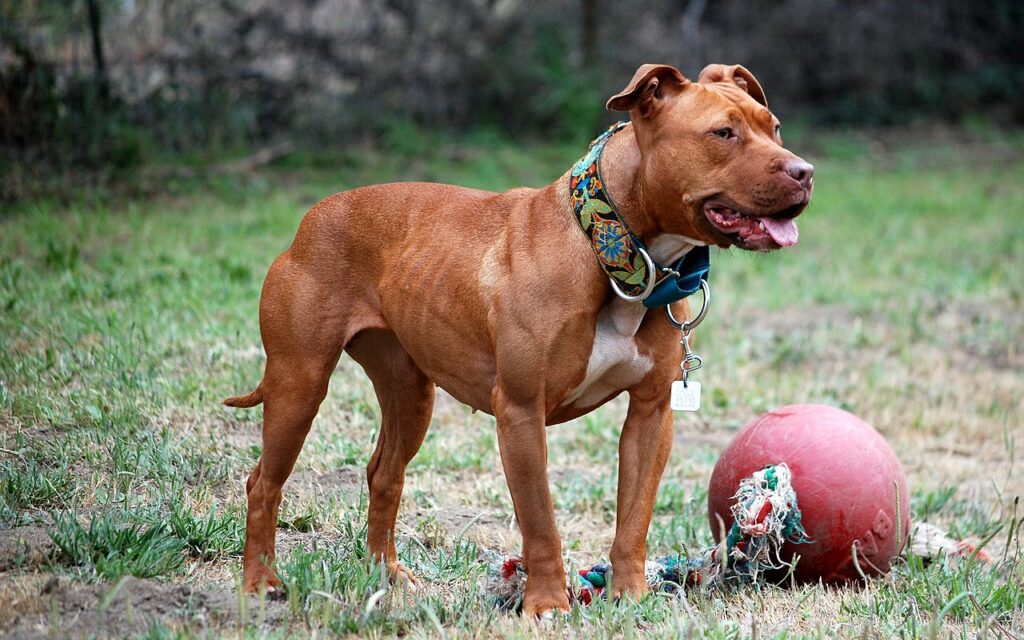
The American Pit Bull Terrier is a medium-sized, athletic and muscular dog, originally from the United States and a direct descendant of the ancient British bull-and-terrier. It’s brave, incredibly loyal to its family and with an energy that overflows, but also a race misunderstood and subject to strict legislation. Before you fall in love with their ear-to-ear smile, you should know exactly what it means to live with an American Pit Bull Terrier.
Is the American Pit Bull Terrier for you?
The American Pit Bull Terrier is not a dog for everyone, and not for his character, but for the responsibility that comes with it. It is a devoted, balanced and loving companion in the right hands, but it demands a constant owner, physically active and willing to comply with the legal obligations that in many countries (Spain included) fall on this breed. These two boxes summarize what’s good and what you should value with a cool head.
In favour .
- Extraordinary attachment to his family; he wants to be with you all day.
- Surprisingly affectionate and tolerant of people.
- Intelligent and eager to please: he learns fast.
- Born athlete, ideal for canine sport and active life.
- Short coat that barely needs maintenance.
- Robust and long-lived for his size.
To be taken into account
- In Spain it is classified as a potentially dangerous dog (PPP): licensed, insured and muzzled on public roads.
- It may show a tendency to reactivity with other dogs if it is not well socialized.
- Huge strength and determination: it needs a steady and consistent owner.
- Too much energy: bored or lonely, frustrated and can be destructive.
- It carries a social stigma and bad press you’ll have to deal with.
- It requires early and intensive socialization, no shortcuts.
Character and temperament

If we had to sum up the character of the American Pit Bull Terrier in two words, they would be strength and confidence. It is a self-confident dog, enthusiastic to the point of being contagious and with an almost obsessive desire to please its owner. That combination, coupled with remarkable intelligence, makes it a brilliant companion for anyone who spends time with it.
One of the great paradoxes of race is its relationship to people. Despite its reputation, the historical standard of the American Pit Bull Terrier criminalizes aggression toward humans: Serious breeders consider an aggressive specimen to be a disqualifying defect. In fact, it is usually a sociable dog, playful and deeply attached to its people, to the point of not taking loneliness very well.
The important nuance is in its relationship to other animals. Due to their origin, part of the population may show a greater tendency to reactivity or intolerance towards other dogs, especially of the same sex. It is not an inevitable sentence – many get along just fine with other dogs – but it is something that the owner must work on from puppyhood with serious and constant socialization. He’s a dog of nuances, not labels.
Coexistence: children, other pets, flat and loneliness
The American Pit Bull Terrier can adapt to a wide variety of environments, as long as its needs for exercise and companionship are met.
- With children: is well socialized, usually tolerant, affectionate and patient. Due to its strength and enthusiasm, adult supervision is always mandatory, especially with small children.
- With other dogs: is the most delicate point. Cohabitation is possible, but it requires careful introductions, early socialization and getting to know your dog well. Same-sex couples cause more problems.
- With cats and small animals: its prey instinct can be elevated. raised with a cat since puppy coexistence usually works; with unfamiliar animals, caution.
- On the floor: surprisingly adapts well to living on the floor if you get enough daily exercise. It’s clean, doesn’t drool excessively and enjoys the couch as much as the countryside.
- Soledad: is his Achilles heel. He’s made to be with his family; spending too many hours only creates anxiety and destructive behaviors.
Education and training
Few breeds respond as well to training as the American Pit Bull Terrier. It is intelligent, motivated by food and play, and greatly enjoys working with its owner. The key is to start early and do it right.
Positive reinforcement is, by far, the best way. Punishing or using harsh methods with a dog so sensitive to its owner only creates distrust and problems. Short, fun and consistent sessions give spectacular results: this dog do you want hit.
The early socialization is not optional, it’s priority number one. Positive exposure to people, other dogs, noises, environments, and different situations during the first few months of a puppy’s life makes the difference between a balanced and a responsive adult. It is also worth working on solid basic obedience (called, sitting, together) and self-control, because we are talking about a strong dog that you should be able to handle in any circumstance.
Exercise and activity
The American Pit Bull Terrier is a complete athlete and needs to burn that energy daily. A couple of short walks are not enough: it requires real physical activity and, above all, mental stimulation. A minimum of one to two hours of daily combined exercise is a good reference.
It excels in canine sports and activities: weight pulling(weight-dragging), agility, canicross, sport bite games, scent-seeking or simply long walks and ball-seeking games.
A tired American Pit Bull Terrier is a happy, quiet dog at home, while a bored one redirects all that energy to furniture, garden, or barking.
Care: fur and hygiene

In terms of maintenance, the American Pit Bull Terrier is one of the most grateful dogs that exists. Its coat is short, smooth, shiny and attached to the body, so a weekly brushing with a glove or bristle brush is enough to remove the dead hair and keep the skin healthy.
Bathing should be occasional, only when you get really dirty, so as not to dry out your skin.The skin is precisely your sensitive point: having such short hair, you are more prone to skin allergies, redness and irritation, so it is advisable to monitor it.
The rest is routine hygiene common to any dog: checking and cleaning the ears to prevent infection, cutting the nails when they ring when walking, brushing their teeth regularly, and protecting their skin from the sun in the summer, as light-coated or pink-cheeked specimens can burn.
Foodstuffs
Being such a muscular and active dog, the American Pit Bull Terrier needs a quality diet, rich in animal protein from a good source, that supports its muscle mass and activity level.
The quantity depends on the weight, age and exercise of each specimen; the important thing is keep it at its ideal weight. It is convenient to be able to feel its ribs without seeing them marked: overweight punishes its joints and favors problems such as hip dysplasia, to which the breed is somewhat prone.
As with any deep-chested, muscular dog, it is wise to divide food into two servings a day and avoid strenuous exercise right after eating.
Health and life expectancy
Thanks to its varied genetic base and a historically performance-oriented breed, the American Pit Bull Terrier is a robust and healthy dog, with a life expectancy of around 12 to 16 years, remarkably long for a dog of its size.
Still, there are a few conditions to watch out for:
- Dysplasia of the hip: the breed has a slightly above average incidence; maintaining a correct weight helps a lot to prevent it.
- Problems with the kneecap: kneecap dislocation may occur in some individuals.
- Degenerative myelopathy: neurological disease affecting the spinal cord in older dogs.
- Skin problems: skin allergies, demodectic scabies and irritations, favored by his short hair.
- Thyroid changes and congenital heart disease: less common, but present in the breed.
Regular veterinary checkups, weight control, adequate exercise, and acquiring the puppy from a responsible breeder who tests the parents’ health are the best weapons for keeping an American Pit Bull Terrier healthy for many years.
Physical appearance

The American Pit Bull Terrier is a medium-sized dog of solid build, athletic and muscular, which transmits power without losing agility. It is larger than the English Staffordshire Bull Terrier from which it descends, with differences of about 15-20 cm in height and 11-16 kg in weight.
In terms of their measurements, males usually measure between 45 and 53 cm to the cross and weigh between 15 and 27 kg, while females round the 43 to 50 cm and the 13 to 22 kg. The head is broad and powerful, with marked jaws; the eyes range from round to almond-shaped, and the ears are small to medium, usually semicircular or rose-shaped. The tail is low-implantation, thick at the base and tapered towards the tip.
The coat is short, smooth, shiny and rough to the touch. A huge variety of colors and combinations are supported – black, red, black, white, black and many more – with the exception of the merle pattern, which does not recognize either the UKC or the ADBA.
Origin and history
The history of the American Pit Bull Terrier begins in the United Kingdom. Until the middle of the 19th century, the now extinct Old English Bulldog and Old English Terrier were crossed to obtain a dog that combined the strength and courage of the bulldog with the liveliness and agility of the terrier.
When these shows were banned in Britain in 1835 with the first animal welfare laws, gambling enthusiasts reoriented their dogs towards fighting among themselves, which was easier to hide.
On American soil the dog evolved. In addition to fighting, it was used as catch dog to control cattle and semi-wild pigs, as a guardian and as a family companion, which favored specimens somewhat larger and longer-legged than their European relatives. The February 10th, 1898, the United Kennel Club (UKC) officially recognized the breed with the name American Pit Bull Terrier. It is also recognized by the American Dog Breeders Association (ADBA), although the American Kennel Club (AKC) has never done so under that name. Dog fighting was banned in the United States in 1976, and today the breed lives as a companion, sports and work dog.
Curiosities
- The term “pit bull” is used colloquially for an entire group of dogs, but some breeders argue that the American Pit Bull Terrier is the only authentic “pit bull”.
- It is one of the most capable climbing and jumping dogs: its agility requires high and secure fences.
- In 1996, the San Francisco protector renamed her pit bulls “St. Francis Terriers” to facilitate their adoption; in 2004 New York tried calling them “New Yorkies”.
- It successfully performs tasks as a therapy dog, detection dog and as a police dog, far removed from its topical image.
- Many hardy, short-haired mixed-breed dogs are mistakenly labeled as pit bulls, distorting statistics on the breed.
- Performance-oriented breeding historically penalized aggression toward people: a dog “gentle with people” was a requirement.
If you are interested in the American Pit Bull Terrier, you will surely also want to get to know its closest relatives and other bull-type breeds. Check out the American Staffordshire Terrier, its closest relative; the compact British Staffordshire Bull Terrier; the unmistakable oval-headed Bull Terrier; and the imposing American Bulldog, another great American worker.
Frequently Asked Questions about the American Pit Bull Terrier
Is the American Pit Bull Terrier a dangerous dog?
It is not dangerous by definition, but it is a strong and powerful dog whose behavior depends greatly on the education, socialization and responsibility of its owner.
Is it legal to have an American Pit Bull Terrier in Spain?
Yes, but it is listed as a Potentially Dangerous Dog (PPP). This involves obtaining an administrative license, taking out liability insurance, wearing a leash and muzzle on public roads, and meeting other requirements.
Is the American Pit Bull Terrier good with kids?
Because of its strength and energy, adult supervision is always mandatory, especially with small children, and minors must be taught to respect the dog.
How much exercise does an American Pit Bull Terrier need?
Enough. He’s an athlete who needs between one and two hours a day of physical activity combined with mental stimulation. He loves dog sports, search games and long walks. A tired pit bull is quiet at home; a bored one becomes destructive.
Does the American Pit Bull Terrier get along with other dogs?
It depends on the specimen and, above all, on its socialization. Due to its origin, part of the breed can show reactivity towards other dogs, especially of the same sex. Many live without problems with other dogs, but it is something that must be worked from puppy with careful presentations.
How long does an American Pit Bull Terrier live?
Its life expectancy is about 12 to 16 years, a remarkably high figure for a dog of its size. Good nutrition, weight control, adequate exercise, and regular veterinary checkups help it reach that age in good health.
What’s the difference between the American Pit Bull Terrier and the American Staffordshire Terrier?
The American Staffordshire Terrier was selected for exhibition and is recognized by the AKC, while the American Pit Bull Terrier was bred with a more functional approach and is recognized by the UKC and ADBA.
Is the American Pit Bull Terrier recognized by the FCI or the AKC?
The American Pit Bull Terrier is not recognized by the International Kennel Federation (FCI) or, under that name, by the American Kennel Club (AKC), but is recognized by the United Kennel Club (UKC), since 1898, and the American Dog Breeders Association (ADBA).