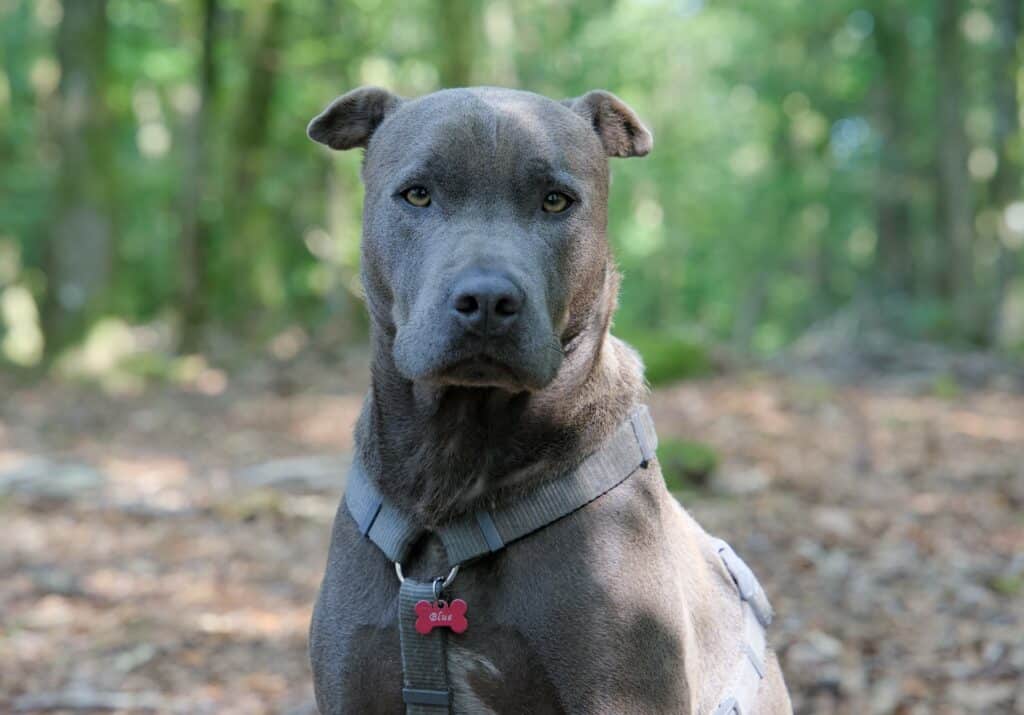
The American Staffordshire Terrier (or AmStaff) is a medium-sized, muscular, short-haired American dog, famous for its strength, proverbial courage and, above all, for the almost addictive affection it professes to its family. Well-bred and socialized, he is a confident, intelligent, and excellent-character companion. It’s a powerful breed that demands an implicit owner: early socialization, positive education and responsibility. Here’s the complete guide to see if it fits you.
Is the American Staffordshire Terrier for you?

The AmStaff is not a dog for everyone, and that is precisely why it is good to be honest before adopting one. It is a compact muscle athlete, very attached to people and with a remarkable ability to learn, but also a strong breed that in many countries – including Spain – is among the dogs considered potentially dangerous. If you’re looking for a loyal, playful, devoted mate, and you’re willing to invest in socialization, exercise and consistent education, few breeds will give you that much. If you want a dog that barely requires dedication, this is not for you.
In favour .
- Extraordinarily loving and loyal to his family.
- Intelligent and eager to please: he learns fast.
- Tolerant and protective of the children in the house.
- Short hair: minimal maintenance of brushing.
- Robust, tough and a very good sport dog.
- He doesn’t usually bark for no reason; good watchdog discreet.
To be taken into account
- In Spain it is PPP race: license, insurance and muzzle on public road.
- He can show reactivity to other dogs even if he’s socialized.
- He needs plenty of daily exercise and mental stimulation.
- Its strength demands an owner with time and a firm hand in the positive.
- Predisposition to skin and joint problems.
- Social prejudices and legal restrictions by country.
Character and temperament
If we had to sum up the character of the American Staffordshire Terrier in three words, they would be confident, intelligent, and loving. The American Kennel Club describes the breed as “clever, confident, good-natured dogs” whose courage is proverbial. A well-bred and socialized AmStaff becomes a loyal and trusted friend to the end, deeply connected to his people and happy to be part of the daily life of the household.
By nature they are a sociable breed that greatly enjoys human company. He’s not a distant or independent dog: He wants to be with you, participate in your plans and get attention. That dedication, combined with his bravery, also makes him a reliable guardian who rarely barks for no reason, much appreciated in the face of more vocal breeds. When he senses a real threat, however, he does not hesitate to step in to protect his own.
There’s an important nuance that no responsible owner should ignore: The AmStaff will not refuse the challenge of another dog. The breed’s official club warns that canine reactivity can occur even in well-socialized dogs, so it is not advisable to leave them alone with other dogs without supervision. It is not aggression toward people – on the contrary, they are often overly trusting of people – but a tendency inherited from their origins that is managed with education, prevention, and common sense.
Coexistence: children, other pets, flat and loneliness

- With children: is one of its strengths. The AmStaff is protective and tolerant of the children in the household, knows how to measure their limits in play and does not pose a threat to them.
- With other pets: coexistence is possible and can be excellent if the introductions are made with tact and, above all, from a puppy.
- On the floor: adapts well to urban life as long as it meets its daily exercise quota. It is a dog that adapts to very different environments, urban or rural, but a floor without enough walks feels terrible to it.
- In the face of loneliness: is a very close-knit breed that doesn’t like to spend long hours alone. Prolonged isolation can translate into anxiety and destructive behaviors. They need company, routine, and a sense of belonging.
Education and training
The American Staffordshire Terrier is intelligent and loves to please, a combination that makes it very responsive to training. This ease of learning, however, comes with a huge responsibility: We’re dealing with a strong dog whose training should never be based on force. Using violence or physical punishment with such an animal can lead to serious behavioural and control problems; positive reinforcement, consistency and patience are the only sensible path.
Early socialization is the key piece. The earlier and better the puppy is exposed to people, environments, noises, other animals and different situations, the more balanced he will be as an adult. It is advisable to work from the beginning on basic obedience, impulse control and correct presentation to other dogs, in addition to getting him used to the muzzle and the leash as a natural part of walks, since in many places their use is mandatory. A polite, confident and well-managed AmStaff is an ambassador for the breed; a careless one feeds the prejudices that weigh on it.
Exercise and activity
Behind that athletic body is a motor that needs to be worn daily. The AmStaff is vigorous, resilient, and playful, and requires a good amount of physical exercise combined with mental stimulation to keep it balanced. A short walk is not enough: it needs long walks, active play, obedience sessions, and challenges that put your head to work.
He’s also a top sporting dog. He shines in disciplines such as agility, obedience, weight pulling, sports bite games, and simple flyball, activities that channel his energy and strengthen the bond with the owner. An AmStaff who gets enough exercise and feels useful is a quiet dog at home; one who is bored and out of breath can become frustrated and problematic.
Care: fur and hygiene

In terms of maintenance, the AmStaff is one of the most comfortable dogs in existence. Their hair is short, smooth, shiny, and attached to the body, so a weekly brushing – with a rubber glove or a firm pig brush – is enough to remove the dead hair and keep the coat healthy and shiny. The moult is moderate and is easily controlled by increasing the frequency of brushing in times of hair change.
The baths should be only those necessary, since this breed has a certain predisposition to dermatological problems and an excess of washing can dry out and alter its skin; it is advisable to use soft and adequate shampoos. The rest of the routine is any dog ‘s routine: Check and clean your ears, brush your teeth regularly, trim your nails when necessary, and monitor your skin for redness, pimples or areas of loose hair that may indicate allergies or skin problems.
Foodstuffs
As a muscular and active dog, the American Staffordshire Terrier needs a quality diet, rich in protein from a good source, that supports its muscle mass and activity level. The important thing is to adjust the amount to its age, weight, actual energy expenditure and physical condition, avoiding both overeating and poor diets.
Weight control is essential: Being overweight punishes your joints — already susceptible to dysplasia — and reduces your quality of life. Divide the daily ration into two portions, measure the portions, moderate the rewards during training, and always ensure fresh water. Because of your tendency to allergies and skin problems, if you experience persistent itching or digestive discomfort, check with your veterinarian, who will be able to direct you to a suitable food for you.
Health and life expectancy
The American Staffordshire Terrier is a generally robust and long-lived dog. A British study from 2024 placed its average life expectancy at around 12.5 years, a figure very similar to the average of purebred dogs; in general terms it is usually spoken of an approximate range of 12 to 16 years with proper care.
Like all breeds, it has some predispositions that should be known and monitored:
- Skin problems: is prone to allergic dermatitis, one of the most common conditions in the breed.
- Demodicosis: demodectic scabies is particularly common in young dogs; an American study found that around 20% of AmStaffs under two years of age suffered from it, well above the canine average.
- Hip and elbow dysplasia: North American studies on hundreds of thousands of X-rays detected hip dysplasia in about 24% of specimens and elbow dysplasia in about 16%.
Going to responsible breeders who test the breeders for health, keeping the dog at its ideal weight, taking care of its skin and following regular veterinary checkups are the best tools for your AmStaff to enjoy a long and healthy life.
Physical appearance
The American Staffordshire Terrier must convey an impression of great strength in relation to its size: It is a compact, muscular dog, but at the same time agile and elegant, very attentive to its surroundings. It is not a dog with long legs or a stylized runner’s silhouette, but rather a chubby and powerful dog. Males measure about 46 to 48 cm at the withers and females 43 to 46 cm, with a weight usually ranging from about 18 to 32 kg depending on sex and complexion.
The head is of medium length, with a broad skull, a marked stop and a highly developed facial musculature in the cheeks; the bite is scissor-like. The ears are inserted high and preferably uncut. The nose must always be black. The breast is broad and deep, the extremities robust and well slumped, and the tail short, inserted high and tapering towards the tip. The coat, short and shiny, supports a wide variety of colours; liver, black and fire colours and specimens with more than 80% white are not recommended. Its great resemblance to the American Pit Bull Terrier is evident, although the AmStaff tends to have a more robust and massive appearance.
Origin and history
The history of the American Staffordshire Terrier begins in 19th-century England, when bloody sports such as bull-baiting were booming and the old Bulldog was very popular. After these practices were banned in 1835, dog fighting took over and demanded more agile animals, which led to the crossing of the old Bulldog with English terriers to give rise to the so-called bull-and-terrier, direct ancestor of this entire family of dogs.
Some varieties of this bull-and-terrier began arriving in the United States around 1850, where the breed was perfected and larger and heavier specimens were selected. In 1898, the United Kennel Club recognized them as the American Pit Bull Terrier. Decades later, in 1936, the American Kennel Club registered a group of these dogs with a different name, “Staffordshire Terrier”, alluding to the English county of Staffordshire from which their ancestors supposedly came. The first registered specimen was a female, Wheeler’s Black Dinah, and the breed club was founded in Illinois.
Over time, a breed oriented to its own standard of beauty gradually separated this line from the original Pit Bull. On January 1, 1969, the AKC revised the name to “American Staffordshire Terrier” to clearly distinguish it from the British Staffordshire Bull Terrier, and the International Canine Federation (FCI) recognized the breed in 1972. Today the AmStaff is classified within Group 3 of the FCI (terriers), in the section of bull type terriers, and is a very different breed from its predecessor, bred as a companion and sports athlete.
Curiosities
- A war hero: During World War I, the famous Stubby dog made this type of dog famous; the U.S. Army even named him a sergeant for capturing a German spy and warning of a gas attack.
- Film star: the actor dog Pete (Lucenay’s Pete), remembered as a loyal companion of children in the La Pandilla comedies, was one of the first specimens registered as a Staffordshire Terrier in the AKC and helped popularize the breed.
- Not to be confused with: the AmStaff is not the same as the British Staffordshire Bull Terrier (smaller) or the American Pit Bull Terrier, despite sharing similar ancestors and names.
- Very popular outside the U.S.: according to the Société Centrale Canine is one of the most popular dogs in France, and in Australia has reached the top ten.
- Regulated breed: in Spain is included among the breeds considered potentially dangerous, and several countries apply specific legislation on its possession.
If you are attracted to the American Staffordshire Terrier, you may be interested in comparing its character and needs with those of other breeds in the same family or of similar temperament. You can take a look at the Staffordshire Bull Terrier, its smaller British relative; the American Pit Bull Terrier, with which it shares origins; the spectacular Bull Terrier, with its unmistakable oval head; or the imposing American Bulldog, another fortress with similar roots.
Frequently asked questions about the American Staffordshire Terrier
Is the American Staffordshire Terrier a dangerous dog?
It is not dangerous by nature: well bred and socialized it is sociable, balanced and very reliable with its family. Yes it is a strong dog that demands responsibility, and in Spain it is among the breeds considered potentially dangerous, with legal obligations such as license, insurance and muzzle on the public road.
Is he good with kids?
He is usually excellent with the children in his home: protective, tolerant and able to measure his limits in play.
Does he get along with other dogs?
With people it is very sociable, but can show reactivity towards other dogs even being well socialized.
How much exercise do you need?
It is an athletic and energetic dog that requires long walks, active play and daily mental stimulation. It especially enjoys canine sports such as agility, obedience or weight dragging.
How long does an American Staffordshire Terrier live?
It usually lives between 12 and 16 years; a British study from 2024 placed its average life expectancy at around 12.5 years.
What health problems does the breed have?
It is quite robust, but has some predisposition to allergic dermatitis, demodicosis (common in young specimens) and hip and elbow dysplasia.
How much does it cost to keep her fur?
Her hair is short and shiny, so a weekly brush and baths only when necessary, using soft shampoos for her tendency to skin problems.
How is it different from the Pit Bull and the Staffordshire Bull Terrier?
They share ancestry, but are distinct breeds. The AmStaff is usually more robust and massive than the American Pit Bull Terrier, always with a black nose, and is clearly larger than the British Staffordshire Bull Terrier.