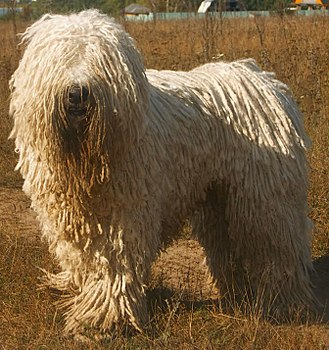
The Komondor is a cattle guard dog of Hungarian origin, unmistakable by its voluminous white coat formed by ropes reminiscent of raspberries or a mop. Hiding beneath that woolly breastplate is one of the largest, bravest, and most independent working dogs in existence. It’s not a race for everyone: The Komondor protects his own with absolute determination and needs an owner who knows how to live up to it.
Is the Komondor for you?
Before you fall in love with its mane, you should be honest: the Komondor is a guard dog with a very marked instinct, designed to live alongside a herd and make its own decisions. It fits with those who have space, experience and time, and collides head-on with life in a small apartment. These two boxes summarize what you gain and what you have to assume.
In favour .
- Exceptional guardian: protects his family, his territory and other animals in the house.
- Quiet and balanced in the day-to-day when there are no threats.
- Very attached to his people and affectionate, especially gentle with the children of the house.
- Corded coat that barely loosens hair once formed.
- A rustic breed, with few hereditary problems for its size.
To be taken into account
- Independent and stubborn: not a dog of blind obedience.
- He’s suspicious of strangers and animals that invade his territory.
- It is not suitable for floors; it needs space and, if possible, a garden.
- Rope maintenance takes time and patience.
- Their size and strength require serious socialization and training.
Character and temperament
The character of the Komondor is that of a manual livestock watchdog: serene and calm while everything is going well, and implacable when he perceives a threat. He spends much of the day observing calmly, almost indolently, but that tranquility is only apparent. At the slightest sign of danger he displays a courage that leads him to stand up to predators as large as a wolf or a bear.
It’s a dog bred for centuries to work alone, away from the shepherd, and that has shaped an independent mind that values, decides and acts on its own. Don ‘t expect a labrador or a golden to be willing to comply . The Komondor cooperates with those he respects, but always retains some measure of discretion. He is affectionate and loyal to his family, and he is often surprisingly gentle with the children in the household. With strangers he is reserved; he tolerates them when he sees that there are no bad intentions, but he never lets his guard down completely.
That combination of calm, courage and autonomy is just what makes it so effective as a guardian and, at the same time, so demanding as a pet.
Coexistence: children, other pets, flat and loneliness
- With children: is gentle and protective of the little ones in its family, but due to its size and its vigilant instinct, it is advisable to supervise play and teach children to respect their space.
- With other pets: usually gets along very well with the animals he rears with and often protects them as if they were his herd.
- On the floor: is not an apartment breed, it needs space, a perimeter to guard and, ideally, a house with terrain to patrol.
- In the face of loneliness: tolerates quiet activity and time alone better than many breeds, because it is used to working without constant human company.
- Day and night rhythm: tends to rest during the day, watching its surroundings, and activate at night, when patrolling its territory.
Education and training
Training a Komondor is an exercise in perseverance rather than strength. Due to its size, power and temperament, lack of education is not an aesthetic detail: an uncontrolled adult can pose a real risk. The good news is that it learns well when it starts early, ideally between four and eight months.
The keys are three. First, start early and socialize thoroughly: the puppy must know people, places, noises and other dogs so that as an adult he does not interpret every novelty as a threat. Second, short, positive, varied sessions, because the Komondor gets bored with repetition and, bored, becomes stubborn. Thirdly, consistency: The rules must always be the same and the corrections firm but fair. If you allow him to engage in hostile behavior once, he’ll hold it against you forever.
Forget unconditional submission. What we’re looking for is a reliable dog that trusts your judgment at key moments, not an automaton. Those who value millimeter obedience will find a Border Collie or a German Shepherd more comfortable; the Komondor asks for a patient guide who understands its guardian nature.
Exercise and activity
The Komondor is not an endurance athlete or a walking dog, but neither is it a couch with legs. In its original job it roams the terrain, watches and, when necessary, displays surprising power: it is able to move quickly and leap over a predator to scare it away.
All it needs are quiet daily walks and, above all, ample space to patrol its air. More than running miles, it needs a purpose: A perimeter to guard, an environment to monitor. The mental stimulation it provides in its guardian role is as valuable as physical exercise. It is not a good idea to force intense activity on him, especially as a puppy, while his joints are developing.
Care: fur and hygiene
The Komondor’s upkeep revolves almost entirely around its famous corduroy coat, and it is wise to understand this before adopting one. You can ‘t brush the ropes . Separate by hand. From the first year onward, the soft inner layer and the rougher outer layer begin to intertwine, and the owner’s task is to gradually divide that mass into strands so that it does not stick to a single felt plate. The adult coat takes about two years to fully form.
Once strung up, the Komondor barely lets loose its hair, surprising the first-time viewer. The bathroom, on the other hand, is an event: The ropes absorb a lot of water and the dog can take more than two days to dry completely, so you have to dry it thoroughly to avoid moisture and bad smell. Also pay attention to the hygiene of the mouth area and the posterior third, where the fur tends to get dirty, and check the skin under the shoelaces from time to time. Ears, teeth and nails follow the usual care of any large breed.
Foodstuffs
As a large dog, the Komondor needs a complete and balanced diet, adjusted to its weight, age, and activity level. The most important thing is not just what you eat, but how: Large, deep-chested breeds are prone to gastric torsion, a potentially life-threatening emergency. To reduce the risk, divide food into two servings instead of one, avoid cravings, and avoid associating meals with intense exercise.
In the puppy stage, too rapid growth can take its toll on developing joints, so a quality feed formulated for large breeds and not overfeeding is preferable. Watch your weight throughout your life: Excess weight puts a strain on hips that already support an imposing body. If you have any questions about the quantity or type of food, your veterinarian is the best guide.
Health and life expectancy
The Komondor is a rustic breed that, thanks to its long history as a working dog, carries few congenital problems. Its life expectancy is around 10 to 12 years, a reasonable figure for a dog of its size.
- Dysplasia of the hip: joint impairment common in large dogs; controlled with good breeding, adjusted weight and sensible exercise.
- Gastric torsion (dilatation-volvulus) is defined as: a vital urgency associated with deep-breasted breeds; handling meals helps prevent it.
- Skin care:‘s dense mantle can retain moisture and dirt, so hygiene is key to avoiding dermatological problems.
With regular veterinary checkups, weight control, and care of the coat, the Komondor is usually a healthy and hardy dog.
Physical appearance
The Komondor is simply one of the largest breeds in existence. Males start from about 70 cm at the withers and reach an average of 80 cm, being able to loosely exceed that mark, while females start around 65 cm. The weight accompanies at that height: about 50 to 60 kg in males and 40 to 50 kg in females. The standard does not set an upper limit on height, a rarity that gives an idea of the animal’s imposing presence.
Under the mantle is a robust, muscular dog, with a slightly longer than tall body, short back and strong limbs. The head is broad, with the snout somewhat shorter than half the skull, and both the nose and lips are always black. But what defines the Komondor is, of course, his fur: long, dense and corded, exclusively white in colour, hanging on ropes resembling raspberries. It is considered the heaviest coat in the canine world, with cords that can measure from 8 to 10 inches [20 to 27 cm]. Unlike the Puli, which looks similar but supports various colors, the Komondor is born and remains white.
Origin and history
The Komondor is a deeply Hungarian dog, but its roots come from farther east. The breed came to Hungary from the Cumans, a Turkic-speaking nomadic people who settled in the country during the 12th and 13th centuries fleeing the Mongol advance. In fact, its name derives from the idea of “Cuman dog”, and remains of these dogs have been found in ancient Cuman tombs. The breed is believed to be descended from Asian dogs brought with those migrations.
The first written mention of the Komondor dates from 1544, and over the centuries it was linked to the guarding of large herds on the Hungarian plain, where its white fur allowed it to camouflage itself among the sheep and surprise predators. It is important not to confuse it with the Kuvasz, Hungary’s other great white guardian: They both evolved separately, raised by different peoples — the Cumans and the Magyars — who for a long time lived in different areas, so they hardly mixed.
Recent history has not been kind to race: Many Komondor died during World War II defending the farms they guarded. Today it has recovered, is still relatively common in your country and has been declared one of Hungary’s national treasures, protected from any modification. It is related to other sheepdogs of particular coat, such as the Puli, the Pumi or the Bearded Collie.
Curiosities
- In English it is nicknamed mop dog, “scrubby dog”, for its obvious resemblance to a mop.
- The cover of Beck’s Odelay(1996) album is a photograph of a Komondor jumping a fence.
- Their coat serves as armor, traditionally protecting the dog from the bites of wolves, who are unable to get through such a tangle.
- After a bath, a Komondor can take more than two days to dry completely.
- Romania is the only country that requires Komondors to wear muzzles in public places.
- Hungarian breeders used to say that an intruder might be able to get into a Komondor’s mansion, but he wouldn’t be allowed out.
If you’re drawn to the world of large shepherd and guard dogs, you’ll be interested in comparing the Komondor to other breeds in its same family and function: its fellow countryman the Kuvasz, the also Hungarian and corduroy Puli, the imposing mountain guard Gran Pirineo, and the woolly Antiguo Pastor Inglés.
Frequently Asked Questions About the Komondor
Is the Komondor a good family dog?
He’s affectionate and loyal to his family and especially gentle with the children in the household, but his guardian instinct, his size and independent character demands owners with space and experience, he’s not a pet for just any home.
Do you have to brush his corduroy coat?
The adult coat takes about two years to form, and once strung, the dog barely sheds hair.
How long does a Komondor live?
With proper nutrition, weight control, and veterinary checkups, it is usually a healthy and resilient breed.
How tall and how much does a Komondor weigh?
Males start from about 70 cm at the withers and are around 80 cm in average, and females from about 65 cm. The weight ranges from 50 to 60 kg in males and from 40 to 50 kg in females, making it one of the largest breeds that exist.
Is it good enough to live in a flat?
It is not advisable. The Komondor needs space and a territory to guard; the ideal is a house with land. In an apartment it feels out of place and its guardian instinct is difficult to manage.
Do you get along with other animals?
He usually gets along very well with the animals he keeps and even protects them as his flock, but he is intolerant of strangers who enter his territory, whom he perceives as intruders.
Is it hard to train?
It is intelligent but independent and stubborn. It learns well if started early (between 4 and 8 months), with short, positive and consistent sessions, and intense socialization. Do not look for blind obedience: look for a reliable dog that trusts your judgment.
Where did the Komondor originate from?
It is a Hungarian breed, although its origins go back to the dogs that the Cuman people brought to Hungary in the 12th and 13th centuries.