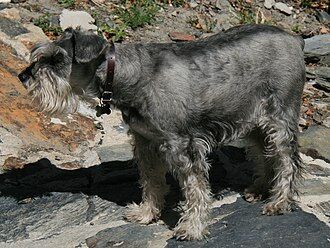
The Schnauzer Estándar is the middle and original version of the three varieties of schnauzer, a robust German dog with a square build and unmistakable beard. Intelligent, loyal and vigilant, he was born as a guardian and scavenger on the farms of southern Germany and today shines as an all-terrain family companion. If you’re looking for a dog of manageable size, character and very little muff, the Standard Schnauzer deserves a spot on your list.
Is the Schnauzer standard for you?
Before you fall in love with that beard, you should look at the breed honestly. The Standard Schnauzer is a working dog with a head, energy and character: it gives a lot, but it asks for involvement in return. These are its lights and its shadows.
In favour .
- Very manageable medium size, neither big nor small.
- Barely loose hair – ideal for someone who hates baldness.
- Remarkable intelligence and enormous eagerness to learn.
- Natural guardian, brave and always on the lookout.
- Very healthy and long-lived for his size.
- Loyal and affectionate, he’s fully integrated into the family.
To be taken into account
- He needs daily exercise and plenty of mental stimulation.
- He has a tendency to bark to warn us: he must be educated.
- Stubborn and independent when he’s bored.
- Wire hair requires stripping or hairdressing.
- Hunting instinct for rodents and small animals.
- He doesn’t like prolonged loneliness.
Character and temperament
The temperament of the Standard Schnauzer is its best introduction card. We’re talking about a dog that’s balanced, awake and has a bomb-proof loyalty. He is considered loyal, affectionate and very close to his family, to the point of following you from room to room so as not to miss anything. This need to be present makes him an excellent companion, but it also explains why he is unhappy if left alone for too many hours.
He’s a watchdog and somewhat jealous of his own, with a highly developed guarding instinct inherited from his past on the farms. Be suspicious of strangers without falling into gratuitous aggression: It warns, observes and, once it is sure that there is no danger, relaxes. That combination of courage and common sense is just what was asked of him when he guarded stables and carriages. At the same time, he is playful, expressive and with a clownish point that surprises those who only see his serious appearance.
Intelligence is another constant. The Standard Schnauzer quickly understands what you want, anticipates routines and solves problems on its own; a double-edged sword if you don’t give it work. It also stands out for its sensitivity: it reads people’s moods very well, which makes it especially useful as a companion for adults and children.
Coexistence: children, other pets, flat and loneliness

Adapting to family life is one of its strengths, provided you understand how it works in each scenario:
- With children: is patient, robust and playful, a good playmate. It is advisable to always monitor the contact with the little ones and teach them to respect the dog when eating or resting.
- With other dogs: has been well socialized since puppyhood, coexisting without major problems.
- With other pets: here weighs its origin as a mouse hunter. It can activate the hunting instinct in front of unknown rodents, birds or cats; with a joint upbringing from a young age it usually learns to live together.
- On the floor:‘s medium size and cleanliness make it suitable for apartment living, provided it gets out to expend energy and manages its tendency to bark as a warning.
- In the face of loneliness: is the most delicate point. It is an intense companion dog that does not like to be left alone for long hours; boredom and anxiety can lead to barking or wrecking.
Education and training
Few medium breeds respond as well to training as this, as long as you respect their way of being. The Standard Schnauzer is very intelligent and eager to please, which translates into a quick learner when sessions are short, varied and fun. The key is in positive reinforcement: prizes, play and a gentle voice accomplish much more than imposition, which only awakens his stubborn vein.
Early socialization is non-negotiable. Exposing the puppy to people, dogs, noise and different environments as a puppy models a safe adult and prevents his guarding instinct from leading to excessive distrust.
Because it is smart and bored with repetition, it appreciates challenges: advanced obedience, olfactory games, agility or any canine sport that combines head and body. A Schnauzer with a job to do is a happy and easy dog to get along with; one without stimulation becomes insistent and mischievous.
Exercise and activity

We’re dealing with a medium-high energy utility dog, not a couch potato. It needs about one or two hours of activity a day, spread out between walks, runs, and, very importantly, interactive play. It’s not just physical exercise: its mind takes as much work as its legs.
He loves to have a mission. Games of searching, tracking, throwing the ball, obedience sessions or agility circuits cover both the physical and mental part. His past as a mouse hunter and farm dog makes him tireless when the plan interests him, and he enjoys excursions, hiking and any outdoor activity with his family.
If you live in a city, plan several outings a day and spend time at home playing mind games. A well-trained Standard Schnauzer is quiet at home; when it lacks spending, you’ll notice it in the form of barking, restlessness, and mischief.
Care: fur and hygiene
The Standard Schnauzer’s coat is hard, rough and dense, wire-like, with a soft undercoat underneath. It is a hair that hardly changes, which keeps the house very clean, but which in turn requires specific maintenance. The traditional technique is the stripping or manual pulling of dead hair, which retains the rough texture and color; many owners opt for machine hairdressing, more comfortable although the mantle softens somewhat.
Regular brushing, a couple of times a week, avoids knots, especially in the beard, eyebrows, and groin, the longest hair areas. This characteristic beard gets dirty with food and water, so it is good to clean it often. Complete the routine with ear care, nail trimming, and regular dental hygiene. A visit to the canine salon every month or two is usually enough to keep it spotless.
Foodstuffs
As a medium, active and muscular dog, the Standard Schnauzer needs a complete and balanced diet, adjusted to its age, weight and activity level.
Divide the daily ration into two servings to promote digestion and monitor quantities: Although it is a robust dog, the excess weight punishes its joints and shortens its life. Always measure portions, moderate prizes during training, and have fresh water always available. If you have any questions about a particular diet, quantities or feed changes, your veterinarian is the best reference.
Health and life expectancy
The Standard Schnauzer has a well-deserved reputation as a strong and healthy dog. Its average life expectancy is around 13 years, slightly above the average of all breeds, and with good care it is not uncommon for it to reach 14 to 16 years in full form.
Maintaining good health depends above all on prevention: regular veterinary checks, daily vaccination and deworming, weight control, dental hygiene and regular exercise. If you’re going to get a puppy, take it to responsible breeders who test the breeders for health and prioritize balance and temperament over aesthetics. Constant veterinary monitoring throughout their life is the best investment in their companion years.
Physical appearance
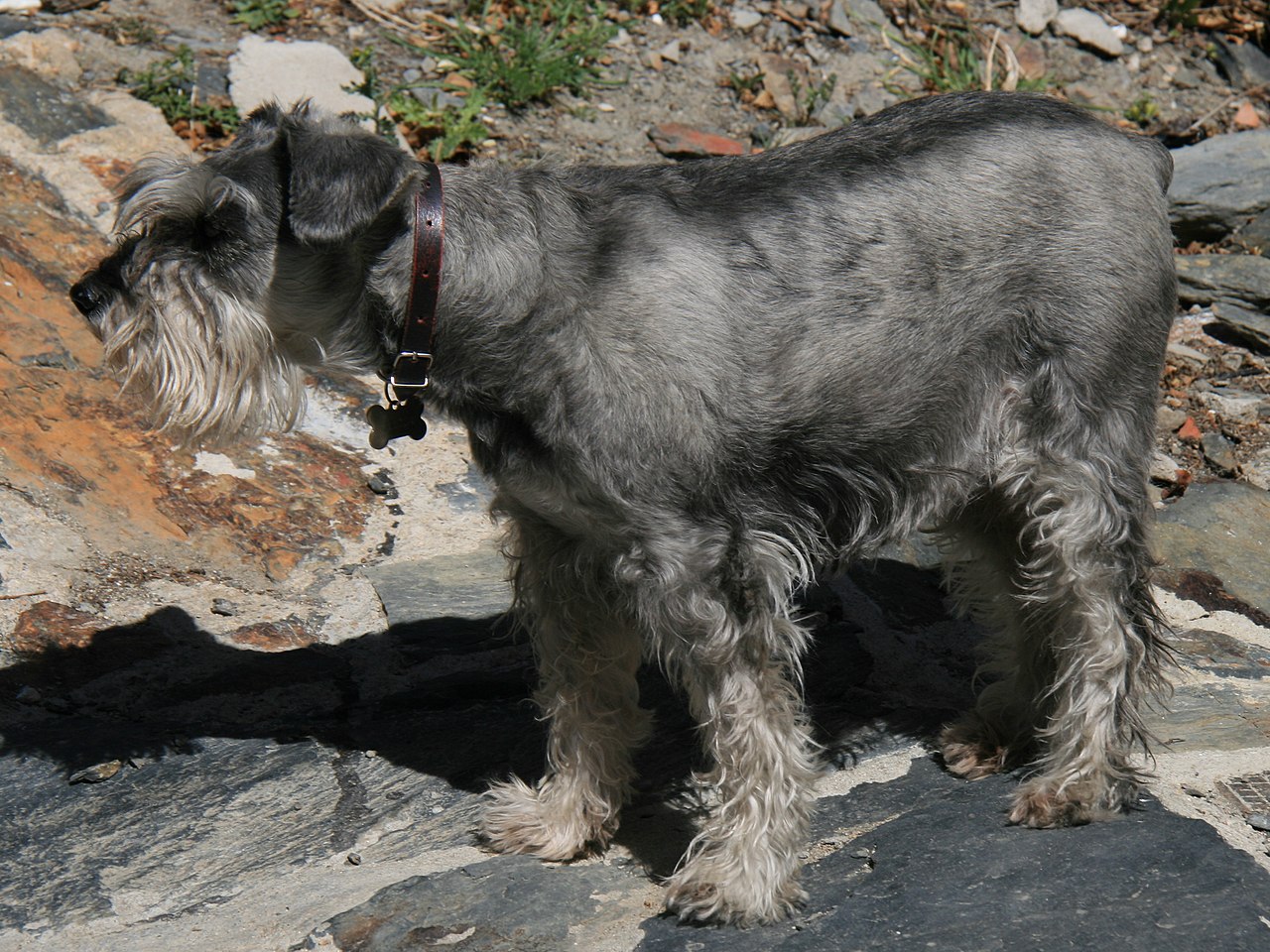
The Standard Schnauzer is a medium-sized, robust dog with a markedly square silhouette: its height at the withers is practically equal to the length of its body.
His most recognizable feature is his face: The hair grows long on the snout to form a plump beard and crowded eyebrows that give it that serious, expressive gesture so characteristic. The mantle is hard and rough, and comes in two accepted colors, the classic salt and pepper (from silver gray to iron gray, always with a darker mask) and solid black. The ears are ⁇ v ⁇ -shaped, implant high and fall attached to the face; the eyes are dark, and the nose and lips, black. Historically, ears and tail were cut off, but in much of Europe and Australia this practice is banned and dogs display their natural ears and tail.
Origin and history
The Standard Schnauzer is the oldest of the three schnauzer breeds and originates from southern Germany, where it shares roots with the German Pinscher. Dogs of this type were bred on farms, both hard-haired and smooth-haired, which could appear even in the same litter; they were used as stable and carriage dogs and, above all, as rat hunters. The hard-haired variety, then known as the Rattler, would eventually give rise to the schnauzer.
The name has a curious history. At the Hanover International Exhibition of 1879, a dog presented in the hard-haired Pinscher class was named ⁇ Schnauzer ⁇ – from German Schnauze, ⁇ hocico ⁇ – and won its category; from there the term ended up designating the entire breed. The first standard was set around 1880 and, in 1917, the official name of the hard-haired breed changed from ⁇ Hard-haired Pinscher ⁇ to Schnauzer. In its country it is known as Mittelschnauzer(medium Schnauzer), to distinguish it from the Giant and the Miniature.
The breed was definitively recognized by the International Cinological Federation (FCI) in 1955 and falls into Group 2 (Pinscher and Schnauzer, Molosoids and Swiss Boyars). Despite its historical prestige, today it is a minority race: In Germany, the salt and pepper variety has been on the list of endangered native breeds for years. Despite its coat and appearance, the Schnauzer is not descended from English terriers, a common confusion because of its silhouette.
Curiosities
- The Standard Schnauzer is the ⁇ medium ⁇ of a family of three: the Giant (Riesenschnauzer), the Standard (Mittelschnauzer) and the Miniature (Zwergschnauzer).
- Its name means, literally, ⁇ hocico ⁇ or ⁇ morro ⁇ in German, alluding to its prominent beard.
- Despite its terrier air, it is not related to English terriers: it shares a lineage with the German Pinscher.
- A Standard Schnauzer went on to win the ⁇ Best in Show ⁇ of the prestigious American Westminster Kennel Club in 1997.
- It is often said that schnauzer-type dogs appear in the works of great masters such as Dürer and Rembrandt, a sign of how ancient this type of dog is.
- Their low hair loss often places them among the breeds best tolerated by allergy sufferers.
Related breeds
If you are attracted to the Standard Schnauzer, you will be interested in knowing its closest relatives. The large and all-terrain option is the Schnauzer Gigante, while the compact and very popular version is the Schnauzer Miniatura. Within the same German family is the agile Pinscher Alemán, with which it shares origin, and the friendly Affenpinscher, another member of the pinscher and schnauzer group.
Frequently Asked Questions about the Standard Schnauzer
Is the Standard Schnauzer a good dog for families with children?
Yes. It is a balanced, robust dog and very attached to its people, patient and playful with the children of the house. As with any breed, it is advisable to monitor the contact with small children and teach them to respect the spaces of rest of the dog.
Does the Standard Schnauzer shed a lot of hair?
Their wire hair barely falls off and is maintained by periodic stripping or hairdressing, not with the seasonal moult typical of other breeds.
How much exercise does a Standard Schnauzer need?
Enough. It’s a medium-high-energy working dog: it needs about one or two hours a day divided between walks, play and, above all, mental stimulation. A bored Schnauzer seeks entertainment on its own, and you will rarely like the one it chooses.
Is it easy to educate?
Yes, it’s very intelligent and eager to please, so it learns fast. It needs consistency, clear boundaries and positive reinforcement. It has an independent and stubborn point, so short, varied and fun sessions work much better than monotonous repetition.
Can he live in a flat?
Yes, as long as you meet his needs for exercise and companionship, he adapts well to apartment life, but he’s a born guardian and warns by barking, so it’s best to work from puppyhood on barking control for good neighborly coexistence.
How long does a Standard Schnauzer live?
With proper nutrition, exercise, and veterinary care, many specimens reach 14 to 16 years of age in good shape.
Do you get along with other dogs and pets?
It is well socialized, coexists without problems with other dogs and with the family. It is advisable to remember its past as a mouse hunter: it can show hunting instinct towards rodents and very small animals, so presentations should be done calmly and supervised.
Is the Standard Schnauzer a guard dog?
By nature, yes. It is territorial, attentive and suspicious of strangers without becoming aggressive. It warns of anything new and shows courage, which makes it an excellent alarm dog and protective companion for the family.