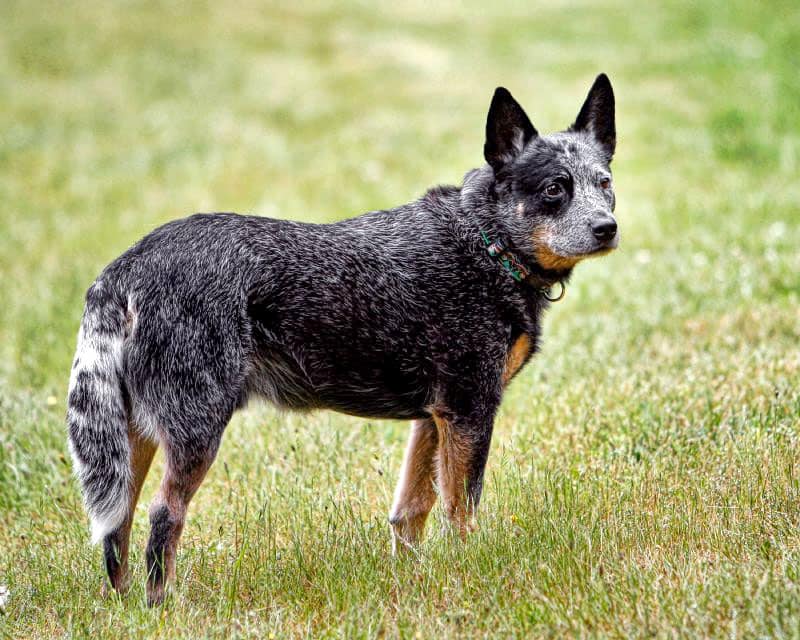
The Pastor Ganadero Australiano(Australian Cattle Dog, also known as the Australian Boyer or the blue heeler) is one of the most resistant, intelligent and energetic working dogs in existence. Born to herd wild cattle across Australia’s vast plains, the dingo blends the hardiness of the European herding breed with the reliability of the European. It’s not a dog for just anyone: It needs an active owner, patience and a job to do. In return, it gives you back an almost obsessive loyalty and a learning capacity hard to match.
Is the Australian Cattle Shepherd for you?
Before you fall in love with their wakeful gaze and mottled coat, be honest: the Australian Cattle Shepherd is a strategic-minded athlete. He shines with sporty owners, ranchers or dog sports enthusiasts, and becomes frustrated (and destructive) in sedentary homes.
In favour .
- High intelligence and tremendous ease of learning.
- Almost inexhaustible physical endurance: the ideal companion for running, hiking or agility.
- Extreme loyalty, very strong ties to his family.
- Excellent guard dog, alert and courageous.
- Very low-maintenance fur, healthy and long-lived.
- Versatile: herding, rescue, detection, canine sports
Against
- He needs a lot of exercise and mental stimulation every day.
- If he gets bored, he digs, chews and destroys without mercy.
- Instinct to nibble on heels: It can harass running children.
- Distrustful of strangers; requires early socialization.
- Stubborn and independent; not for passive first-time owners.
- It can be dominant with other dogs of the same sex.
Character and temperament

If we had to describe the Australian Shepherd with three words, it would be intelligent, tireless and independent. It ranks tenth in Stanley Coren’s famous canine intelligence ranking, which means it understands new commands with very few repetitions. But that privileged head has a flip side: if you don’t give it a job, it will invent one, and you rarely like the outcome.
He’s a dog deeply attached to his people. He usually chooses a reference person and follows him everywhere – hence the affectionate nickname “velcro dog”. With his family he is affectionate, playful and surprisingly sensitive: It captures the mood of its owner and reacts to it. With strangers, however, he is reserved and cautious, a direct inheritance of his guardian side. That combination of inner devotion and outer distrust makes him an excellent alarm dog.
It keeps its herding instinct intact by its heels: it was bred to move stubborn cattle by nibbling at their hooves, and that impulse can surface with people running, bicycles, or noisy children. It is not aggression, it is work; but it must be channeled from a puppy. It generally works silently and only barks to warn or draw attention.
Coexistence: children, other pets, flat and loneliness
The Australian boyar can be a wonderful family companion, but his fit in the home depends a lot on how he manages his energy and his instincts.
- With children: is good with older, respectful children, but tends to “catch” the little ones who run and scream by biting their heels.
- With other dogs: tolerates dogs that it already knows well, but it is not a pack dog.
- With other pets: their strong chase instinct forces gradual introductions with cats or small animals; they get along better if they grow together.
- On the floor: can live in an apartment as long as his exercise needs are met.
- In the face of loneliness: is one of his weaknesses, isolated in a yard or alone for many hours, he gets bored, frustrated and becomes destructive, he needs to be part of family life.
Education and training
Training an Australian Shepherd is both a pleasure and a challenge. It’s bidable(cooperative) and learns at an astonishing rate when training is varied, structured and motivating. Positive reinforcement is the absolute key. These dogs don’t respond well to coercive methods. In fact, they were bred to bite when treated harshly, so physical punishment is counterproductive and dangerous.
Trainers who know them describe them as one of the most adaptable breeds you can work with. Those who apply old-fashioned strap-pulling techniques, on the other hand, pronounce them stubborn and irritable. The difference is not in the dog, but in the method. The tail says it all: a dropped tail betrays a repressed or bored dog; a high tail, an attentive and happy one.
Training priorities: intensive socialization from puppyhood, controlling the urge to nibble on heels, a good call, and, above all, mental exercises that channel their intelligence.
Exercise and activity

Here is the heart of the breed. The Australian Shepherd was designed to travel enormous distances herding cattle under the scorching sun of Australia, and that machinery is still intact. A quiet walk around the neighborhood feels good, but it’s not far enough: it needs structured activity that involves your body and mind.
We’re talking about a minimum of one to two hours a day of intense exercise: running, swimming, throwing the ball, long walks, or ideally, a dog sport. Agility, flyball, obedience, olfactory games and, of course, herding tests are their paradise. It’s actually one of the best dogs in the world for guiding cattle reluctant to move across long distances.
The golden rule: a tired Australian Shepherd is a good Australian Shepherd. When he’s not burning his energy, he spends it digging holes in the garden, redecorating your furniture or looking for a way out on the street. Mental stimulation counts as much as physics; learning new tricks drains him as much as running.
Care: fur and hygiene
Good news for those who hate maintenance: the Australian boyer is what in English they call a “wash and wear” dog, to wash and ready. Its coat is short, straight and double, with a dense inner layer and a hard, waterproof outer one that protects it from rain and weeds. It does not require hairdressing or complicated care.
It does not shed hair constantly throughout the year, but “changes its coat” suddenly once a year (twice in the case of whole females). During these molting weeks, thorough brushing is recommended several times a week to remove dead hair; the rest of the year, a weekly brushing is more than sufficient. Bathe only when it is really dirty, check and clean your ears regularly, trim your nails when they hit the floor, and maintain good dental hygiene.
Foodstuffs
As a muscular and very active working dog, the Australian Shepherd needs a quality diet, rich in animal protein and adjusted to its very high energy expenditure. The exact amount depends on its age, weight (between 18 and 26 kg) and, above all, the actual activity level: a working or competing specimen burns much more than a companion.
Divide the ration into two meals a day to keep your energy stable and reduce the risk of digestive problems. Watch the weight: Although it is an athletic breed and rarely prone to obesity if it exercises, a sedentary and overfed dog will suffer in its joints. Always have fresh water available, especially after strenuous exercise, and avoid exercising right after eating. If you have any questions about rations or feed, consult your veterinarian.
Health and life expectancy
The Australian Cattle Shepherd is a remarkably long-lived and robust breed. A British study from 2024 attributed a half-life of 14 years old to it, above the average of purebred dogs (12.7) and half-breeds (12).
Nevertheless, it carries some hereditary predispositions that should be known and screened by testing the breeders:
- Congenital deafness: linked to the spotted (piebald) genes that give the white coat. In an Australian study, about 10.8% had deafness in one or both ears.
- Patients who are at risk of retinal deterioration (PRA/PRCD): degeneration of the retina that causes progressive blindness in adulthood; it is recessive in heredity.
- Dysplasia of the hip: is uncommon, but there is enough to recommend screening X-rays.
- Musculoskeletal problems such as: with age can appear spondylosis, osteoarthritis or cruciate ligament ruptures, frequent because of their active life.
Acquiring it from a responsible breeder who performs genetic testing for deafness and RA is the best guarantee of a healthy puppy.
Physical appearance

The Australian boyer is a medium-sized, compact, muscular and perfectly balanced dog, with a silhouette that deliberately recalls that of the dingo. The standard prioritizes moderation: neither too large and heavy, nor too small and thin.
The males measure between 46 and 51 cm is crossed and weighs 20 to 26 kg; the females, between 43 and 48 cm and 18 to 26 kg. The head is strong and proportionate, with a broad skull, small or medium ears, erect and separate, and dark brown oval eyes that radiate alertness and intelligence.
Its hallmark is the mottled coat, which comes in two varieties: blue(the classic “blue heeler”, with bluish, black or tan base and possible fire marks) and red(“red heeler”, with uniform red spotted throughout the body). Interestingly, the cubs are born almost white – a heritage of the Dalmatian – and develop their final color from two to three weeks of age. The tail, of good plumage, hangs slightly curved at rest and rises when the dog is activated.
Origin and history
The history of the Australian Shepherd, unlike that of many breeds, is wonderfully documented because it is relatively recent. In the early 19th century, Australian cattle ranching expanded over vast plains and cattle became semi-wild. The British herding dogs of that time – the Smithfield collie type – could not stand the heat, the distance, or the harshness of those cattle, and they tended to bark and bite excessively.
The solution came by crossing these dogs with the the dingo, the native canine perfectly adapted to the climate, silent and tireless. From those experiments, begun by breeders such as Thomas Simpson Hall, James Timmins and George Eliot around 1830-1840, a resistant and discreet working dog emerged. Later, other blood was added: the dalmatian, for the dog to work comfortably among horses and reinforce its loyalty (and hence the white puppies at birth), and the the kelpie, which brought the fire-colored markings and honed its shepherding prowess.
The result was an active, compact, and colorfully unique dog in the world, combining the cautiousness of the dingo, the reliability of the dalmatian, and the skill of the collie and kelpie. In the late 19th century, journalist and amateur Robert Kaleski pushed the breed and drafted a standard that was accepted in 1903. Since then it has been exported all over the world thanks to its reputation as a working dog. He ended up being known by a collection of nicknames: blue ., blue dog, heeler, Queensland heeler, the blue heeler and red heeler.
Curiosities
- The oldest dog in history was an Australian boyer.“Bluey”, an Australian Cattle Shepherd, held the Guinness record for canine longevity for decades: he lived for over 29 years working on a farm in the state of Victoria.
- He’s got dingo blood on him. is one of the few modern breeds that deliberately incorporates the Australian wild canine in its genetics.
- They’re born white. Like the Dalmatian pups, the Australian boyer comes into the world with almost no pigment and turns blue or red over the course of weeks.
- A television star. The popular children’s series Bluey stars a family of Australian Cattle Shepherds, which has skyrocketed awareness of the breed worldwide.
- Heels by design. Its grazing technique consists of nibbling on the corvejones (heels) of the cattle and bending over to dodge the ticks; hence the nickname “heeler”.
- Top 10 in intelligence. is among the ten most intelligent breeds according to Stanley Coren’s ranking of obedience and work.
If you are attracted to the Australian Shepherd’s industrious and intelligent nature, you may be interested in other herding and herding breeds with which it shares energy and skills. Check out the spectacular Pastor Australiano, the tireless Border Collie– considered the world’s smartest dog – the charismatic Welsh Corgi Pembroke, another small, big boyer, and the versatile Pastor Alemán, the world’s leading working dog.
Frequently Asked Questions About the Australian Cattle Shepherd
Is the Australian Shepherd a good dog for beginners?
It is not the best choice for passive first-time owners. Its intelligence, energy and independence require experienced driving, plenty of exercise and constant training. For an active, committed and willing to learn person, it can be an extraordinary companion.
How much exercise do you need a day?
At least one to two hours a day of intense activity, combining physical exercise (running, swimming, long walks) with mental stimulation (olfactory games, tricks, dog sports).
Can he live in a flat?
Yes, as long as their needs for exercise and companionship are met. The problem is never space, but the time and activity you devote to it. A well-exercised Australian boyer can rest easy in an apartment.
Do you get along with children and other dogs?
It is good with older and respectful children, but tends to “catch on” by biting the heels of running children, so it needs socialization and supervision.
Do you lose a lot of hair?
It is a very low-maintenance dog that “changes its coat” suddenly once a year (twice in whole females).
Why are puppies born white?
It is a heritage of the Dalmatian, which was used in the creation of the breed. The puppies are born almost without pigment and develop their definitive blue or red color from two to three weeks of age.
How long does an Australian Shepherd live?
It is a long-lived breed: the average age is 12-16 years, with a British study from 2024 placing it at 14 years on average.
Why is he biting his heels?
Because that’s exactly what it was bred to do: move stubborn cattle by biting their hooves and bending over to avoid being kicked. It’s a work instinct, not aggression, but you have to channel it from a puppy so it doesn’t bully people or children.