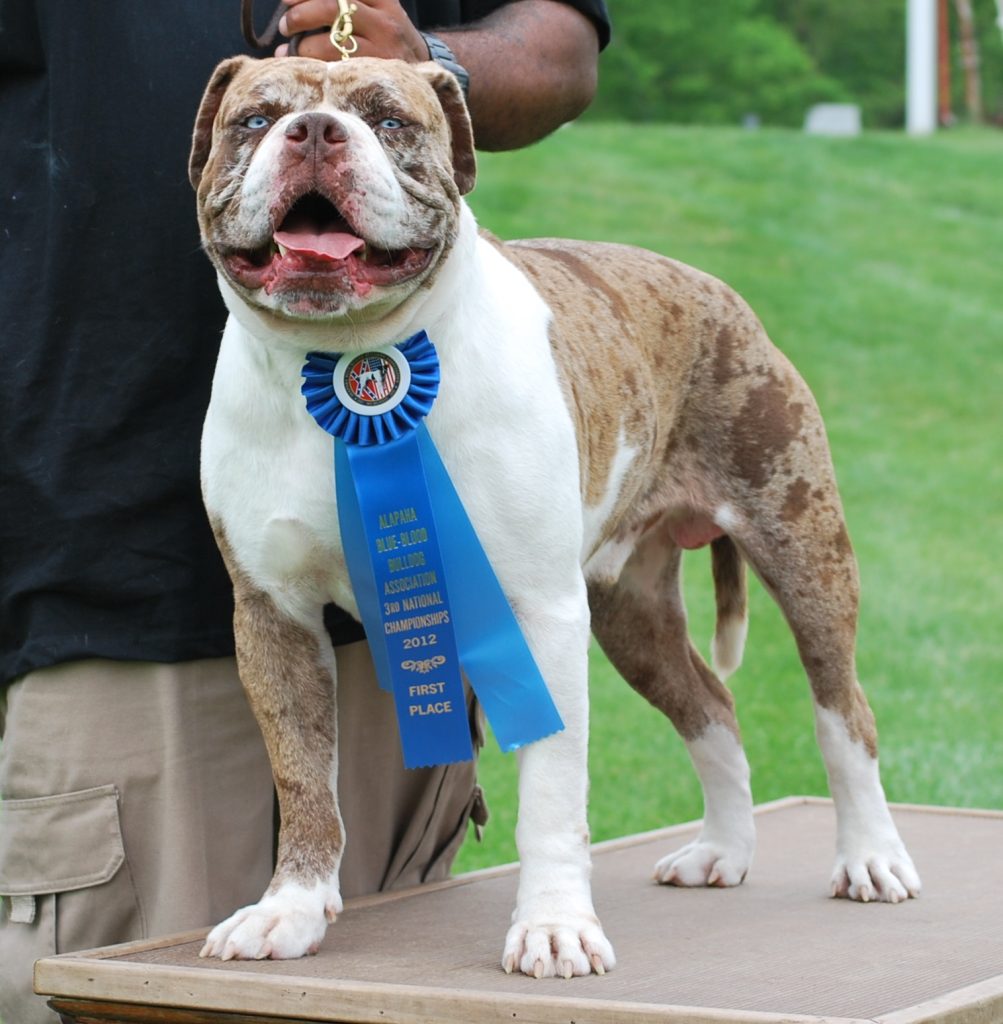
The Alapaha Blue Blood Bulldog is one of the rarest and most unknown bulldogs in the world: A muscular, imposing-looking American guard dog bred for generations in South Georgia to protect home, family and livestock. If you are looking for a molosoid of character, loyal to the bone and very different from the couch bulldog, this fact sheet tells you, with verified data, everything you should know before falling in love with him.
Is the Alapaha Blue Blood Bulldog for you?

The Alapaha Blue Blood Bulldog is not a dog for everyone, and that’s just the first thing to say. We are dealing with a large, strong, territorial keeper, who does his best in the hands of people with experience in dogs of character, with time to socialize and educate him, and with an environment where he can act as a protector without becoming a problem. In return, he offers enormous loyalty and a deep bond to his family.
Before you go any further, honestly evaluate if you fit his profile.
In favour .
- Born guardian: protective, brave and very attached to his family.
- Short coat, easy to maintain.
- More athletic and functional than many end-nosed bulldogs.
- Intelligent and eager to please those he respects.
- Impressive and deterrent without needing to be aggressive.
Against
- Very rare breed and hard to get outside the U.S.
- Strong territorial instinct: It requires serious socialization.
- Its strength and size call for a firm and experienced owner.
- Brachycephalic: sensitive to heat and overstrain.
- It’s not recognized by the FCI or the AKC.
Character and temperament
The temperament of the Alapaha Blue Blood Bulldog is best understood from its function: For generations it was bred as a guard and protection dog. Hence its most defining trait, a highly developed protective and territorial instinct. With his own, he is affectionate, loyal, and surprisingly sensitive; with strangers, he is reserved and vigilant, always alert to what is happening in his territory.
He’s a self-assured dog with a strong will and a good dose of character. He ‘s not a lethargic molosoid . observe, calculate and decide. That intelligence, combined with his determination, makes him a fascinating companion for someone who knows how to channel it, but it also means he’s not forgiving of lack of leadership. He needs a consistent, calm and fair reference figure who sets clear boundaries without resorting to harshness.
Because of its rarity, it is advisable to avoid grandiloquent descriptions: each specimen is an individual and its balance will depend both on its breeding line and on the socialization and education it receives.
Coexistence: children, other pets, flat and loneliness

With children. is usually protective and patient with the children of his own family, especially if he has grown up with them. Nevertheless, his strength and size force him to always supervise the play with the little ones and to teach children to respect the spaces and rest of the dog.
With other pets. Coexistence with other animals is possible, but it depends a lot on early socialization and the individual himself.
Flat and lonely. is not the ideal dog for a small flat: it appreciates a home with space and, above all, an environment where it can feel in charge. It does not tolerate prolonged loneliness, because it is very dependent on its family; it is a bored Alapaha and can only develop undesirable behaviors. It needs to be part of the daily life of the house, not live isolated in a yard.
Education and training
The education of an Alapaha Blue Blood Bulldog begins before it reaches home: choosing a good breeding line and a well-bred puppy is already half the task. From there, the two priorities are socializing and serene leadership. Exposing it to people, noises, environments and other animals from a young age, always in a positive way, is what will make the difference between a balanced watchdog and a reactive dog.
It responds well to positive reinforcement and consistency. It is intelligent and wants to please those it respects, but its independent nature makes it punish incoherence: if one day you allow it something and the next you don’t, you will lose authority. Clear rules, routines and short, motivating sessions work much better than confrontation or harshness, which only get a suspicious dog.
If you are a first-time keeper, rely from the outset on a trainer who has experience with guard breeds.
Exercise and activity
The Alapaha is more athletic than the typical end-nosed bulldog, but it is still a brachycephalic dog and that conditions its exercise. It needs moderate daily activity – walks, play, exploration – to stay fit and mentally satisfied, without ever falling into overstrain.
Heat is its great enemy: with high temperatures you have to slow down, look for cool hours and always bring water. A heat stroke on a short-snouted dog is a serious urgency. Beyond physical exercise, this dog enjoys and balances with mental work: olfactory games, obedience and tasks that give him a job fit perfectly with his guardian mentality.
Care: fur and hygiene
In terms of maintenance, the Alapaha Blue Blood Bulldog is grateful. Its coat is short and smooth, so a weekly brushing is enough to remove the dead hair and distribute the natural fat of the skin; in moulting season you can brush it more often. It does not need frequent baths: only when it is really dirty, with a specific shampoo for dogs.

As a good bulldog, he pays attention to his facial folds if they are marked: they must be kept clean and dry to avoid irritation and dermatitis. He completes hygiene with a regular check of the ears, cutting nails when necessary and a good dental routine, which in brachycephalic breeds is especially important.
Foodstuffs
As a large, muscular dog, the Alapaha needs a quality diet tailored to its age, weight, and activity level. A complete and balanced diet, or a well-formulated diet with veterinary advice, should provide the protein and energy that your athletic build demands without overdoing it, because excess weight punishes the joints and aggravates any breathing difficulties typical of a brachycephalic.
Splitting the ration into two daily servings, controlling the quantities and monitoring the weight on a regular basis are simple habits that make a difference in the long run. As with all deep-breasted and large-sized dogs, it is advisable to avoid intense exercise just before and after eating.
Health and life expectancy
The health of the Alapaha Blue Blood Bulldog is closely linked to its condition as a rare breed and brachycephalic bulldog. On the one hand, its somewhat less extreme nose than that of the English Bulldog usually gives it somewhat better respiratory functionality; on the other hand, it is still a short-snouted dog, sensitive to heat and stress, in which the respiratory tract must be monitored.
As with other breeds with a reduced genetic base, responsible breeding is essential to minimize hereditary problems. It is advisable to choose breeders who work on the health of their lines and monitor the typical points of molosoids and brachycephalic: breathing, skin and folds, eyes and joints. According to breed associations, their life expectancy is usually around 12 to 15 years, a remarkable figure for a dog of this size. Regular veterinary checkups and proper weight are the best investment in their longevity.
Physical appearance
The Alapaha Blue Blood Bulldog is a muscular and compact bulldog, with a powerful and athletic appearance. It is noted for its large, broad head, with a brachycephalic (short) snout, although usually less exaggerated than that of other bulldogs.
In terms of measurements, it reaches about 51 to 64 cm at the cross and a weight of between 23 and 41 kg. One of its peculiarities is the marked sexual dimorphism: The males are usually much larger, weighing almost twice as much as the females. The coat is short and the characteristic coat is usually white with black, blue (merle), lions or brown spots; it is not uncommon to see very showy merle patterns and even blue eyes.
Origin and history
The Alapaha Blue Blood Bulldog is believed to be descended from the Old English Bulldogs(old English bulldogs) that arrived in America in the 18th century. These dogs were first used in the cruel “blood sports” of the bull baiting and the bear baiting and, later, as cattle and pig management dogs.
For several generations, the breed was bred almost exclusively by the Lane family in Rebecca, Georgia. It was they who ended up establishing a breed registry around a dog named Otto, the founding specimen of their breeding program; hence ⁇ Otto ⁇ has sometimes been used as a nickname for the entire breed. At the beginning of the 21st century, the estimated population was just 120 to 150, which gives some idea of the extent to which it is a jealously preserved minority breed.
Curiosities
- A nickname with a proper name. The breed is sometimes known simply as ⁇ Otto ⁇ , after the founding dog of the Lane family lineage.
- Why “blue blood”? The ⁇ Blue Blood ⁇ evokes both the bluish tones of some merle layers (sometimes with blue eyes) and the idea of a pure lineage, a strain cared for for generations.
- Very different males and females. Its pronounced sexual dimorphism causes a male to weigh almost twice as much as a female of the same breed.
- Tail is intact. Unlike other bulldog-like breeds, its tail remains intact, without amputation.
- It’s extremely rare. With just over a hundred specimens estimated at the beginning of the 21st century, it is one of the rarest bulldog breeds in existence.
If you are attracted to this guardian molosoid, you may want to compare its profile with that of other bulldog and guard dog breeds before deciding. Take a look at Bulldog Inglés, its distant relative; the energetic Bóxer; the towering Cane Corso; and the colossal Mastín Inglés, another large molosoid root guardian.
Frequently Asked Questions about the Alapaha Blue Blood Bulldog
Is the Alapaha Blue Blood Bulldog a dangerous breed?
It is not a ⁇ dangerous ⁇ breed by nature, but it is a guard dog of strength and character that is not suitable for everyone. Its protective instinct and its corpulence require an experienced owner, early socialization and consistent education.
Is it recognized by the FCI or the AKC?
The Alapaha Blue Blood Bulldog is not recognized by the FCI or the American Kennel Club. It is a rare American breed, managed by specific registries and associations such as the Alapaha Blue Blood Bulldog Association, not by major international federations.
How tall and how much does an Alapaha Blue Blood Bulldog weigh?
It measures approximately between 51 and 64 cm at the withers and weighs between 23 and 41 kg. Sexual dimorphism is very marked: males can weigh almost twice as much as females, so within the same breed you will find specimens of very different gauge.
Is he a good family dog with kids?
With his family he is usually very attached and protective, and can live well with children if he has been raised with them and is well socialized.
Do you need a lot of exercise?
It needs moderate daily exercise: walks, play and some mental work, without falling into overstrain. It is athletic for a bulldog, but its relatively short snout makes it not well tolerate heat or prolonged intense exercise sessions.
Why is it called “Blue Blood”?
The name alludes on the one hand to the bluish and grayish tones that appear in some merle layers of the breed (sometimes with blue eyes), and on the other to the idea of a lineage ⁇ of blue blood ⁇ , a strain cared for for generations by the Lane family. ⁇ Alapaha ⁇ comes from the river and the region of the same name in southern Georgia.
Is it a hard breed to find?
Yes, it is a very rare breed. At the beginning of the 21st century it was estimated that there were only between 120 and 150 specimens. Finding a puppy outside the United States is complicated and requires going to serious breeders linked to the records of the breed; be wary of those who offer you ⁇ Alapahas ⁇ too easily.
Does he snore or have respiratory problems like other bulldogs?
It is a brachycephalic bulldog, with a short snout, so it can snore and pant and is sensitive to heat, but its snout is usually less extreme than that of the English Bulldog, which gives it somewhat more respiratory functionality.