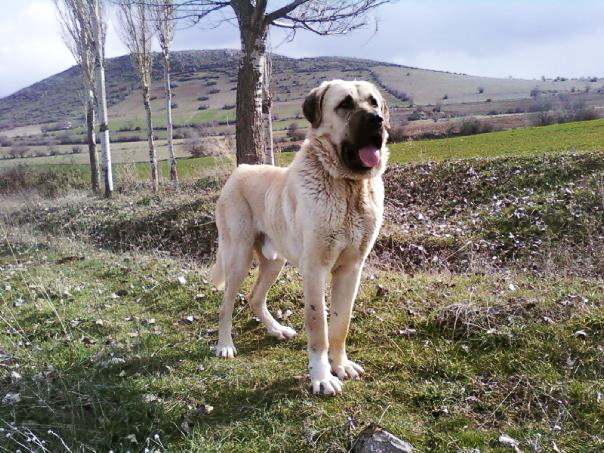
The Aksaray Malaklisi is a giant sized Turkish cattle guard dog, originally from the province of Aksaray in the heart of Anatolia. Also known as Malaklı Karabaş, “Turkish Mastiff” or “Anatolian Lion”, it is considered one of the largest dog breeds on the planet. It is an imposing protector, loyal and deeply territorial, bred for generations to stand up to wolves in defense of the herd.
Is the Aksaray Malaklisi for you?
Before you fall in love with its lion-like demeanor, be honest: the Aksaray Malaklisi is a huge working dog with a guarding instinct, not a pet for any household.

In favour .
- Exceptional guardian: territorial, courageous and deterrent by his very presence.
- Very loyal and attached to his owner and his family.
- Short coat and low maintenance.
- Rustic and long-lived for its size (13-15 years).
- Quiet and serene when there is no threat; not a nervous dog.
Against
- Giant size: eats, occupies and costs a lot.
- Distrustful of strangers; demands early and constant socialization.
- Independent and stubborn: not easy to train.
- It doesn’t fit with flats and urban life; it needs fenced land.
- Not tolerant of other dogs of the same sex.
- Rare breed outside Turkey: difficult to find and without FCI recognition.
Character and temperament
The temperament of the Aksaray Malaklisi is that of a classic Anatolian guard: serene and observant in day-to-day life, but capable of transforming into an insurmountable barrier when perceiving danger.
It is a markedly independent dog. For centuries it has worked alone or in pairs, away from the shepherd, making its own decisions in front of the wolf. This autonomy explains that it is an animal that thinks for itself and tends to obey above all the person it recognizes as its reference.
It is a dog of deep bonds rather than easy affections: it demonstrates its affection by watching, accompanying and always putting itself between its own and what it considers a threat.
Coexistence: children, other pets, flat and loneliness
With the children in your family the Aksaray Malaklisi is usually tolerant and protective, but its size changes everything: a dog of 80 kg can throw a child without bad intentions.
With other animals there are important nuances. Raised to protect livestock, it can coexist very well with animals it considers “its” herd or family, but tends not to tolerate other dogs of the same sex and may view intruders – dogs, wild animals – as a threat.
As for the floor and loneliness, this breed does not fit in an apartment. It needs a house with fenced terrain where to patrol and deploy its instinct. It tolerates well being outdoors and quiet routine, but not lack of space or social isolation: although it is independent, it suffers if it is completely separated from its family.
Education and training
Training an Aksaray Malaklisi is not a task for beginners. It is intelligent, but also independent and stubborn: it does not obey to please, but when it understands and respects the one who guides it. It needs a calm, consistent and confident owner, able to set limits without resorting to harshness, which with this breed is counterproductive.
The absolute priority is early socialization: exposing the puppy, in a controlled and positive way, to people, noises, other animals and different situations. A well-socialized Malaklisi distinguishes the everyday from the real threat; one who is not can become overly suspicious. Positive reinforcement, short sessions and patience give much better results than imposition.
It should be assumed that it will never be a dog of millimeter obedience of competition: its genetics of autonomous guardian takes precedence over its own criteria.
Exercise and activity

The Aksaray Malaklisi is not a high-performance sport dog, but a watchdog that alternates long periods of quiet watchfulness with moments of high intensity when something triggers it.
Ideally, a large, secure plot of land where it can move about freely and exercise its watchful instinct, complemented by exits that stimulate its sense of smell and its head.
During the growth you have to be especially careful: in a dog that will reach so much weight, impact exercise, jumps and excessive stairs can damage still immature joints.
Care: fur and hygiene
The Aksaray Malaklisi wears a dense short coat that only needs a weekly brushing to remove dead hair, something more frequent in moulting seasons.
Bathing should be occasional, only when it is really dirty, so as not to dry out your skin. As a good molosoid of marked papada, checking and drying the folds is suitable for the face and bellies, as well as keeping an eye on snails and food scraps.
Foodstuffs
Feeding a giant-sized dog is a serious and economical undertaking. The Aksaray Malaklisi needs a quality diet, high in protein and adjusted to its large body mass, age and activity level.
In puppies of giant breeds, the feeding of the growth period is critical: a poorly adjusted energy and calcium intake favors too rapid growth and bone and joint problems.
In adults it is advisable to avoid vigorous exercise just before and after eating, a classic precaution in large and deep-chested dogs to reduce the risk of gastric torsion.
Health and life expectancy
The Aksaray Malaklisi is, as a whole, a rustic dog, the result of generations of functional selection under harsh conditions.
As with all very large and heavy dogs, the logical points of attention are the joints– hips and elbows – and, by their conformation, the precautions against gastric torsion that have been discussed in feeding.
As it is a rare breed and still in the process of becoming established, the most sensible thing to do is to go to serious breeders and keep regular veterinary checks, vaccinations and deworming up to date.
Physical appearance
The Aksaray Malaklisi is, first of all, a imposing dog. It usually measures between 70 and 90 cm at the cross – with the males in the upper part of the range – and weighs approximately between 60 and 90 kg, the female being about 10 kg lighter than the male.
Its most characteristic feature is the head, large and massive, with hanging beetles and dorsal fin: in fact, it is said that the term “malaklı” refers precisely to those fallen lips. The ears, also large, are of low implantation and fall to the sides.
The the fur is short.. In terms of color, the specimens range from cream, beige and lionskin to more grayish tones, almost always with the unmistakable black mask on the face and dark ears.
Origin and history
The Aksaray Malaklisi takes its name from the province of Aksaray, in the central region of Anatolia (Turkey), where it has been bred for generations as a livestock guard dog.
Although at first glance it resembles the famous Kangal, the genetic analysis identifies him as a distinct race. of the other Turkish guards, such as the Kangal, the Akbash or the Kars.
Today it continues to fulfill its original function in its homeland, where a a pair of dogs – male and female – can keep between 700 and 800 sheep. Some specimens have been exported to other countries, where they are equally employed as cattle guards or as defense dogs, although outside Turkey it remains a rare breed.
Curiosities
- It is known by very expressive nicknames: “Turkish Mastiff” and “Lion of Anatolia”, the latter for its size and paw-like mane.
- It is considered one of the largest dog breeds in the world; some sources place it only behind the giant Persian shepherds.
- The name «malaklı» refers to its hanging bellies, its most recognizable feature.
- It works traditionally in pairs, male and female, sharing oversight of herds of hundreds of heads.
- Unlike many Western breeds, is not recognised by the FCI: its official endorsement comes from the Turkish Kennel Federation.
If you are attracted to the profile of the Aksaray Malaklisi – molosoid, guard and large – you will be interested to know other related breeds of strength and protective character such as the Cane Corso, the Mastín, the Gran Danés or the San Bernardo, all giant dogs with a strong protective instinct towards their family.
Frequently Asked Questions about Aksaray Malaklisi
Is the Aksaray Malaklisi a dangerous dog?
It is not a “dangerous” dog by nature, but it is a powerful guard with a strong territorial instinct and distrust of strangers. It traditionally obeys its owner above all else and may be apprehensive of outsiders. In inexperienced hands, with no socialization or clear boundaries, its size and protective nature make it a demanding breed. With a competent owner, early socialization and a suitable environment, it is a balanced and reliable companion.
How tall and how much does an Aksaray Malaklisi weigh?
It is one of the largest breeds in the world. Specimens usually measure between 70 and 90 cm at the withers – the males in the upper part of the range – and weigh approximately 60 to 90 kg, with the female about 10 kg lighter than the male.
Can you have an Aksaray Malaklisi on one floor?
It is not a breed suitable for a flat. It is a working dog of giant size, bred to watch over herds in the open field, which needs space, a fenced plot and a function. Locking it in an apartment causes stress and behavior problems.
Is the Aksaray Malaklisi good with children?
With the children of his own family he is usually tolerant and protective, faithful to his guardian instinct. Nevertheless, due to his enormous size and strength, all coexistence with small children must always be supervised, and it is advisable to teach the child to respect the dog.
How is it different from Kangal?
They are similar in appearance – both are black-masked Anatolian cattle herders – but the Aksaray Malaklisi is noticeably larger and heavier, with a more massive head and more pronounced bill.
How long does an Aksaray Malaklisi live?
Their life expectancy is around 13 to 15 years, a remarkable longevity for a giant-sized dog, in which the usual is usually shorter.
Is it recognized by the FCI?
No. The Aksaray Malaklisi is not recognized by the FCI. In its country it is supported by the Turkish Canine Federation, which works on setting the standard of the breed.
Do you need a lot of exercise?
It needs daily activity – long walks and, above all, patrol space – but it is not a dog for high-intensity sports or racing – it is a guard dog that alternates quiet vigilance with bursts of energy when it senses a threat.