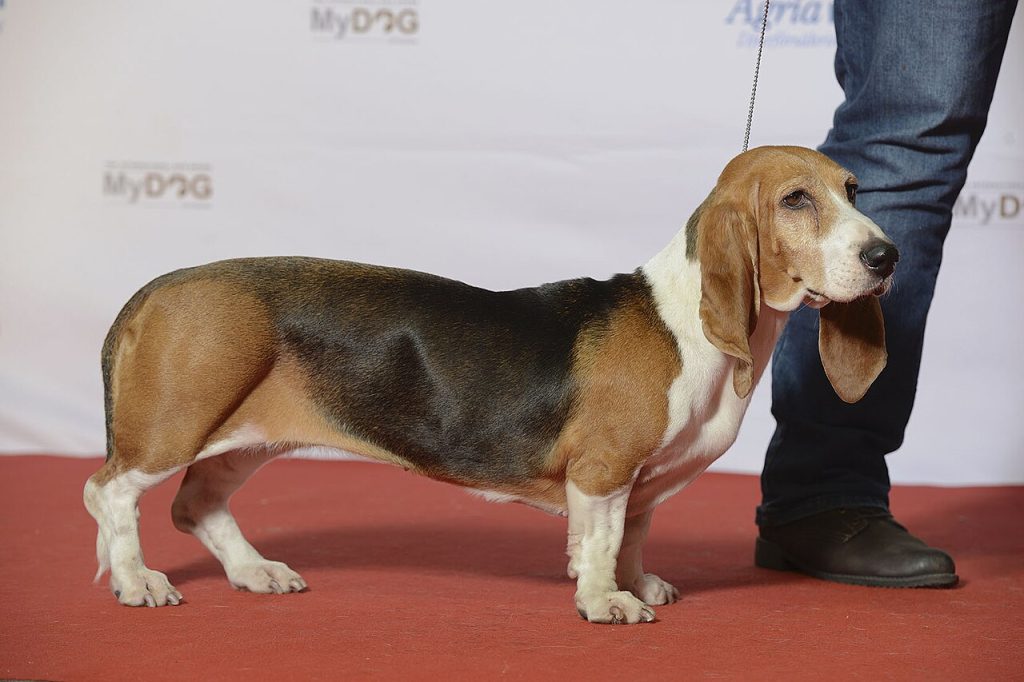
The Basset Artesiano Normando is one of France’s oldest and most iconic short-legged hounds: A quiet, sociable dog with an extraordinary sense of smell, bred for centuries to track down rabbits and smaller pieces walking alongside the hunter. Today he is above all an excellent family companion, though he still keeps his nose-to-the-ground instinct intact. If you’re looking for a small-to-medium-sized, affectionate, well-balanced dog, but you’re willing to live with his stubbornness and insatiable smell, the Norman Artesian Basset deserves a thorough introduction.
Is the Basset Artesian Norman to you?
Before you fall in love with those endless ears and that melancholy gaze, let’s be honest: The Norman Artesian Basset is a wonderful dog for the right home, but it doesn’t fit with everyone. It’s a hunting dog converted back into a companion dog, and that marks both its virtues and its limits.
In favour .
- calm and kind. temperament, perfect for the family.
- Handled size: sturdy body but short stature.
- Very social with people and, in general, with other dogs.
- Short coat and easy to maintain.
- Smell and stamina exceptional for its size.
- He usually gets along great with kids.
Against
- Cabezota: the tracking instinct rules obedience.
- If he catches an interesting smell, he can ignore you completely.
- Tendency to gain weight; overweight punishes his long back.
- Long ears prone to infection; they require cleaning.
- Some specimens are barking or “howling”.
- He needs daily exercise despite his lazy appearance.

Character and temperament
The standard of the breed sums up the character of the Norman Artesian Basset in two words that say almost everything: it must be quiet and good natured. It is an affable dog, attached to its family and little given to conflicts. It is not a nervous guard nor a hyperactive athlete; rather it transmits a gentlemanly calmness, that phlegmatic air so typical of bassets that awakens so much sympathy.
Now, beneath that placid appearance beats a purebred hound. When its nose detects a trail, the Norman Artesian Basset transforms: He concentrates, follows the trail with admirable determination and just stops listening to you. It’s not disobedience in bad faith, but centuries of selection to work autonomously, away from the hunter. Understanding that duality – dog on the couch at home, tracking machine in the field – is the key to living with it without frustration.
It is also a sociable and communicative dog. Many specimens “talk” a lot: low barks and melodious howls that are part of its heritage as a pack.
Coexistence: children, other pets, flat and loneliness
The Norman Artesian Basset is, first and foremost, a family companion dog. Its patience and tolerance make it a excellent companion for children, always with the supervision and mutual respect that any dog deserves.
The coexistence with cats or other pets is possible if they grow up together, although it is worth remembering that we are facing a hunter of small pieces: very small animals (rodents, rabbits) can awaken their prey instinct.
Is this valid for floor? Yeah, with nuances. Its level of indoor activity is moderate and it adapts well to small spaces, but there are two tolls: It needs its daily walks without fail and can be noisy, something to consider with nearby neighbours. Frequent stairs and jumps don’t suit him because of his long column. As for the loneliness, it is a gregarious dog that prefers company; it tolerates staying only for reasonable periods, but prolonged neglect can result in howling or boredom behaviors.

Education and training
Let’s be clear: the Norman Artesian Basset is not the breed with which you will win obedience contests. It is intelligent, but also independent and stubborn, a combination that demands patience. The good news is that it responds wonderfully when the method is right.
The formula that works is positive reinforcement and, especially, food. As a good greedy hound, it will do almost anything for a tasty prize. The sessions should be short, fun and consistent; punishments and harshness only get it to close in on itself. Start socializing and the rules from a puppy, while it’s a sponge, and don’t wait for the nose instinct to take over.
There is one non-negotiable point of safety: the called will never be 100% reliable when there is a trail in between. So it is prudent to work the lap from small, but also release it only in fenced or safe areas.
Exercise and activity
Their short-legged silhouette is deceiving. The Norman Artesian Basset was bred for walking for hours tracking, so it has much more stamina than it looks and needs real daily exercise. It’s not enough to just leave it lying around in the garden.
The ideal is one or two good walks a day where you can: For this breed, walking is both physical exercise and mental stimulation. Smell games, home trails, and foraging for food make him happy and tire his mind. What you should avoid are the strains that torment your back and joints: repeated jumps, running down stairs or overstraining in growing puppies. Regular walks, yes; impact sports, best with moderation.
Care: fur and hygiene
In the fur section, the Basset Artesiano Normando is one of the easiest. its the mantle is short, dense and smooth, with little maintenance: a weekly brushing is enough to remove the dead hair and keep it shiny, although it loosens hair moderately throughout the year.
The real focus is the ears. Those long, slender, dangling ears that characterize him so much are also a risk zone: Because of poor ventilation, they retain moisture and promote otitis. They should be checked and cleaned regularly. The same applies to eyes and face creases, which can accumulate dirt. Complete the routine with nail trimming, dental hygiene, and bathing only when needed.

Foodstuffs
If there’s one word that defines the Norman Artesian Basset’s relationship with food it’s voraciousness. He loves to eat and rarely says no, which makes him tremendously easy to reward in training… and dangerously easy to overeat.
The weight control is a priority. in this race. Every extra pound is a direct burden on its long spine and joints, already demanded by its morphology. It is advisable to provide a complete and quality diet, with rations measured according to their age, weight and activity, divided into two servings. Watch out for the out-of-control prizes and the “helpers” at the table: In such a gluttonous dog, excess accumulates quickly. Having fresh water available at all times and keeping an eye on your figure – you should be able to feel your ribs – is the best guarantee of long-term health.
Health and life expectancy
The Norman Artesian Basset is, as a whole, a rustic and long-lived dog. Its life expectancy is usually around 12-14 years of age, a good figure for a dog of its size, provided that the weak points of its anatomy are taken care of.
Its most defining feature – short legs – comes from a form of chondrodysplastic dwarfism(osteochondrodysplasia), the same trait that other bassets and the Teckel share. That long body morphology and short legs leads to increased exposure to back and spine problems, so maintaining a fit weight and avoiding jumping is critical. hanging ears predisposes to recurrent otitis, and eye monitoring is also recommended. As with all breeds, it is advisable to go to responsible breeders who look after the health of their lines and keep up to date with veterinary checks, deparasitisation and vaccination.
Physical appearance
The Basset Artesian Norman is a small size, elongated body and short legs hound, of lighter build and more elegant than its relative the Basset Hound.
The most distinctive is its head, domed and noble, topped by extraordinarily long, thin, low-inserted, tip-wrapped ears. The look is calm, a melancholy spot. The front legs may present the characteristic inward turn (a trait that historically differentiated it from the Artois variety). The the coat is short and smooth, and it comes in two patterns: tricolor(lion and white with black mantle, i.e. a dark spot on the back) or two-tone(lion and white).
Origin and history
The Norman Artesian Basset has its roots in the short-legged hounds of northern France dogs of the early 19th century, dogs that exhibited this characteristic dwarfism.
Interestingly, it shares that same ancestral trunk with the popular Basset Hound: of those French bassets, English breeders developed in the late 19th century a heavier, strong-boned dog, while the French maintained a lighter line focused on fitness for hunting. The documentation of these French bassets as purebred goes back to 1870. From a common type emerged two strains: one with straight front legs (the Basset de Artois) and one with half-torqued legs (the Norman). Figures such as Count Le Coulteux de Canteleu were key in the fixation of these hounds.
Today it is recognized by the International Kennel Federation (FCI) as the number 34, within Group 6 (sows and similar breeds) breed, and also by the United Kennel Club of America. Despite its prestige, it is still a relatively uncommon outside France breed.
Curiosities
- It is one of the six types of basset recognized by the FCI, all of French origin.
- It shares direct ancestry with the Basset Hound, but retains a lighter and “athletic” physique.
- Its short legs are not a defect, but a deliberate selection: they allowed the hunter to follow the dog as it walked.
- The black “mantle” on the back of the tricolor specimens is reminiscent of a small saddle.
- Their sense of smell is among the finest in the canine world, matching that of other great trackers.
- In France it is still prized as a minor hunting dog, not just as a pet.
If you are attracted to the Norman Artesian Basset, you will surely enjoy meeting other dogs and short-legged breeds with a similar profile. We recommend that you take a look at the Basset Hound, its most famous relative; the inexhaustible Beagle, another small dog with a great sense of smell; the Dachshund or Teckel, which shares that morphology of long body and short legs; and the imposing Bloodhound, the tracker par excellence.
Frequently Asked Questions about the Norman Artesian Basset
Is the Norman Artesian Basset a good family dog?
His calm, kind, and sociable nature makes him an excellent family companion, very patient with children, and generally friendly with other dogs.
How is it different from the Basset Hound?
They share French ancestry, but the Norman Artesian Basset is lighter, slender and hunting-oriented, while the Basset Hound – developed in England – is heavier, strong-boned and more markedly wrinkled.
How tall and how much does he weigh?
Its height at the withers varies between 30 and 36 cm and its weight is around 15-20 kg. It is a small dog but with a robust and elongated body.
Is it hard to educate?
He’s intelligent but independent and stubborn, like a good hound, with positive reinforcement, food rewards and short, steady sessions, he responds well, although the call will never be fully reliable if there’s a trail in between.
How much exercise do you need?
It needs one or two good walks a day in which it can smell, as well as olfactory games. It is wise to avoid frequent jumps and stairs to protect its long spine.
What health problems are more common?
Because of its long body morphology and short legs (chondrodysplasia), it is prone to back problems; its dangling ears favor otitis and tend to be overweight.
How long does a Norman Artesian Basset live?
Their life expectancy is usually around 12-14 years, a good longevity for a dog of their size when their weight and weaknesses are taken into account.
Does he adapt to living in a flat?
It’s quiet inside the house, but it can be barking or howling, something to appreciate if you have neighbors nearby.