The Hokkaido is one of Japan’s oldest and most authentic dog breeds: A primitive hunter, loyal to the core and able to stand up to the most extreme cold. Little known outside its home country, the Hokkaido combines the nobility of Japanese working dogs with a courageous temperament and absolute devotion to its family. In this comprehensive guide, you’ll find out if the Hokkaido is the dog you’re looking for, what his character is like, what care he needs, and where his fascinating history comes from.
Is Hokkaido for you?

The Hokkaido is not a dog for everyone. It is a primitive breed, with a very marked hunting instinct and an independence that demands a patient and constant owner. In return, it offers a loyalty and nobility that are difficult to match. Before you fall in love with its “Japanese wolf” appearance, it is advisable to know if it fits with your lifestyle.
In favour .
- Extraordinary loyalty and a strong bond with his family.
- Rustic dog, healthy and very long-lived (about 15 years).
- He can take the cold like no other breed and enjoy the outdoors.
- Brave, watchful and a good natural guardian.
- Clean and no body odor, like a good Japanese dog.
To be taken into account
- Strong prey instinct: watch out for other small animals.
- Independent and stubborn; needs firm and consistent education.
- Very rare outside Japan; hard to find.
- It’s not ideal for floors or hot weather.
- High incidence of hereditary ocular abnormality (HEA).
Character and temperament
The character of the Hokkaido is that of a classic Japanese dog: reserved with strangers, unconditional with his own. It is known above all for its loyalty to the owner, its courage and its amazing resistance.
It is an alert dog, attentive to everything that happens around it, with an excellent sense of direction. In fact, tradition has it that a Hokkaido is able to return to its master no matter how far away, thanks to its natural instinct. That same acuteness makes it an excellent watchdog, warning of any novelty without being a compulsive barker.
Beneath that stoic appearance is a sensitive, family-only dog, not effusive or clingy, but deeply affectionate, cautious and aloof with strangers, never submissive, and that combination of courage and self-control is precisely what makes those who know the breed fall in love.
Coexistence: children, other pets, flat and loneliness

With children: the Hokkaido can be a wonderful companion for children in the house, as long as it grows up with them and is well socialized from puppyhood.
With other pets: here is its most delicate point. The Hokkaido retains a very vivid hunting instinct, so it should not be left loose near small animals that it may perceive as prey. Coexistence with other dogs is possible with socialization, but its dominant character can generate friction, especially between males.
On the floor: is not its natural habitat. It is an active, resilient and outdoor-loving dog that feels much better in a house with a large yard or garden. In an apartment it can adapt only if you guarantee it plenty of daily exercise.
Although Soledad: is independent, it is not good to spend too many hours alone. It is a dog that lives for and for its family; prolonged isolation can cause it frustration.
Education and training
Raising a Hokkaido requires patience, consistency and mutual respect. It is an intelligent but also independent and somewhat stubborn dog, heritage of centuries of working autonomously in the mountains. It does not respond well to harshness or authoritarian methods: if you feel it “fights” with you, you have lost.
Early socialization is non-negotiable: the sooner you get used to people, environments, noises and other animals, the better you will manage your natural prudence and instinct. Short, varied and motivating sessions work much better than mechanical repetition.
With a steady owner, the Hokkaido learns quickly and enjoys collaboration. But it will never lose its own criteria: don’t look for a submissive dog, look for a companion who trusts you.
Exercise and activity
The Hokkaido is a moderately active dog but with remarkable endurance. It needs daily quality exercise: long walks, walks in the countryside or mountains, and opportunities to explore and smell.
In addition to physical expense, he appreciates mental stimulation. Smell games, tracking, and activities that tap into his hunting instincts keep him balanced and happy. A bored Hokkaido with insufficient outlets may become restless or develop undesirable behaviors. In short: It’s not a sedentary dog, but it’s also not a hyperactive athlete; it’s looking for the midpoint of an active outdoor life.
Care: fur and hygiene
The coat of the Hokkaido is twofold: an outer coat of long, hard hair and a short, soft undercoat that serves as insulation.
The exception is the spring and autumn moults, when the dog releases the undercoat abundantly. In those weeks it is advisable to brush it almost daily to remove the dead hair and prevent it from accumulating around the house. The baths should be sporadic: the Hokkaido is a naturally clean dog with little smell, and washing it excessively dries its skin.
Complete the routine with the basics of any dog: checking and cleaning the ears, cutting the nails when necessary, and taking care of dental hygiene.
Foodstuffs
As a rustic, medium-sized breed, the Hokkaido does not have exotic food needs, but it is advisable to offer a balanced and high quality diet, adjusted to its age, activity level and weight.
The most important thing is to control the rations and avoid overweight, which in the long term punishes the joints and shortens life. Divide the food into two servings a day, always have fresh water available and adjust the amounts according to the exercise of each season.
Health and life expectancy

The Hokkaido is generally a healthy, resilient and long-lasting dog: its life expectancy is around 15 years, the result of centuries of natural selection in a demanding environment.
However, the breed carries an important hereditary problem: collie eye abnormality (AEC), a retinal disorder with a particularly high incidence in Hokkaido. It is estimated that about a third of specimens are affected and many more are carriers.
In addition to CEA, joint care, maintaining a proper weight, and keeping up-to-date with veterinary checkups, deworming, and vaccination are essential to a Hokkaido’s long and active life.
Physical appearance
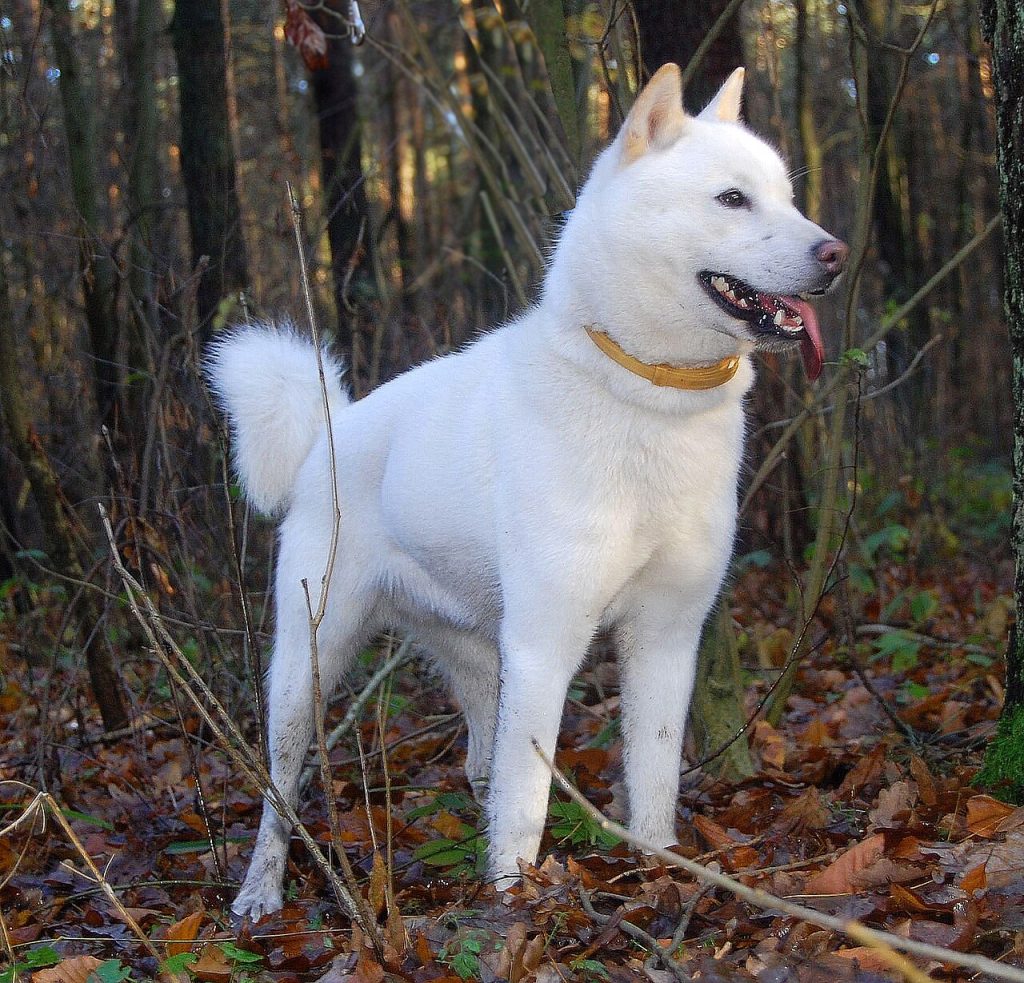
The Hokkaido is a medium size dog and looks robust and balanced, very much in line with the Japanese spitz. The males measure about 49-50 cm at the withers and the females slightly less, with a weight of around 20 kg. Its body is compact and muscular, well proportioned, transmitting agility and strength.
The head is triangular in shape, with small, triangular, erect ears, and small, upward-looking, triangular eyes that give it an attentive and determined expression.
Interestingly, some specimens have the tongue partially or fully pigmented blue-black, a detail reminiscent of other primitive Asian breeds.
Origin and history
The Hokkaido is one of the oldest Japanese breeds and its history is intertwined with the ainu people, the indigenous people of northern Japan. Hence one of its traditional names, “Ainu-ken”. It is believed to descend from medium-sized dogs brought to the island by immigrants from the main island of Honshu, with a lineage dating back to the Jōmon period, thousands of years ago.
The geographical isolation of the island of Hokkaido allowed this line of primitive dogs to remain relatively pure, with little influence from later breeds.[citation needed] For centuries, the Ainu employed it as large game dog, capable even of confronting the Hokkaido brown bear to protect its owner, a feat that is part of the breed’s legend.
In 1869, the English zoologist Thomas W. Blakiston gave the breed the name “Hokkaido”. His fame grew after episodes such as rescuing survivors of a military expedition trapped by snow while crossing the Hakkōda Mountains in Aomori Prefecture in 1902. In 1937, the Japanese Ministry of Education declared it natural monument and a protected species by law, officially naming it Hokkaido-Inu. Even so, in Japan it is still popularly called Hokkaido-Ken.
Curiosities
- The Hokkaido is recognized in Japan as living natural monument, an honor reserved for the country’s most valuable native breeds.
- It has many names: Ainu-ken, Seta, Shita and, in Japanese, Dō-ken.
- Tradition attributes to him the courage to stand up to a brown bear to defend his master, jumping on its neck and poking its teeth until the bear retreated.
- It is famous for its sense of direction: it is said to be able to return to its owner from great distances.
- Some specimens have a bluish tongue, a trait shared with other primitive Asian races.
- Outside Japan, it is a very rare breed, making it a true canine gem little known in the West.
If you are attracted to the noble and primitive nature of Hokkaido, you may be interested in other Japanese and Nordic breeds of similar temperament. We recommend that you meet Akita, the quintessential Japanese big dog; the tough Husky Siberiano, another master of the cold; the elegant and fluffy Samoyedo; and the quirky Chow Chow, with whom he shares the curious blue tongue.
Frequently Asked Questions about Hokkaido
Is the Hokkaido a good dog for beginners?
It’s not the easiest choice for someone who’s never had a dog. The Hokkaido is a primitive Japanese breed, very loyal to its family but independent, with strong hunting and territorial instincts. It needs a steady owner, one who understands early socialization and knows how to set boundaries calmly. If you have experience with character races or are willing to train and devote time to it, it can be an extraordinary companion.
How long does a Hokkaido live?
It is a long-lived and rustic breed: it usually lives for about 15 years, and it is not uncommon for it to reach that age in good shape if you take care of its diet, weight and activity.
Does Hokkaido get along well with children?
Yes, as long as it grows up with them as a puppy and is well socialized. It is a loyal and protective dog that can form a strong bond with the children in the house. As with any dog, it is advisable to supervise play with small children and teach toddlers to respect their rest times.
Can he live in a flat?
It is not ideal. The Hokkaido is an active and resilient dog that enjoys the outdoors and space. It can adapt to a floor if you guarantee it plenty of daily exercise and mental stimulation, but it is much more comfortable in a house with a yard or garden where it can move.
Does Hokkaido withstand the cold well?
Exceptionally well. It is one of its hallmarks: its double coat of hair, dense and insulating, was developed to withstand the winters of the island of Hokkaido. The heat, on the other hand, makes it worse, so in summer you have to give it shade, fresh water and avoid exercise in the hottest hours.
Do you lose a lot of hair?
Yes, especially in spring and autumn, when the undercoat changes. During these weeks it is advisable to brush it almost daily to remove the dead hair. The rest of the year, brushing once or twice a week is usually enough to keep the coat healthy.
What health problems does the breed have?
The most characteristic is the Collie’s eye anomaly (CEA), a hereditary retinal disorder that in Hokkaido has a high incidence.
Is the Hokkaido a rare breed?
Yes, it is very rare outside Japan. In its own country it is protected and recognized as a natural monument, but it is difficult to find it in Europe or America.