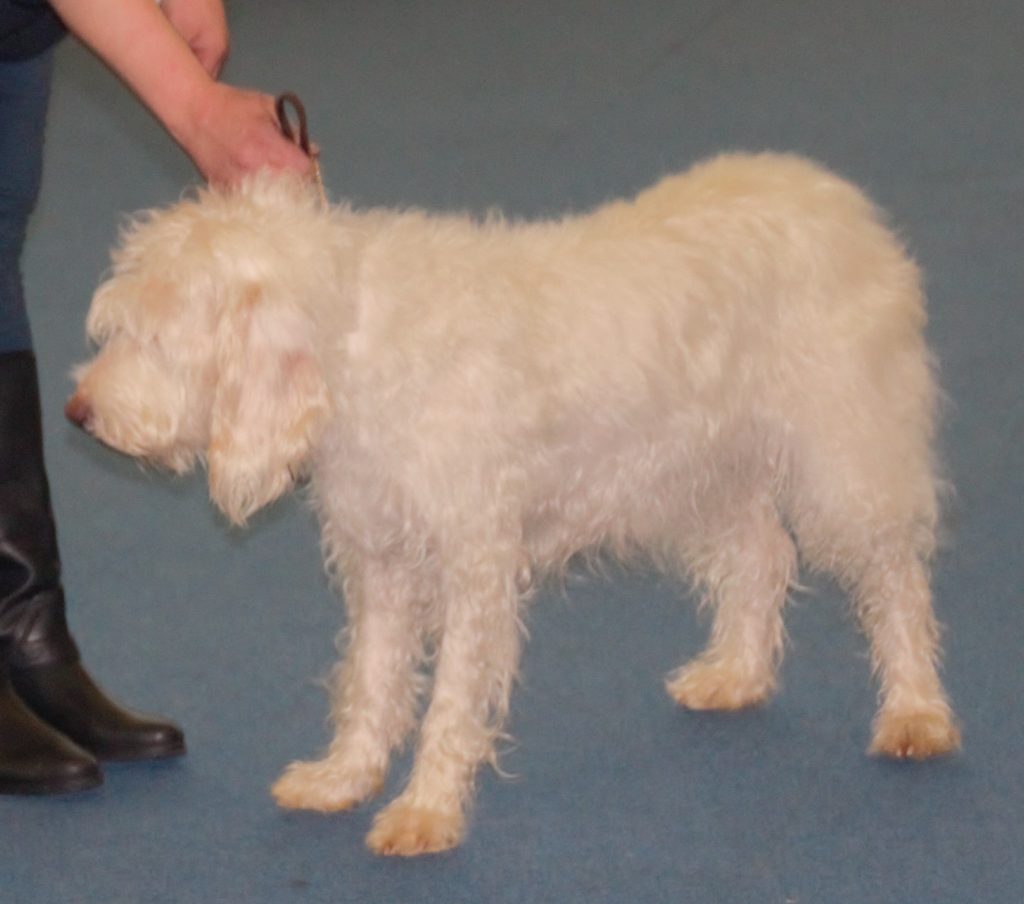
The Hard-haired Istrian hound is one of the oldest and most genuine hounds in the Balkans: a rough-coated, white Croatian tracker with orange spots, who keeps working in the mountains much longer than resting on the couch.
Is the hard-haired Istrian Hound for you?

Before you fall in love with her rustic look, be honest: The hard-haired Istrian Hound is a working dog. It’s selected, generation after generation, to track and collect game in rough terrain, and that instinct sets everything else apart. It is not a breed for those looking for a quiet city dog, but it is an excellent choice for hunters, canine sportsmen or very active rural families who want a tough and characterful companion.
In favour .
- Excellent sense of smell and great tracking instinct.
- Very sturdy and rustic, suitable for long field days.
- Hard coat that withstands bad weather and weeds well.
- Loyal and kind to his family inside the house.
- Generally robust health, typical of a functional breed.
To be taken into account
- Voluntary and independent: more expensive to train.
- He needs a lot of daily, intense exercise.
- Strong hunting instinct: he can chase and run after a trail.
- He tends to bark/voice, inherited from his work as a hound.
- Rare breed outside the Balkans; hard to find.
Character and temperament
The temperament of the hard-haired Istrian Hound is best understood by remembering what it was created for. It is a hunting dog rather than a companion dog, and that translates into a willing, determined and quite independent character. In the mountains it is tenacious, tireless and very focused on the trail; at home, however, it is usually calm, affectionate and balanced with its people.
This duality is typical of hounds: dogs that work away from the guide, making their own decisions about the trail, and that is why they develop remarkable autonomy. It is not a submissive dog that obeys to please; it cooperates when the task makes sense to it. With patience and respect it becomes a faithful companion, but it is advisable not to expect the docility of a shepherd or a retriever.
Coexistence: children, other pets, flat and loneliness

With the family, including children, the hard-haired Istrian Hound is usually affable and tolerant, as long as its rest is respected and it socializes well as a puppy.
The most delicate issue is the small animals: its powerful hunting instinct makes cats, rabbits or other small pets look like prey, especially if you didn’t grow up with them.
It is not a breed designed for floor. It needs space, frequent outings and, if possible, a rural or semi-rural environment. It also does not take well the extended loneliness: a dog so active and with such a loud voice that is left alone and bored will tend to bark, dig or look for a way to escape after an interesting smell.
Education and training
Raising a hard-haired Istrian Hound requires more perseverance than many other breeds, precisely because it has been selected for its ability to work autonomously, not for its docility.
The keys work well: positive reinforcement, short and varied sessions, and commands with a clear purpose. early socialization is essential for managing dogs, people, and new environments well. called is the critical point: given its instinct and nose, you have to work hard and assume that in uncontrolled open areas it can disconnect completely if it catches a smell.
Exercise and activity
There are no shortcuts here: it is an endurance dog designed to spend hours in the field. It needs daily, long and intense exercise, which combines physical wear and mental stimulation. Long walks, running, hiking, trail work or ideally real kinetic activity are what keep it balanced.
A hard-haired Istrian Hound that does not expend its energy becomes a frustrated dog: barking, destroying or escapist. Olfactory sports (mantrailing, tracking tests) are an excellent way to channel its instinct when it is not given a hunting use. As a rule, think of hours of activity, not a short walk around the block.
Care: fur and hygiene
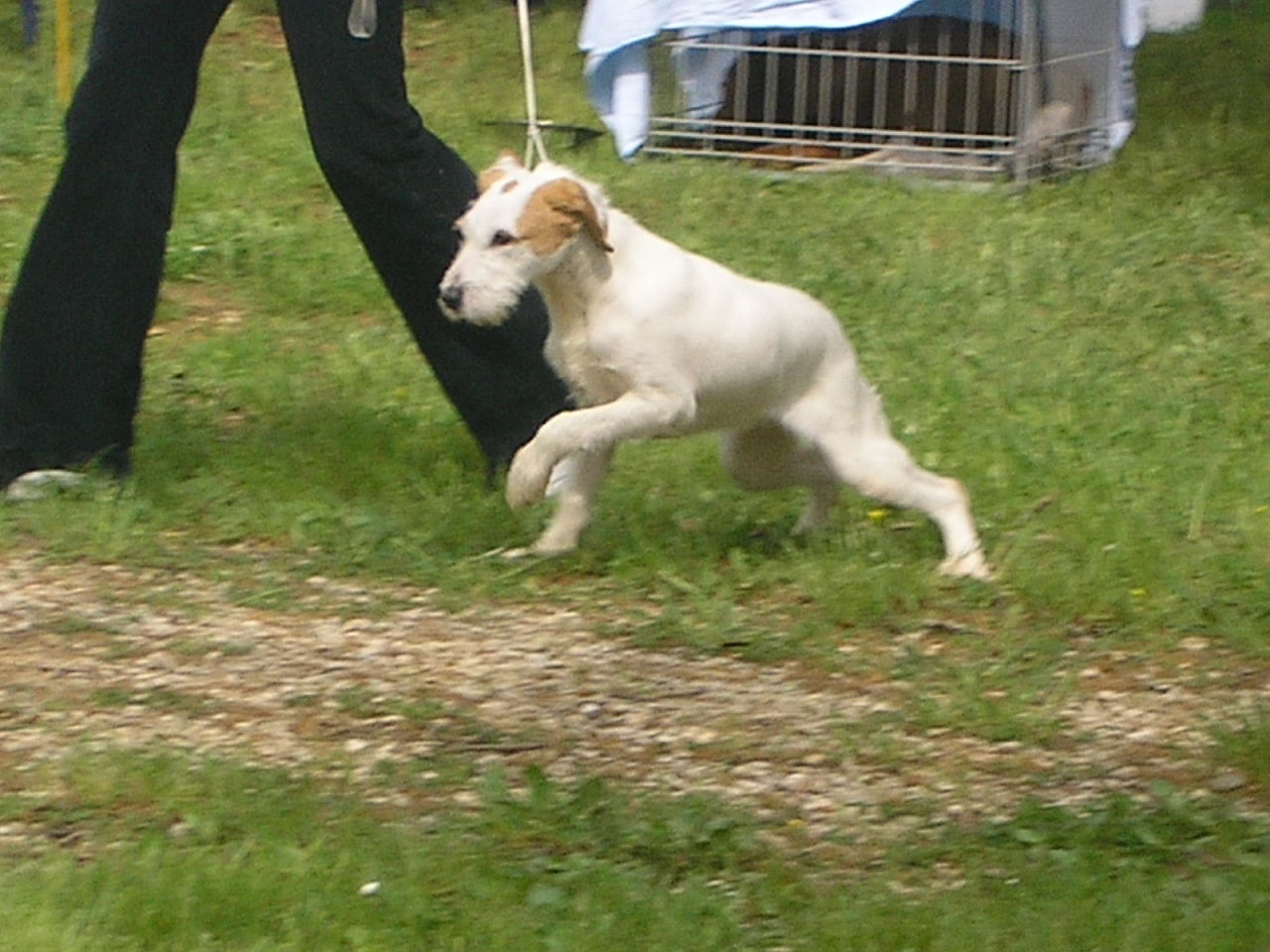
The hard coat of this breed is intended for work, not for the window, so its maintenance is relatively simple. The outer layer measures between 5 and 8 cm and is supported on a woolly undercoat that insulates from cold and moisture. A regular brushing, once or twice a week, is enough to remove dead hair, mud and plant remains that it collects in the field.
Depending on the line and type of hair, a stripping may be appropriate a couple of times a year to remove old hair and maintain the rough texture. After each outing to the mountains it is advisable to check ears, pads and between the fingers for spikes, ticks or small wounds. Baths, only the necessary; the excess softens the mantle and takes away its natural protection.
Foodstuffs
As an athletic and energy-consuming dog, the hard-haired Istrian Hound needs a high-quality diet, tailored to its activity level.
Prioritize a feed or diet with a good intake of animal protein and fats to sustain resistance, divided into two daily intakes to take care of digestion. Watch the weight: A working hound should be kept fibrous, never overweight. After a hard day’s work, make sure you’re well hydrated and spaced out your exercise meals to reduce digestive hazards. Any adjustment should be discussed with the veterinarian.
Health and life expectancy
As a functional breed and little modified by fashion, the hard-haired Istrian Hound usually enjoys a robust health and a rustic constitution.
As with any active dog with hanging ears, attention should be paid to the ear infections(checking and drying the ears after the field) and the joint wear associated with intense exercise. Regular veterinary checks, deworming and post-hunting control are the best prevention. Although there are no very precise official figures, life expectancy in a healthy medium-sized hound is around 12-14 years.
Physical appearance
The hard-haired Istrian Hound is a dog of medium size and rustic and functional appearance. Its height at the cross varies markedly, from about 43 to 60 cm, and its weight ranges from 12 to 27 kg; this amplitude is due to the fact that it is bred priming hunting performance over morphological uniformity.
Its most distinctive feature is the hard and rough coat, white with yellow or orange markings, present mainly on the ears. The ears are wide and hang flat, and the tail is long, worn erect and curved inwards.
Origin and history
The hard-haired Istrian Hound (in Croatian, isarski oštrodlaki gonič) is one of the oldest hound breeds in the Balkans. It was developed in the mid-19th century by crossing the Gran Grifón Vandeano with the Short-haired Istrian hound, another tracker from the region.
The breed participated as such in its first morphology competition in Vienna in 1866. Although its name points to the Istrian peninsula, its true area of formation also encompasses the Croatian Littoral, Dalmatia, Gorski Kotar and Lika.
Curiosities
- She is one of the two breeds of Istrian hound, along with her short-haired cousin, with whom she shares some of her ancestry.
- Despite having over a century and a half of documented history, it is still a very rare outside Croatia and Slovenia breed.
- Their recognition as a Croatian breed by the FCI in 2003 ended decades of national dispute over their provenance.
- It continues to be bred primarily for its ability to work, which explains the large size variation between specimens.
- The white coat with orange spots is not only aesthetic: the light colour helps the hunter distinguish it from the vegetation.
If you are interested in the hard-haired Istrian Hound because of its tracker and working dog profile, you may want to compare its character with other related breeds: the Bloodhound, a tracking specialist; the Basset Hound, another tenacious hound with a prodigious scent; the popular Beagle, a pack hound par excellence; or the Vizsla, if you are looking for a versatile hunter of inexhaustible energy.
Frequently asked questions about the hard-haired Istrian Hound
Is the hard-haired Istrian Hound a good companion dog?
It may be in an active household, but remember that it is primarily a hunting dog. It is bred for its performance in the mountains more than its role as a pet, so it needs plenty of exercise, mental stimulation and a family that understands its tracking instinct. In experienced hands and with daily activity, it is a balanced, loyal and surprisingly kind companion at home.
How tall and how much does a hard-haired Istrian hound weigh?
It is a medium-sized breed with considerable variation, because work on aesthetic uniformity is emphasized. The height at the withers is usually between 43 and 60 cm, and the weight between 12 and 27 kg.
What color is the hard-haired Istrian Hound?
Its coat is white with yellow or orange markings, which appear mainly on the ears and sometimes at the base of the tail or body.
Is the hard-haired Istrian Hound easy to train?
Not particularly. Having been selected for hunting and not as a show dog, it tends to be voluntary and independent, which makes it more demanding to educate than many other breeds. It responds well to positive reinforcement, constancy, and a guide who poses meaningful tasks, but is bored with mechanical repetition.
How much exercise does the hard-haired Istrian Hound need?
It is an endurance dog designed to spend hours crawling in rough terrain. It needs long and intense daily exercise: walking, running, sniffing or hunting work. Without proper relaxation it can become restless, barking or escapist following a trail.
What is the hard-haired Istrian Hound used for?
It is a traditional tracker dog from the western Balkans, used to hunt foxes, hares and rabbits, as well as larger pieces. It works by following the trail with its nose stuck to the ground and barking to point the piece to the hunter, a task that is still its main function today.
Where did the hard-haired Istrian hound originate?
It is a Croatian breed. Although its name points to the Istrian peninsula, its breeding area also includes the Croatian Coast, Dalmatia, Gorski Kotar and Lika.
Does the hair of the hard-haired Istrian Hound require much care?
It is not a coat of high maintenance in the aesthetic sense, but a regular brushing and, depending on the line, some stripping or arrangement of the dead hair a couple of times a year is advisable.