The Kombai is one of the rarest and most fascinating dog breeds in South India: A muscular, brave and fiercely loyal ranger, born in the Tamil Nadu lands to protect farms and hunt big game. Also known as polygamous dog, the Kombai combines an athletic physique, a reddish coat with a black mask and a temperament that goes from absolute tenderness with his family to the most forceful ferocity in the face of an intruder. In this article, we review, with verified data, everything you need to know about this almost unknown canine gem in the West.
Is the Kombai for you?
Before you fall in love with this breed, you should be honest: The Kombai is not a dog for just anyone. He’s a primitive guardian, powerful and full of character, bred for centuries for serious tasks. It shines in the hands of experienced people with an active, outdoor lifestyle, and may prove too much for a first-time homeowner or a small apartment in the city. These boxes sum up their lights and their shadows.
In favour .
- Exceptional guardian: courageous, alert and deterrent.
- Extremely loyal and affectionate to his family.
- Very tolerant and protective of the kids at home.
- Rustic and healthy, with few hereditary diseases.
- Short coat with minimal maintenance.
- Smart and athletic, he learns fast.
Against
- Suspicious and potentially vicious of strangers and other dogs.
- Not suitable for beginners or small floors.
- He needs a lot of exercise and space.
- Strong instinct for prey and territoriality.
- Very rare breed: almost impossible to find outside India.
- It requires intense socialization from a puppy.
Character and temperament

The temperament of the Kombai is that of an old-school guard dog: intelligent, intensely loyal and of a surprising nobility. with those he considers his own.
This kindly face coexists with a very strong protective instinct. In the face of a stranger, an unknown dog or any situation it perceives as a threat, the Kombai transforms: it becomes instantly alert and can become frankly ferocious. It does not bark for barking; it evaluates, warns and, if necessary, acts. That is why its reputation as a guardian is so solid in its homeland.
It is also a dog with a strong personality, self-confident and independent. It does not constantly seek to please like a Labrador; it respects a consistent leader but does not obey out of blind submission. Understanding and accepting this dominant and distrustful character with strangers is the key to living well with it.
Coexistence: children, other pets, flat and loneliness
With children: is one of its great strengths. The Kombai is remarkably tolerant and protective of the little ones in its family, and usually consents to more abrupt play than usual.
With other pets:‘s territorial nature and prey instinct make coexistence with unfamiliar or same-sex dogs conflict-prone, and small animals may awaken its hunting instinct.
Floor and solitude: the Kombai is an outdoor dog by nature. A floor, unless it is very spacious and is compensated with a lot of exercise, is not its place; it needs space to patrol and expend energy. It also does not take well prolonged solitude: it is a dog linked to its people who, bored and alone for too many hours, tends to frustration.
Education and training
The Kombai is very intelligent and learns quickly, but its independence and firm character make it a not recommended for first-time owners dog. It needs a calm, confident and consistent guide, who sets clear rules from day one without ever resorting to physical harshness, which would only feed its mistrust.
The early socialization is by far the most important. A Kombai puppy must know many people, dogs, environments and noises in a controlled and positive way to learn to differentiate between normal and truly threatening. Without that work, their guardian instinct can spill over into problematic reactivity.
It works very well with positive reinforcement and short and varied sessions that hold its mind. It is advisable to work from puppy the control of impulses, the call and the management of its prey instinct. It is a dog that respects those who earn their respect with patience and constancy.
Exercise and activity

This is an athlete. The Kombai was bred to hunt large game and patrol large properties, and jump hedges and obstacles with astonishing ease. His need for exercise is high: long walks, runs, intense play and activities that test his body and his sense of smell.
A Kombai that doesn’t expend energy is a frustrated Kombai, and that frustration translates into destructive behaviors, over-vigilance, and tension. The ideal is to have a fenced and safe space where you can move freely, in addition to directed daily activity.
Care: fur and hygiene
The good news is that the Kombai’s maintenance is minimal. His short coat, smooth and attached to the body barely needs more than a weekly brushing to remove dead hair and keep the mantle healthy and shiny. It requires no hairdressing or sophisticated care.
The rest is the basic hygiene of any dog: checking and cleaning the ears (especially for their bent tips), cutting the nails when needed and taking care of dental hygiene.
Foodstuffs
As a muscular, athletic, high-energy dog, the Kombai needs a complete and high in quality protein diet that supports its muscle mass and activity level.
It is advisable to divide the ration into two daily servings in the adult and avoid intense exercise immediately after eating, a reasonable precaution in large and deep-breasted dogs.
Health and life expectancy
The Kombai is a indigenous and rustic breed, shaped more by natural and functional selection than by aesthetic criteria.
There is no official standard or extensive health studies, as it is such a rare breed and not recognized by the FCI, so care is based on common sense: vaccination, deworming, good nutrition, adequate exercise and regular veterinary checkups.
Physical appearance

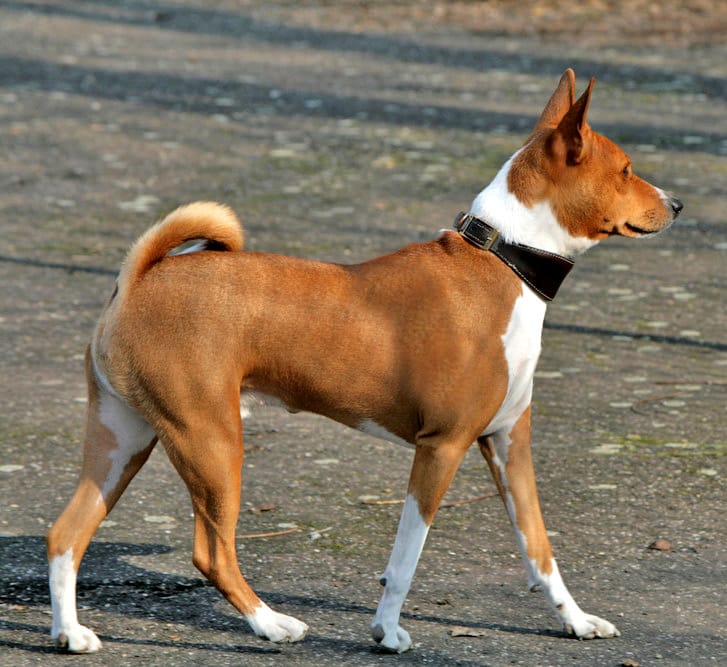
The Kombai is a medium-sized dog described as wide, compact, muscular, powerful and athletic. Males are around 58 cm at the withers, with a robust but agile constitution, made for running and jumping.
Its most recognizable feature is the face: a thin black mask, almost like an anti-face, on a short, smooth coat that ranges from light brown to deep red. The eyes are dark; the ears, of medium length with the tips bent (in some specimens completely black). The tail, wide and slightly populated, carries it curved over the back forming a characteristic sickle.
Origin and history
Traditionally bred by zamitars(landlords) and other owners for guarding and for courses, the hunting of larger pieces, in which it stood out for its robustness and its ability to save any obstacle.
Their story is tinged with warrior legend. It is said that the zamindars of Kombai gave these dogs as gifts to Hyder Ali and Tipu Sultan for their armies, and that the ferocious animals were trained to dismember enemy horses by cutting off their tendons. In gratitude, Tipu would have sent the village an idol of Ranganathaswamy. It is said that the polygamists valued these dogs so much that they even exchanged a horse for one of them.
In the 20th century their situation became uncertain: While some reports from the 1960s described it as popular and on the rise, others described it as virtually extinct. A state-run breeding facility in Tamil Nadu even pushed for their recovery along with other local breeds, though it suspended the program when several buyers returned their dogs considering their unsuitability as a pet. Today, it is a very rare and highly prized breed, which breeders in southern India are trying to preserve.
Curiosities
- Dog of war: According to tradition, they were trained to cut the tendons of enemy horses on the battlefield.
- It’s worth a horse: It is said that in ancient times polygars were willing to trade a horse for a single Kombai.
- Two names: Kombai and “polygraph dog” designate the same breed; the latter alludes to the polygraphs or local chiefs who raised them.
- Film star: the Kombai was recently featured in the Malayalam movie Eko, making himself known to a wider audience.
- Too much dog for the living room: part of the official attempts to popularize it failed precisely because its guardian character did not fit the indoor pet life.
If you are attracted to the profile of the Kombai, you will surely connect with other loyal and strong-willed guard breeds. You can discover the versatile Pastor Alemán, the imposing Rottweiler, the rugged Cane Corso or the elegant and athletic Dóberman, all of whom are born guardians who share with the Kombai loyalty and protective instinct.
Frequently Asked Questions about Kombai
Is the Kombai a dangerous dog?
The Kombai is not dangerous to its family: it is loyal, affectionate, and very tolerant of house children. Its protective character and distrust of strangers make it imposing as a guardian, but its reputation as “fierce” only emerges in the face of intruders or unfamiliar dogs.
Is the Kombai suitable for living in a flat?
The Kombai is an energetic, territorial working dog accustomed to the outdoors of South India. It can adapt to a wide floor if given several hours of exercise and stimulation a day, but fits much better in a house with a courtyard or fenced plot where it can patrol and move about.
How long does a Kombai live?
Being a rustic and native breed, without the burden of hereditary problems of many highly selected breeds, the Kombai usually enjoys a long life for its size, around 12-15 years, provided it receives good nutrition, exercise and basic veterinary care.
Does the Kombai get along with children?
Yes. One of its hallmarks is how tolerant and protective it is of children in its own family, even to the point of putting up with rough play. Yet, as with any large and powerful dog, coexistence with small children should always be supervised and the child taught to respect the animal.
Is it easy to train the Kombai?
It is very intelligent and learns quickly, but it is also independent and has character. It is not a dog for beginners: it needs a calm, consistent and firm guide without harshness, positive reinforcement and above all a lot of socialization from puppyhood to channel its guardian instinct.
Where can I get a Kombai?
It is an extremely rare breed, almost unknown outside of South India (Tamil Nadu).Outside that region it is practically impossible to find specimens, and it is not even recognized by the FCI.
How does the Kombai differ from other Indian breeds like the Rajapalayam?
Both are from Tamil Nadu, but the Rajapalayam is a white hare-like dog, taller and stylized, bred to hunt wild boar. The Kombai is more compact, muscular and reddish-brown in coat with a black mask, bred primarily as a guard and big game dog.
Does the Kombai need a lot of exercise?
Yes, it is an athletic and resistant dog that jumps mushrooms and obstacles easily. It needs intense daily exercise: long walks, running, play and mental challenges. A bored or confined Kombai develops frustration and problematic behaviors.