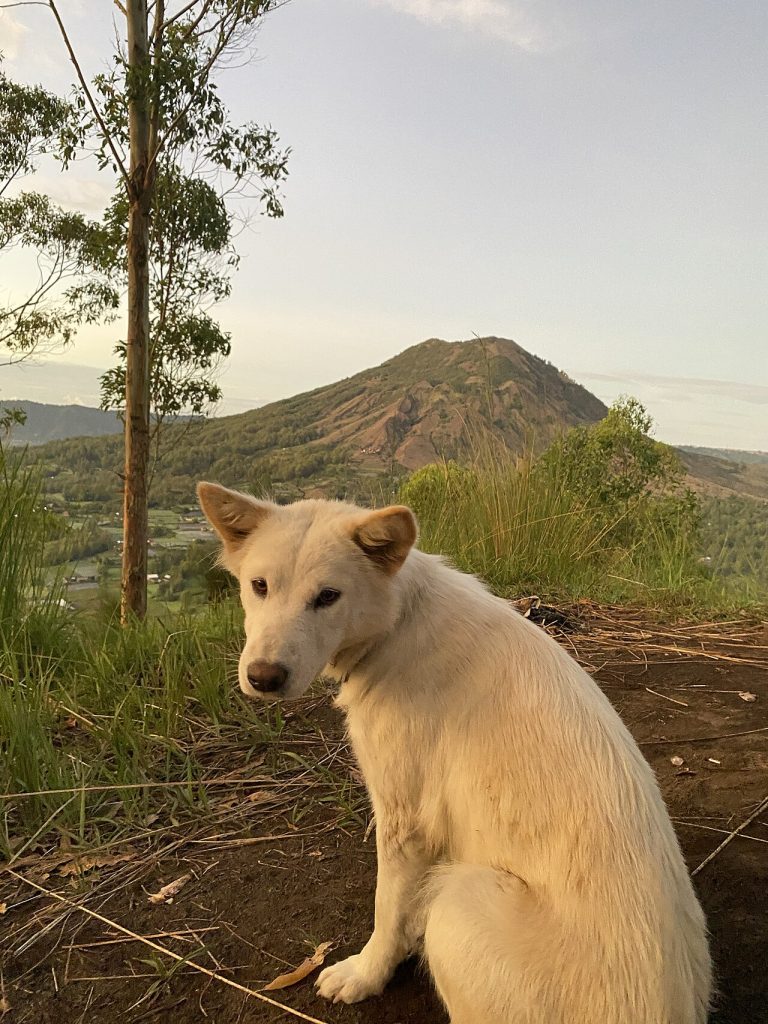
The Kintamani is the only official dog breed on the island of Bali (Indonesia): a medium-sized dog, spitz-looking and fiercely independent character, born from Balinese stray dogs and recognized by the FCI in 2019.
Is the Kintamani for you?

The Kintamani is not a dog for everyone. It is an animal of semi-wild origin, with centuries of outdoor life behind it and a character that retains much of the native dog. Before falling in love with its white wolf pattern, it is advisable to be honest about what it means to live with it.
In favour .
- Natural guard dog: warns and protects without being vicious.
- Very close and affectionate with his family.
- Rustic, agile and tough, little in the way of blood.
- Spectacular spitz look, very showy white cape.
- Autonomous: does not depend on constant company for entertainment.
Against
- Proudly independent and territorial – not a submissive dog.
- He needs outdoor space; he suffers in small apartments.
- He tends to climb, dig and bark if he’s bored.
- Very rare breed outside Indonesia: difficult to find and advise.
- It requires an experienced owner and early socialization.
Character and temperament
The defining trait of the Kintamani is its fierce independence. It is a dog that thinks for itself, decides, and can at the same time be tender and affectionate to its owners.
It’s remarkably territorial. In the face of an unfamiliar sound or presence, the Kintamani is alert and barks; it watches its space with determination. However, it is not an aggressive dog by nature: Breeders and experts describe him as gentle with people, though firm enough to be a worthy guardian. With his family, he lets down his defenses completely and shows himself to be close.
A peculiarity of its temperament is its climbing side: it loves to climb walls, roofs and trees and stand there watching, a behavior inherited from its kinship with the New Guinea singing dog.
Coexistence: children, other pets, flat and loneliness

With the family and the kids. Well socialized, the Kintamani is affectionate and protective with its core. However, due to its strong and territorial nature, coexistence with small children must be supervised and the toddlers educated to respect their space, especially when resting or eating.
With other pets. Their territoriality can cause friction with other dogs, especially of the same sex. Socialization from puppyhood is crucial.
On the floor. is not his ideal environment. The Kintamani is made for the outdoors: in Bali he digs holes to shelter and some live in small caves between rocks.
In the face of solitude. is more autonomous than average, but that doesn’t mean it tolerates abandonment.
Education and training
Training a Kintamani is a challenge that requires patience and consistency. Being such an independent dog, it does not respond well to harsh methods or mechanical repetition; it shuts down. Positive reinforcement, short and varied sessions, and a trusting relationship in which the dog decides to collaborate work best.
The early socialization is the key piece: exposing it from puppyhood to people, noises, other animals and different environments reduces its natural suspicion and channels its territoriality.
Exercise and activity
The Kintamani is a very active dog. On its island it roams freely over vast territories, climbing and exploring all day long. Moved to a conventional home, it needs that channeled energy expenditure: long walks, exploration, play and mental enrichment.
Its arboreal and digging nature must be kept in mind: if you do not give it enough outlets, it will seek its own by climbing fences or digging in the garden.
Care: fur and hygiene
The Kintamani wears a medium to long, dense coat, reminiscent of a cross between Samoyed and Alaskan Malamute.
Interestingly, Bali breeders insist on confining the dogs to cool, dark caves near the Kintamani volcano, convinced that cold and penumbra are an essential step for them to develop their characteristic white, thick coat.
Foodstuffs
There are no specific breed guidelines for the Kintamani, given its recent recognition and origin as a native dog. As a medium and active dog, it needs a complete and balanced diet, adjusted to its age, weight and exercise level.
In a home, the wise thing to do is to have good feed or diet under veterinary supervision, water always available, and weight control, since an active dog may need generous rations when he is expending a lot of energy.
Health and life expectancy
The Kintamani is a rustic breed. A relevant genetic data is that, since 1926, a rabies control measure banned the entry of foreign dogs into Bali; since then the dogs of the island have been bred within their own genetic pool for almost a century.
There are no official figures for life expectancy in the standard due to recent recognition, but due to its medium size and native dog vigor it is in the usual range of similar breeds, around 12-15 years with good care.
Physical appearance
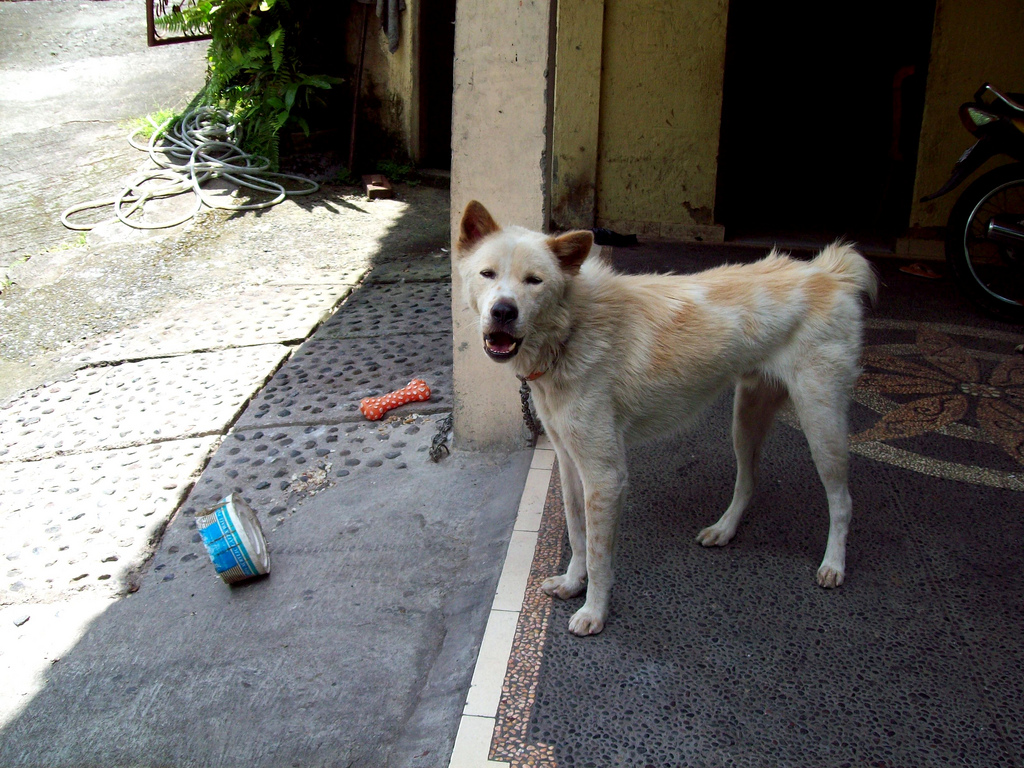
The Kintamani resembles a cross between Samoyed and Alaskan Malamute: long hair, broad face, flat forehead and flat cheeks like those of Chinese-type dogs such as the Chow Chow or Shar Pei.
Height at the cross: females measure between 44 and 52 cm; males, between 49 and 57 cm, practically the same height as the Bali stray dog from which it descends.
Among its desired features are the erect ears, the tail curved forward and maintained over the midline, the medium to long mantle, almond-brown eyes and black skin pigmentation.
Origin and history
The ancestors of Balinese stray dogs arrived on the island about 3,000 years ago. Genetic studies indicate that the Kintamani is related to the local Balinese island dogs, which in turn are closely aligned with the australian dingo and new Guinea singing dog, and more distantly with recognized Asian breeds, and even less with those of European origin.
The breed was developed in the Kintamani region, in the mountainous northeast of Bali, next to the caldera of the Batur volcano, from local free-living dogs. In 1926, the aforementioned ban on importing foreign dogs isolated the Balinese gene pool, refining it for almost a hundred years. The result is the current Kintamani, the most popular dog among the island’s residents and its only official breed, recognized by the FCI in 2019.
The Bangli Regency administration promotes the breed with an annual Kintamani dog show and contest, guides breeders, sets the rules of the standard and has promoted pilot breeding projects in some villages.
Curiosities
- It is the bali’s only official dog breed and one of the few in Southeast Asia recognized by the FCI.
- Many Kintamani have no formal owner: they live outdoors and are fed by neighbors and good Samaritans.
- He climbs like a few dogs: climbs rooftops, trees and walls, a trait inherited from the New Guinea singing dog.
- It still retains the feral instinct of giving birth in burrows dug into the earth.
- Some live in small caves among the rocks of the Kintamani volcano.
- Breeders use cold, dark caves to foster the development of their dense white coat.
If you are attracted to the Kintamani’s spitz air and primitive character, you may also be interested in other breeds with independent temperament, lupine appearance, or a link to Nordic and Asian dogs. Akita Husky Siberiano Chow Chow Samoyedo
Frequently Asked Questions about Kintamani
Is the Kintamani a suitable dog to live in a flat?
The Kintamani is an independent, territorial and climbing dog, accustomed in Bali to living in the open air and to move freely. In a flat it needs long walks, stimuli and a constant owner; without that it can become barking and anxious. It fits much better in a house with a courtyard or fenced garden.
Is he an aggressive or dangerous dog?
It is not a vicious dog, but it is markedly territorial. With its own family it is affectionate and tender; with strangers or unfamiliar noises it warns and barks, which makes it a good guard.
What coat colors does the Kintamani standard accept?
The most desirable is white, preferably with the tips of the ears of apricot-tone. The FCI standard also supports lions (beige), red, scarlet and black.
Is the Kintamani recognized by the FCI?
The Fédération Cynologique Internationale officially recognized the Kintamani in 2019. It is the only official dog breed native to Bali, developed from the island’s local stray dogs.
How long does a Kintamani live?
There are no official longevity figures in the standard, as it is a very recently recognised breed and with much of the population living semi-wild.
Why does the Kintamani climb rooftops and trees?
Unlike most breeds, the Kintamani climbs rooftops and trees and spends part of the day perched or sleeping on a wall. This arboreal nature is believed to be an inheritance of the New Guinea singing dog, with which it is genetically related.
How is the Kintamani different from the Balinese stray dog?
The Kintamani comes from the Balinese street dog, but has been selected for decades. The Balinese street dog is usually short-haired and many colors; the Kintamani has medium to long hair, tail curved forward over the midline, erect ears and a denser coat.
Does the Kintamani need a lot of exercise?
Yes. It is a light, agile and very active dog, used to roaming freely in its territory in Bali. It needs long walks, exploration and daily activity. A bored and confined Kintamani tends to bark, dig and climb out of frustration; exercise and enrichment are key to its balance.