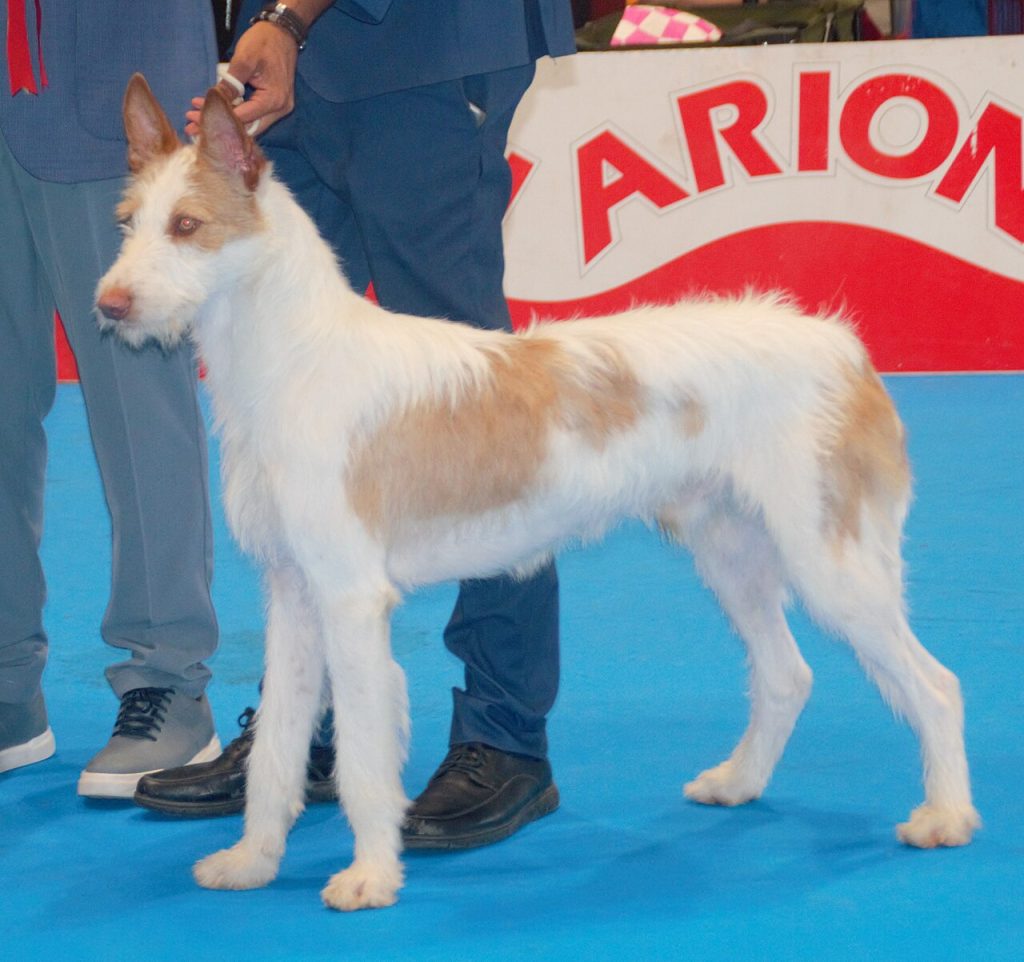
The Podenco Andaluz is one of the oldest and most authentic dog breeds in Spain: a hound with exceptional sight, hearing and smell, bred in the southern peninsula to hunt rabbits by trail and by race. Agile, tireless and deeply attached to the Andalusian land, it is a rustic, healthy and loyal dog, with a unique variability – up to nine varieties between sizes and hair types – reflecting centuries of adaptation to the countryside. If you’re looking for an active, noble and characterful partner, this guide tells you everything you need to know about the Andalusian Powerhouse before you decide.
Is the Andalusian Powerhouse for you?

The Andalusian Podenco is not a dog for any household. It is a breed hunter, with an energy and an instinct that must be understood and channeled.
Points in favour
- Very healthy and rustic, with few hereditary problems.
- Loyal and affectionate to his family; very attached to his own.
- Smart and with tremendous physical endurance.
- Clean, odorless, and simple coat maintenance.
- Sociable with other dogs (hunting in packs).
- Versatile: There are sizes and coats for many lifestyles.
Points to Consider
- Very strong hunting instinct: chases rabbits, cats and small prey.
- It needs plenty of daily exercise; it is not a sedentary dog.
- Reserved with strangers if he doesn’t socialize well.
- Independent: Obedience requires patience and motivation.
- Without a good fence or control, he can escape following a trail.
- He gets bored and suffers if he spends many hours alone and inactive.
Character and temperament
The Andalusian Podenco combines two souls that coexist in perfect balance: that of the native hunter and that of the faithful companion. In the countryside it is awake, determined and methodical; at home, a calm, affectionate dog and very attached to his family.
It is a intelligent and independent dog, accustomed for centuries to make decisions on its own while tracking and chasing. This autonomy means that it is not a servile dog: it cooperates with you when it understands the why, not out of submission. With its owners it is sweet, sensitive and even clingy; with strangers it tends to be reserved and cautious, which makes it a good warner without becoming aggressive.
Its most defining feature is the passion for rabbit hunting. Everything in it – the highly tuned senses, energy, concentration – is designed to track and capture. Understanding and respecting that instinct is the key to living happily with an Andalusian Powerhouse.
Coexistence: children, other pets, flat and loneliness

With children: is an affectionate and patient dog with the little ones of his family. Playful and tolerant, he usually enjoys the company of children, although it is advisable to supervise the game and teach children to respect their rest and their food, as with any breed.
With other dogs: by its origin of hunting in rehala (hounds of twenty or more dogs), the Podenco Andaluz is sociable and usually gets along well with other dogs, especially if it is socialized from puppy.
With cats and small animals: here is the big nuance. Its prey instinct towards rabbits, rodents and birds is very high. It can coexist with a cat if they grow together, but there is never an absolute guarantee; with ferrets, rodents or birds loose, coexistence is not advisable.
On the floor: can live on the floor if you give it enough exercise. indoors it’s quiet and clean, but it needs to vent its energy outside. for floors the small and medium varieties fit best.
Soledad: is a very attached family dog and does not do well in long hours of solitude. If it spends too much time alone and without stimuli, it may develop anxiety, barking or destructive behaviors.
Education and training
Educating an Andalusian Podenco is an exercise in patience and knowing its nature well. It is intelligent and learns quickly, but its independence makes it not obey “because it does”: it needs to understand what it gains. positive reinforcement methods – food rewards, play, praise – work infinitely better than imposition, before which it tends to block or disconnect.
The early socialization is fundamental. A puppy that knows people, dogs, noises and varied environments becomes a balanced and confident adult, less suspicious of strangers. It also works the call (the “here”) from the beginning and with a lot of reward, because its instinct of pursuit can make it ignore your voice when it starts after a trail.
It is precisely because of this instinct that it is advisable to be cautious when releasing it: do it only in safe and fenced areas until you have a very solid call. Still, no pod is 100% reliable to a rabbit. Short, fun and frequent sessions yield much more than long and repetitive ones.
Exercise and activity

If there is something that defines the Podenco Andaluz it is its enduring strength. It was bred to work for hours under the Andalusian sun, with a trot as fast as its gallop.
He enjoys running free in safe spaces, sniffing, exploring, and chasing. Activities such as canicross, coursing, hiking, or sniffing and tracking games feel wonderful to him, because they combine physical wear and tear with the mental stimulation his hunter’s head demands.
A well-exercised Andalusian Podenco is a calm and happy dog at home. A bored and restless one becomes a nervous, barking or destructive dog. Exercise is not a luxury with this breed: it is a necessity.
Care: fur and hygiene
The maintenance of the Podenco Andaluz is simple and varies according to its hair type:
- A weekly brush is enough to remove the dead hair and keep the coat healthy.
- Pig hair or hard hair: somewhat denser and rougher; thanks to a slightly more frequent brushing and, in some examples, a slight manual arrangement.
- Long or short hair: requires more attention to avoid tangles and knots, with regular brushing.
In all cases it is a clean and odorless dog. The baths should be sporadic, only when it gets really dirty, so as not to damage the natural protection of the skin. Complete the hygiene with the usual: check and clean the ears, brush the teeth regularly and cut the nails if they do not wear out on their own. Watch pads and skin after field days.
Foodstuffs
The Andalusian Podenco is an athletic dog with an active metabolism, so it needs a balanced and high quality diet, with good input of animal protein that supports its musculature and endurance. The ration should be adjusted to your size (remember that there are large, medium and small specimens), your age and, above all, your actual level of exercise: A poodle that hunts or runs every day burns a hell of a lot more than one with a quieter life.
It divides food into two daily servings in adults to promote digestion, and avoids intense exercise just before or after eating. It controls its weight regularly: it is a dog that must be kept juicy and fibrous, without overweight, to preserve its joints and its agility. Always have fresh water available, especially after activity and in the summer heat.
Health and life expectancy
One of the great virtues of the Podenco Andaluz is its iron health. Being an autochthonous breed, functional and very little altered genetically by man – it retains primitive instincts and a great ability to adapt to the environment – it does not drag the long list of hereditary diseases that affect more manipulated breeds.
Its life expectancy is usually around 12 to 14 years old, and it is not uncommon for well-groomed specimens to outgrow it. Like all dogs, it benefits from basic preventive care: vaccination, internal and external deworming (important for their outdoor life and contact with ticks in the field) and periodic veterinary checks. After the days of hunting, it is advisable to inspect ears, eyes, pads and skin for spikes, cuts or parasites.
Physical appearance
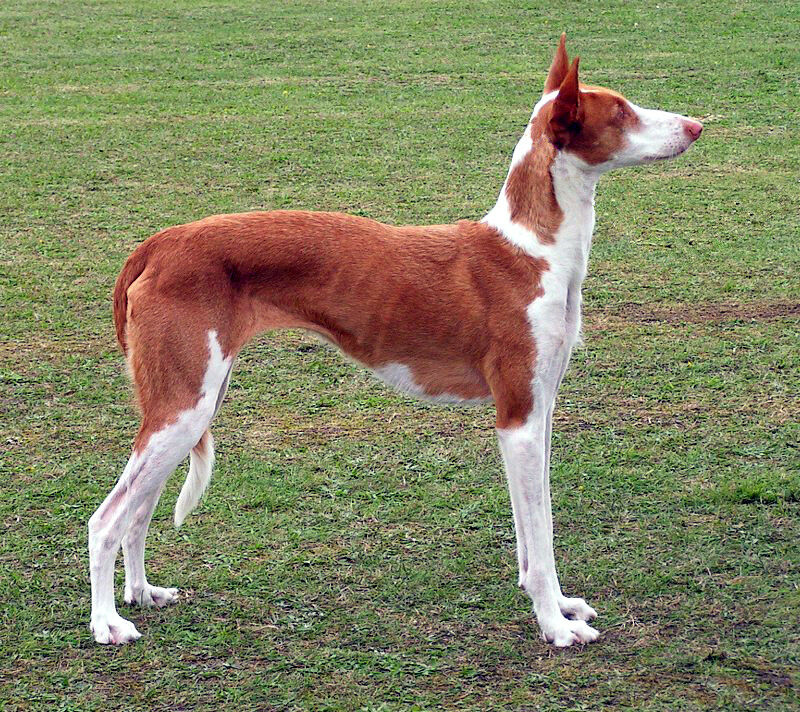
The Andalusian Podenco is a dog of harmonious lines, light and athletic appearance, made for speed and endurance.
The most distinctive feature of the breed is its enormous variability. There are three sizes – large, medium, and small – and three types of hair – hard, long, and straight – which combine to produce up to nine different varieties. This diversity is attributed to the adaptation to the different microclimates of Andalusia, from the mountains to the marshes and the agricultural field. The coat features colors ranging from white to deep red (cinnamon), often in combinations of white and cinnamon. The body is smooth and muscular, with a trot as fast as the gallop.
Origin and history
The Andalusian Podenco is a very old dog, linked to the Andalusian land since ancient times. It belongs to the large family of Iberian poodles – along with the Ibicenco, the Portuguese, the Canary, the Maneto or the Spanish orito – , dogs of the trail and sight hound type present throughout the Mediterranean basin. They were long thought to be “primitive” dogs brought from the Middle East some three thousand years ago, perhaps by the Phoenicians through their colonies.
However, recent genetic studies s have nuanced this idea: the Podenco is closely related to other European hunting dogs and, in fact, the Andalusian Podenco is genetically the closest relative of the Spanish Greyhound.
Despite its age, it did not enter the official canon until 1990, when Manuel Lobo Moreno promoted the Club Nacional del Podenco Andaluz. The racial characterization was carried out by the University of Cordoba and presented at the II Symposium of Spanish Canine Races, being recognized by the RSCE as a standard in 1992. The Ministry of Agriculture published the official standard in 2001, and in 2014 the German canine association (VDH) also recognized it. The FCI, on the other hand, does not recognize it, because of its great resemblance to the Portuguese podanco.
Curiosities
- El “quitaor”. The large poodle accompanied the greyhounds in the hunt for the hare: it lifted the piece from its hiding place to shoot it and then “took” it from the greyhound to take it to its owner.
- From him is born the Maneto. The short-haired, medium-sized, Andalusian Podenco Maneto is derived from short, robust legs by a phenomenon called bassetismo.
- One of the most numerous breeds in Spain. In 2009 the podenco was, along with the Spanish Greyhound, one of the two most numerous breeds in the country.
- Multipurpose dog in the yard. The big ones played the guards of the estate; the boys, the rat and rodent hunters.
- A vulnerable breed. Despite its number, the RSCE includes it among the Spanish breeds considered vulnerable, so its conservation has cynological interest.
If you are attracted to the Andalusian Poodle, you will surely enjoy meeting other breeds of athletic dogs, hunting or strong family ties. Take a look at the Greyhound and Whippet, two fast and stylish greyhounds who share the Podenco’s passion for racing; the Vizsla, another energetic hunting dog very attached to its people; or the versatile Beagle, a prodigious-smelling hound as our protagonist.
Frequently asked questions about the Andalusian Government
Is the Andalusian Podenco a good dog to live on a flat?
It can adapt to a floor as long as it receives plenty of daily exercise: several long walks and, if possible, free runs in a safe area. It is not a couch dog; if it is bored or lacks physical outlet, it can become restless or destructive.
Does Podenco Andaluz get along with children?
Yes. It is a loving and loyal dog to its family, and is usually tolerant and playful with the children of the house. As with any breed, it is advisable to monitor the relationship with the youngest and teach the children to respect their rest and their food.
Can you get along with cats or other small animals?
It is delicate. The Andalusian Podenco has a very marked rabbit hunting instinct, so it can chase cats, ferrets, rodents or birds. Coexistence with a cat is possible if they grow together and socialize from puppyhood, but there are never total guarantees; with other dogs, however, it is usually sociable, since it hunts in packs.
How much exercise do you need a day?
It’s a tireless hunter with great stamina, so it needs at least an hour or an hour and a half a day of intense activity: long walks, running, sniffing and playing.
Does the Andalusian Powerhouse do a lot of hairdressing?
Depending on the variety, the smooth-haired (short-haired) barely needs a weekly brushing; the pig-haired (hard-haired) appreciates a somewhat more frequent brushing; and the short-haired (long-haired) requires more attention to avoid knots.
Is it recognized by the FCI?
The Andalusian Podenco is recognized by the Royal Canine Society of Spain (RSCE) since 1992 and was recognized by the German canine association (VDH) in 2014, but the Fédération Cynologique Internationale (FCI) does not recognize it, partly because of its great similarity to the Portuguese Podenco standard.
How many varieties of Podenco Andaluz are there?
Three sizes (large, medium and small) are combined with three types of hair (pink or hard, silky or long, and smooth or short), giving nine possible varieties.
Is he a healthy dog and how long does he live?
The Podenco Andaluz is a rustic breed, very little genetically altered and usually very healthy, without the burden of hereditary diseases of other more manipulated breeds.