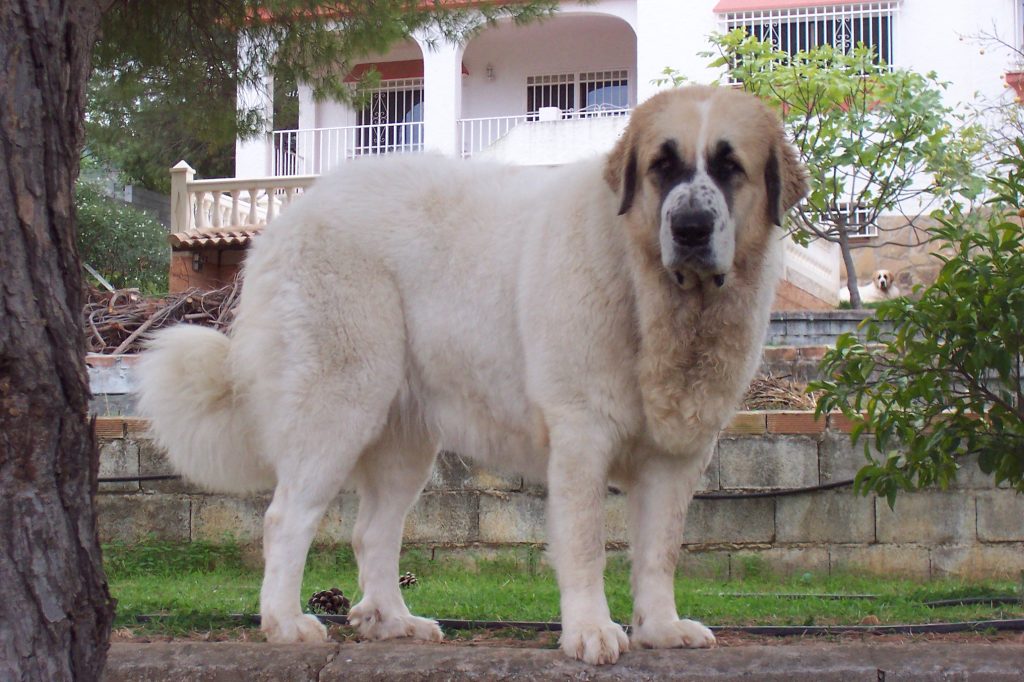
The Mast of the Pyrenees is the great white guardian of Aragon: a mountain moose bred for centuries to walk alongside trash-eating herds and stand up to wolves and bears in the Pyrenees heights. It is enormous – males exceed 33 inches [77 cm] at the withers and can weigh from 180 to 180 pounds [60 to 90 kg] – but beneath that mole is a calm, noble, and surprisingly balanced dog. If you are looking for a quiet protector with a family vocation, and you have space and patience, the Pyrenean Mastiff is one of the canine jewels of Spain. Here’s everything you need to know before you decide.
Is the Pyrenean Mastiff for you?
Before you fall in love with the photos, be honest: we are talking about a dog that can weigh as much as an adult and needs a specific environment to be happy. It is not a dog for any house. The Pyrenean Mastiff shines in the right place and suffers – he and his family – in the wrong one. These two lists help you decide at a glance.
In favour .
- Born guardian: deterred by his presence alone, without gratuitous aggression.
- Noble temperament, calm and balanced inside the house.
- Very tolerant and protective of the children in the family.
- It barks little and selectively; it is not a nervous dog.
- Rustic and cold-resistant thanks to its dense coat.
- He doesn’t need strenuous exercise or hours of running.
To be taken into account
- Giant size: it needs space, ideally a house with fenced land.
- Strong guarding instinct: you have to socialize him very well from puppyhood.
- Independent and stubborn; not a dog of sporting obedience.
- She sheds a lot of hair and drools; high food expenditure.
- Shorter lives, like most giants.
- Not for small apartments or first-time homeowners without advice.
Character and temperament

The Pyrenees Mastiff is, first and foremost, a paused work dog. For generations it was not asked for speed or obedience, but criterion: to stay alone with the herd, assess each situation and decide when to intervene.
In day-to-day life, it is serene, self-assured and remarkably balanced. It does not seek conflict or be disturbed by any noise; it reserves its energy for what it truly considers a threat. With its family it is affectionate, loyal and protective, and tends to watch over its own with more discretion than with fear. It is not a clingy or dependent dog, but it is very attached to its people.
In the presence of strangers, it is reserved and vigilant, although not hostile if well socialized. Their way of saving is more deterrent than reactive: intervene, warn and only escalate if the situation demands it. This nobility – the word most repeated among breeders – is precisely what the breed standard asks to be preserved: A dog “intelligent, noble and functional”, never clumsy or aggressive by default.
Coexistence: children, other pets, flat and loneliness
With children. The Pyrenean Mastiff is usually patient and protective with the children of the house, whom it treats with almost paternal tolerance. That said, its enormous size requires supervision at all times: a specimen of 70 or 80 kg can accidentally throw a small child when turning or leaning.
With other pets. Being a dog bred to live between the cattle and not to prey on them, its prey instinct is moderate and coexists well with other animals when it grows up with them.
On the floor. Frankly: not ideal. This mastiff needs space to move at its own pace and, above all, a yard or terrain to patrol. It can live in a large dwelling if its walks are taken away, but a small apartment in the city goes against its nature of outdoor keeper.
Soledad. tolerates loneliness better than many breeds due to its independent nature and being used to stand guard on its own.
Education and training
Training a Pyrenean Mastiff is a consistency and patience exercise, not a mechanical repetition. It is intelligent, but also independent and somewhat stubborn: it was selected to think for itself, so don’t expect an instant response from a shepherd or a retriever. It will obey when it understands the why and trusts the person in front of it.
The absolute key is the early socialization. A puppy that knows people, noises, other animals and various situations will grow into a confident adult who distinguishes the everyday from the threatening. A poorly socialized specimen, on the other hand, can become overly suspicious, and in a dog of this size that is a serious problem.
It works with positive reinforcement, calm and calm leadership; harsh methods only get it to close in a band. It is advisable to start as a puppy to get used to the leash, veterinary handling and walking without pulling, because when it weighs 70 kg it will be too late to improvise. It is not the right breed for a first-time owner without the support of a good educator.
Exercise and activity
Here comes the good news for many: the Pyrenean Mastiff he’s not a hyperactive dog.. Its energy is half-low and its idea of a perfect day is to keep an eye on the terrain, take a couple of long walks and rest in the shade.
With a couple of daily walks of good duration and access to a space where to move your air you have plenty. What is convenient is the exercise moderate and constant, avoiding sudden efforts, especially as it grows: like any giant, its joints are delicate during development and should not be forced to jump, run excessively or climb stairs continuously until the skeleton matures.
The best stimulation for this breed is not physical but environmental – having “a job” – a garden to patrol, a family to accompany – keeps it mentally satisfied far more than any ball.
Care: fur and hygiene

The mantle of the Pyrenean Mastiff is abundant, thick and of medium length, designed to insulate it from the cold of the mountain. It does not require a hairdresser or a haircut, but it does require a regular brushing, two or three times a week, which becomes almost daily during the spring and autumn transplants, when it sheds significant amounts of hair. A good brush removes dead hair, prevents tangles on the back of the pants and ears, and keeps the coat healthy.
Bathing should be sporadic, only when it is really dirty, so as not to remove the natural fat that protects its coat. Pay attention to the ears – large and fallen – to keep them clean and dry, check the eyes and control the growth of the nails. Like many molluscs, it may drool, especially after drinking or eating, something that is part of the package when choosing this breed.
It is a rustic and generally not delicate dog, better adapted to cold than heat: in summer it needs shade, plenty of fresh water and avoid exercise in the middle hours of the day.
Foodstuffs
Feeding a 60- to 90-pound dog is not cheap or trivial. The Pyrenean Mastiff needs a of good quality and well balanced diet, adjusted to its giant size, age and activity level. The pup and growth phase is especially critical: a specific feed for large or giant breeds, with adequate calcium and energy, helps the skeleton to develop at a healthy rate and reduces the risk of joint problems.
It is advisable to distribute the food in two doses a day instead of a single copious one, an important measure in deep-breasted dogs to reduce the risk of gastric torsion (a vital urgency in giants). It is also advisable to avoid strenuous exercise just before and after eating, and to control weight: Obesity punishes your joints and your heart. Always consult your veterinarian about the quantities and type of diet most suitable for your animal.
Health and life expectancy
The Pyrenean Mastiff is, as a whole, a rustic and robust dog, but it shares the servitude of all giant breeds.
The most important monitoring points are:
- Hip and elbow dysplasia: the most common problem in giants; it is advisable to breed from parents with official tests.
- Gastric torsion/dilatation: veterinary emergency typical of large deep-chested dogs; prevented by distributed dosing and rest after meals.
- Joint and growth problems: avoid overweight and abrupt exertion during development.
- Watch out for the heat:‘s dense coat makes it prone to heat stroke in the summer.
A relevant data for the future of the breed: in 2026 the Pyrenean Mastiff was among the sixteen Spanish breeds considered vulnerable by the Royal Canine Society of Spain, with a declining number of quality specimens.
Physical appearance

The Pyrenean Mastiff is a very large dog, with a powerful and harmonious structure, but – and this is key in the standard – never heavy, clumsy or lymphatic.
In terms of size, the standard sets a minimum height to the 77 cm in males and 72 cm in females cross, with no upper limit: in fact, large specimens are preferred.
Its hallmark is the coat: white with a well-defined mask of darker colour on the face, often with spots of the same tone spread throughout the body. The ears, medium and low, always feature dark spots. The head is large and strong, the expression noble and intelligent, and the ensemble conveys serenity and power to equal parts.
Origin and history
The Mastín del Pirineo is the the only dog breed native to Aragon and one of the great protagonists of traditional Spanish cattle breeding. Documented in the historical Kingdom of Aragon since the Middle Ages, it was born linked to the transhumanity: the annual journey of sheep herds from the high pastures of the Pyrenees in summer to the lowlands of the Maestrazgo in winter.
Their mission was clear and hard: to accompany the cattle from puppyhood, live among the sheep and protect them – and the shepherds – from attacks by wolves, bears and thieves.
Three examples were exhibited in Madrid as early as 1890, and the first Book of Spanish Origins(1913) features an inscribed “Spanish Mastiff of the Pyrenees”. But the 20th century was hard for the breed: when the wolf disappeared from the Pyrenees in the forties and after the economic hardships of the postwar period, keeping such a large dog ceased to be profitable and the population collapsed.
The breed was officially recognized by the International Kennel Federation in the year 1954. The real recovery came in the seventies from the hand of Rafael Malo Alcrudo, which tracked the few specimens with the typical characteristics that remained in the field. In 1977, together with Daniel Lloréns Guerrero and Jaime Graus Morales, he founded the Club of the Mastín of the Pyrenees of Spain, which brought together breeding efforts and made the breed known inside and outside the country. Today there are clubs in several European countries, in America, Australia and Japan, although their preservation remains a challenge.
Curiosities
- It’s the aragon’s only native breed, a symbol of the community’s cattle heritage.
- Not to be confused with the Pyrenees mountain(Gran Pyrénées) or the Shepherd of the Pyrenees: they are three distinct and separate breeds, despite sharing a mountain.
- It is also not the same as the Mastín Español, with which it shares function but no exact origin or type.
- Their ancestors wore the carlanca, a spitz necklace that is still an icon of mastiff herding today.
- He was selected for working alone, making decisions without the shepherd in front: hence his independent character and his nobility.
- Its recovery in the 1970s literally started from a handful of surviving specimens in the Aragonese countryside.
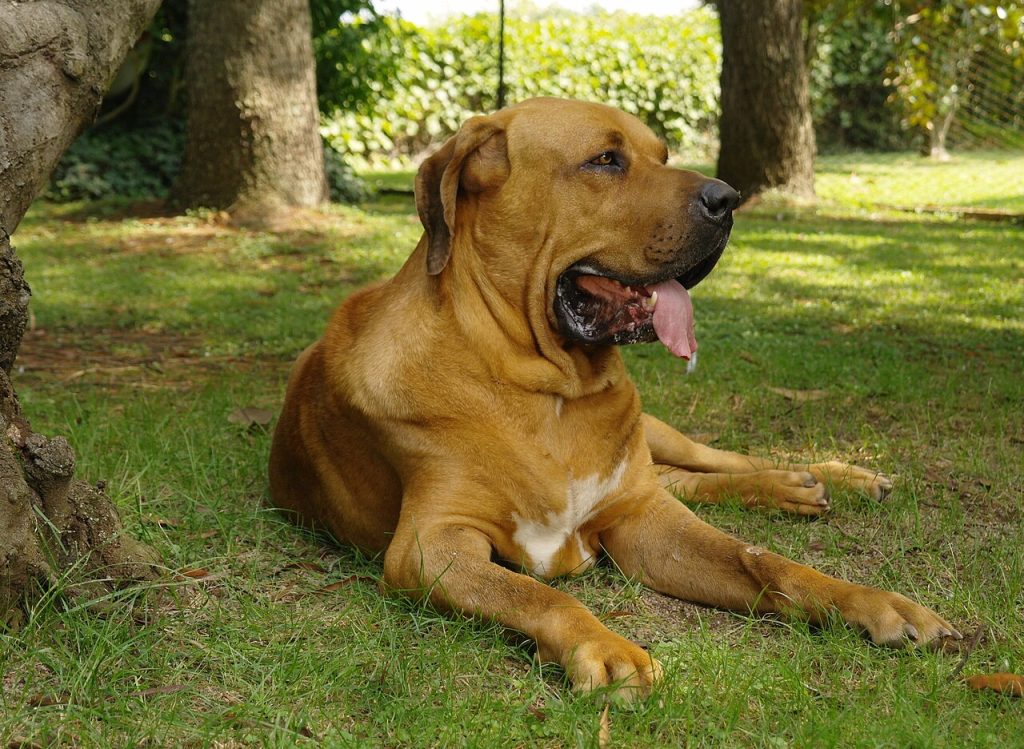
If you are attracted to the Pyrenean Mastiff, you will surely enjoy meeting other great keepers and molossos of similar profile. Check out the English Mastiff, the imposing Cane Corso, the rescuer San Bernardo and the giant Terranova, all of them huge dogs with a calm heart.
Frequently asked questions about the Pyrenean Mastiff
How much does a Pyrenean Mastiff weigh?
The weight of an adult Pyrenean Mastiff is usually between 60 and 90 kg, making it one of the heaviest breeds in existence, with males clearly larger and heavier than females.
How tall is he?
The standard sets a minimum cross height of 77 cm for males and 72 cm for females, with no upper limit. In fact, in this breed, large specimens are preferred, so it is normal to see dogs that far exceed those figures.
Is he an aggressive or dangerous dog?
Not by nature. The Pyrenean Mastiff is a noble and balanced guardian that discourages with its presence more than with aggression. Well socialized from puppyhood, it is reserved with strangers but affectionate and protective with its family. Its size, however, requires a serious and responsible education.
Do you get along with the kids?
Yes, it is usually very patient and protective of the children in the family. The only real precaution is its size: such a large dog can accidentally throw a small child, so coexistence must always be supervised.
Can he live in a flat?
It’s not ideal. It’s a giant outdoor guard dog that feels much more comfortable in a house with fenced-in terrain where it can patrol. In a spacious home with daily walks it can adapt, but a small apartment in the city goes against its nature.
How long does a Pyrenean Mastiff live?
Their life expectancy is around 10-12 years, somewhat lower than that of medium-sized dogs, as is the case with most giant breeds.
Do you lose a lot of hair?
It has a dense coat of medium length and a lot of loose hair, especially during spring and autumn moulting.
How is it different from the Pyrenees?
They are two distinct breeds. The Pyrenean Mastiff is a moose guard of Aragonese origin, white with dark mask and spots. The Pyrenean Mountain (Gran Pirineo) is of Franco-Spanish origin and mostly white in coat. They share the mountain and guard function, but they are different dogs.